
Torcello in half a day: a walk into Venice’s early history
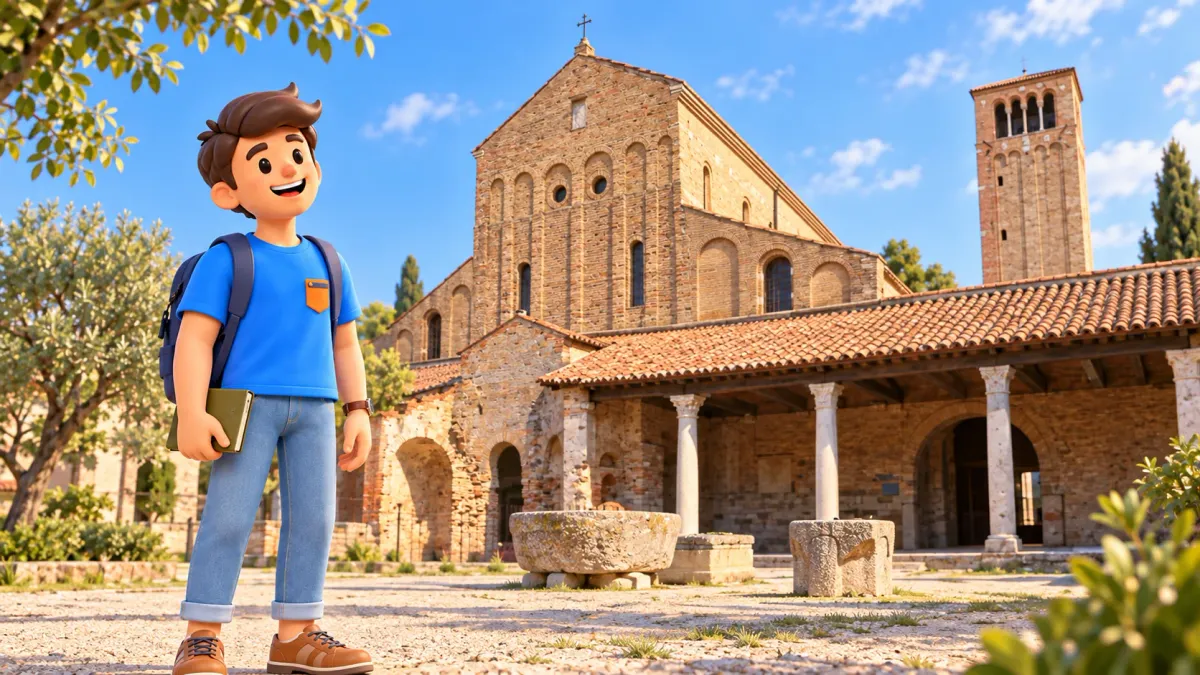
For a first visit to Torcello, allow about three hours on the island: follow the canal, see Devil’s Bridge from the bank, reach the square and its stone seat, visit Santa Maria Assunta inside and look at Santa Fosca outside. Return to the same boat landing. Crossings, waiting and your journey to the Venice departure stop are additional. The main route does not require crossing the unrailed Devil’s Bridge.
There is one principal interior visit: the basilica. Add an estimated 60–90 minutes for the museum, or roughly 30–45 minutes for the bell tower. Choose according to your interest rather than quietly including both within the same three hours. Torcello then becomes a worthwhile half-day of its own rather than a brief gap between Murano and Burano.
What visiting Venice’s origins really means
Torcello offers an earlier lagoon history through a different setting: open space, water, green plots and a substantial church complex. It is not a place where all of Venice appeared on one particular day. The story involves connections between islands and mainland, trade, settlement and changing water. Look for historical layers rather than a single convenient foundation legend.
Try RoadMe for a fully worked-out personal trip plan shaped around your interests, dates and pace. Planning in the app makes it much easier to distribute history, art and island walks across different days, with space for crossings and unhurried breaks.
This itinerary suits an interest in mosaics, medieval architecture and a place that looks very different from its prosperous past. If your main wish is bright facades and shopping windows, Burano offers another kind of experience. Choose Torcello for its own appeal rather than because it is the last unchecked name on an island list.
With children, explain beforehand that the central experience is a large old building and images inside, rather than an entertainment area. Try comparing the basilica’s high, long volume with the lower portico beside it. A small visual task encourages attention without turning the visit into a test of names and dates.
Arriving and allowing for the return
The route starts and finishes at the ACTV Torcello landing. Check an actual journey with the operator for your date: depending on the departure point and service, a change may be needed, including via Burano. Neighbouring islands do not promise an immediate connection. Waiting can matter as much as a short journey aboard.
A hotel, the railway station and San Marco create different approaches to the appropriate Venice departure stop. Calculate that walk first, then the boat and any connection. Check the return direction towards your next destination too. Do not rely on the last apparently suitable service quoted in an old trip report when you have a booking back in the centre.
There is no ordinary pedestrian bridge between Torcello and Burano. You cannot finish sightseeing and simply walk to the colourful houses across the next bridge. This land itinerary stays on Torcello and returns to its landing. A clear boundary makes it easier to visit another island later without leaving today’s experience unfinished.
Three hours around one main visit
This is an estimated budget, not the author’s personally timed walk. All movement is given its own allowance; a stop at the bridge does not mean climbing onto it. Fit the basilica within its current opening period and place the flexible outdoor sections before or after.
- 15 minutes: arrival and orientation.
- 10 minutes: Devil’s Bridge from the bank.
- 15 minutes: the square and stone seat.
- 45 minutes: the basilica interior.
- 15 minutes: Santa Fosca outside.
- 35 minutes: all walking out and back.
- 30 minutes: a drink, small snack or rest.
- 15 minutes: flexibility.
That totals 180 minutes ashore, excluding boats. The museum collection and tower ascent are additional. If a longer basilica visit matters more than a cafe pause, redistribute time deliberately. There is no need to shorten every other part simply to preserve the original total.

The canal and Devil’s Bridge are part of the visit
From the landing, follow the main public canal-side path, Fondamenta dei Borgognoni. Water and greenery establish a different scale from central Venice’s tight streets. Notice the church silhouette gradually appearing ahead. You do not need an invented circuit of the entire island to appreciate the change of setting.
Devil’s Bridge can be appreciated from the bank. Its low arch, steps and lack of side parapets create its recognisable appearance. The name comes with legends, not proof of who built it or whether the work took one night. Looking at its structure and reflection is enough without adding certainty that history does not provide.
Crossing it is not required for the main itinerary: stay on the public canal path. The later approach to the monumental centre includes the ordinary public crossing. Avoiding Devil’s Bridge does not make the whole walk guaranteed step-free. If mobility is a concern, check the specific sections beforehand rather than relying on a general island description.
Watch children beside the water and keep narrow passages clear while stopping. When the paving is wet, look at your footing before choosing a camera angle. A useful photographic idea is simply to include the space around the bridge. Understanding it does not require standing at its crest or repeating someone else’s unsupported pose.
The square and Attila’s Throne: separate name from history
Several buildings stand close together in the monumental centre. That does not give them one ticket or identical opening arrangements. Begin by looking at the positions of the basilica, Santa Fosca and the museum buildings. This brief orientation makes them parts of a historical setting rather than doors to open in sequence.
The stone seat is popularly called Attila’s Throne, but the name does not establish ownership by the Hun ruler. The object has its own history and differing interpretations of its original function. For a short visit, remembering the distinction between a familiar name and a confirmed fact is enough. An expressive story does not need an invented scene of Attila sitting here.
Torcello is interesting precisely because these explanations are layered. Legend lives beside archaeology without replacing it. Look at the stone as an old object that has passed through different uses and interpretations. Sitting on it or queuing for a portrait is unnecessary for this small stop to remain memorable.

Give Santa Maria Assunta’s mosaics time
The foundation of the first cathedral on Torcello is dated to 639. That is not the date of the entire present building surviving unchanged. Its architectural form is associated with substantial rebuilding in 1008, while the famous mosaics belong to later medieval phases. A few time markers reveal development rather than a single frozen antiquity.
Inside, let your eyes adjust to the light and scale. Choose two main directions: the apse and the inside of the entrance wall carrying the Last Judgment. Look at the overall organisation before individual figures. A first visit does not need an explanation of every scene or a search for every character’s name on a small phone screen.
Mosaic matters for its method as well as its subject. Many small pieces form an image at a distance, while surface and light change under closer attention. Keep the permitted distance and follow on-site rules. This is an opportunity to see artistic work, rather than a reason to touch old material to feel its age.
Checked on 17 October 2026, the diocese lists basilica opening from 10.30am to 6pm in March–October, last admission at 5.30pm. In November–February it lists 10am–5pm, last admission at 4.30pm. Closure is listed for 25 December and 1 January. Check current notices before travelling, especially when a particular artwork is your main purpose.
Ordinary tourist admission is paid, with separate eligibility conditions and concessions published by the owner. Do not assume a museum ticket covers the basilica. Shoulders and knees must be covered, and behaviour should respect the religious setting. An organised guided group also has its own requirements, different from simply looking around independently.
Santa Fosca and one optional addition
At Santa Fosca, change what you notice. After the basilica’s high longitudinal shape, look at the more compact building and its surrounding portico. Columns, arches and roof offer a comparison between two ways of arranging space side by side. The main plan allows fifteen minutes outside without promising entry according to a generic directory’s church hours.
For more historical context, choose the Torcello Museum. Its history began in 1870, and it occupies two buildings, Palazzo dell’Archivio and Palazzo del Consiglio. Archaeological and medieval material helps explain the island as a place of life and exchange. Not every object was found beneath the nearest path: the collection includes a wider lagoon and mainland context.
Add roughly 60–90 minutes, making about four to four and a half hours on the island. The current MUVE site lists April–October opening from 11am to 5.30pm, last admission at 4.30pm. In November–March it lists 11am–5pm, last admission at 4pm. Monday is closed. This is the museum’s own schedule, distinct from the basilica and older reference pages.
If landscape from above matters more, consider the bell tower instead of the museum addition. Allow an estimated extra 30–45 minutes for ascent and viewing; a queue may extend that. Admission is separate and paid. The tower finishes earlier than the basilica, so check its own hours rather than assuming an open church means you can climb at the same moment.
With RoadMe, you can get a personal plan for the whole trip with history, art or walking given the emphasis you prefer. Try planning in the app to make each day’s pace and Torcello visit work more comfortably with the rest of Venice.

A break and the walk back
The main plan’s thirty-minute break suits a small snack or quiet rest. A long restaurant lunch needs more time, and a famous name does not guarantee an available table. Private gardens, a house museum or closed land are not automatic additions either. Each needs its own visiting arrangements and a recalculation of the day.
Return along the main public route to the landing. For a shorter version, allow about two hours: fifteen minutes for arrival, ten at the bridge from the bank, ten in the square, thirty-five in the basilica, ten at Santa Fosca outside, twenty-five for all walking, ten for a pause and five for flexibility. Boats remain outside that estimate.
The museum has stairs to exhibition floors; ask about suitable access beforehand if needed. Bring water and an extra layer for wind, account for rain and follow the operator’s current information. For another day, use the Burano half-day walk or the three-day Venice plan with art and islands. One carefully observed place can already change how you see the lagoon.


