Evening Strasbourg: Cathedral, Bateliers and Riverside Bridges
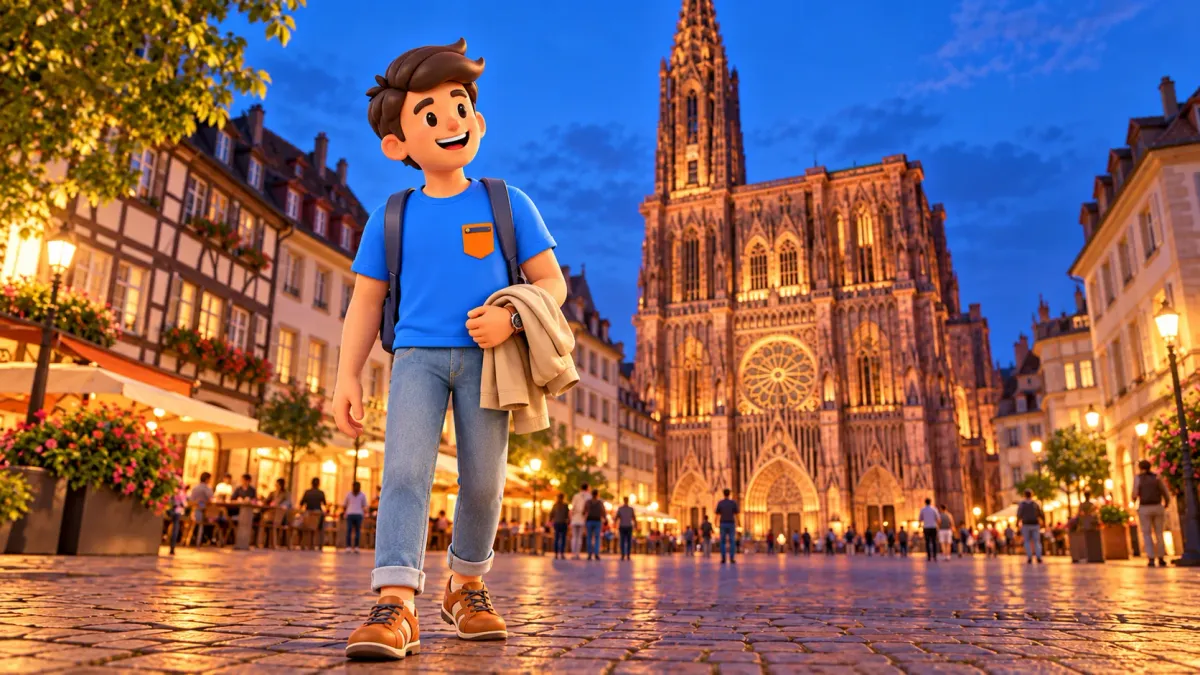
After a museum visit, continue discovering Strasbourg outside: begin with the cathedral’s stone façade, reach the Ill and finish near the smaller crossings of the Krutenau. Evening changes the focus. Carved detail gradually gives way to outlines, reflections and light in windows.
Start at Cathedral Square, continue to Place du Château, then cross Pont du Corbeau to the outer side of the river. Follow Quai des Bateliers towards the Abreuvoir footbridge and Saint-Guillaume. Allow roughly ninety minutes to two hours, including a short rest. Approach, return and dinner require additional time.
Choose your evening by light and pace
Begin while stone details remain visible. Architecture can lead the first section, with broader river views later. Twilight depends on the date and weather: the same clock time in summer and winter creates very different light.
Try RoadMe to have a personal route or whole trip plan worked out around your interests, dates, pace and budget. The app makes it much easier to connect a museum day, evening walk and rest in a programme that suits you.
Work from the end of your own visit rather than assuming all museums close together. If your chosen museum opens late, another evening may suit the walk better. Entry to the cathedral, palace or church is not required for this route.
Cathedral light shows belong to particular programmes with their own dates. An ordinary evening walk does not include one. Monument lighting can also change, so choose the outing for the city itself and the view actually available, keeping expectations flexible.
Decide how the evening will finish: beside the river, over dinner or back at your accommodation. This leaves energy for the part you most want. Returning to a place already seen by day is worthwhile too; changing light provides a separate reason to look again.
The route from cathedral to Saint-Guillaume
The sequence moves from a major monument towards the everyday river city. After Cathedral Square and Place du Château, use open public streets to reach Pont du Corbeau. Cross to the outer, southern bank, then follow Quai des Bateliers east and northeast.
| Section | What to notice | Suggested approach |
|---|---|---|
| Cathedral Square | Depth in the stone front and neighbouring houses | A few attentive pauses |
| Place du Château | Gothic and palace architecture together | One wide view and one detail |
| Corbeau and Bateliers | A working river, façades and reflections | Unhurried progress on the upper quay |
| Abreuvoir and Saint-Guillaume | A small bridge, church outline and changing viewpoints | A short finish with no compulsory interior visit |
Available upper public paths form the backbone. Lower waterside platforms are optional where access suits; they do not form one continuous compulsory line. The route is linear, with no return to the starting square included.
The duration is an unmeasured planning estimate with observation and a short rest. Add time for prolonged photography or a seated dinner. Check your onward connection beforehand, including current transport arrangements if you expect to use them.
After a substantial museum day, choose one of two smaller versions. For architecture, keep Cathedral Square and Place du Château. For water, start at Corbeau and finish at Abreuvoir. Each has a complete thread, so connecting them is optional. Your approach depends on where the daytime visit ended. With companions, agree on the finish before starting; one person’s wish for more photographs need not turn a short outing into another full sightseeing session.
Cathedral Square: begin with depth in stone
At Place de la Cathédrale, first see the cathedral among its surrounding houses. Its great vertical presence emerges from a close urban fabric. Narrow approaching streets and smaller buildings communicate scale more clearly than an isolated close-up.
Choose a small section of the west front: an arch, slender stone elements or the edge of a recess. While daylight remains, trace how one layer overlaps another. The Gothic surface has spatial depth, changing with a small movement of your viewpoint.
Then move to an available wider position. As detail becomes less distinct, outline and the relationship between stone and sky become stronger. This is another way of seeing the same monument, without needing a special projection performance.
Historic neighbouring houses return the view to a human scale of storeys, windows and everyday use. For more context in good daylight, save the walk around Strasbourg Cathedral. One chosen thread is enough for this evening.
Place du Château: change periods within a few steps
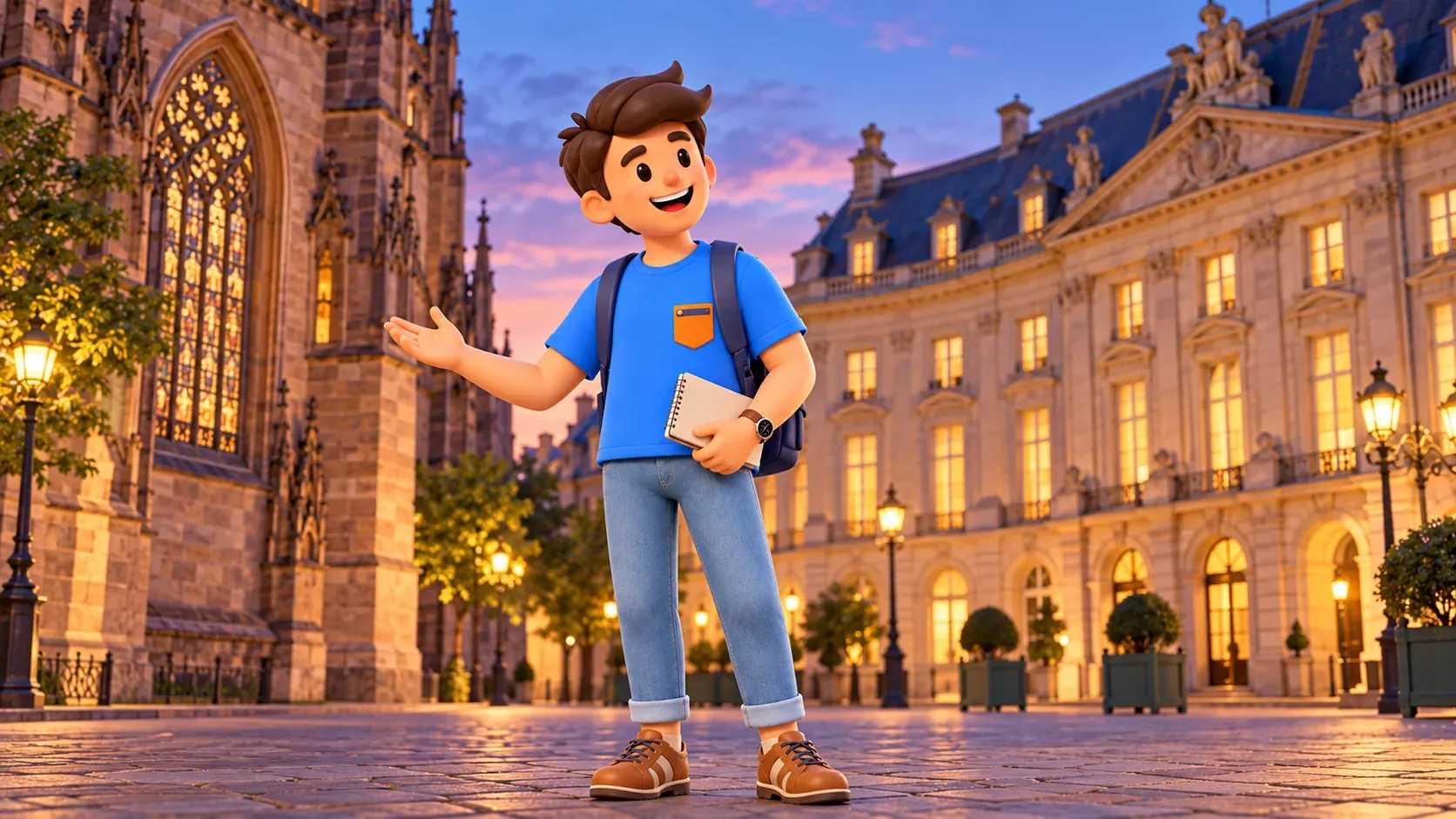
Beside the cathedral’s southern side, Place du Château brings different periods together. Gothic and Renaissance parts of the Œuvre Notre-Dame buildings stand near the more regular composition of the eighteenth-century Palais Rohan. The open space supports an exterior comparison.
Look at rooflines and window rhythms. Medieval modelling and palace symmetry organise attention differently. Evening can simplify the comparison by bringing larger forms forward while leaving fine details for another visit.
The square relates to religious and representative life. Buildings serving the cathedral stand near the residence of its prince-bishops. Their different public roles explain the ensemble more usefully here than a complete list of rooms inside.
Continue by an available street towards Pont du Corbeau. Do not depend on a shortcut through palace interiors or museum courtyards. The exterior comparison and onward walk remain possible without an open door.
Pont du Corbeau: remember a working river
At Pont du Corbeau, the outing acquires another story. Beside the Old Customs House and former Great Slaughterhouse, now the Historical Museum, water recalls trade and municipal work. The Ill carried goods and helped organise the city’s economy.
Compare large buildings with the direction of the channel. The customs building’s length and the crossing’s connection with the opposite bank explain the importance of this place without entering a collection. Think about how the river city functioned rather than inventing one precisely reconstructed scene.
After crossing, stay on the outer bank towards Bateliers. Your viewpoint changes: previously close buildings become part of a view across water. You do not need to cross again at every bridge for variety.
Bateliers: façades, people and reflections
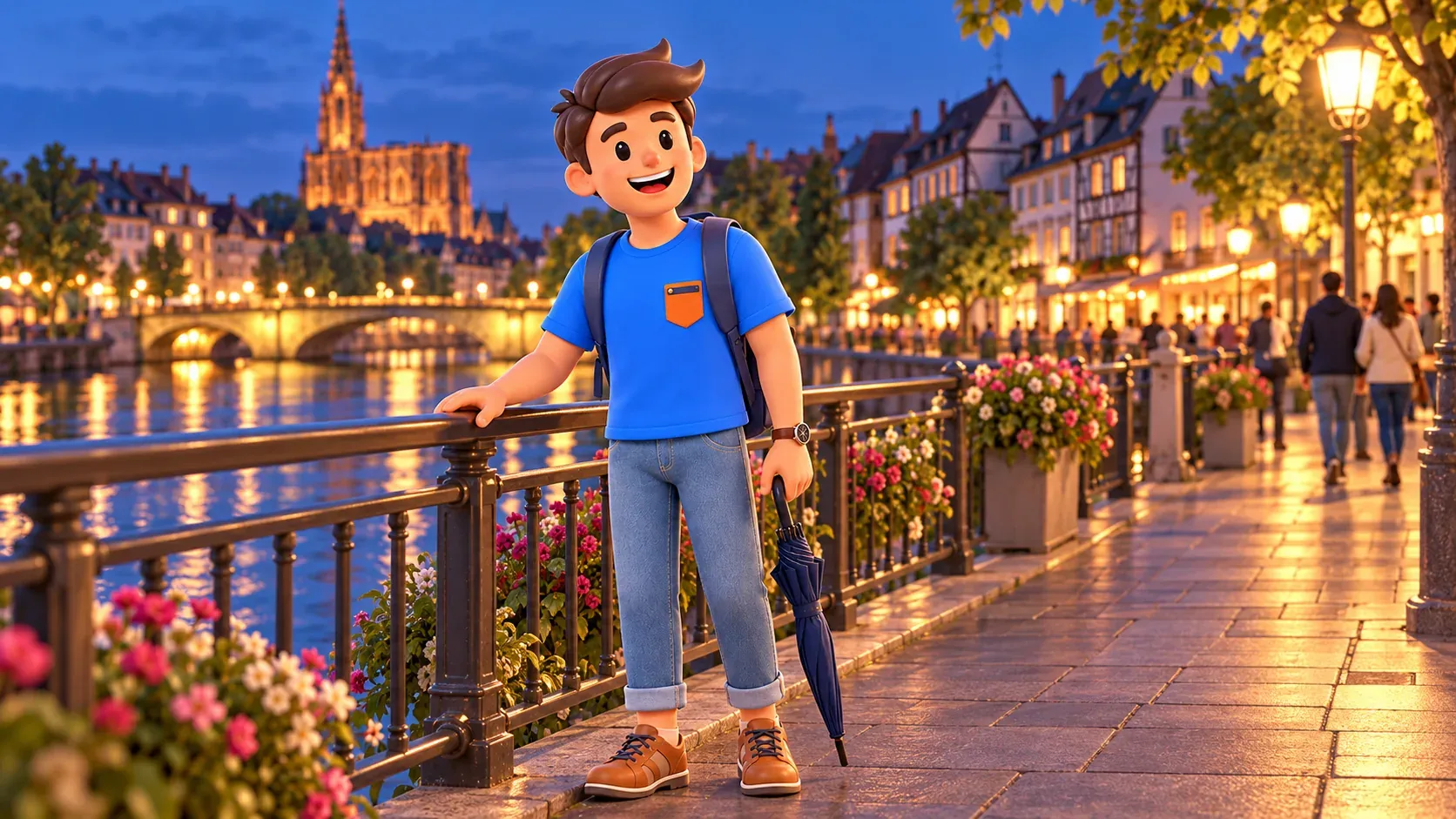
Quai des Bateliers links the old island with the riverside Krutenau. Its redevelopment strengthened its role as public space for walking and rest. Evening brings together movement, views towards historic buildings and the life of neighbouring businesses.
Choose stopping places with enough room for others. Pedestrians and cyclists can share the public route; a long photo session in a narrow stretch quickly becomes an obstruction. A few steps aside can also provide a more convenient view.
Try three scales of observation: a whole bank with the cathedral’s vertical outline, one façade, then a fragment reflected in the river. Water changes the image, so neighbouring viewpoints already differ. Repeating the same picture at every stretch is unnecessary.
Evening does not guarantee emptiness or silence. The quays and Krutenau continue their ordinary life. Sometimes including that movement in your impression is more interesting than waiting for a scene entirely free of people. For a longer pause, choose an available place where you feel comfortable.
In wind, rain or light that no longer suits you, keep the option of finishing sooner. The walk does not require descending to the water. The upper route remains the basis, with individual stops chosen from actual conditions.
Abreuvoir: a small bridge and everyday memory
Passerelle de l’Abreuvoir connects the quay with a narrow lane on the Grande Île. Its name recalls a former place for watering horses. This small story returns the river to everyday urban life, complementing the monumental opening.
The metal structure belongs to the small urban bridges of the early twentieth century. Stone supports and open railings let you compare the crossing’s materials with its surroundings. Its importance lies in connecting banks while maintaining an intimate scale.
From an available position, look along the river and towards the cathedral. Crossing and retracing the bridge is unnecessary if you are continuing on the same quay. Changing the direction of your gaze already reveals the contrast between a tight lane and open water.
If time is short, end the riverside section here. The walk has already connected a great façade, a square and a modest crossing. Continue towards Saint-Guillaume if you still want more and the onward journey is convenient.
Saint-Guillaume: finish with a church outline
The bridge and church of Saint-Guillaume form the next river setting. The church connects with the history of the Guillemites and the later Protestant congregation. Its exterior form is well suited to an evening introduction from available public space.
The façade’s asymmetry relates to the old entrance and street alignment. A bell tower added in 1667 reinforced that unusual arrangement. The difference between the building’s direction and its outer termination gives the outline character without elaborate external decoration.
An anchor at the top recalls boatmen associated with the place. Look only as closely as visibility allows, rather than trying to identify every detail in darkness. Church, crossing and river together already communicate the essential setting.
The church has its own opening hours and separate events. This exterior outing assumes neither an open interior nor a concert. Finish with a suitable view of church and water, keeping time for what follows.
Dinner or an unhurried return
In RoadMe, it is easier to work out a personal plan for the whole trip, fitting evening walks around your other interests. Set your pace and available time so the app can create a route with space for visits, dinner and rest.
If dinner is part of the evening, select a suitable place and check its arrangements beforehand. A lively neighbourhood does not establish a free table everywhere. A long meal adds to the walk rather than fitting automatically inside its ninety minutes to two hours.
For another day, save the longer walk along the Ill. Tonight can finish at your chosen crossing without adding the opposite side of the centre. Several connected images that change with the light make a satisfying evening.