
San Fermo in Verona: why are there two churches in one building?
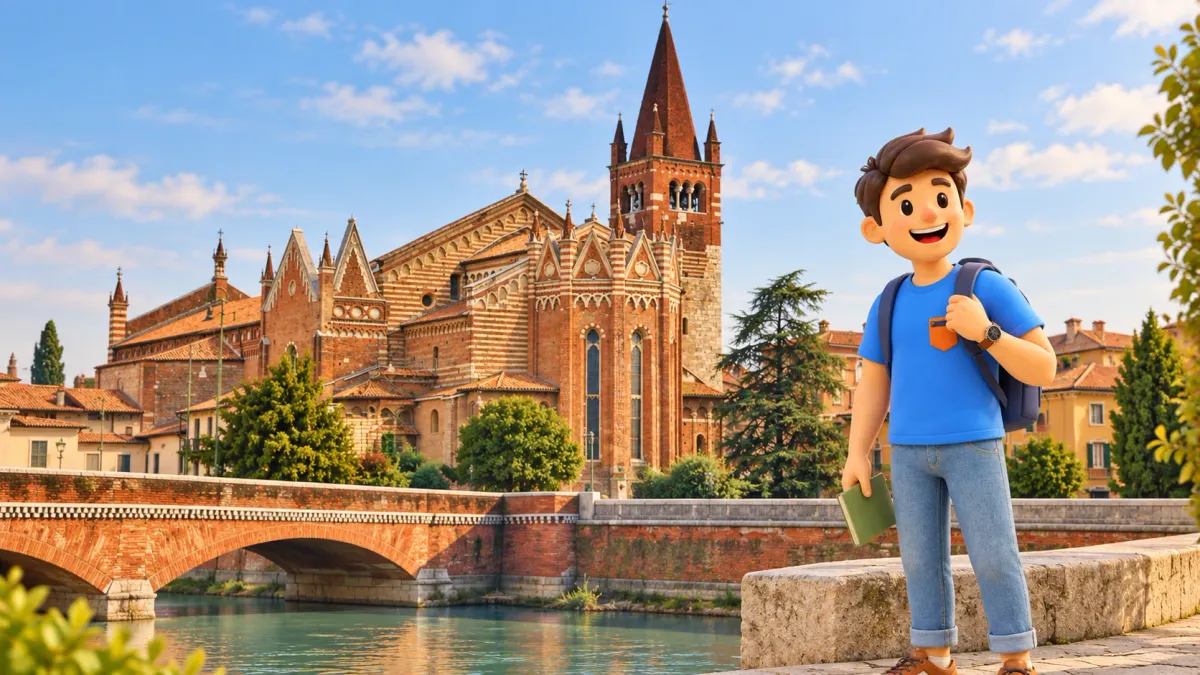
San Fermo is recognisable from its red brick, pale stone bands and intricate outline near Ponte Navi. Its most surprising feature, however, is inside: beneath the upper church lies another substantial sacred space. One visit lets you experience how differently architecture can direct your attention and movement.
You do not need a catalogue of altars and artists to make sense of it. Start with why the two levels exist. The lower space is associated with Romanesque architecture and the veneration of relics; the upper church acquired a distinctive Gothic character. Their contrast is a reason to spend time in one building, rather than hurry towards another attraction.
The two levels were part of an earlier plan
RoadMe makes it much easier to turn an interest in Verona’s unusual architecture into a personalised route or a plan for the whole trip. Try choosing history, art and a relaxed pace to connect visits like this with walking and time to rest.
The name to use when finding the entrance is San Fermo Maggiore, the church near the Adige and Ponte Navi. Keep it separate from San Fermo Minore. Similar dedications do not mean two levels of the same complex, nor two neighbouring entrances into it.
The Benedictines created a Romanesque building here in the eleventh and twelfth centuries with two levels already in its design. The lower one housed the relics of Saints Fermo and Rustico; the upper accommodated worship with the congregation. Different purposes could therefore remain closely connected at one site.
The complex passed to the Franciscans in the thirteenth century. They subsequently transformed the upper church, giving it its Gothic character. “Romanesque below, Gothic above” is a helpful description of the visitor’s impression, but it should not suggest that the Franciscans first invented the second storey.
The lower space is commonly called the lower church and can also be explained architecturally as a large crypt. Those names do not imply two independent parishes with separate addresses. You are looking at related parts of a historical complex whose present form developed over time.
Below, notice the rhythm of supports and vaults
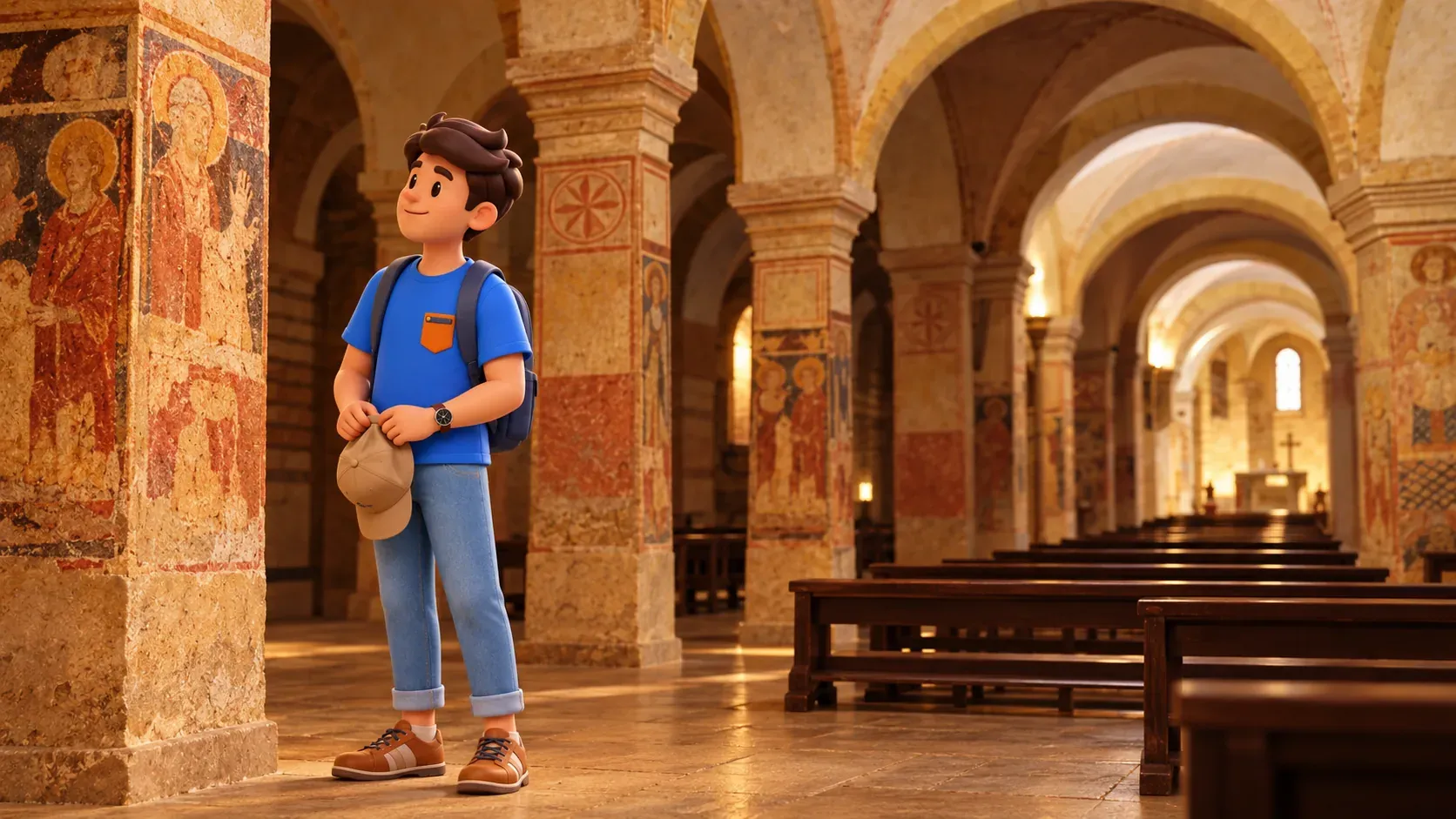
In the lower church, repeated supports, round arches and relatively low vaults shape the experience. Space appears in successive bays: the next section emerges beyond the previous one, painted surfaces meet stone, and movement feels different from the wider upper hall. This is a good reason to slow down.
Do not immediately search for the most famous fragment. Pause somewhere that leaves circulation clear and follow one line of supports into the distance. Then look at the vault above you. Comparing those directions explains much of the room without architectural terminology or a plan in your hands.
Painted fragments introduce a human scale. Choose one image you can see from the available visitor space and notice its relationship with a pier or wall. The interest is not only in what it depicts. Painting belongs within the building’s structure, rather than appearing as a separate picture hung against a neutral gallery background.
Give your eyes a moment to adjust after the street. Instead of trying to see everything through a camera, look first and then decide whether a photograph is useful and permitted. Quiet conditions do not guarantee an empty room, and this remains part of a working church.
Above, allow your attention to travel farther
The upper church changes more than the height above your head. Its more open space allows a longer view and an impression of the whole volume. That difference becomes especially apparent after the succession of lower bays. There is no need to decide in advance which level is more beautiful.
One major feature is the timber ceiling, whose form is often compared with an upturned ship’s hull. Begin with the overall curve and repeated rhythm, then select a smaller area of decoration. The comparison helps you picture the shape; it does not mean an actual dismantled ship has been placed over the church.
Painted surfaces and other artworks do not require a complete circuit with a checklist. You could make the ceiling your main focus, then give attention to one painted ensemble. That keeps the visit coherent without making the upper church a test in which every artist must be identified immediately.
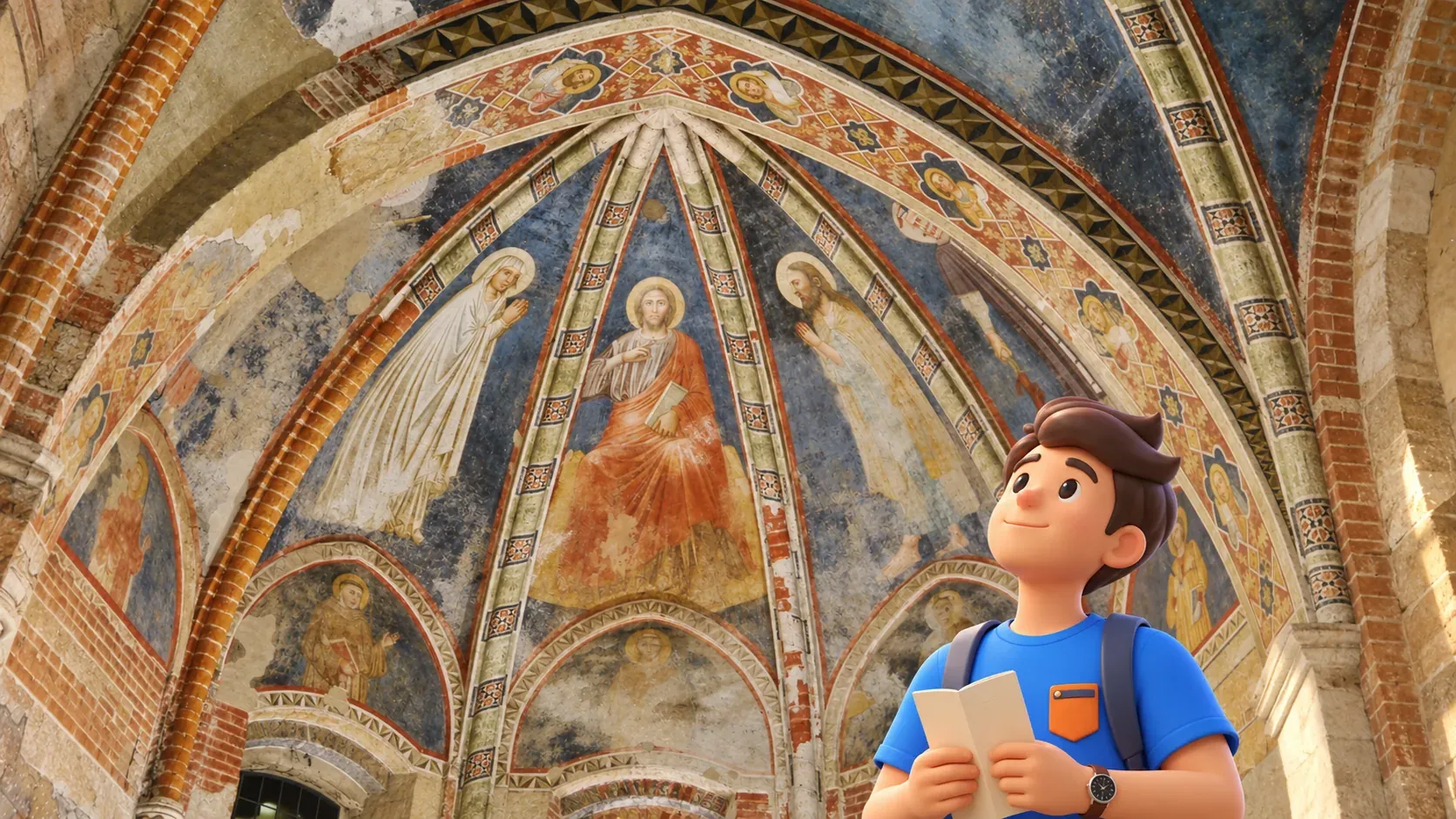
Distinguish the different parts of the interior, too. The wooden covering of the main space and the painted vault in the sanctuary are not the same architectural element. This matters even when looking at photographs: an attractive close view of frescoes may not show the ceiling described in your guide.
Choose one artistic focus rather than a complete inventory
If you want an individual artwork alongside the comparison of spaces, the Brenzoni monument with Pisanello’s painting offers a useful focus. It brings sculpture and painted imagery together. Avoid attributing the entire ensemble to one painter: different forms of art within a monument can be the work of different makers.
Find a position within the permitted visitor area from which you can appreciate the whole. First consider where physical architecture ends and depicted architecture begins, then look at how the figures relate. A few minutes of attention can be more rewarding than a long biography read while continually switching between a screen and the wall.
You can also leave out this extra focus. If the building is your main interest today, the lower vaults and upper timber ceiling already give the visit a clear subject. A satisfying encounter does not have to include every valuable object. Choosing a theme is more useful than mechanically completing a list.
For someone unfamiliar with church art, a simple question works well: where does the room lead my attention? Below, the answer might involve a nearby support or passage; above, a longer view and a movement upwards. That is a personal observation, not an examination in architectural styles.
The relics connect the history of the two levels
The lower space’s original function explains why it should not be treated as an accidental basement. The memory of the saints to whom the complex is dedicated matters here. Their martyrdom belongs to the church’s devotional tradition, which should be distinguished from a precise account of what a visitor can inspect today.
In the eighteenth century, the relics were moved to the main altar of the upper church to protect them from flooding by the Adige. The episode shows that the relationship between the levels changed. You cannot assume that the shrine’s present location is identical to the medieval arrangement.
The nearby river consequently becomes more than attractive scenery. Water influenced decisions about caring for the building and its contents. Historical flooding, however, does not mean the lower space will necessarily be flooded during your visit. Follow the current visitor arrangements rather than imagining a hazard from an old story.
Such changes are part of what makes San Fermo interesting. Some structures survived, others were reworked, important objects moved, and later artworks were added. The building is not a frozen image of a single century. It continued to be used, cared for and altered.
Plan one substantial visit without racing around four churches
RoadMe can help work out a personalised plan for your whole trip, connecting selected churches, art and ordinary walks around your interests. The app makes it much more convenient to organise a manageable route from these ideas at a pace that suits you.
For a focused encounter with both levels, allow 45–65 minutes inside, 10–15 minutes for the exterior, a 25–35-minute break afterwards and 15–20 minutes of flexibility. Together, that gives roughly 95–135 minutes. Travel from your accommodation, returning and any admission queue are additional; these are planning allowances, not a measured compulsory tour duration.
Start with the section indicated by the current visitor circulation. There is no need to seek another doorway or interrupt movement on a staircase for a supposedly perfect dramatic sequence. The contrast works without one mandatory order. Simply recall the first space when you reach the second.
You can choose a neighbourhood walk afterwards, giving it a separate time allowance. Our Filippini walk from San Fermo towards the Adige introduces the surrounding area. It is not an extension of church admission and is not automatically included in the two-hour block suggested here.
If you are choosing between several church visits, use our guide to choosing two Verona churches for one day. Decide according to interest and energy. San Fermo already offers two contrasting spatial experiences, so another famous church need not immediately become the next objective.
Resolve visiting times, stairs and worship before setting out
Tourist visits require paid admission. The operator offers individual entry and a combined option for several historic churches. An ordinary independent visit does not require advance reservation, and tickets can be purchased at the first church you visit. Choose the product that fits your plans rather than treating a combined ticket as an instruction to visit every building consecutively.
At preparation, the operator publishes seasonal hours. In October 2026, tourist visits run Monday–Saturday, 9.30 am–6 pm, and Sundays and religious holidays, 1 pm–6 pm. For winter, from 1 November 2026 to 28 February 2027, the hours shorten: weekdays 10 am–5 pm, Saturdays and holiday eves 10 am–5.30 pm, Sundays and holidays 1 pm–5.30 pm.
Check the arrangements for your actual date: services and specific events can interrupt cultural visits. An open church door does not always indicate an available sightseeing period. Do not plan to begin a substantial visit just minutes before closing, even if last admission has not yet passed.
The stairs require particular attention. The operator explicitly states that wheelchair access is not possible because of steep steps. Do not rely on a general claim that the upper church is fully accessible and only the lower part presents difficulties. If steps are a problem, clarify the conditions in advance and consider another visit where necessary.

Leave with the difference between the spaces in mind
Three relationships give the visit a useful structure: the lower level and the veneration of relics, the upper and congregational worship, and the later transformation that introduced another artistic language. They explain the unusual arrangement more effectively than dozens of names absorbed in a hurry.
Keep your own impression of the contrast as well. Where did your attention remain close, and where did it move upwards? Which surface stays with you: stone, a painted fragment or timber? With that question, San Fermo becomes an experience of its own in Verona, rather than a brief interval between better-known names.


