Seoul before Joseon: where to find traces of Baekje
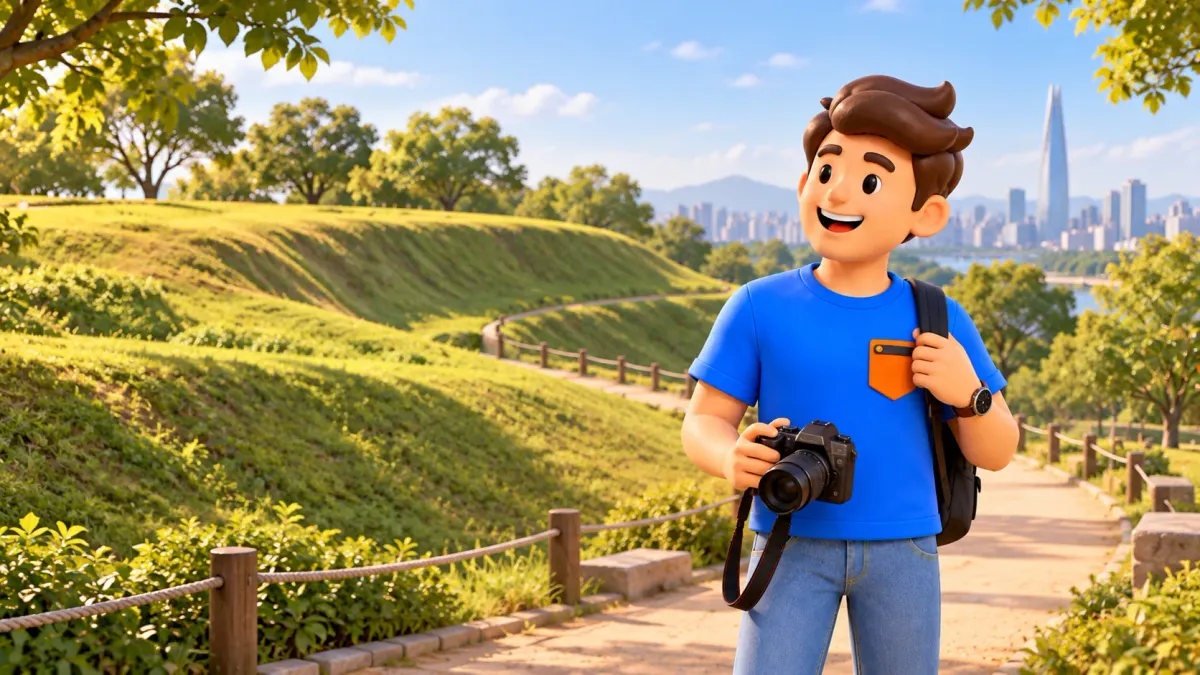
For Seoul before the Joseon palaces, head south of the Hangang to Songpa. Mongchontoseong’s earthen defences, Seokchon-dong’s stone tombs and Pungnap’s archaeological places belong to the earlier Baekje capital landscape. Start with a selected section inside Olympic Park for around ninety minutes. Add Seokchon with a separate urban walk or transfer and a pause if you want more: a selective half-day can take three and a half to four and a half hours. Visiting every ancient site in the district is unnecessary for a meaningful introduction.
The main change is how you look. Instead of familiar gateways and painted halls, expect grassy contours, low stone tiers and marked traces of vanished buildings. They need attention, but reveal a capital environment long before late-medieval Seoul. A modest rampart can matter more than an impressive modern arch. First identify what you are seeing: defence, burial or presentation of excavation findings.
Begin with landform, then add stone
Mongchontoseong works as a first stop: Olympic Park’s public paths allow observation of an earthen fortress without a compulsory museum visit. Seokchon changes material and purpose, presenting a burial landscape. Keep Pungnap as an independent alternative if settlement traces and archaeological interpretation interest you more. These places share history but are not adjacent rooms. Two different ways of seeing Baekje can offer more than an exhaustive district inventory with little time to observe. Choose the comparison before adding every possible name to the plan.
Build this historical outing into a convenient trip with RoadMe: the app fully develops a personal itinerary around your interests, dates and pace. Archaeology, walks, contemporary districts and rest receive suitable places in a programme that is easier and more effective to use in Seoul.
| Place | What remains | The main question |
|---|---|---|
| Mongchontoseong | Earthen defences and terrain | How was space protected? |
| Seokchon-dong | Stone burial structures | How was remembrance built? |
| Pungnap Baekje Cultural Park | Marked traces and reconstruction | How can a vanished town be imagined? |
| Baekje Museum | Research and collections | How do finds relate to context? |
Ninety minutes at Mongchontoseong can cover one rampart section and an overall public-path view. This editorial allowance excludes hotel travel and a complete circuit. Allow forty-five minutes to an hour separately at Seokchon. If combining them, budget ordinary streets or transport and rest. A longer list is not automatically more useful. One clear change from earth to stone provides a substantial comparison, while leaving the broader archaeological landscape available for another visit. The programme should match curiosity and energy rather than an obligation to complete every historical location.
Baekje and Hanseong: a capital before familiar palaces
Baekje was one of ancient Korea’s kingdoms. Its early capital period concerns Hanseong in the Hangang valley, within present-day Seoul. Written tradition dates its foundation to 18 BCE, but this should not be presented as one precisely excavated event at every site. Archaeological finds and historical records are different kinds of evidence. They help investigate authority, settlement and connections rather than making the modern district an unchanged town founded on a single securely identified day. An early capital developed through time, leaving fragments rather than a complete frozen scene.
In 475, after Hanseong fell, Baekje’s political centre moved to Ungjin, present-day Gongju. Later phases concern other places on the peninsula. For a walk, separate Seoul’s early layer from subsequent developments. Not everything named Baekje stands in one neighbourhood or belongs to one century. The city’s history is wider than Joseon, while early history is not one motionless picture either. Earthworks and burials reveal different parts of that changing environment. Their relationship is more useful than treating every surviving fragment as evidence of exactly the same moment.
Mongchontoseong: a fortress that resembles a park hill
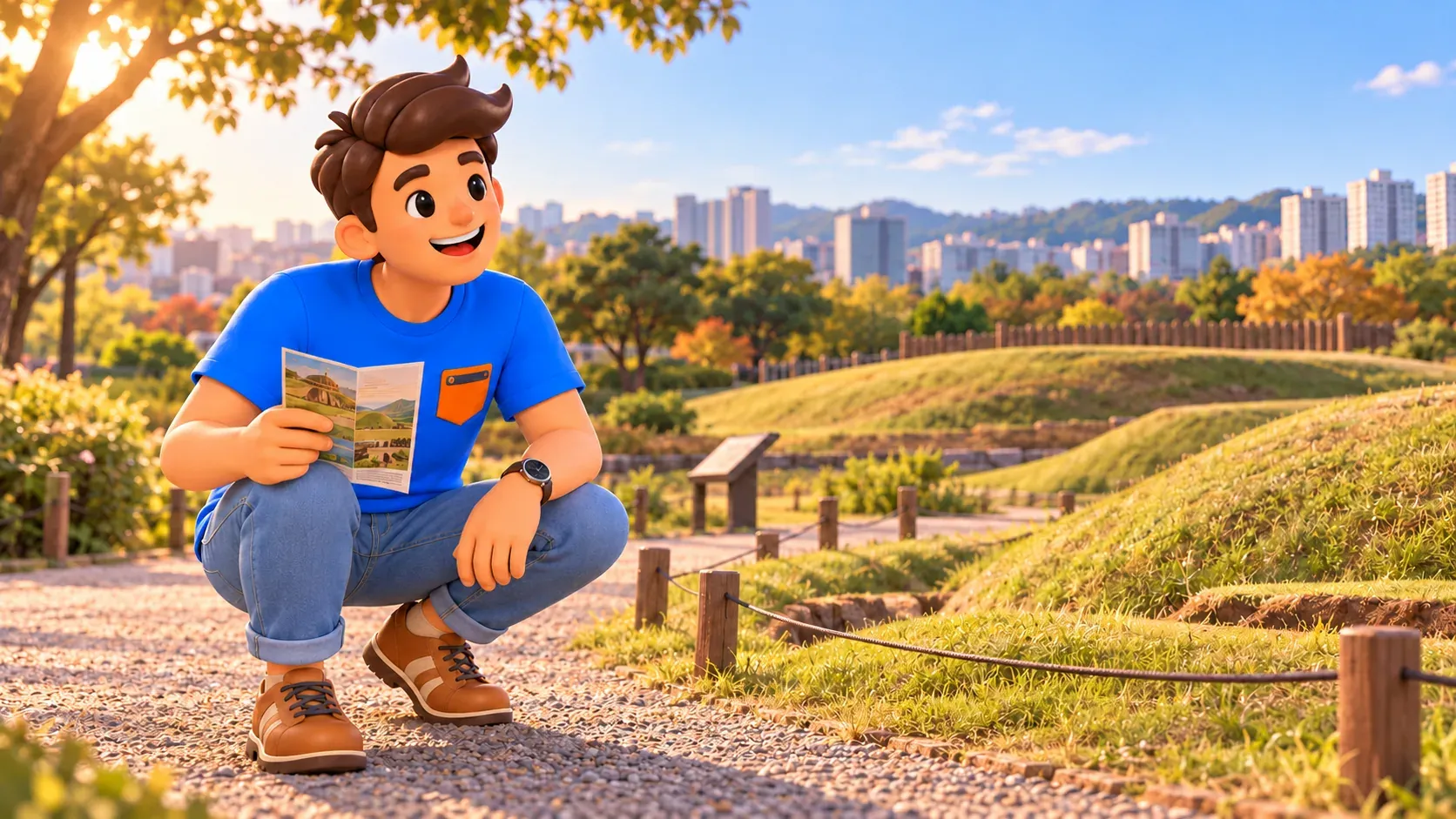
Mongchontoseong, 몽촌토성, lies within Olympic Park. Grassy ramparts use natural rises, making them easy to read as ordinary recreational terrain from afar. Notice how their curve relates to a slope and how height changes the view. Defence operated through ground, water, approach and location, rather than a wall considered alone. Stone towers are not necessary to understand the purpose. The absence of a familiar monumental façade helps direct attention to space itself as part of construction. A landscape can carry architectural evidence without presenting a complete standing gateway.
Choose a permitted position beside one curve. Follow the outline, then identify the difference between inner and outer levels. Which directions are visible? Where does movement change? These are observation questions, not a reconstruction of every battle. If a wooden palisade section or presented moat appears nearby, consider modern interpretation. A visible element need not itself survive from antiquity. Reconstruction can explain discovered traces while remaining materially different from an archaeological remnant. Keeping that distinction makes the experience clearer, rather than reducing interest in what the contemporary presentation helps you imagine.
Excavations revealed roads, building places and objects that inform research into organised life within the fortress. This does not mean the whole interior now opens as an excavated palace. Some history remains underground, some is explained through research. A good walk connects what is visible with a question instead of drawing missing details as established fact. Among present-day greenery, consider the working fortified space while noticing paths and visitors now. Two times coexist without becoming an illusion of complete ancient reconstruction. The public landscape is an entry into evidence, not a replacement for it.
Start at Olympic Park
Mongchontoseong on Line 8, Exit 1, provides a useful approach to Olympic Park. Choose public paths towards the selected rampart area rather than the entire park with museums and sports facilities. Ordinary walking access to the main grounds is 05:00–22:00; individual squares can differ. Daylight is better for reading terrain. A square’s longer opening does not establish round-the-clock access everywhere inside. Current barriers and archaeological work govern particular fragments separately. Keep the route on permitted paths while giving attention to the relationship between earthwork and setting.
Seokchon-dong: a different burial architecture
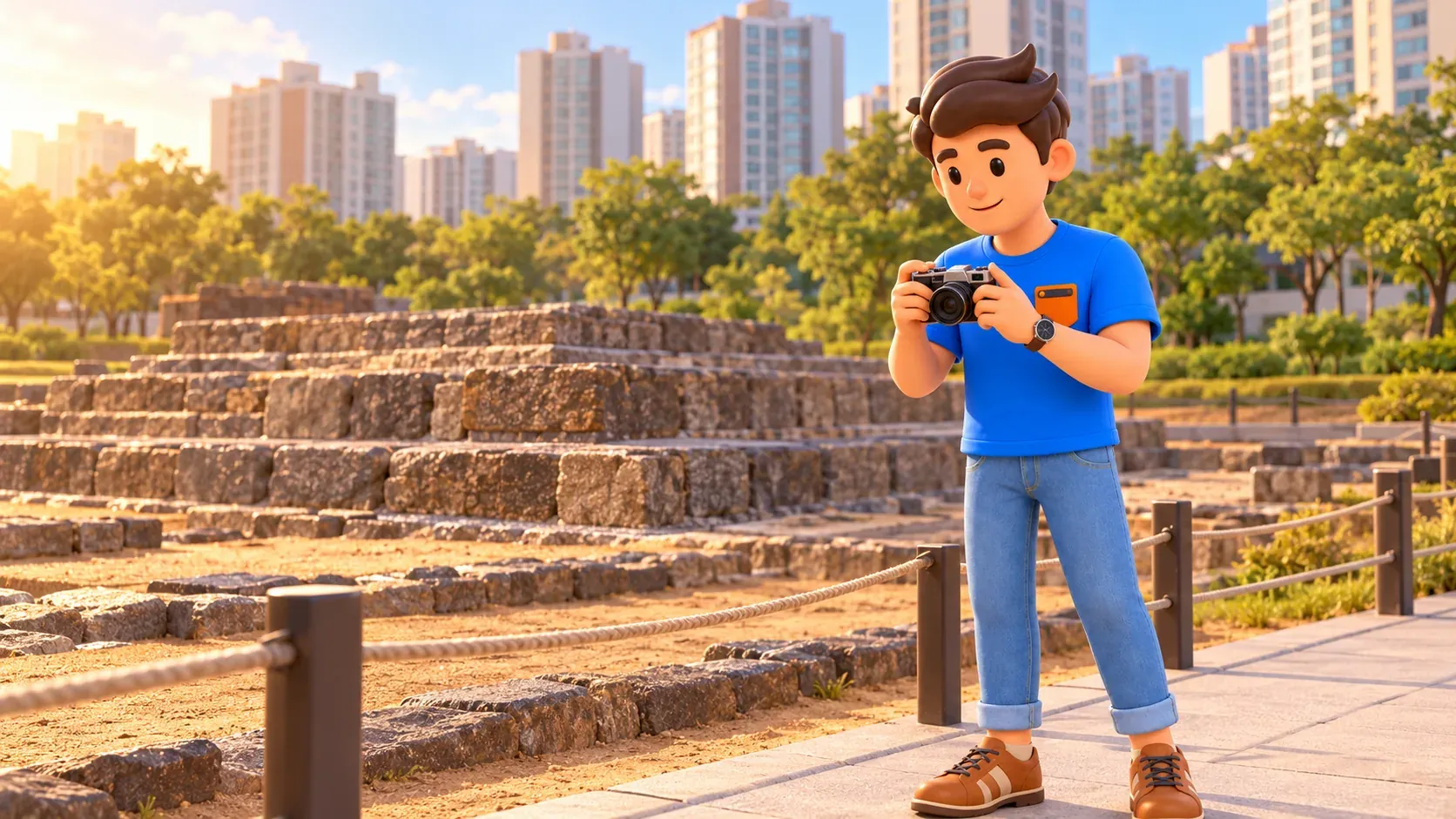
The ancient tombs in Seokchon-dong, 서울 석촌동 고분군, stand among modern urban buildings. Broad stone bases and stepped tiers belong to early Baekje burial culture. This differs from Joseon’s wooded royal mounds with rows of officials and animals. Do not merge them because both are called tombs. Material, form and period show a distinction before a long chronology is learned. Begin with base and edge, then compare scale with an ordinary modern building beyond the site. A low surviving structure can still communicate considerable organised effort.
The surviving area is a fragment of a larger cemetery. Urban development changed its surroundings, and today’s appearance is not the complete ancient landscape. Tomb No. 3 has a particularly broad stepped stone base. It has been associated with King Geunchogo, but that attribution remains a hypothesis rather than a definitively identified burial. This precision matters: a structure retains historical value when an individual’s name is uncertain. Archaeology can illuminate society through construction without answering every biographical detail. Understanding evidence and interpretation separately adds value to what is visible.
Notice transitions between tiers and how stone forms a low, wide mass. It needs a different gaze from a tall pyramid or a museum chamber with an open doorway. Do not expect access inside a burial space: the walk concerns exterior views from permitted routes. Size and arrangement suggest quarrying, transport and building labour. A low remnant becomes evidence of resources and organisation rather than simply old stones on protected ground. An overall view and one chosen edge complement each other, giving the form a clear subject at two scales.
Add the tombs as a separate urban stage
The site address is 21 Garak-ro 7-gil. Use Seokchon on Lines 8 and 9 or Seokchon Gobun on Line 9, followed by the public approach. From Olympic Park, a separate urban walk or transfer is required; this is not the continuation of a park trail. Allow the connection and rest when combining both. A selected daytime visit around an hour is more useful than trying to enter every excavation area. Restricted sections remain research spaces even when the overall site resembles a small neighbourhood park.
Pungnap: presenting a vanished town
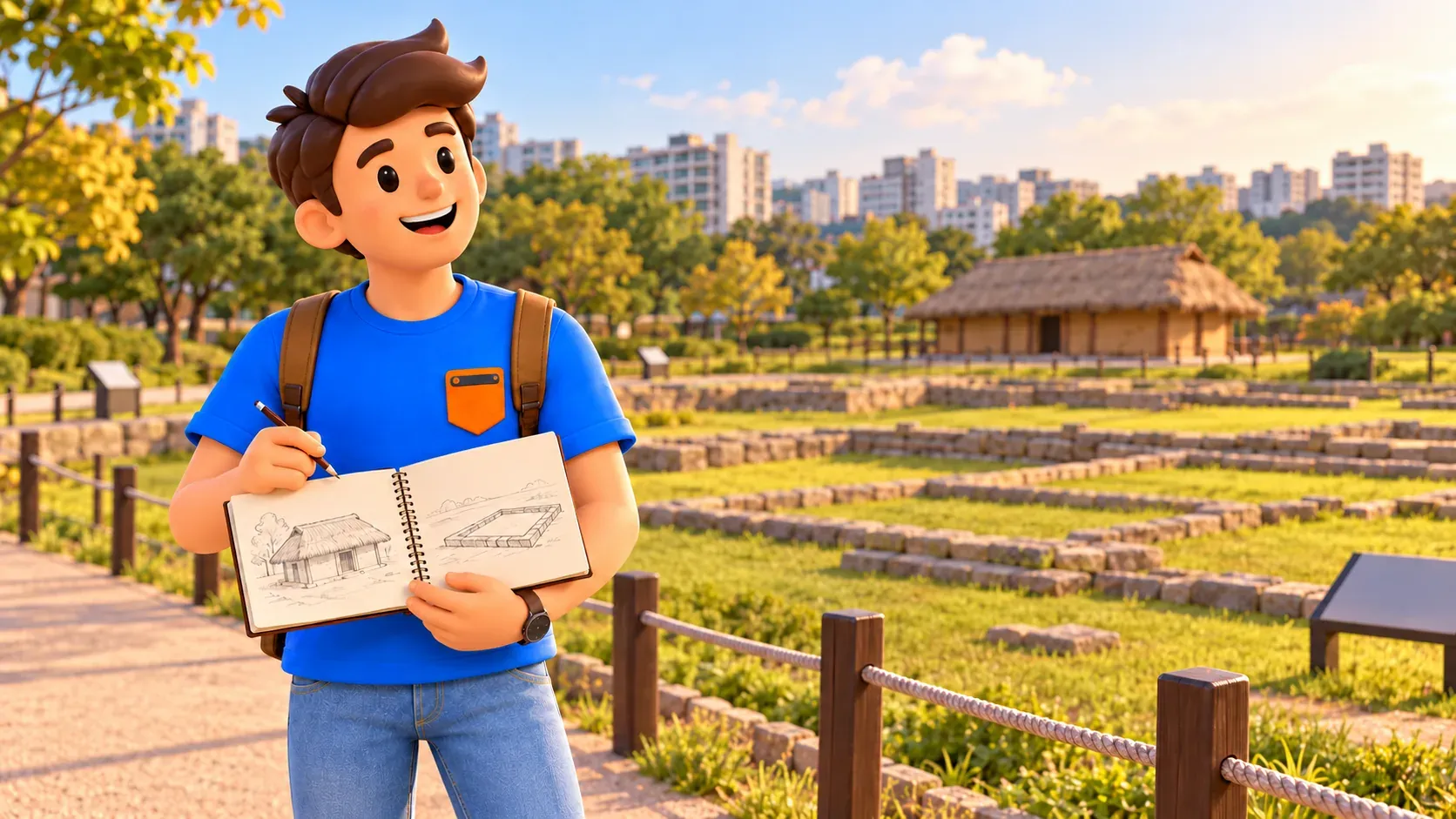
Pungnap Baekje Cultural Park concerns settlement within the ancient Pungnaptoseong area. Marked outlines and ways of presenting vanished buildings are central. A line on the ground and a reconstructed house provide different information. One makes a discovered plan legible, the other suggests walls and covering. Compare them without treating every surface as untouched antiquity. The park shows movement from trace to interpretation, rather than a completely preserved residential district where time stopped. That process can be an interesting subject independent of a longer fortress circuit.
A reconstructed dwelling with earthen walls and a plant-based roof helps suggest domestic scale. It is a modern reconstruction informed by research, not a house surviving unchanged from Baekje. The distinction improves the experience by revealing how the past is presented. Consider how a low trace becomes a proposition about volume and then a visible example. Choose Pungnap separately if this relationship appeals more than an extended Olympic Park walk or comparison of burial structures. Different interests can lead to different first encounters with the same early-capital history.
The museum is an addition with current limitations
Seoul Baekje Museum helps connect fortresses, tombs and finds with capital history. When preparing this article in October 2026, however, its first-floor permanent exhibition is undergoing renewal: the published construction period is September–December 2026, with a December return planned. Some special galleries also face limitations. A complete museum visit is therefore not this walk’s foundation. Check which rooms are accessible on your actual date, rather than relying only on general building hours or a future exhibition announcement. A planned return is not a guaranteed full reopening.
This does not make the archaeological subject unavailable. Outdoor sites allow a beginning through ground, material and scale, with a museum added under suitable conditions later. A collection’s history is not a promise that every mentioned object is on view today. Keep one question from rampart or tomb and return to it through interpretation. The interior can then deepen your own observation instead of becoming a compulsory condition for interest in early Seoul. The outdoor programme remains useful during exhibition changes, rather than collapsing around one unavailable gallery.
What to take from early Seoul
Mongchontoseong teaches defence through terrain, Seokchon remembrance through stone volume, and Pungnap the difference between trace and reconstruction. You need not see everything together. Choose one question and two forms if time suits. Contemporary buildings do not cancel the earlier layer; they reveal how small surviving areas continue within a much later urban setting. That relationship makes the subject local and alive, rather than requiring all present-day Seoul to disappear for an idealised image of a distant capital. Fragments can be meaningful without pretending to be complete.
Explore different periods more conveniently with RoadMe: the app prepares a complete personal route or trip plan around your interests and preferred rhythm. Ancient sites, museums, contemporary districts and rest form a programme that helps you use time more effectively.
Look once more at a low line of earth or stone when leaving. It is no longer an inconspicuous piece of park. It is a readable trace of a capital older than familiar palace roofs, and a reason to understand Seoul through several connected layers.