
Paris without long walks: three compact outings
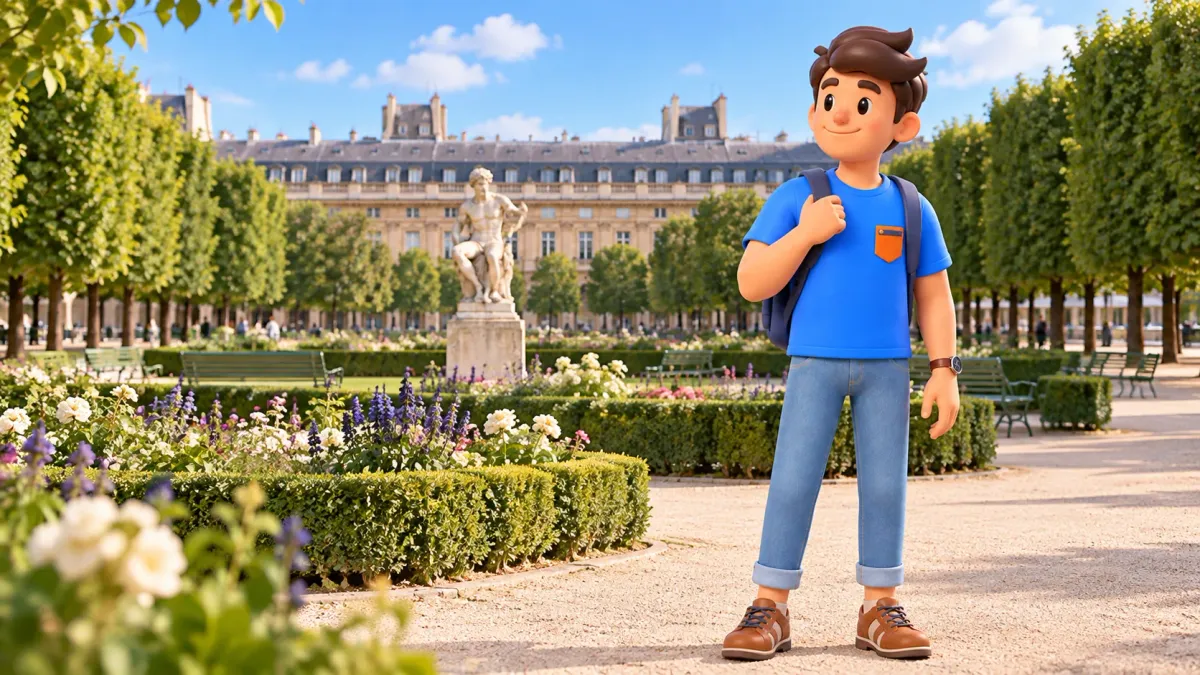
A short Paris walk can have a complete story without crossing several neighbourhoods. A courtyard, a garden and a place to sit may be enough to notice how the city arranges its spaces. The useful choice is often one small area with a clear return, particularly when a substantial museum visit or another commitment already occupies the day.
These are three separate alternatives: the Palais-Royal’s public courtyard and garden, Place des Vosges, and a selected northeastern part of the Luxembourg Garden. Each allows approximately 90 minutes from an above-ground Métro meeting point back to the same station. Choose one. Travelling between all three would create a different programme.
Choose one short walk, with a proper pause
Palais-Royal: contemporary art within a historic ensemble. Begin and finish at Palais-Royal–Musée du Louvre on lines 1 and 7. Choose this option for a courtyard, Buren’s striped columns and a small garden section. The Louvre, shopping passages and Place Vendôme are outside the programme.
Place des Vosges: arcades, façades and a square. Begin and finish at Saint-Paul on line 1. This option centres on repeated architectural forms, selected southern arcades and the central garden when open. Victor Hugo’s house is an exterior stop. A complete Marais circuit requires a separate outing.
Luxembourg Garden: the Medici Fountain and a palace view. Begin and finish at Odéon on lines 4 and 10. Keep to a selected northeastern section for water, trees and one architectural relationship. The entire garden, its museum and Senate interiors are excluded.
Try RoadMe to work out a complete personal trip around your dates, interests, pace and budget. Using one considered programme in the app is more convenient and efficient when short walks, major visits and rest need to fit together across your stay.
Each alternative preserves 20 minutes for seated rest. The remaining allowances cover observation and every connecting movement; they do not represent continuous walking. All timings are editorial planning estimates, not measurements from a personal trip. Increase the overall allowance or shorten observation if your approach takes longer, rather than sacrificing the pause automatically.
The clock starts above ground. Travel from accommodation, Métro journeys, station corridors, shopping and a substantial meal need additional time. A café with table service can take longer than sitting on a garden bench. If particular access arrangements matter, check the chosen station exit, surfaces and entrance separately. A compact itinerary does not establish a fully step-free journey.
Palais-Royal: courtyard geometry and a garden
From the above-ground Métro meeting point, approach Place Colette and the public domain entrance at 8 rue Montpensier. Visit the main courtyard first, then continue north towards the garden through permitted public passages. Return through the same public access and towards the station. The walk does not use offices or working institutions behind the palace façades.
The 90-minute allowance is ten minutes for the initial approach, twenty for courtyard observation, twenty for selected garden observation, twenty for sitting, and another twenty for all remaining internal connections, the exit and station return. That final block gathers those connecting walks; do not count them again inside the observation allowances. Shops beneath the galleries are optional additions requiring their own time.
The palace began as Cardinal Richelieu’s residence, the Palais-Cardinal. Its name changed after passing to the royal family. This brief history makes the courtyard more interesting: the familiar royal name sits over an earlier story. Today public courtyards and gardens coexist with functioning institutions, whose rooms are not automatically open because the outdoor domain is free.
Daniel Buren’s Les Deux Plateaux introduces black-and-white striped cylinders of different heights into the courtyard. Look at the whole setting before selecting a detail. The surrounding columns and windows establish one order, while the artwork creates another. Moving a few steps changes how its rows overlap, offering a simple way to appreciate the work without a long explanation of contemporary art.
Compare a view along a row with one across it, keeping the walkway clear. Notice paving and metal grilles underfoot; changing surfaces still matter on a short outing.
Continue to a small part of the garden rather than automatically completing its perimeter. The enclosing galleries have a connection with commerce and public life. In the late eighteenth century, Victor Louis developed buildings with spaces to rent to traders. That history helps explain the architectural frame around the greenery: the garden belongs to a city ensemble, not a detached park.
Find an available bench within the chosen section for your pause. If seats are occupied, reduce the garden exploration and allow a suitable alternative resting place nearby, adjusting the connection. Garden seating cannot guarantee an empty place at your arrival. Afterwards, retrace the public approach instead of adding another district simply because it appears close on a map.
The domain’s public spaces are free to enter. Regular opening is 8am–8.30pm from 1 October to 31 March, and 8am–10.30pm from 1 April to 30 September. Daytime leaves room before closing, although temporary restrictions should still be checked. If a garden or passage is closed, finish earlier in available public space or choose another day; service doors are not substitute entrances.
Place des Vosges: let one square hold your attention
From Saint-Paul, follow public pavements east along rue Saint-Antoine, then north on rue de Birague to the square’s southern side. Use marked crossings. Select southern arcades, Hugo’s exterior and a small section of the central garden. The return uses Birague and Saint-Antoine back to the same station, with no shortcut through Hôtel de Sully.
Allow fifteen minutes for the approach, twenty for selected arcades and Hugo’s exterior including local movement, twenty for the garden including its selected short paths, twenty for rest, and fifteen for the exit and public return. Together these make ninety minutes. A complete circuit of every side would change the scope; a few carefully chosen views can explain the ensemble.
Completed in 1612, the square was formerly called Place Royale. Red brick, pale stone, rooflines and arcades make separate houses read as one composition. Begin with a wider view, then inspect one opening or window pattern. Repetition is the subject here: the same architectural language creates a public setting larger than any individual façade.
Under a selected arch, compare the shaded view with the open perimeter. Leave room for people moving in both directions. Arcades offer partial shelter, but wind can carry rain through their open side and the station approach remains outdoors. Choose this option for an exterior architectural visit, rather than expecting a continuously dry corridor through the neighbourhood.
Victor Hugo’s house is at 6 place des Vosges. Its literary association adds a human connection to the square, without making this a museum day. This itinerary views the façade only. From 11 June to 13 December 2026, during the Hugo and architecture programme, the entire museum is paid, including the permanent collection.
An interior visit therefore needs separate planning. Regular museum hours are Tuesday–Sunday, 10am–6pm, with the last tickets sold at 5.15pm. Those arrangements apply inside, not to viewing the exterior from public space. If you decide to enter, extend the outing accordingly; keeping the original ninety-minute promise by removing the rest would defeat its purpose.
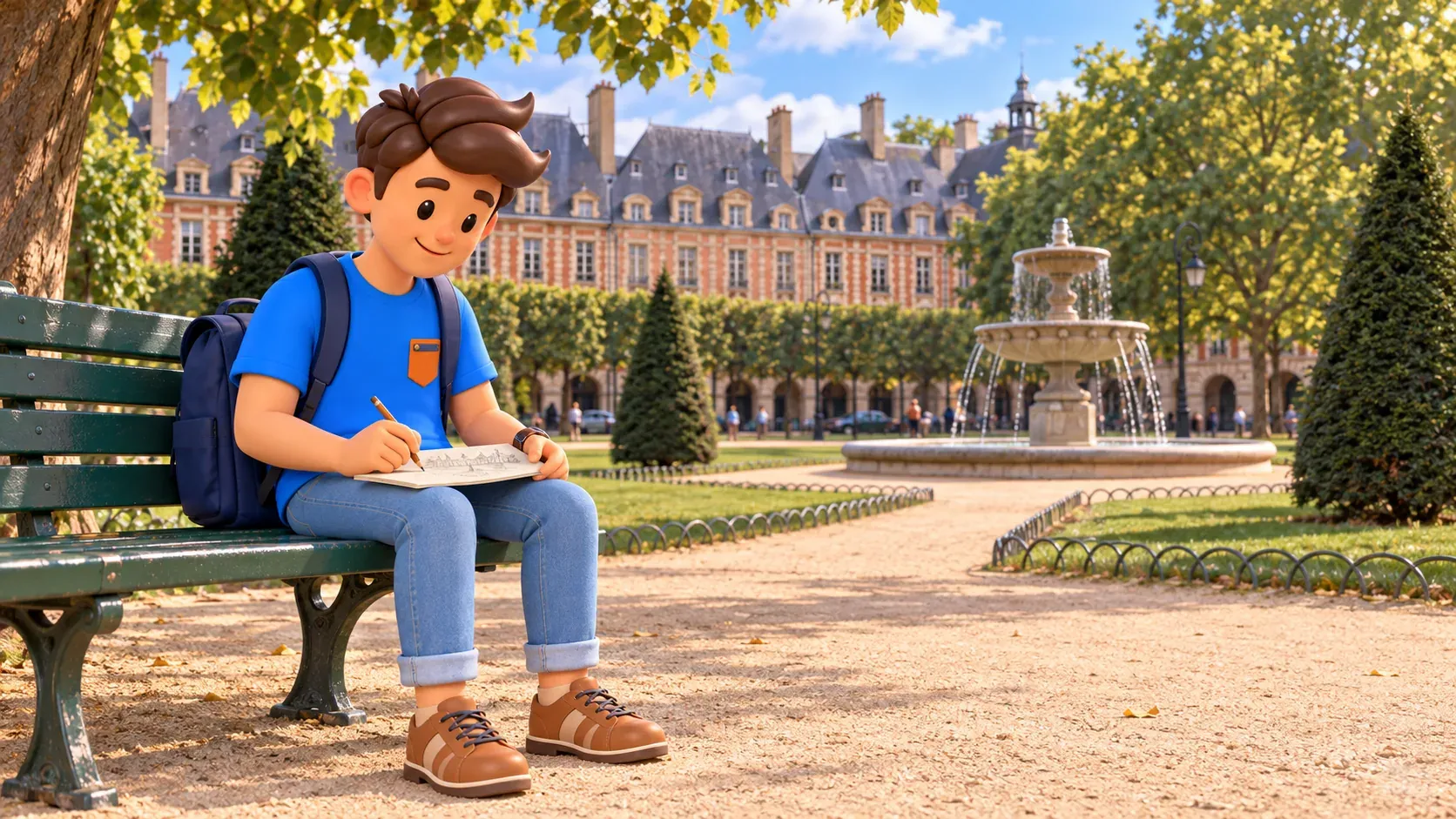
The fenced central garden is Square Louis-XIII, with seasonal gates. From 1 to 24 October 2026 it opens at 8am on weekdays and 9am at weekends, closing at 7.30pm. From 25 October to 28 February, closing becomes 5.45pm, with those opening times unchanged. The square’s public perimeter and its enclosed garden should not be treated as a single round-the-clock space.
When open, choose a short path and an available bench. The central equestrian statue of Louis XIII provides a connection with the square’s royal identity, but you need not visit every fountain and monument. If the gates are closed, stay on permitted public perimeter space. A seated break may then need a separate place and extra time; postponing the garden outing can be preferable to searching for an unofficial entrance.
Luxembourg Garden: keep to its northeastern corner
After reaching Odéon above ground, walk south along rue de l’Odéon. Cross rue de Vaugirard at a public crossing and approach the northeastern public entrance, Porte Médicis, from rue de Médicis. This route does not enter the Senate’s formal courtyard. Inside, use selected public garden paths between the fountain and a view of the palace exterior.
The allowance is fifteen minutes for the approach, fifteen at the Medici Fountain, fifteen for the palace view from the garden, twenty for sitting, ten for all short internal connections, and fifteen for leaving by the same public gate and returning to Odéon. That totals ninety minutes. A full Grand Bassin circuit and the garden’s distant areas would add walking beyond this selected programme.
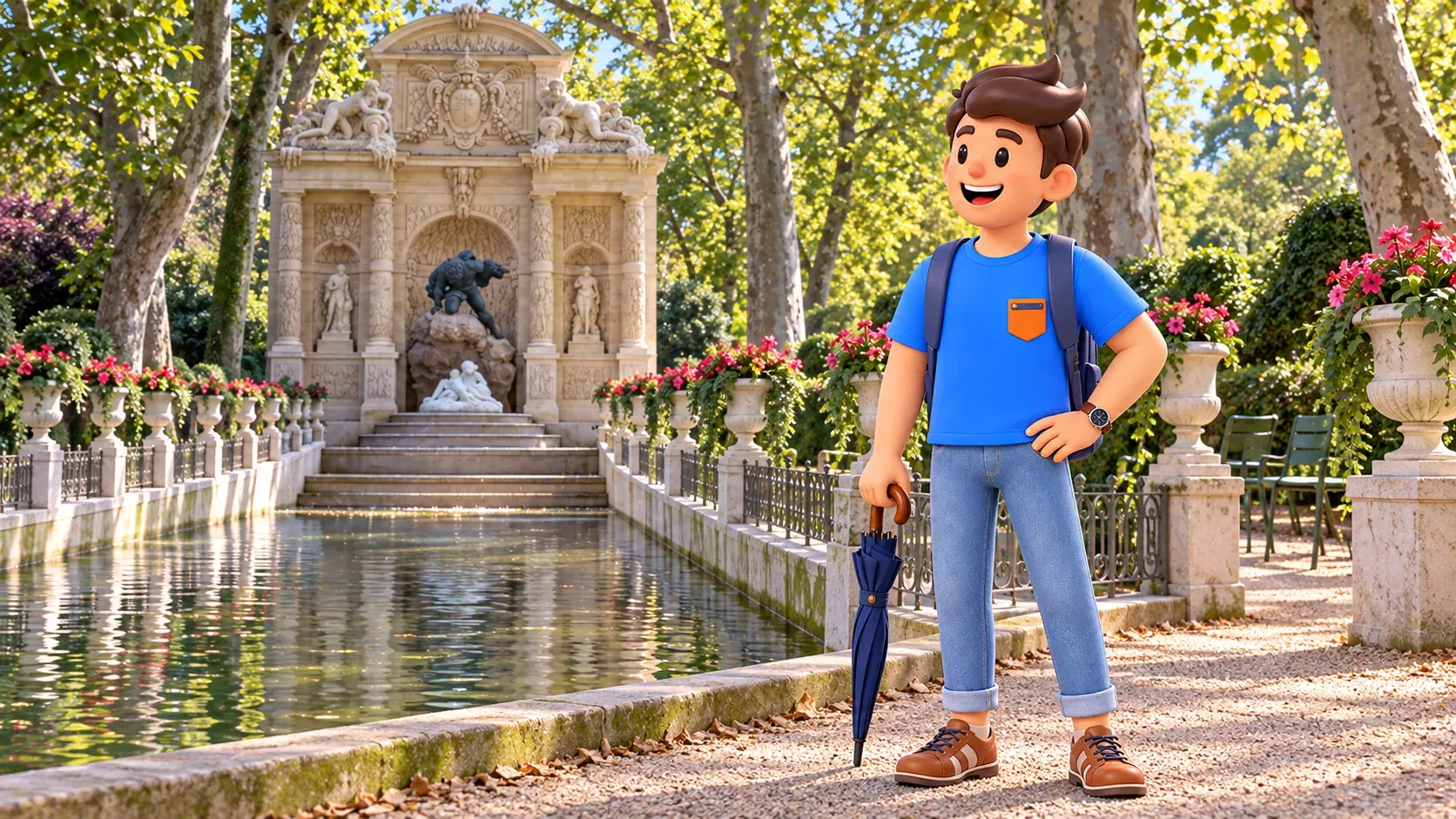
The fountain developed from a grotto commissioned by Marie de Médicis around 1630, inspired by Italian gardens. Its present appearance reflects later changes. During the nineteenth century, construction of rue de Médicis prompted its relocation, with a long basin and new sculptures added. This small piece of history turns the reflected water into a clue about how the city changed around the garden.
Look along the basin, then at the stone frame around the central sculptural scene. Trees, water and enclosed architecture create a different setting from Place des Vosges. One attentive comparison is enough for this short outing; you do not need to circle every side of the fountain. Seasonal flowers and an empty path are possibilities, not promises attached to the itinerary.
Salomon de Brosse designed the Luxembourg Palace for Marie de Médicis with Florentine inspiration. Here you see it from the public garden. The working Senate, its rooms and the separate museum are excluded from the free outdoor programme. That exterior view connects the fountain’s Italian theme with the larger residence without adding another admission commitment.
Garden entry is free, with seasonal opening. For 1–15 October 2026, the owner lists 7.45am–6.45pm; later autumn closing is earlier. Choose a morning outing, for example 10am–11.30am, and check hours for your actual date. Keep to paths and permitted areas; public access does not allow resting on every lawn.
Choose an available chair or bench within the small selected area for the twenty-minute pause, then return towards Porte Médicis and Odéon along the original public streets. Closed access or uncomfortable weather may justify shortening the programme or choosing another day. Searching for a distant gate can increase the walking, so do not assume such a diversion fits the same ninety-minute allowance.
Fit a small walk into the rest of Paris
Your current location may be the best deciding factor. After a major museum, choose a nearby small outdoor area rather than travelling across Paris for a similar break. Set a finish time and preserve the next journey. For a broader neighbourhood visit, our two-hour Marais walk and Louvre courtyard walk offer separate, larger sequences.
Use RoadMe to prepare a complete personal journey around your interests and preferred pace. It is a more convenient and efficient way to organise walks, substantial visits and pauses by your dates and budget throughout the trip.
Finish at the agreed station before deciding whether to continue. One architectural observation, a little historical context and time to sit already make a worthwhile outing. Any further walk deserves its own travel and rest allowance, chosen after you know how this one feels.


