
The Marais in Two Hours: Squares, Mansions and Small Gardens
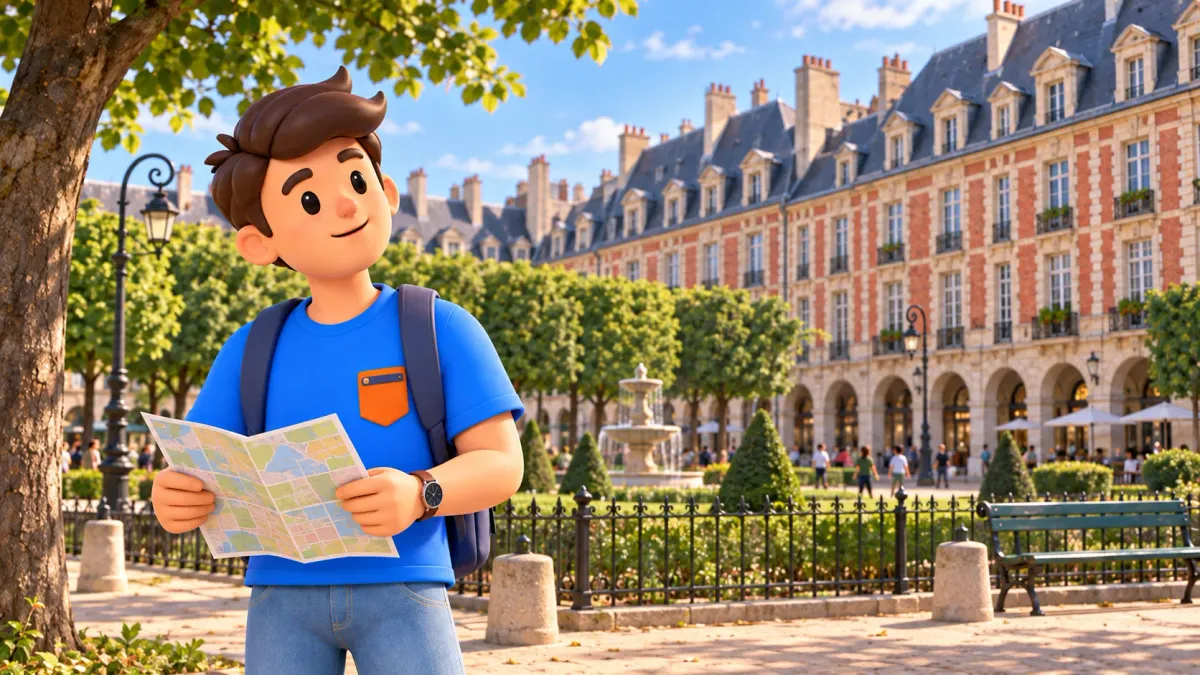
Two hours in the Marais can bring together a square, historic mansions and small gardens if you choose a compact part of the district. The interest lies in changing spaces: a courtyard beyond a busy street, greenery behind a façade, and arcades that make a large square feel like one architectural ensemble. A few thoughtful stops can give the walk a clear character.
Start at Place des Vosges, visit the accessible courtyard and garden of Hôtel de Sully, continue towards Carnavalet and finish at Jardin des Rosiers–Joseph-Migneret. The main programme excludes museum collections and mansion interiors. Choose a daytime slot: gardens and passages have opening arrangements, and a public street does not make every doorway an open entrance.
A two-hour walking plan
The main sequence is Place des Vosges → Hôtel de Sully → rue de Turenne and rue des Francs-Bourgeois → Carnavalet’s exterior on rue Madame de Sévigné → rue des Rosiers and the Joseph-Migneret garden. The beginning introduces an architectural ensemble, the middle explores urban residences, and the end leaves room for a small green pause.
Allow approximately 40 minutes for walking and another 80 for your selected stops and rest. These are editorial estimates, not timings measured on the ground. Travel to the starting square, a full meal, shopping and museum galleries require extra time. If you have an entry appointment later, reserve the journey to that attraction before assigning the remaining time.
A walk shaped around your preferred themes is easier to prepare with RoadMe: the app offers a two-hour route from your location with a theme you can choose. Try a personal programme that gives history, architecture or relaxed exploration the attention you want.
In the Marais, it is easy to want to enter every attractive doorway. Decide beforehand whether these two hours are mainly for façades, photography or greenery. One central interest makes it easier to use the available time well. With companions, agree on your first shared pause so that different interests do not become a repeated discussion about the next stop.
Place des Vosges: see the whole ensemble
At Place des Vosges, first take in the square as a whole, then walk beneath the arcades. Red brick, pale stone details and rooflines create a recognisable frame around the central garden. As your position changes, notice how repeated forms establish order while individual details keep the buildings interesting. You do not need to examine every façade completely.
The square was formerly called Place Royale. Its old name helps explain the formal character of the space: this is an architectural ensemble with a royal association. That brief connection to the past is enough to make a short visit more meaningful. The individual stories of its many residents and buildings can become the subject of another outing.
If the central garden is open, use its paths to look back towards the arcades from inside the ensemble. If you prefer to keep moving, spend more time around the covered perimeter. Choose one wide photograph, then put the camera away for a short stretch. Architecture can feel different when you are looking beyond a promising picture.
A leisurely pause is also a good reason to come here. If you want to spend the first half-hour at a table, adjust the remainder of the route accordingly. You do not have to hurry to Sully simply because it is next on the list. Time enjoyed in one space can be a worthwhile introduction to the district.
Hôtel de Sully: courtyard and garden
From the square, an open public passage connects with Sully’s garden and courtyard. This connection involves steps. Alternatively, approach the main entrance at 62 rue Saint-Antoine using the public streets. Choose a path that is open and suitable for you; the shorter passage need not be part of everybody’s walk.
The mansion’s history begins in 1624, when Mesme Gallet commissioned an urban residence. The Duke of Sully bought it in 1634, and the building retained his family’s name. These dates explain why the current name differs from that of the original patron. A house can change hands while the memory of an owner remains in the city’s geography.
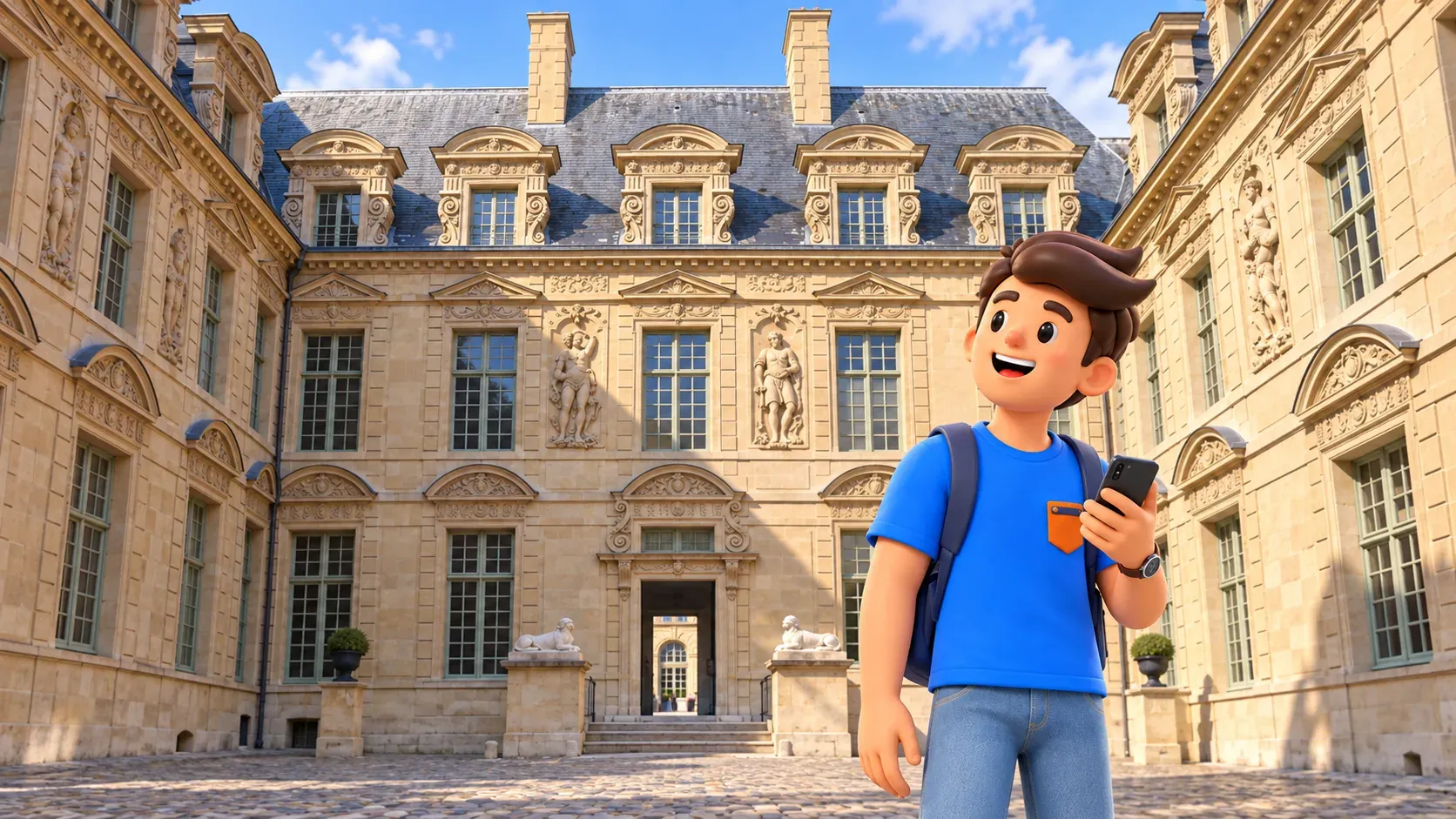
Look at the courtyard first. The enclosed space helps you notice the decoration and proportions of the façades. Then move towards the garden. Compared with Place des Vosges, this is a different way of arranging space: a large public ensemble gives way to a former private residence, parts of which visitors can now enjoy.
The courtyard and garden are free to enter. The current regular opening hours are daily from 9 a.m. to 7 p.m. Sully closes on 1 January, 1 May, 1 and 11 November, and 25 December. Check for changes affecting your actual date. Free access refers to these outdoor areas; interiors require a separate organised visit.
Do not automatically combine exterior exploration with a tour of the rooms. If the interiors matter to you, arrange the appropriate visit and give it a separate time allowance. The two outdoor spaces are enough for this itinerary. Afterwards, continue through public streets rather than treating a service doorway or neighbouring private courtyard as an extension of the route.
Carnavalet: a residence becomes a city museum
From Sully, head via rue de Turenne towards rue des Francs-Bourgeois, then Carnavalet on rue Madame de Sévigné. Along the way, look at changes of scale: substantial façades stand beside shop windows and everyday activity. Notice a doorway or a pattern of windows without making every appealing house another compulsory stop.
Carnavalet is dedicated to the history of Paris and opened to the public in 1880. Its setting brings together two historic mansions. That gives even an exterior visit a point: former residences have become a place where the city keeps its memory. Understanding that purpose does not require rushing through an entire collection in a few minutes.
In this two-hour plan, Carnavalet is an exterior stop. Add a separate museum block if you want to explore the permanent collection. Individual visitors can enter it free without booking; groups have reservation requirements. Temporary exhibitions are paid programmes with their own arrangements, so the permanent collection’s free entry does not apply to every event in the museum.
The regular opening schedule is Tuesday to Sunday, 10 a.m. to 6 p.m.; the museum also closes on 1 January, 1 May and 25 December. Last entry and the end of gallery visits come before the overall closing time. Check the format and entry time for a specific visit. The outdoor street walk still works when the museum is closed.
A good reason to return is an interest in one period of Parisian history. That makes a museum visit more purposeful than an improvised rush through rooms between street stops. Remember what interested you in the district itself. It can suggest a future theme rather than simply adding another museum name to a list.
Jardin des Rosiers–Joseph-Migneret
Continue along rue Madame de Sévigné towards rue des Rosiers, then find the garden entrance at 10 rue des Rosiers. The greenery sits within the built-up district. After the square and mansion courtyard, this is a smaller-scale pause suited to the final part of the walk. Find the official entrance before moving from the street onto the garden paths.
The garden lies among historic mansions and is named after Joseph Migneret, a teacher who helped save Jewish children during the Occupation. This brief explanation gives the place another layer: a small green space also preserves neighbourhood memory. Approach its commemorative elements with quiet attention, alongside enjoying the garden itself.
Take a seat if one is available, look at the planting and recall the different spaces of the route. Compare how the open square, enclosed courtyard and garden between buildings feel. This deepens the experience without adding new addresses. Leave a few minutes without the camera or a search for the next attraction.
The garden’s opening hours are seasonal, with earlier closing in winter than in summer. Strong winds or bad weather can also lead to closure. Keep this section for daytime rather than leaving it until late evening. If the gate is closed, finish in public street space or return to an open part of the square; a neighbouring private doorway is not an alternative entrance.
Look more closely at the Marais
For photographs, try three scales: a wide view of the square, one façade detail at Sully and a smaller piece of greenery. This makes the pictures reflect the shape of the walk rather than repeat the same composition. Choose a few images beforehand and avoid lingering in a narrow passage used by other people.
The term hôtel particulier means a private urban mansion, rather than necessarily a hotel. In the Marais, it is a useful key to the district: a historic home may now contain a museum, an institution or another use. A handsome façade does not establish access inside. Keep street, courtyard, garden and rooms distinct when deciding what to visit.
Try looking at a new space before reading a long account of it. What seems most noticeable: colour, shape, size or its position among the streets? A short historical explanation can then connect the impression with the past. This works especially well if a large collection of dates becomes tiring. Compare your observation with a companion’s; one may notice the ensemble, another a small entrance detail.
If food is part of the outing, choose the format first. A quick snack and a full meal take different amounts of time. For a short programme, sitting down after the final garden can work if it suits your schedule. Agree on the pause with your group, so one person is not hurrying through architecture while another is waiting to rest.
Continue around your own interests
After two hours, decide whether to explore one museum more deeply, stay among the streets or change the setting. A compact walk does not need to become an exhaustive Marais overview. If mansions and water appeal, the Île Saint-Louis walk can form a separate part of the day. Allow for travel between districts and a rest.
For the whole trip, it is more convenient to let RoadMe prepare a personal day-by-day plan around your dates, interests, pace and budget. Try a coherent programme that gives favourite neighbourhoods and larger visits a place suited to you.
The main impression of this route is a sequence of changing city spaces: arcades, a residence, a museum façade and a green pause. Choose what you would like to see again. That answer can make the next part of your Paris trip more meaningful and leave time for discoveries of your own.


