
Centrale to Repubblica: A Two-Hour Architecture Walk in Milan
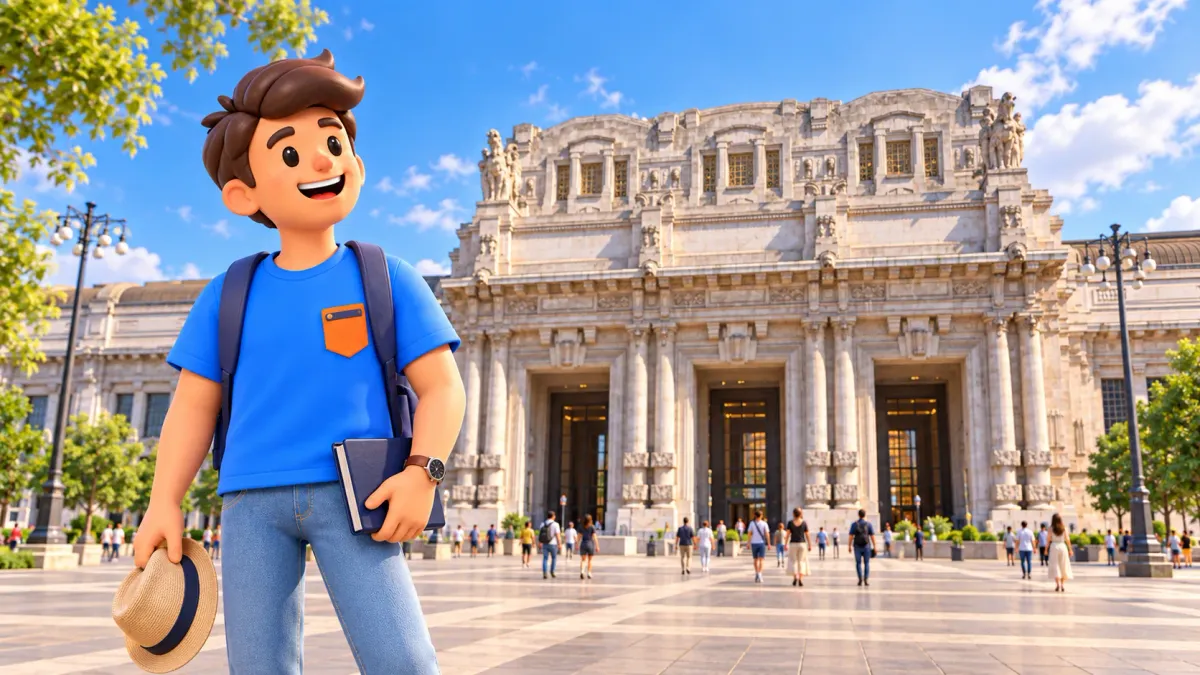
A two-hour walk from Milano Centrale to Piazza della Repubblica offers a compact introduction to twentieth-century Milan. Start outside the station on Piazza Duca d’Aosta, look at the nearby Pirelli Tower, then follow Via Vittor Pisani south towards Torre Breda and finish on Piazza della Repubblica. The interest lies in the contrast: a monumental railway entrance, a slender corporate landmark and a tower woven into an ordinary city street.
A short walk with time to look
Choose this route if you enjoy buildings but do not want to organise a museum visit. Its main stops are exterior views from public space. You need neither an architecture qualification nor a checklist of technical terms: compare the way each building meets the pavement, shapes its windows and ends against the sky. A few deliberate observations make the short distance worthwhile.
Try RoadMe to develop a personal trip plan around your interests, dates, pace and budget. The app makes it more convenient and efficient to fit an architecture walk into the whole stay, with substantial visits, meals and travel considered together.
Allow roughly 1.3–1.8 kilometres outdoors, including modest changes of viewpoint. This is a planning estimate, not a measured navigation track. Start the two-hour clock once you are outside on Piazza Duca d’Aosta; arriving by train, finding the exit and arranging luggage storage take additional time. The finish is Piazza della Repubblica, not a return to the station platforms.
| Part of the outing | Allowance |
|---|---|
| Centrale: exterior and overall composition | 20 minutes |
| Pirelli: public ground-level views | 20 minutes |
| All walking connections and crossings | 30 minutes |
| Torre Breda: tower and street-level base | 15 minutes |
| Piazza della Repubblica: final perspective | 15 minutes |
| A short drink stop | 10 minutes |
| Flexibility | 10 minutes |
The total is 120 minutes. A window such as 10:00–12:00 is an example, not a reservation or an opening schedule. Daylight helps with façade details; choose your actual start according to the season and conditions. A longer café service, shopping stop or station interior visit requires a longer outing or a shorter version of the walk.
Centrale: Milan presents an entrance
Begin on the public square in front of the main façade. Before approaching individual decorations, step back enough to see the relationship between the higher central section and the long lower wings. The entrance feels ceremonial because of its scale, repeated vertical supports and sculptural emphasis. This is a railway building designed to announce arrival, not simply a container for platforms.
The present station opened in 1931. Ulisse Stacchini won the design competition in 1912, so the building’s story stretches across more than one moment in Italian history. Its eclectic language combines elements associated with Liberty and Art Deco with monumental interwar architecture. Rather than forcing it into one pure style, notice how ornament and mass work together.
Look at the enormous rectangular entrance openings, the heavy piers around them and the groups of sculpture above. Then compare those details with the repetitive windows along the wings. You can understand the contrast between a public ceremonial centre and a much longer working building without identifying every carved figure or trying to read the whole façade as a textbook.
Keep your viewing position clear of busy pedestrian flows and entrances. The square is part of an active transport setting, and other people are trying to catch trains. The route does not require access to platforms, a royal room or a restricted railway space. A general description of a station’s attractions does not establish permission to explore every part of it.
Pirelli: the silhouette does the work
Move to public ground-level viewpoints around the Pirelli Tower near Piazza Duca d’Aosta. Use the actual pavements and crossings rather than aiming for a straight line across traffic. The change from the station is immediate: instead of a broad, richly modelled entrance, the tower offers a slender vertical form. Take a first look from farther away before considering its individual surfaces.
Completed in 1960 as Pirelli’s headquarters, the tower is associated with Gio Ponti and a wider design and engineering team. Ponti worked with collaborators including Antonio Fornaroli and Alberto Rosselli, while Pier Luigi Nervi and Arturo Danusso contributed structural expertise. The building’s light-looking outline was a collective achievement, not a sketch made possible by one name alone.
Watch how the broad face narrows towards the ends. A small change in viewing angle can make the tower appear remarkably thin; another reveals more of its window grid. The projecting roof slab also helps define its finish against the sky. These observations explain its identity more usefully on this walk than a competition over exact height or changing skyline records.
The setting also introduces a different public message. The station makes arrival feel monumental; Pirelli’s post-war corporate tower presents modernity through a concentrated silhouette and carefully organised surfaces. This is an interpretation you can test by looking at both buildings, rather than an invitation to memorise a catalogue of styles. Ask which one communicates through decoration and which through overall form.
This stop is an exterior visit. Office floors, upper viewpoints and roofs are not included, and the Pirelli Foundation’s separate address should not be mistaken for the tower entrance. For the broader story of Milan’s skyline and its relationship with the cathedral, see our article about the Madonnina and the city’s tall buildings. That history is a separate subject from this compact street walk.
Via Vittor Pisani: let the street connect the story
Continue south along Via Vittor Pisani towards Piazza della Repubblica. Use public pavements, available porticoes and permitted crossings. The thirty-minute walking allowance covers all connections in the outing, including moving between viewpoints; it is not an extra half-hour that begins only after leaving Pirelli. Pause for details where you can stand without blocking the route.
Here the subject changes from an isolated landmark to the space between buildings. Notice the rhythm of supports under the porticoes, the width of the street and the changing relationship between lower blocks and taller structures. You do not need every address to recognise how an approach road gives large buildings a setting. Looking along the street also helps keep the route legible.
The porticoes are part of the experience, but they do not make the entire outing a covered route. Crossings and squares remain exposed, and current works may change which side is convenient. If rain, heat or fatigue makes the walk uncomfortable, shorten the time spent viewing façades. Private lobbies are not assumed shelters, and this outline is not a step-free access audit.
Torre Breda: look at the base before the top
Approach Torre Breda at Piazza della Repubblica 32, near the meeting of Via Vittor Pisani and Viale Tunisia. This public street setting is the useful destination for the walk. Do not use a garage entrance on Via Felice Casati as a sightseeing address or assume that a tower’s different service entrances all lead to a public reception area.
Built in the 1950s, the tower was designed by Luigi Mattioni with Eugenio and Ermenegildo Soncini. Its programme brought offices and homes into a composition with a broad lower block and a much taller vertical element. From the pavement, the contrast is more revealing than treating the whole structure as a single narrow object rising directly from the ground.
Begin with the lower portion. Its frontage relates to the adjoining street, including the portico along Via Vittor Pisani. Then look up at the repeated window pattern of the tower. The building has to work at two scales: close to people walking and using the street, and high above them in the wider city view. That double role distinguishes it from the station’s ceremonial entrance.
Choose one comfortable public position and compare base and tower before changing angle. There is no need to circle every side or enter residential and office areas. If photography interests you, one wide composition showing the lower block may explain the building better than several tight pictures of the upper floors. Keep residents, entrances and working businesses in mind while you stop.
Repubblica: finish where an earlier station stood
End in the public space of Piazza della Repubblica, using real crossings to reach your chosen final viewpoint. The earlier nineteenth-century central station stood in the area of today’s square. When the present Centrale opened farther north in 1931, the relationship between the two locations changed. The walk connects successive chapters of railway Milan, rather than two surviving station façades.
This piece of history makes the final view rewarding. Look back towards the direction you came from and think about the street as a link between old and new urban arrangements. Do not expect a perfectly symmetrical composition or a visible railway track to follow. The city’s development is more complicated than a diagram of two points joined by one ideal line.
Use RoadMe to turn the architectural interests you discover here into a personal plan for the whole trip. Planning neighbourhood walks, major visits and time to rest together in the app is easier than fitting disconnected suggestions into each day afterwards.
The ten-minute drink allowance is a short pause, not a full lunch or a guaranteed café service time. Choose a currently open place and check its menu if you want to sit down. The public exterior views themselves do not require a museum ticket; food, transport and any separately arranged visit have their own conditions and costs.
Keep the rest of the day realistic
If you have a train to catch, work backwards from the actual departure and allow the full journey back, station circulation and an appropriate boarding buffer. Two free hours between transport commitments are not automatically two hours available for this outing. Large luggage may make a dedicated walk later in the stay more comfortable; confirm storage arrangements separately rather than assuming they are free.
For another day, our Porta Nuova walk offers a different chapter of modern Milan. Adding that whole route now extends both distance and time, so treat it as a separate choice. Conditions were checked on 17 October 2026. Three buildings, one connecting street and the memory of an earlier station are enough to give this short outing a clear subject.


