
Marseille’s two harbour forts: what Saint-Jean and Saint-Nicolas reveal

At the entrance to Marseille’s Old Port, two fortified sites face each other across the water. Fort Saint-Jean occupies the northern side; Fort Saint-Nicolas rises on the southern side. From a distance, they can look like a reassuring pair guarding the city. Their shared story is more complicated, and more interesting, than that first impression.
The forts protected a maritime entrance, but they also expressed royal authority over Marseille itself. They are not identical medieval twins, nor two halves of a single attraction with the same admission. Compare them through one question: who was being protected, and who was being watched? You can begin to understand the answer without entering every tower or visiting both sites on the same day.
Two shores, one question about the city
Start with the gap between the forts. This is an entrance, where movement between harbour and open water becomes visible. Position matters before architectural vocabulary does: each side has a relationship to passing vessels, the shoreline and the city behind. Looking across helps you read them as connected places rather than unrelated names on a map. Yet the connection does not erase their differences. Saint-Jean brings older buildings into a later military enclosure; Saint-Nicolas presents a different arrangement of bastions shaped around its rocky site. Their paired position provides a useful starting point, not a promise that they were built together in one operation.
That is why a little historical context improves an ordinary harbour view. Stone walls do more than decorate the water. They define a controlled place, organise access and make power visible at a distance. A visitor can notice that without reconstructing every military episode. Give yourself one theme to follow, then allow each fort to complicate it. Our two-hour Old Port walk offers a separate way to enjoy the harbour setting. Here, the aim is to change how you look at the entrance, rather than expand a pleasant promenade into an exhaustive survey of every defensive structure around Marseille.
Let RoadMe work out a complete personal Marseille trip around your interests, available days and pace. The app makes it much more convenient and effective to give historical visits, harbour walks and time to look their right place throughout the journey.
Royal protection also meant royal control
The decisive shared context is Louis XIV’s assertion of authority over Marseille in the seventeenth century. In 1660, after tensions between the city’s governing consuls and the crown, the king ordered a citadel and the strengthening of the opposite side. Saint-Nicolas belongs directly to this moment; the royal fortifications of Saint-Jean followed later. The policy addressed possible attack from outside while also preventing resistance within the city. It is too simple to describe the pair only as protection against foreign enemies. The relationship between a powerful port and the monarchy is part of what the walls were built to express.
Keep both directions in mind when you look back towards the town. The sea connected a royal garrison with the outside; the elevated positions also gave it command over the urban setting. This does not require imagining every surviving opening as a cannon permanently aimed at residents. It means recognising that defence and political control could occupy the same structure. A picturesque modern view can conceal an uncomfortable relationship. Once you know that, the two forts become an introduction to the history of city and state, rather than a generic story of brave defenders facing outwards towards an anonymous danger at sea.
Saint-Jean: several histories inside one outline
On the northern side, the site of Saint-Jean precedes the royal fortress. The Hospitaliers of Saint John of Jerusalem had a commandery here, and older elements remain within the later complex. The square Tour du Roi René belongs to the fifteenth century; the round Tour du Fanal belongs to the seventeenth. Their contrasting shapes are an easy first distinction. The Fanal served as a lookout and light for vessels entering the harbour. Do not assume that every tower has the same age or purpose simply because a later wall groups them under the single name Fort Saint-Jean.
The royal enclosure began from 1668, adding another layer to a site already tied to the port. From outside, compare the massive square tower, the smaller round tower and the long lower buildings rather than try to date every piece of stone. The complex is a historical accumulation, not one untouched design preserved from a single year. Our Mucem and Fort Saint-Jean half-day guide explores a possible visit more fully. For this story, the useful discovery is that a recognisable outline can hold different institutions, functions and periods. That makes the fort an especially good place to practise looking slowly, even when you remain outside.
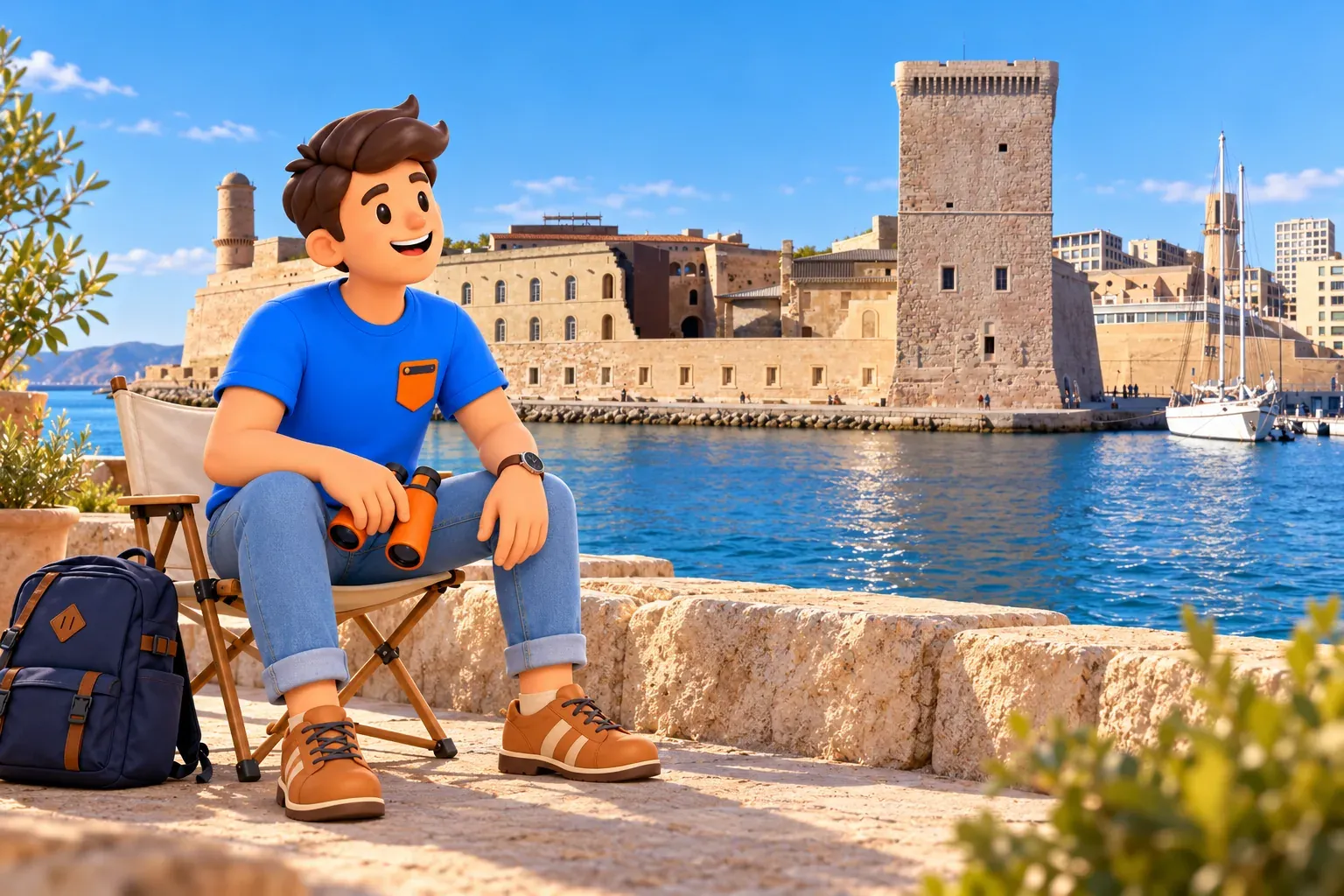
Saint-Nicolas: a citadel shaped by the terrain
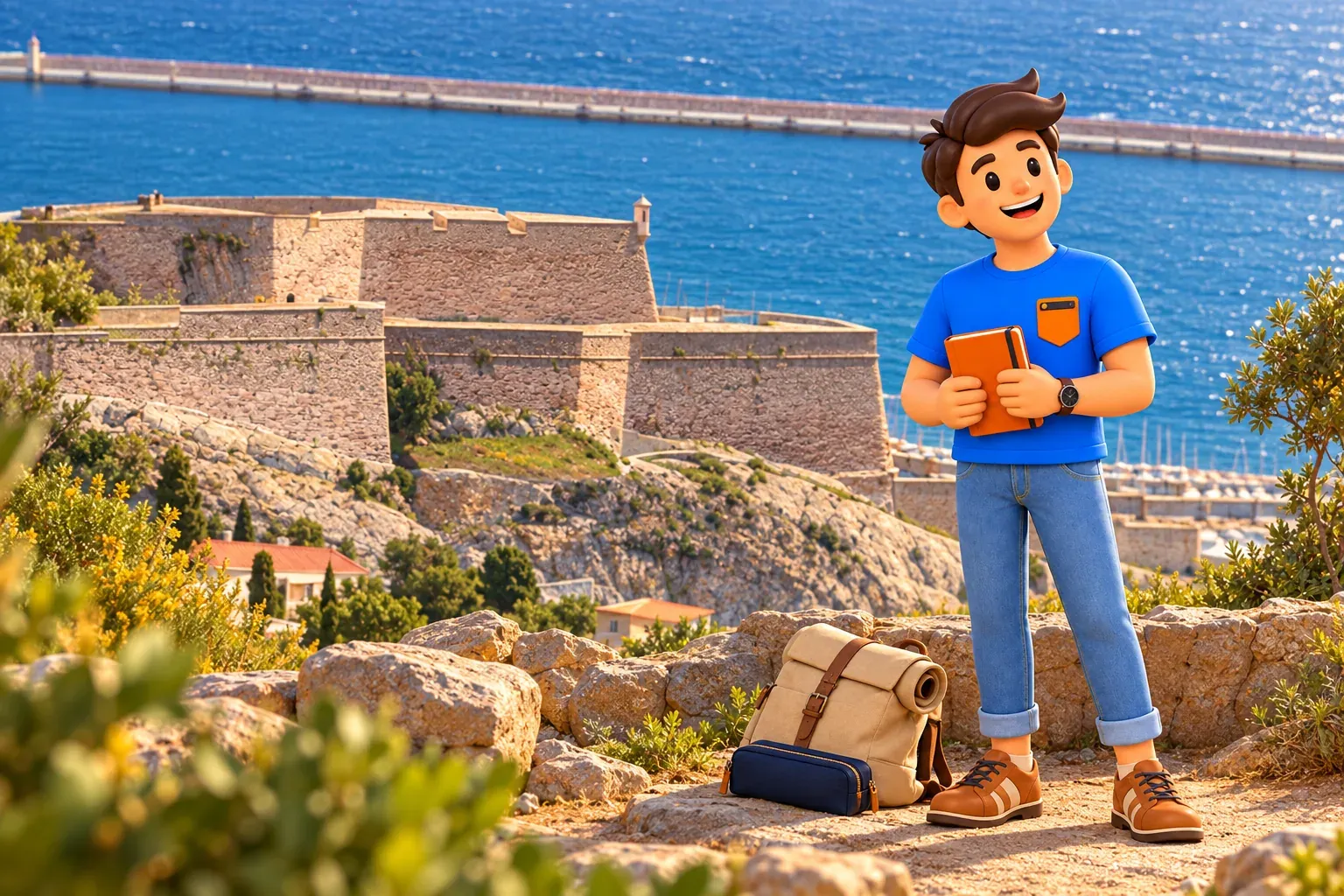
Saint-Nicolas gives the comparison a different visual language. Its construction was entrusted to the military engineer Louis-Nicolas de Clerville, and the citadel was completed in 1664. Angular bastions and successive enclosing walls belong to a design adapted to the rocky ground. Compare this with Saint-Jean’s familiar towers: the interest is not finding a matching tower opposite, but noticing another way to organise a fortified site. The arrangement spreads across a slope and has depth. A photograph of one seaward wall does not show the whole system, and a neat outline on paper would not convey the experience of the terrain.
The historical complex includes an upper and a lower fort. A nineteenth-century boulevard cut between them, changing the relationship of the pieces and connecting the developing city beyond. The present Citadelle de Marseille project concerns the upper Fort d’Entrecasteaux; the lower Fort Ganteaume is not automatically included in that visitor offer. This distinction is useful before choosing any tour. Our illustration uses an elevated photo-inspired view of the lower bastions with a fictional foreground; it does not identify a public viewpoint or an entrance. Look for the layers in the landscape, while leaving detailed access to the actual visit arrangements.
Walls contain lives as well as military plans
It is easy to read a fort through a plan, then forget the people who occupied it. Saint-Nicolas held garrisons and served as a military prison, with uses that changed over time. The citadel’s own account treats its memory as plural: work, confinement, observation, daily life and later restoration all belong to its history. That makes it more than a single symbol of royal control, although that origin remains important. You do not need a catalogue of famous prisoners to understand that an attractive wall could enclose very different experiences for those on either side of it.
Saint-Jean also retained a military role long after its royal construction. Its later cultural use should not make the preceding centuries disappear. When you see a pleasant place today, ask how its use differs from the one it was organised to serve. A ramp, an enclosure or a controlled entrance can be read without inventing a battle at every corner. The shift in function is itself an interesting history. This approach gives a first visit substance while leaving more detailed accounts to the interpretation offered on site, where a particular building or object can be explained in its own context.
Restoration is part of the present story
The stone surfaces visible now have needed continuing care. At Saint-Nicolas, ACTA VISTA connects heritage restoration with vocational training and opportunities for people facing barriers to employment. This work is part of the site’s present, rather than an invisible preparation completed before visitors arrive. A restored fort is the result of people learning skills, maintaining materials and making choices about an inherited structure. That thought adds something to the view: the old walls belong to contemporary working lives too. You can appreciate the relationship without treating a restoration area as somewhere visitors may wander or try tools.
Our illustrated craft scene is fictional, with sample stones and idle tools; it is not an actual visitor workshop or an invitation to work on the monument. For a real activity, choose something offered by the organiser and follow its conditions. The broader point is that heritage does not preserve itself. Military buildings can acquire new meaning through the labour of keeping them standing and through the people involved. That gives the two-fort comparison a present tense, rather than end it at a royal construction date. The city continues to decide how its inherited spaces will be used and shared.

From restricted sites to public places, with real conditions
Saint-Jean became part of the Mucem’s public landscape in 2013, bringing restored outdoor spaces, gardens and cultural uses into the relationship between port and city. This changed how people could encounter a former military site. It does not mean every exhibition or activity is included in ordinary outdoor access. The fort is part of the museum complex, with its own actual opening conditions. Exceptional closure notices take priority over a general description of free access. A historical milestone explains a change of role; it cannot prove that a gate, tower or bridge will be available on the day you arrive.
At Saint-Nicolas, opening gardens in 2024 marked a stage in a continuing cultural project. Current arrangements are narrower than that milestone might suggest: for 2026, the Citadelle states that its gardens and guinguette open only during events. Choose a confirmed guided visit, workshop or actual event if you want to enter, checking what it includes. Do not plan an unrestricted garden break from an old account of regular free opening. Our southern Old Port walk describes a broader outing around this shore. The paired history remains worth understanding even when the suitable visit is one site, a particular event or an exterior view.
RoadMe creates a personal plan for the entire trip, connecting the places and stories that interest you. Organise a richer Marseille stay in the app, with a sensible rhythm for visits and travel, while confirming current admission arrangements with each organiser.
Choose one visit and keep the other shore in view
You can give the story a practical shape without trying to complete both interiors. Select a confirmed visit that suits your interest, then look across towards the other side when conditions and your actual position allow. Keep time for arrival and return instead of adding a second appointment simply because the forts appear close across water. Mucem’s footbridges connect Saint-Jean with the J4 and the Saint-Laurent side; they do not cross the harbour entrance to Saint-Nicolas. A line of sight is not a pedestrian connection. Check the real journey if you intend to change shores, including any current transport disruption.
The illustrations use staged foregrounds and do not provide routes or visitor facilities. Plan from the actual entrance, permitted spaces and conditions, particularly where slopes or steps matter to your group. Then let one remembered contrast carry the outing: square tower and angled bastion, protection and control, old military boundary and new public use. You will have learned something substantial about Marseille without turning two forts into two full inventories. Their value together lies in the relationship across the port. A selected visit and an attentive view can be enough to make that relationship visible for the rest of your stay.


