
Marseille Old Port in two hours: a first walk by the water
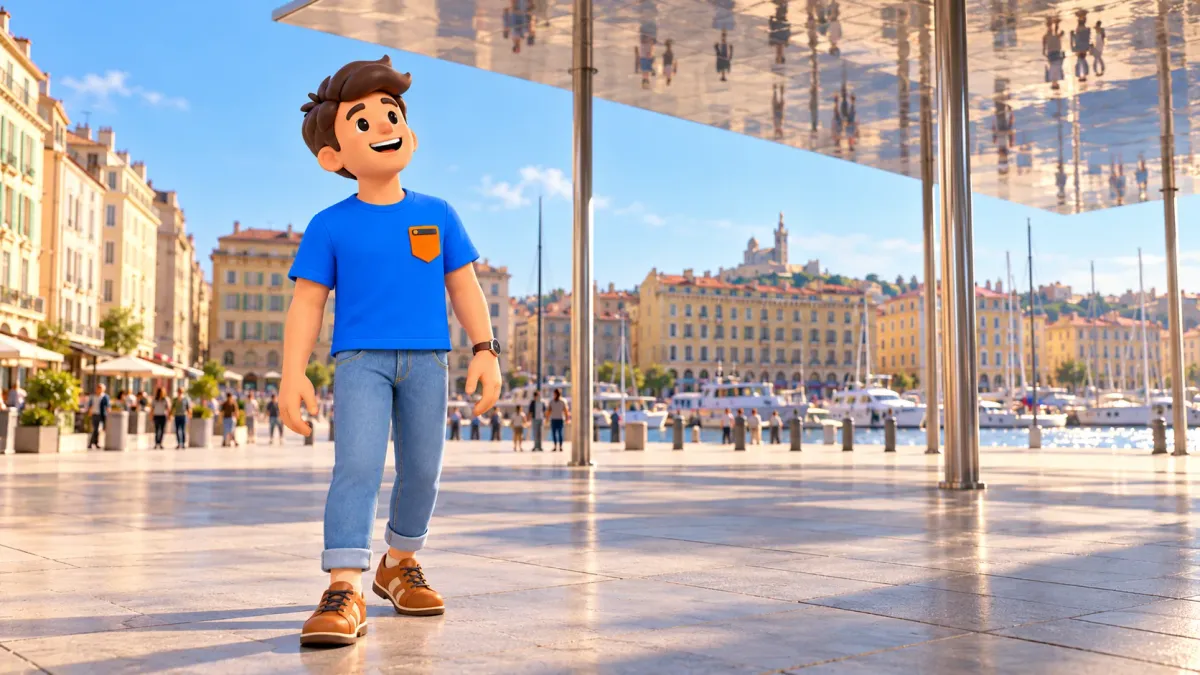
Two hours at Marseille’s Old Port are enough for a satisfying first encounter if you keep the route close to the water. Start at the mirrored Ombrière, pass Saint-Ferréol, follow the northern quay to the town hall and step briefly into the spaces behind it. A drink and an unhurried return complete the loop. You finish where you began, with a clearer sense of the harbour and time to notice its everyday life.
This walk suits an arrival afternoon, a gap before dinner or anyone who wants a modest beginning before exploring farther. It does not include a boat trip, a museum or a climb into Le Panier. The proposed minutes are editorial allowances rather than measured walking times; entrances, street conditions and the pace of your party can change the balance.
A small loop with room to stop
Think of the two hours as four loose blocks: twenty minutes around the starting point and church, twenty-five along the quay, thirty around the town hall and its immediate surroundings, and forty-five for a pause and return. These are budgeting aids, not appointments. If one view holds your attention, shorten the next stop rather than trying to recover every minute by walking faster.
The route stays around the eastern and northern edges of the basin. It turns back before the harbour entrance; circling the whole Old Port would create a different outing. Keep the Ombrière as your meeting point and your finish. Decide before setting off whether the short rise behind the town hall suits everyone, or whether the quay-only version would be more comfortable.
Keep your arrival or onward journey separate from the sightseeing allowance. Two hours between trains do not mean two hours at the waterfront: getting to the port, finding the starting point and returning all need their own margin. With that distinction made, the walk can remain pleasantly simple.
Let RoadMe work out a personal Marseille itinerary around your interests and available time. The app makes it much more convenient to turn a short gap by the harbour into a coherent plan for your visit.
Begin beneath the Ombrière, then look beyond the mirror
At the eastern end of the harbour, the Ombrière gives the walk an unmistakable starting landmark. Its polished underside reflects people and the paving below; the canopy belongs to the waterfront renewal designed by Foster + Partners. Take a moment to look upward, then move to a clear position where you can study the basin without obstructing people passing through the space.
A good first photograph can include the reflected scene, but do not spend the entire stop arranging it. Compare the long lines of the quays, the masts and the opening towards the sea. Looking across to the other shore helps establish the scale of the harbour before the walk reduces it to doors, balconies and individual boats.
If the area is busy, agree on a visible meeting position outside the main pedestrian flow. The shelter is open-sided, so it should not be treated as a guaranteed refuge from driving rain or wind. In sunny conditions, take the shade that is actually available rather than assuming that a roof makes every part of the square comfortable at every hour.
Saint-Ferréol: a short change of atmosphere
Continue towards Saint-Ferréol-les-Augustins at the northeastern corner of the port. The church provides a useful contrast to the open waterfront: pause to take in the facade before deciding whether to enter. It is associated with the Augustinians and has been altered over time. A brief look is enough here; this route is built around the harbour, not a complete inventory of religious artworks.
If the church is open and a visit is appropriate, allow a few quiet minutes inside. Services, prayer and actual access determine what is possible. Published visitor information can change, and a closed door is a reason to keep the exterior stop, not to wait until the whole walk loses its rhythm. Do not count on the church as an essential indoor break from the weather.
For companions with different interests, this is an easy place to make a small agreement. One person might prefer a short interior visit while another studies the facade from a suitable public spot. Set a simple meeting point and a short shared allowance.
Follow the northern quay without racing the boats
From the church, follow the northern waterfront towards the town hall. The broad idea is straightforward: keep the basin beside you and let the quay connect the stops. Use appropriate crossings and the pedestrian space that is open on the day. You do not need a sequence of minor street names to enjoy this section; the harbour itself provides the direction.
Vary your attention between the water and the buildings. A boat seen close up, a facade reflected between masts or a change in the angle of the hill beyond can make a useful stopping point. Remain on the public quay and leave working access clear. The presence of boats does not make pontoons, gangways or private moorings part of a public walking route.
Choose one or two observations instead of photographing everything from every position. With children, a simple search for different hull shapes or colours can make the walk more engaging without requiring a long explanation. Keep the group away from the edge while looking and leave space for other people to pass.
The town hall: read the facade from the quay
The Hôtel de Ville gives the northern shore a clear architectural anchor. Its seventeenth-century baroque building brings a civic presence directly to the harbour. View it first from the public waterfront, where you can connect the facade with the space in front and the buildings around it. The stop makes sense without an interior visit or a collection of architectural terms.
Try two perspectives: one facing the building and one looking back across the basin. That simple change explains why the town hall belongs to this setting rather than appearing as an isolated monument. Give yourself enough room to see the whole facade, taking care around routes used by pedestrians and vehicles.
Treat municipal interiors as a separate matter. This programme assumes exterior viewing only; it does not promise entry to offices, council rooms or special events. If you have specifically booked a public visit, give it its own time and shorten the rest of the walk. Otherwise, this is the point to decide whether to make the little detour behind the waterfront or remain by the water.

Behind the town hall: Bargemon and a glimpse of Daviel
The space around Villeneuve-Bargemon offers a change from the continuous line of the quay. Step into it if the approach suits your party, then notice how the civic buildings relate to one another. This is a brief detour immediately behind the town hall, not the start of a full exploration of the upper old quarter. Keep the return to the waterfront in mind.
Nearby, the eighteenth-century Pavillon Daviel once served as a courthouse. That single change of function adds a little depth to the walk: the harbour area contains the history of city government and justice as well as maritime activity. Look at the building from public space. No interior access is assumed, and there is no need to add every neighbouring historic facade to the itinerary.
Changes of level matter more here than they do beside the basin. If steps, slopes or the available approach are inconvenient, leave this section out and spend the same minutes near the town hall on the quay. This is a complete alternative, not a failed version of the walk. For a short outing, keeping everyone comfortable has more value than reaching one additional architectural detail.
Make the pause part of the walk
Plan a pause of around twenty minutes near the area you have already reached, choosing a place and a seat that suit your budget and the conditions. It can be a drink at a cafe or simply a rest in an appropriate public space. If you order, check the menu and whether the available service fits the time you have.
Use the pause to choose the character of the return. Perhaps you want more photographs, perhaps a quieter pace, or perhaps everyone is ready to finish. A substantial meal belongs to a longer programme: ordering, waiting and eating can easily take more time than the modest break proposed here. If lunch becomes the priority, keep it and reduce the architectural detour or the remaining waterfront stops.
This is also the best moment to separate optional enthusiasm from the original two-hour commitment. A companion may now want to explore Le Panier or visit the museum farther along the coast. Those are good ideas for later, but decide openly whether the group has more time. Do not silently turn a small circular walk into a much longer afternoon with an uncertain finish.
If your first harbour walk inspires a longer stay, RoadMe can develop a personal trip plan around what interests you most. Try the app to organise the next part of Marseille more conveniently, with a programme that fits your pace.
Return to the Ombrière with a new angle on the port
Return along the northern quay towards the eastern end of the basin. Repeating this short section is useful: the opposite direction changes the views, and there is less pressure to identify landmarks now. Save a little of the remaining time for a photograph or a final look across the water.
Finish at the Ombrière rather than leaving the endpoint vague. If your next destination lies elsewhere, count that onward journey separately. In bright conditions, take a brief rest before travelling on, especially if the walk follows an early arrival or a long journey.
When you have a full day available, our one-day Marseille walk extends the introduction into Le Panier and the northern cultural waterfront. That longer itinerary gives those areas proper attention. For today, the smaller loop has already connected a contemporary public space, a church, civic architecture and the harbour, without asking you to cross the city between them.

If time, weather or energy change
With only one hour, keep the Ombrière, the view of Saint-Ferréol and the quay towards the town hall, then turn back. Drop the Bargemon and Daviel detour and the seated cafe break first. Avoid trying to halve every stop while keeping every place: a smaller route with a few real pauses feels more like a visit than a rapid survey of facades.
In strong wind, heavy rain or uncomfortable heat, shorten the exposed section and reassess whether this is the right moment for a waterfront walk. An open public setting is not an all-weather attraction. If mobility requirements are important, check the actual surface, crossings and approach in advance and prefer the lower quay version when suitable; a generally flat setting is not a verified accessible itinerary.
For a late-afternoon visit, make the scenery rather than an exact sunset the objective. Light varies with season and conditions, and church access may be different from an earlier visit. You can also spend the whole allowance on the quay and a longer pause. The useful measure of these two hours is whether you leave refreshed and better oriented, ready to choose what Marseille should mean for the rest of your trip.


