Château d’If and Monte Cristo: where the novel meets real history

Château d’If is a real fortress, and its prison history is real. Edmond Dantès and the Abbé Faria belong to The Count of Monte Cristo. Holding those two facts together makes the island more interesting: you can enjoy the power of a story without looking for documentary proof of a fictional prisoner’s escape.
This is a guide to reading the place, rather than a substitute for planning the crossing. It distinguishes three layers: the fortress and its prisoners, the novel by Alexandre Dumas, and the later visitor experience shaped by the novel. You do not need to finish a long book before seeing the island, but a little context can change what you notice there.
Keep three stories in view
A famous literary place can arrive in your imagination before you have seen its stones. Perhaps a film, a childhood edition or simply the name Monte Cristo has already supplied a dark cell, a dramatic escape and an isolated island. That is a valid reason for curiosity. The useful next step is to ask which part belongs to the building’s history, which to a novel and which to the way a monument tells a story to visitors. You do not have to choose only one layer. The distinction lets each contribute without turning an evocative display into historical evidence.
Our half-day Château d’If guide considers the practical shape of an island outing. Here, leave the detailed crossing decisions to that separate question and give some attention to the encounter itself. You may enjoy a real fort more when you stop requiring every doorway to match a screen memory. A literary association adds a personal reason to visit, while the surviving building offers a history beyond the character who made it famous. The aim is to arrive with curiosity and clear expectations, not to test whether an old prison can reproduce every moment of a story you already know.
Let RoadMe build your complete personal Marseille trip around your interests, available days and preferred pace. The app makes it much more convenient and effective to fit literary discoveries, island experiences, neighbourhood walks and culture into a stay designed for you.
The fortress existed long before the novel
The château belongs to the sixteenth-century defence of Marseille under Francis I. The monument’s history records completion in 1531, centuries before Dumas’s novel. Its first purpose was a royal fortress, not a building designed for Edmond Dantès. Keep that order in mind as the compact island and substantial walls come into view. Sea, rock and fortification form a real physical setting. Their presence helps explain why a writer could find the place so suggestive, but their historical purpose does not depend on the plot that later transformed its fame.
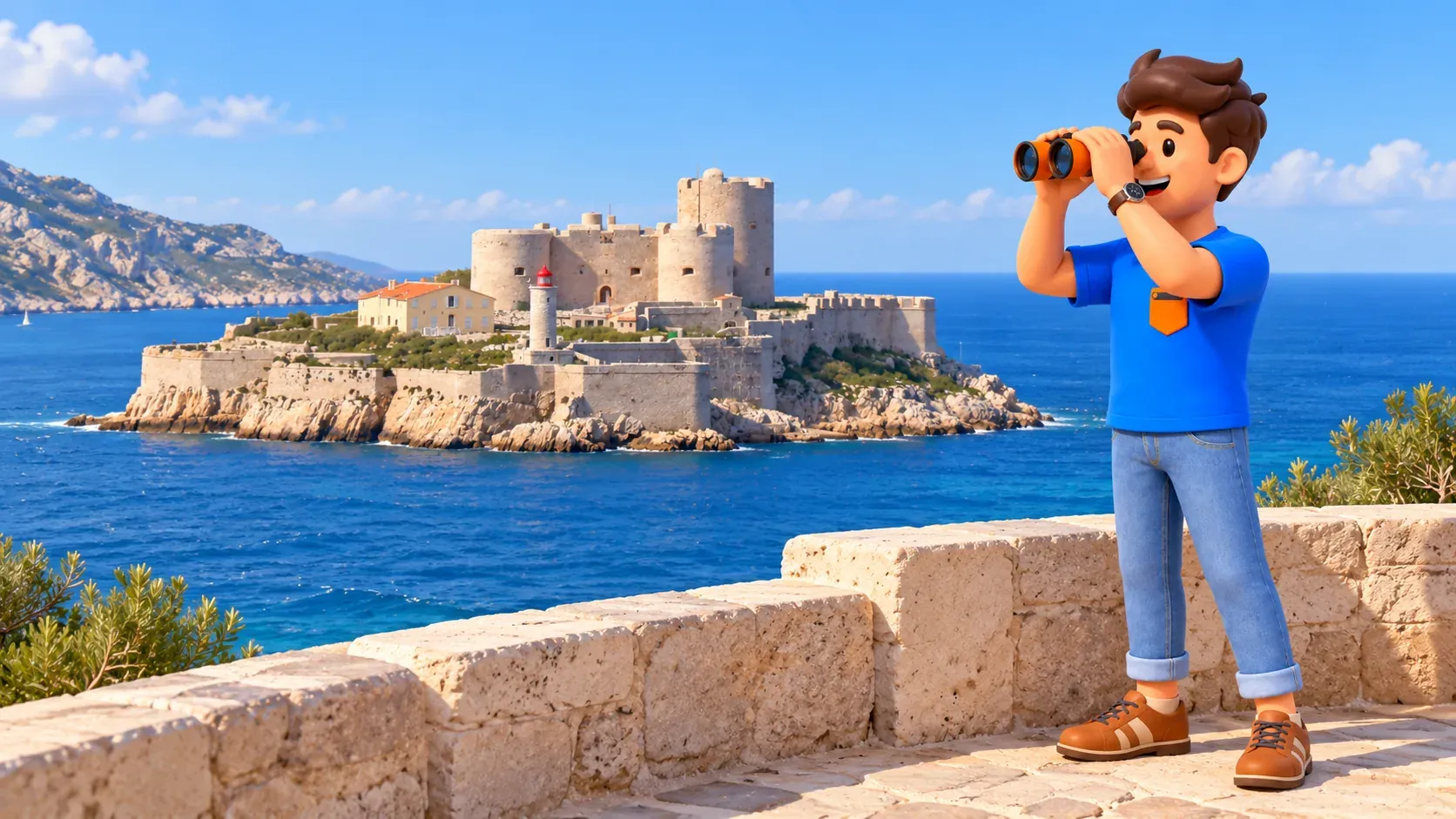
Look first at the relationship between the strong central building, its round towers and the lower outer defences. You need not classify every military detail to recognise that this is more than a lonely room on a rock. Our illustrations take the exterior architecture from photographs, with staged or fictional foregrounds. They do not reconstruct the original sixteenth-century arrangement, present an exact landing route or establish a real mainland viewpoint. Let the actual monument’s explanation distinguish construction periods. The rewarding first impression is one of scale and setting: a small island can contain several different spaces and functions, even when a famous novel makes one imagined cell dominate your attention.
Real imprisonment did not have one uniform experience
The fortress later served as a prison, across different periods and circumstances. The monument’s account distinguishes collective spaces from rooms where wealthier prisoners could pay for less harsh conditions, known as pistoles. That variation matters. It prevents a single dark literary image from becoming an explanation of every prisoner’s life. It also reminds you that differences between rooms can relate to real arrangements, not only to dramatic atmosphere. The history of confinement includes institutions, money and changing uses, alongside the human experience that made the island a powerful setting for fiction.
The monument also draws attention to graffiti left by prisoners associated with the events of 1848. Such traces offer a different kind of encounter from a space named after Dantès. Where interpretation identifies historical marks, read them within that explanation rather than supply a famous character’s name yourself. Do not touch, add writing or treat any old scratch as proof of an escape. One identified trace is more useful than a made-up complete biography. You can acknowledge real people and real confinement without turning a holiday visit into a catalogue of suffering or assigning every room the same conditions for all the years the place was used.
Dumas gave the real place a fictional prisoner
The Count of Monte Cristo appeared in serial form between 1844 and January 1846. The work is associated with Alexandre Dumas and his collaboration with Auguste Maquet. Its imagined story gives Marseille and If a lasting literary connection: a young man is unjustly imprisoned, and the island becomes part of his transformation. This is enough context for a first visit without retelling the whole plot. The novel’s force does not require Dantès to have been a real inmate, nor make every circumstance of his confinement a faithful record of how the prison operated.
Treat the real setting as something the writer could use, rather than a guarantee that each scene happened. Fiction selects, compresses and gives places emotional meaning. A fortress can be both a historical site and a convincing imagined obstacle to freedom. Keeping that distinction does not spoil a reading experience; it allows you to notice what the story asks the setting to do. If you remember a film more clearly than the book, leave room for the actual building to look different. This article does not identify the island as the exact shooting location of any particular adaptation or promise that its visitor spaces reproduce a film set.
Named cells and a tunnel belong to the story’s afterlife
Rooms associated with Dantès and Faria can make the novel feel startlingly concrete. That feeling is part of the monument’s literary reception, not evidence that the characters were historical prisoners. The Centre des monuments nationaux explains that, as readers came to the island, guards created the famous connecting tunnel between the named cells to feed visitors’ imaginations. The distinction is the central point: this is not a surviving passage dug by the fictional men in a documented real escape. A visitor feature and an imagined action can be related without being the same thing.
Use the distinction to make the visit richer. You are seeing not only how a prison becomes a novel’s setting, but also how a successful novel changes the way a real place is presented. That is a genuine cultural history of its own. A named room can be meaningful without becoming an authentic bedroom of someone who never existed. Read the information actually offered and keep the role of interpretation visible. You do not need to argue with the atmosphere or refuse the imaginative pleasure. Simply avoid carrying home the story as a claim that a real Dantès once passed through an authenticated escape tunnel before your arrival.
Read one detail carefully instead of completing the whole legend
During a confirmed visit, try separating observation from association. You see stone, a doorway or a particular view; you remember an episode from a book. Both responses can matter, but they answer different questions. Ask what the monument says about the actual space before attaching the remembered scene. If a detail remains unexplained, it can remain a question. A partial understanding is more useful than inventing a hidden function for every opening. The place does not become less interesting when some of its history stays outside the short time you have available on the island.
Our illustrated reading room and storytelling desk use modern props: a book, a lock, a key and a blank sealed letter. They are fictional scenes, not a Dumas manuscript, original prison objects or an exhibition available inside the château. The images express the relationship between reading and a real place without supplying evidence for the novel. Approach actual objects differently: let their identified context tell you why they matter. That leaves the illustrated traveller free to invite curiosity while the monument carries its own history. One thoughtful contrast between a documented feature and a literary association can be enough to make the outing memorable.

You can come as a reader, or simply as a curious visitor
If you know the novel, choose one question to bring rather than a checklist of scenes. How does an island setting affect your sense of distance? What is different when you move from reading a prison to entering a real fort? If you have not read it, a short introduction is enough to recognise why Dantès matters to the visitor story. There is no admission test in literary knowledge. You can enjoy the architecture and learn about the real place without spending the whole stay trying to catch up with a very long book.
One geographical distinction helps keep expectations clear: If is not the island of Monte Cristo where the novel’s treasure belongs. The names are connected through the story, not interchangeable destinations in Marseille’s bay. Nor does an imagined escape turn the visit into permission to explore closed openings, climb walls or enter the water; swimming is prohibited on the site. For another historical comparison, our story of Marseille’s two harbour forts looks at much later royal fortification in the city. Comparing real purposes across places can give the literary visit a wider frame without making every monument part of the same fictional adventure.
Give the real island the conditions it needs
A literary interest does not remove ordinary island constraints. The château may close in bad weather, and a monument ticket does not itself include the sea crossing. Check the scope of your actual boat product: a cruise that passes the island is different from a trip with a landing, and any bundle needs its own stated inclusions. Confirm the return as well as the outward journey. The site has uneven ground and numerous steps, with significant mobility limitations. Check relevant arrangements directly rather than treating arrival at a landing stage as proof that every part of the fort will suit you.
Choose a real available visit, not a promise to fulfil every literary expectation in one afternoon. Our two-hour Old Port walk offers a separate city encounter if the crossing does not fit your stay. The imagined story can remain part of your Marseille experience even when the island visit stays unconfirmed. If you do go, leave with the three layers clear: the real fortress and prison, the novel, and the visitor presentation shaped by readers. The island gains depth when those layers remain distinct. You can take pleasure in the legend and still give the people, stones and history of the actual place their own attention.
RoadMe turns the places and stories you care about into a personal plan for the whole trip. Organise a richer Marseille stay with less planning effort in the app, and confirm the chosen crossing, landing and monument access with the operators.