
Madrid’s bear, strawberry tree and Kilometre Zero: reading Sol’s symbols
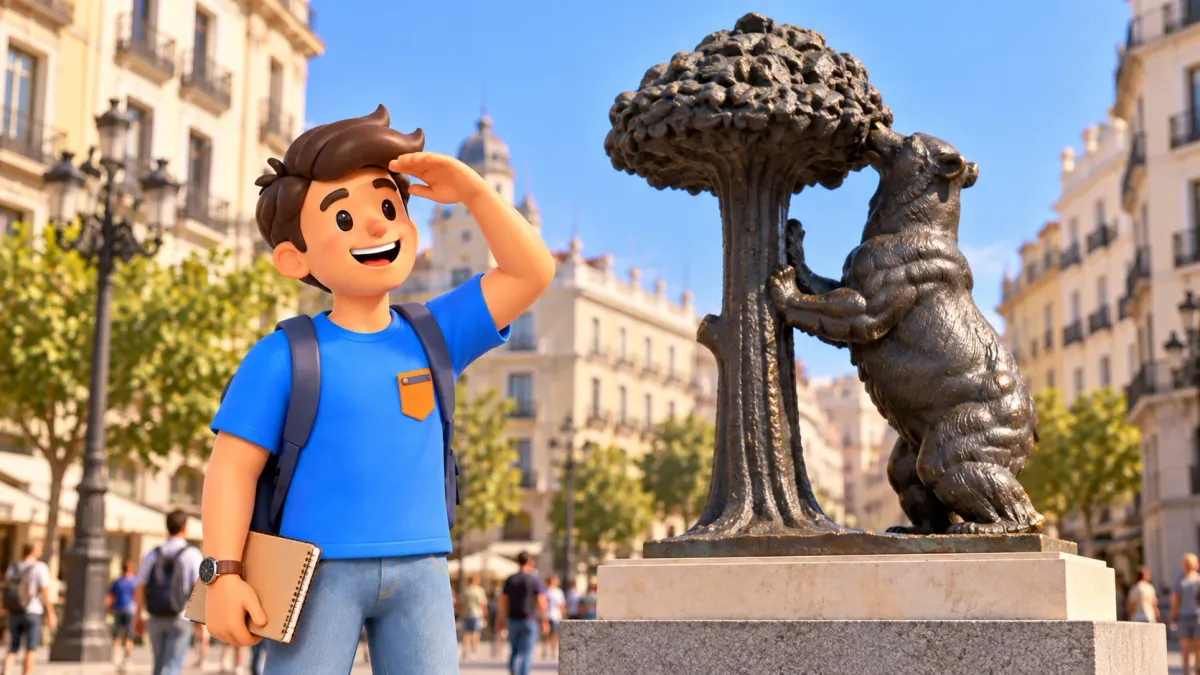
Madrid’s bear and strawberry tree, Kilometre Zero and the clock above the Real Casa de Correos tell three different stories in one square. The bear represents the city through heraldry, the pavement marker refers to Spain’s radial roads, and the clock connects ordinary public time with a shared New Year ritual. You can understand their relationship without crossing central Madrid. Give Puerta del Sol a little attention, look both down and up, and distinguish an old symbol from the age of the object that represents it.
A small walk with a clear subject
This outing suits a free morning or a gap between larger visits. Begin near the bear on the northeastern side of Sol, towards the start of Calle de Alcalá. Continue to the pavement marker in front of the former post office, then look at the building and its clock. The connections are short; most of the time belongs to looking and discussing. A compact geography does not guarantee a convenient stopping place, however. People gather around the popular objects, and the square remains a space that others need to cross.
Organising these discoveries into a trip is more convenient in RoadMe, which develops a personal itinerary around your interests, dates, pace and budget. Try planning the whole journey there so that short historical walks, substantial visits and rest fit together across your days.
Use three questions: what is represented, when was this particular object made, and what does it do today? You need not memorise a long chronology. A coat of arms identifies a city; a road marker establishes a reference point; a clock offers a shared measure of time. Thinking about function makes the details easier to retain. It also helps elsewhere in Madrid, where a modern sculpture may carry a much older image and a useful everyday object may gradually become a monument.
The bear: an older emblem, a modern sculpture
Antonio Navarro Santafé created the bear and strawberry tree sculpture installed in Sol in 1967. The monument is therefore a twentieth-century interpretation of a considerably older city emblem. That distinction matters more than remembering every date in the square. Look at the raised front paws, the animal’s heavy body and the compact canopy. Together they form a clear composition. Step back enough to see the pair as a whole, keeping a route open for passers-by. The relationship between the two figures explains the sculpture more effectively than a hurried close-up alone.
The municipal heritage account connects the pairing with a medieval dispute between the town and the ecclesiastical chapter over pasture and wooded land. In that account, pasture went to the chapter, while trees and hunting belonged to the town; the bear standing against the tree expressed the town’s side of the settlement. Read this as an explanation of heraldic imagery. It is not a literal record of one encounter in a forest, nor a wildlife survey proving how many bears once lived where the square now stands.
Popular explanations concerning the animal’s sex, constellations and the origin of Madrid’s name should not all be treated as one established story. The useful core is simpler: the animal and tree belong to municipal heraldry, and the sculpture gives that pairing a physical presence. Seven stars appear in Madrid’s symbolism, but you do not need to find them on the bronze bear’s back. A formal coat of arms, a simplified municipal graphic and a freestanding sculpture serve different purposes. Their related imagery does not make every element identical.
A strawberry tree is a real plant
The Spanish word madroño refers here to Arbutus unedo, the strawberry tree. Its English name can suggest ordinary garden strawberries growing on branches, which is the wrong picture. This is a different evergreen plant with its own rounded fruits. Regional environmental material describes its glossy green foliage and the decorative qualities of flowers and fruit. The sculpted canopy simplifies those details into a recognisable mass. Treat the bronze as an interpretation rather than a botanical identification guide: its main task is to make the relationship between animal and tree clear.
Try removing one figure from the composition in your imagination. An isolated bear or tree would remain recognisable, but the combination makes a more specific sign of place. Notice how the paws, trunk and raised muzzle join the image into a single action. With children, ask for a description of the pose before giving its name. Looking does not require touching the bronze or climbing onto the base. A few attentive minutes can make the symbol memorable without adding an invented good-luck ritual to your visit.
Why older photographs show a different setting
The sculpture has moved several times within Sol. It stood near Calle del Carmen during one phase, later returned towards its earlier position, and moved again during the square’s recent remodelling. The city’s March 2023 announcement places it at the eastern end of the bench alignment along the square’s northern arc, close to Alcalá. This explains why an older photograph or caption may show a different neighbour. Use the current position to orient yourself, and read earlier views as records of the square’s changing arrangement.
The emblem remains recognisable through those changes. Compare a close view of paws and trunk with a wider view including façades and pedestrians. One reveals the sculptor’s forms; the other explains the monument’s everyday role as a meeting place. If the base is crowded, give it space and look again later. No single photograph is essential to understanding the visit. A slightly different angle may say more about the object’s place in Madrid than waiting for a completely empty background that never arrives.
Kilometre Zero: a road reference, not a geographic centre
Cross towards the Real Casa de Correos and look at the pavement in front of it. Kilometre Zero refers to Spain’s radial road network, historically directed outwards from Madrid. Its meaning concerns a starting reference and the capital’s place in communications. It does not establish the mathematical centre of the country or mean that every Spanish road begins beneath your shoes. “Centre” can describe a function or a symbolic importance without identifying one geographical calculation. Keeping that distinction makes a small and heavily photographed marker considerably more interesting.
The first official plaque was installed in 1950. As with the bear, the idea is older than the object through which visitors encounter it. In March 2023 the plaque returned to its previous location after work on the square. A large compass rose now surrounds it, with provincial capitals and the autonomous cities named around its extremities. Look beyond the central marker to notice that surrounding composition. It suggests directions and connections, though it should not replace a usable map or navigation instructions for an actual journey elsewhere.
A pavement object changes how people move. You can view a tall sculpture from some distance; a low marker is easily hidden by a person or bag. Take a brief look, then leave room for someone else. A photograph of your shoes is optional. The more useful connection is between the object and your own journey: arrival in Madrid, routes extending beyond the city, and the choice of where to travel next. Even when you cannot read every detail comfortably, the idea of an agreed starting reference remains understandable.
Look up: a post office and a later clock
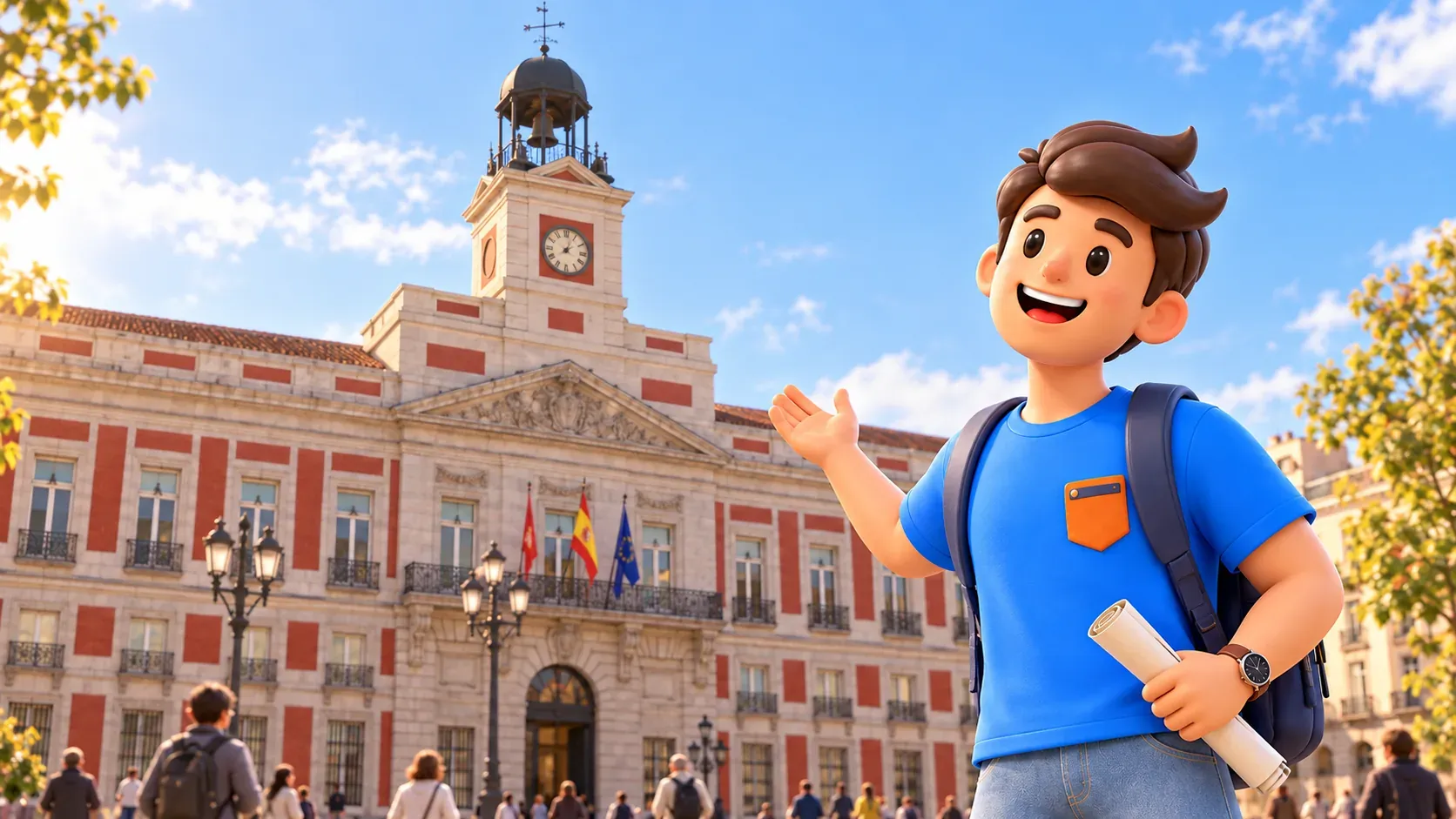
The Real Casa de Correos stands behind the marker. Completed in 1768, with Jaime Marquet playing a major role in the project, the building originally functioned as the central post office. Today it houses the presidency of the regional government of the Community of Madrid. This is distinct from Madrid’s city government and the Palacio de Cibeles. Our walk uses the exterior only. A public-facing façade does not grant general access to working rooms, and any special event or separately arranged visit has its own conditions.
The clock belongs to a later chapter. In 1866 the clockmaker José Rodríguez Losada offered Madrid a new clock after problems with its predecessor. First read the horizontal rhythm of the building, then isolate the vertical clock tower. They now form one familiar image, though they did not originate at the same moment. You do not need to wait for a particular chime. A clock placed above a busy shared space already explains the value of public time to people following quite different daily routes.
That role gains another meaning on New Year’s Eve. The twelve strokes are associated with eating twelve grapes to welcome the year, connecting this particular building with a widely recognised ritual. An ordinary daytime visit and a major holiday gathering are different situations. Daytime access to the square does not promise unrestricted access to every point on 31 December. You can understand the symbolism without joining the crowd: imagine how the same façade becomes a focus for a common moment, while retaining its much longer history beyond the celebration.
A relaxed ninety-minute order
Start when you are already in the northeastern part of Sol and finish at a convenient edge of the square for your onward direction. These are editorial estimates, not timings measured on the ground. Travel from accommodation, station exits, food and waiting for a preferred photograph need separate allowances. Viewing these outdoor objects requires no attraction ticket, but transport and purchases remain expenses. Temporary barriers, events or dense pedestrian movement may change what is comfortable. Follow current instructions and shorten a stop when necessary rather than forcing the schedule.
- 15 minutes: orient yourself on Sol and find the bear towards Alcalá.
- 20 minutes: examine the animal and tree from available, permitted positions.
- 15 minutes: move to Kilometre Zero and notice the surrounding compass rose.
- 20 minutes: look at the former post office and clock, comparing their dates and functions.
- 10 minutes: pause somewhere comfortable without obstructing a route.
- 10 minutes: reach your chosen edge of the square and decide how to continue.
Continue with one coherent plan
For a longer line through the old centre, use our two-hour walk from Sol to Almudena. It has a separate timing framework; adding it after this visit extends the day. Our one-day Madrid itinerary offers a broader first introduction. Choose the scale you actually want instead of combining every suggestion automatically. The purpose of this smaller outing is to give familiar objects meaning, leaving you free to explore elsewhere with a clearer understanding of what you have already seen.
For an easier way to connect these stops with the rest of your days, try personal trip planning in RoadMe. The app builds the itinerary around your interests and pace, helping historical discoveries, walks and rest work together across the journey.
Afterwards, Sol has a simple structure in your memory: the bear expresses city identity, the marker suggests directions, and the clock offers shared time. Those meanings do not demand an extended museum visit, but they change a casual crossing of the square. On a later return, finding just one of the three can bring the others back to mind.


