
How different communities helped shape Bangkok

Bangkok becomes more interesting when its streets are read as places people have made together. A church by the river, a Chinese Buddhist temple and a Hindu gateway on Silom are not isolated exceptions to the city. They offer different beginnings for understanding how communities have helped shape its spaces. Start with one neighbourhood and one visible relationship between a place, its purpose and the lives around it.
This introduction uses Kudi Chin, Chinatown and Silom as three perspectives. It does not claim that they tell the whole history of Bangkok or that one community can be reduced to one religion. Nor are the three areas a single compact walk. Kudi Chin lies on the western bank in Thonburi; Chinatown and Silom are different parts of the eastern city. Choose a neighbourhood for today's outing and let the others remain possibilities.
Look for contributions rather than fixed labels
A community can leave its mark through a place of worship, a shared institution, a recipe or the continued use of a street. The useful question is not “Which group owns this piece of Bangkok?” but “What has this place made possible for people?” That leaves room for overlapping identities and changing lives. A building may make a particular tradition visible without defining everyone who lives nearby or everyone who uses its surroundings.
With RoadMe, it is much easier to turn these interests into a personal Bangkok trip. The app develops the whole itinerary around your time, interests and comfortable pace, bringing a chosen neighbourhood together with other discoveries, meals and proper rest.
Begin with something concrete. Notice a doorway and the way people approach it, a roofline above ordinary houses or a shopfront that belongs to a working street. Then add a small piece of context. You do not need a complete family history to understand that a neighbourhood holds more than one story. Nor should you guess a person's ancestry or beliefs from appearance. The buildings are a starting point for curiosity, not a licence to classify their neighbours.
Kudi Chin: a church within a varied neighbourhood
Santa Cruz Church is a landmark of the Catholic community in Kudi Chin, where Portuguese-Thai heritage forms part of a wider religious and cultural setting. The area also includes Buddhist and Chinese religious sites and Muslim community history. This makes a useful correction to the idea of a single, sealed “Portuguese quarter”. Look at the church as a meaningful centre within a neighbourhood that contains other traditions, rather than as a label for every person and building around it.

The church's exterior offers a clear visual anchor, while the surrounding lanes bring the scale back to daily life. A neighbourhood is not made only from its largest landmark. Approaches, thresholds and the relationship between buildings also help you understand the place. Observe from public space and let homes remain homes. A beautiful doorway does not imply an invitation to enter, and an open window does not turn an ordinary room into part of a visitor exhibition.
Close neighbours do not become identical
Different places of worship in one area make diversity visible, but they do not prove that every resident shares the same experience or that every historical relationship was simple. Avoid treating the walk as evidence for a perfect story about all periods of city life. A more modest observation is stronger: traditions have left recognisable places that continue to matter. You can appreciate that contribution while allowing the neighbourhood its complexity and the people their individual lives.
For a focused outing, choose one landmark and some nearby public streets. Our separate two-hour idea for Kudi Chin offers a more specific way to approach the area. It need not be attached to every other river visit. If you are coming from the eastern side, include the actual crossing and approach in the day. The riverbank setting makes the story attractive; it does not remove the practical distance between your hotel and a chosen lane.
Chinatown: a temple can express collective effort
Wat Mangkon Kamalawat offers another starting point. The tourism authority describes its foundation in 1871 with support from donations by the local Chinese community. That small fact shifts attention from an isolated building to a collective undertaking. A place of worship can embody resources and effort gathered for a shared purpose. You do not need to know every donor's story to recognise why the institution contributes something different from a decorative landmark.

It is a Chinese Buddhist temple, and the exterior's architectural language helps distinguish it from the other examples in this article. Look at the arrangement of entrance, roof and surrounding urban space without turning every colour or motif into an instant generalisation about Chinese culture. The building represents a particular religious setting. It does not explain the beliefs of every person in Chinatown, and it should not make the neighbourhood's ordinary work disappear behind a single picturesque identity.
Give Chinatown more than one possible mood
A visitor may know Chinatown mainly through an image of evening food and bright streets. A daytime visit centred on a religious institution asks a different question. Neither experience has to invalidate the other. Decide what you want from this outing: a selected place of worship, street observation or a meal. When one activity leads, the rest can fit around it more comfortably. An ambitious attempt to complete every version of the neighbourhood can leave less attention for each.
The tourism authority states that photography inside Wat Mangkon is prohibited. Keep the camera away in the interior and follow the actual visitor arrangements. The memory of a place does not depend on a complete image record. If you want a broader neighbourhood plan, our daytime and evening Chinatown article treats those choices separately. Use it to choose the kind of outing, rather than assume a temple visit and a full food evening are interchangeable additions.
Silom: a Hindu landmark in an ordinary working city
Sri Maha Mariamman Temple on Silom was founded by people from Tamil Nadu in the late nineteenth century. Its South Indian architectural character and dedication to Mariamman make another contribution visible within Bangkok. This is a place of worship with its own religious purpose, not a decorative contrast installed for visitors to a business district. That short context makes the relationship between a distinctive gateway and the surrounding city more meaningful.
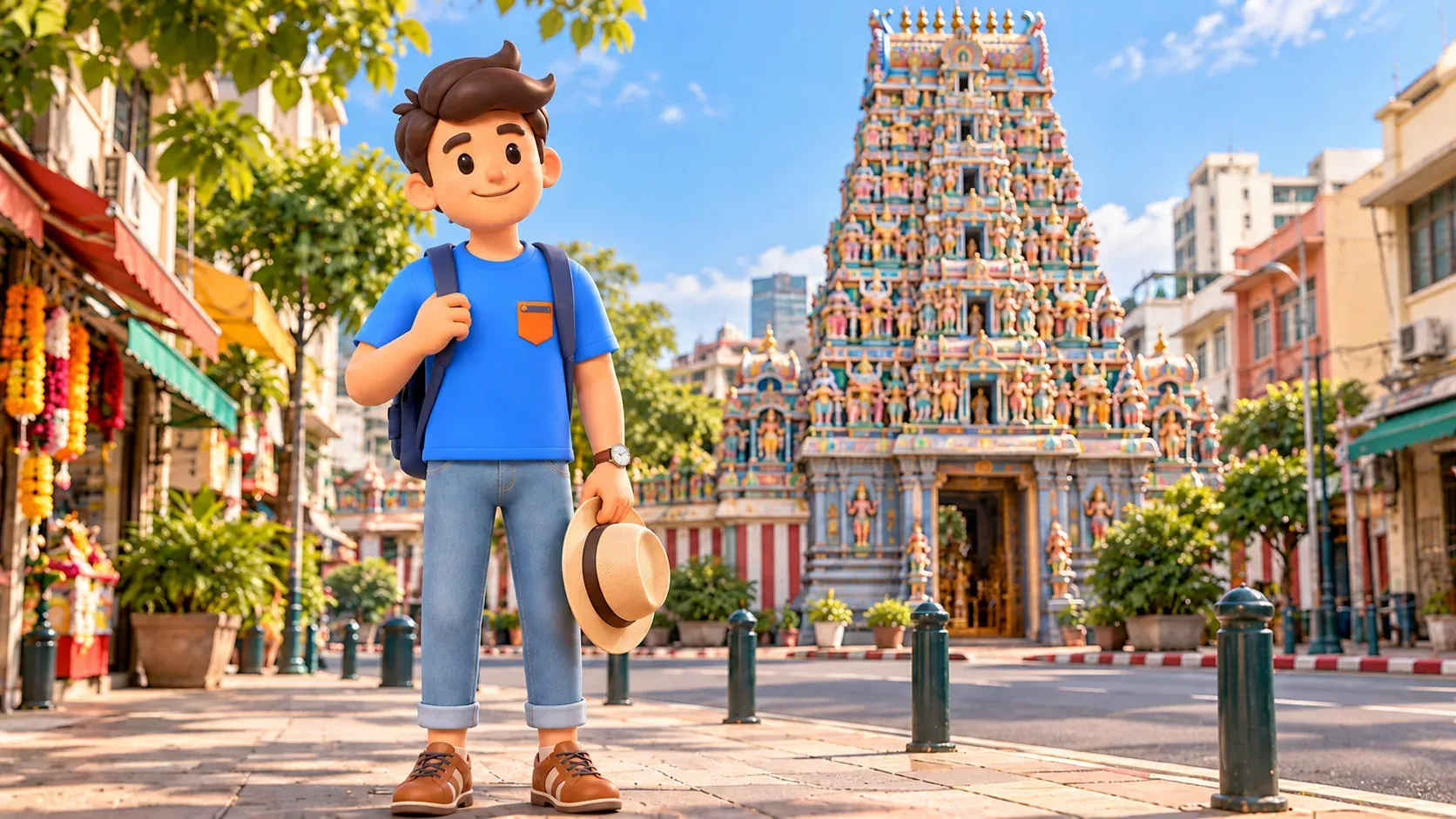
From an appropriate public position, look at the entrance tower's density of forms and the scale of the street beside it. The contrast is interesting without an invented story about a hidden world detached from modern Bangkok. Religious practice and ordinary urban activity can occupy the same present. A building with an older history is not automatically a relic of a vanished community. It can remain meaningful while the surrounding streets continue to change.
Curiosity works best with attention to the place
Photography inside Sri Maha Mariamman is prohibited according to the tourism authority. If you visit, let the arrangements determine your movement and leave room for worshippers. No visitor needs to imitate a ritual or pick up an offering to feel that the experience has been authentic. Observing quietly can be a complete activity. A religious interior has its own purpose, and being interested in it does not make every part available for a photograph or an explanation.
For another outing, our Silom walk with a library, older houses and the Hindu temple offers a different selection. Treat it as its own plan rather than a short extension to a full Chinatown day. The two areas are on the same side of the river but not one continuous small precinct. Choose the journey and allow the transition its real time, especially when you want enough energy to notice the place you arrive at.
A small cake can hold a story of exchange
Back in Kudi Chin, khanom farang kudi chin gives a different way into the subject. The tourism authority describes the cake through Portuguese and Chinese influences. A food tradition can carry a relationship without remaining an unchanged copy of something from elsewhere. That is a useful thought for a city shaped by encounters: contributions can become local through making, adaptation and continued enjoyment, rather than stay neatly attached to a single origin forever.

If you choose to try a cake, make the stop a real break and use the business's current availability. This article is not a guarantee that one named shop or batch will be ready when you arrive. Nor does one taste give you the whole history of a community. It can be a small, memorable part of a visit, especially when it sits beside a considered look at the streets rather than an exhausting search for every recommended bite.
Choose one area for a small outing
A workable starting allowance within one neighbourhood is fifteen minutes to orientate, forty-five for one selected visit, thirty for nearby public streets, twenty of seated rest and ten to finish. Together that is about two hours locally. Hotel journeys, river crossings and journeys between the three areas are extra. This is an indicative plan, not a promise of completing every landmark or of finding the same conditions on every day.
Let your interest decide the area. Kudi Chin can begin with the relationship between a riverside church and surrounding lanes; Chinatown with a community-supported religious institution; Silom with a Hindu landmark in a busy urban setting. These are three examples, not a hierarchy of communities or a checklist needed to understand Bangkok. You can spread them across a trip and still keep the larger question of how people make a city together.
Bring the neighbourhood into the whole trip
The strongest comparison may emerge later, when you notice how differently the three places connect an institution with its surroundings. Keep one observation in your notes, along with a question that remains open. There is no need to close the subject with a claim about everyone in the city. A good visit can make you more precise about what you saw and more curious about what you have not yet understood.
RoadMe makes it more convenient and effective to turn these discoveries into a personal plan for the entire trip. Let the app work out the overall route and pace, so community stories, other interests, food and enough rest fit the Bangkok you want to experience.
Bangkok's communities have contributed places that can be seen, used and remembered. Looking at a church, a temple or a small food tradition does not complete their history. It gives you a beginning: a way to see the city as inhabited and made by people, with distinct stories that continue beyond the part a visitor happens to encounter.


