
Business Bay on Foot: The Opus, O-14 and a Pause by the Canal
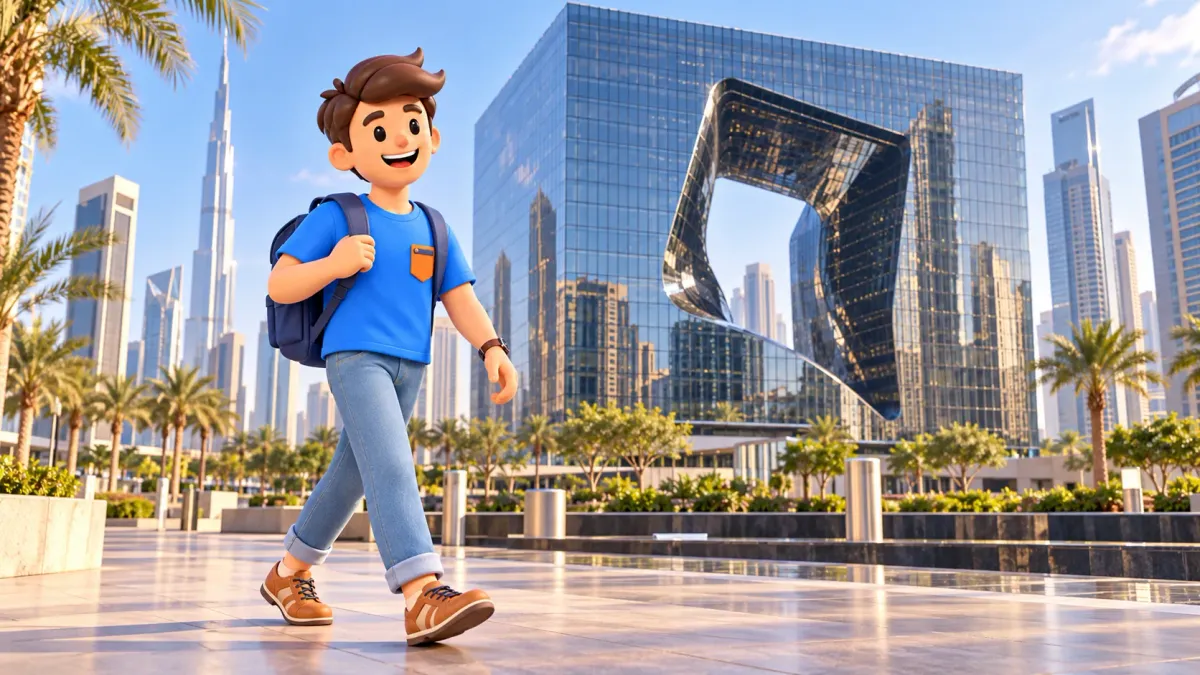
Business Bay is more interesting when its towers stop merging into one glass skyline. The Opus gives a building a conspicuous inner void; O-14 wraps offices in a white concrete shell full of openings. One makes absence the main image, while the other turns an exterior surface into structure, shade and pattern.
This walk uses those two buildings as its anchors and ends with a modest waterside pause in Business Bay. Keep roughly two to three hours free, including finding public viewpoints, street connections and rest. The duration is an editorial estimate, not a measured route. This is a ground-level architecture outing, with no assumption of entry to offices, hotels or private terraces.
A route between two buildings, not an endless waterfront walk
RoadMe can create a personal route or whole trip plan based on your interests, dates and pace. Try planning Business Bay in the app: connecting architecture, a pause and your next destination is much more convenient than managing separate attraction lists during the holiday.
Begin around The Opus, continue towards O-14 using suitable public streets and crossings, then choose an accessible waterside section for the finish. The buildings are in the same district but are not adjacent façades on one small square. Allow real time between them rather than treating their photographs as proof of an easy uninterrupted path.
Save the actual destination names and intended public approaches before setting out. A tower's address can lead towards an operating entrance, parking ramp or service area. Your aim is a comfortable permitted exterior viewpoint, not necessarily the door used by hotel guests or office workers.
A useful framework is about half an hour around The Opus, a flexible transfer block, another half-hour with O-14 and a shorter waterside finish with a pause. Keep the remaining time unassigned for orientation and changing your mind. Actual streets, access and comfort determine the detail.
Choose weather suited to walking. Business Bay includes ordinary roads and exposed approaches as well as landscaped waterfront spaces. Do not assume the entire route is a shaded promenade. If conditions or the available pedestrian connection are unsuitable, reduce the outing to one architectural stop rather than forcing the full sequence.
The Opus: look at the space that has been left inside
The Opus is recognised by a large, freely shaped opening in a glass volume. From a distance, it can look like a cube with part removed. The design by Zaha Hadid Architects works through the contrast between regular outer edges and the flowing inner surface of the void.
The project for Omniyat was presented in 2007, with construction and completion belonging to later stages through the 2010s and around 2020. This is not a story of a single instant. The idea preceded the finished building, and the complex combines several uses rather than being explained solely by the hotel inside.
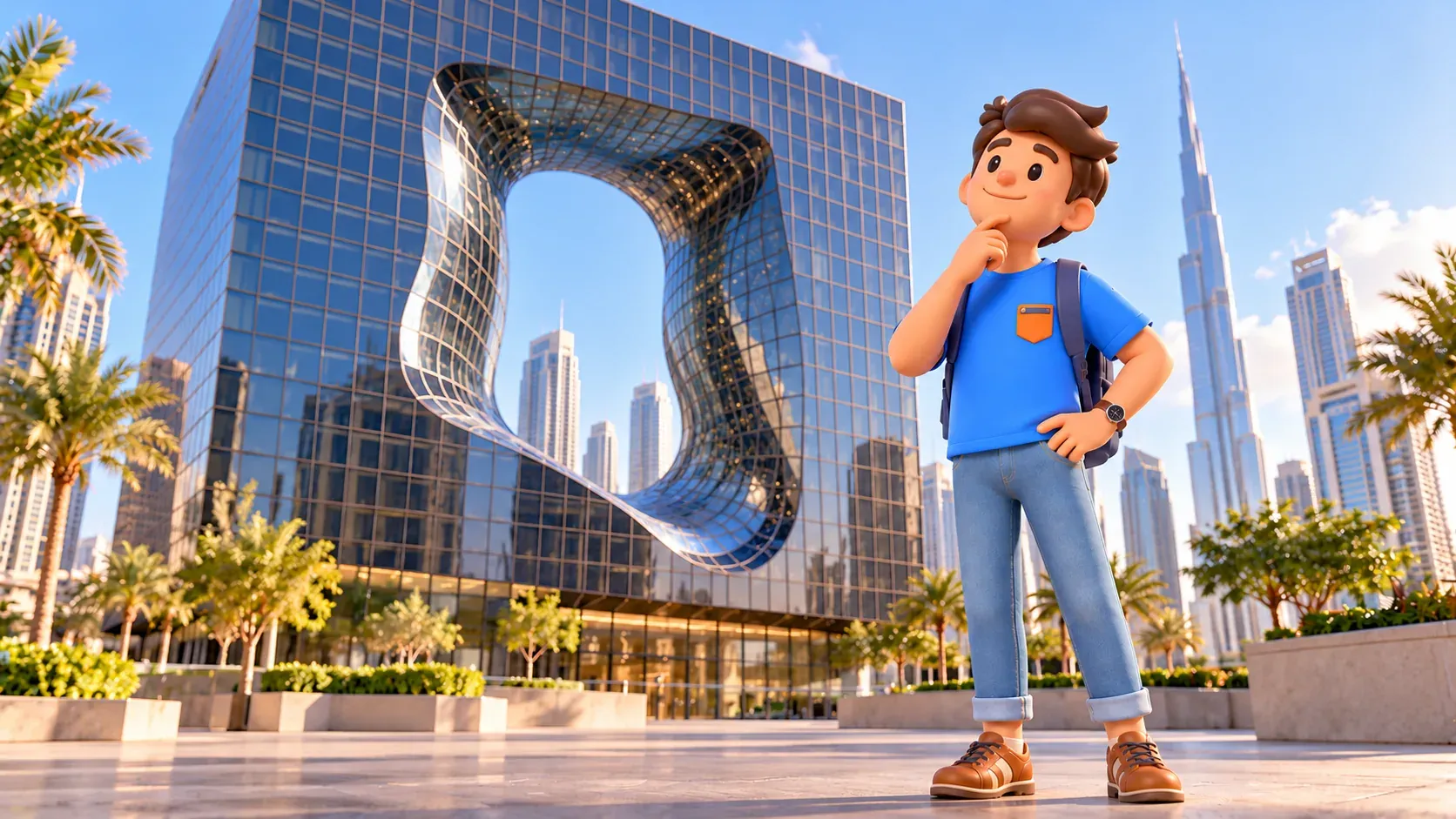
From a public viewpoint, notice how the two main parts remain connected at the bottom and by an asymmetrical upper bridge. The opening is therefore held within a larger outline. It is not just an unbuilt gap between unrelated towers; the surrounding form makes it a deliberate architectural space.
Move only where access allows and compare two angles. The curved inner glass changes its apparent depth as you shift, while the outer grid remains more regular. Reflections can make the contrast clearer: the city reads differently on a flat surface and on one that bends.
Try a simple question: are you noticing the building's mass or the space within it first? The answer can change with your position. That is the useful discovery here, more than producing one photograph that exactly matches a famous promotional image.
Keep the exterior visit distinct from the building's working life
The Opus contains functioning spaces, and architectural curiosity does not automatically grant access to them. A hotel lobby, restaurant or office entrance has its own purpose and conditions. If you deliberately want an interior experience, check the current offer separately and give it an appropriate place in the day.
For this walk, remain with public exterior observation. Do not block operating entrances or step into service areas to improve a composition. You can understand the contrast of cube and curve without finding a route through every part of the complex.
Photographs work best when they preserve something of the building's larger outline. A close detail of curved glass may be attractive, but a wider frame helps explain why it feels unusual. Keep both possibilities in mind rather than taking many nearly identical views.
Before leaving, identify the next public route towards O-14. Use proper crossings and the paths available on the day. The ordinary connection between architectural highlights is part of a city walk; it should not be hidden behind the promise that everything is conveniently on the waterfront.
O-14: a façade that does real work
O-14 presents an entirely different approach. The tower by Jesse Reiser and Nanako Umemoto is wrapped in a white perforated concrete shell. The exterior system carries loads, shapes the building's image and helps protect the recessed glazing from direct sun.
The project belongs to the same broad period of experimentation as many of Dubai's distinctive contemporary buildings. Construction began in 2007 and its concrete structure was completed in 2009. The name refers to the plot designation, a practical origin behind an unusually memorable form.
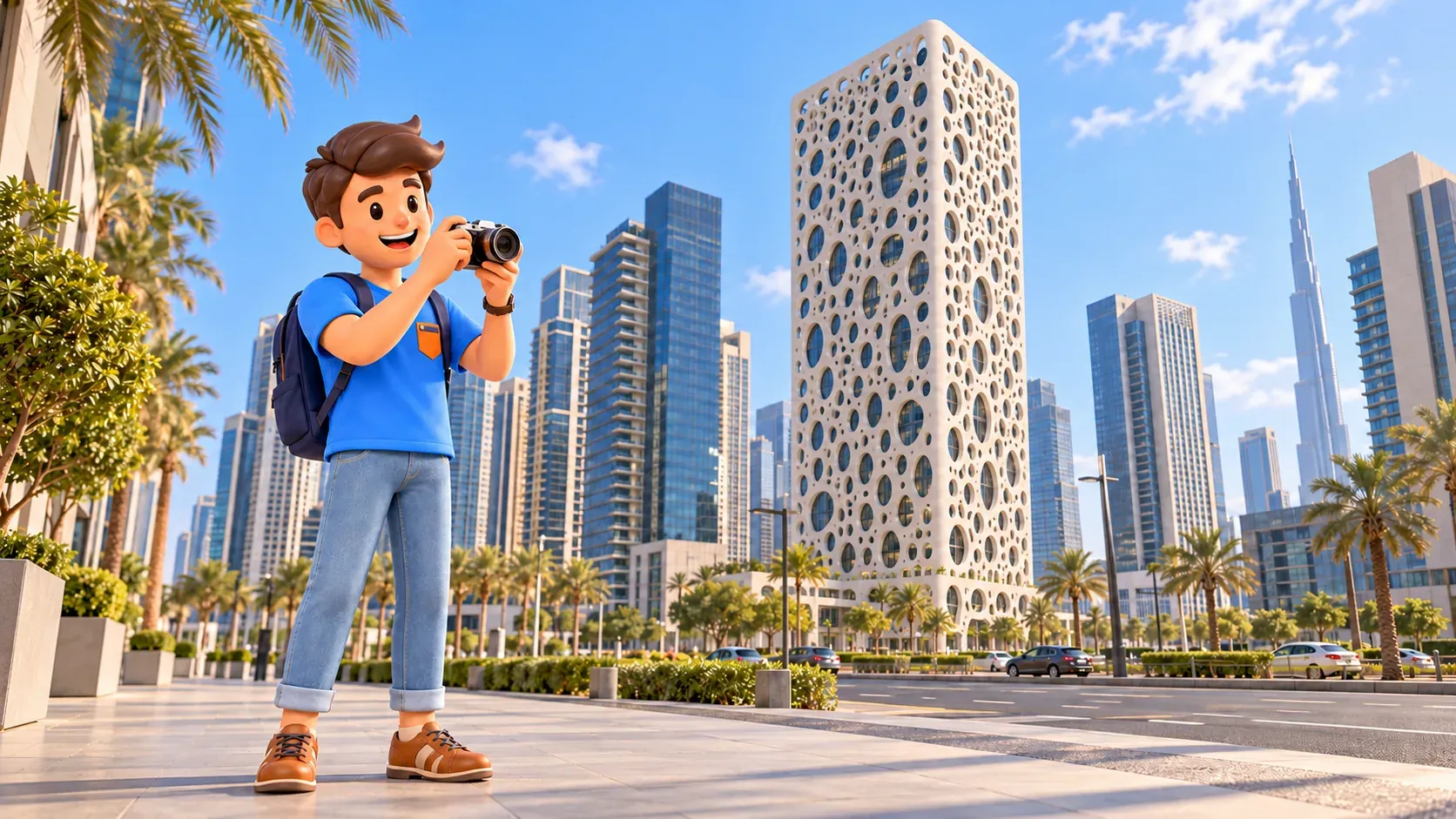
Look at the depth of an opening rather than seeing only a pattern of dots. The concrete thickness creates a small light-and-shadow space, with glazing set farther behind. The gap between outer shell and inner enclosure is part of the architectural system, not merely a decorative distance.
From an angle, the openings become deeper or narrower in appearance. Their varying sizes soften the repetition normally associated with office floors. You can read the surface as a whole, then choose one small area to understand how the pattern works.
The useful comparison with The Opus is now visible. One building's major opening sits within a glass volume; the other distributes many openings across a structural skin. Both use empty space, but at different scales and for different effects.
Allow enough time to look without treating the building as a puzzle requiring every technical answer. A simple recognition that structure, shade and appearance can be one system already makes this stop more meaningful than a quick photograph of an unusual white tower.
Finish beside the water, with a clear limit
Choose a nearby accessible public waterside section as a change of scale after the two façades. Business Bay's water and wider canal setting introduce reflections and a longer horizontal view. The point is a short finish, not a commitment to follow every turn of the waterway.
Use the actual open paths and check how they connect to your intended exit. A visible opposite bank, private frontage or distant promenade does not establish a direct route to it. Stop where access is clear and the return remains straightforward.

In comfortable conditions, sit where permitted or choose refreshments from a clear current offer. A simple drink can provide enough pause to compare the two buildings you have just seen. There is no need to assume a particular café or book a long meal for the waterfront to become part of the day.
Look at the reflections for a moment. A rigid façade becomes a changing surface on water, giving a third way to think about the glass and concrete encountered earlier. The walk can end with that small observation instead of another major landmark.
Do not automatically continue to the more distant canal bridges. They belong to a different walking emphasis and can add substantial time. A named district and a connected water network are not the same thing as a compact sightseeing area that can all be completed at once.
Make a simple architectural comparison
At the end, use three questions: what holds the building up, what shapes the light and what gives it a recognisable image? At O-14, the outer shell participates in all three. At The Opus, the shaped void and changing glass surfaces organise the visual experience differently.
You do not need an engineering qualification to observe these relationships. Keep visible facts separate from assumptions: you can see an opening's depth, but its exact technical performance needs proper information. It is fine to leave with a question rather than invent a structural explanation.
If you enjoy drawing, sketch only the basic contrast: a regular outline with one curved opening, then a surface with many varied holes. If you prefer photography, take one wider image and one detail at each building. Both approaches slow attention without requiring an additional attraction.
With children, ask which shape is missing from a whole and which surface is full of smaller openings. Keep the comparison playful and brief. The street journey and weather matter as much as the topic, so shorten the route if the group needs a gentler outing.
For adults with different interests, agree on one shared question rather than requiring everyone to study every façade equally. Someone may enjoy form, another shade, another photography. A conversation during the waterside pause can connect those views.
How this fits with other Dubai walks
For the nearby high-rise centre at a different scale, our two-hour Downtown walk compares the Opera, park, lake and Souk Al Bahar. Choose it as another outing or deliberately reduce both plans before combining them.
If the changing reflection at The Opus or the open pattern of O-14 made you curious about materials, the Downtown sculpture walk explores related questions through bronze, steel and public space. Architecture and art can speak to each other without requiring one exhausting continuous route.
RoadMe can connect architecture, art and other interests in a personal multi-day itinerary at your pace. Use the app to organise the whole trip more efficiently, so Business Bay becomes a planned part of the holiday rather than another isolated set of pins.
Before starting, save your intended start, two main destinations and a clear finish with onward transport. Carry water, comfortable shoes and a light bag, and keep the plan flexible around actual access. These practical choices let the buildings hold your attention.
A good Business Bay walk leaves two distinct images: a cube organised around a void and a white shell where openings become a working system. The water adds a quiet third perspective, with enough energy left for the rest of your day.


