
Art Among the Skyscrapers: A Downtown Dubai Sculpture Walk
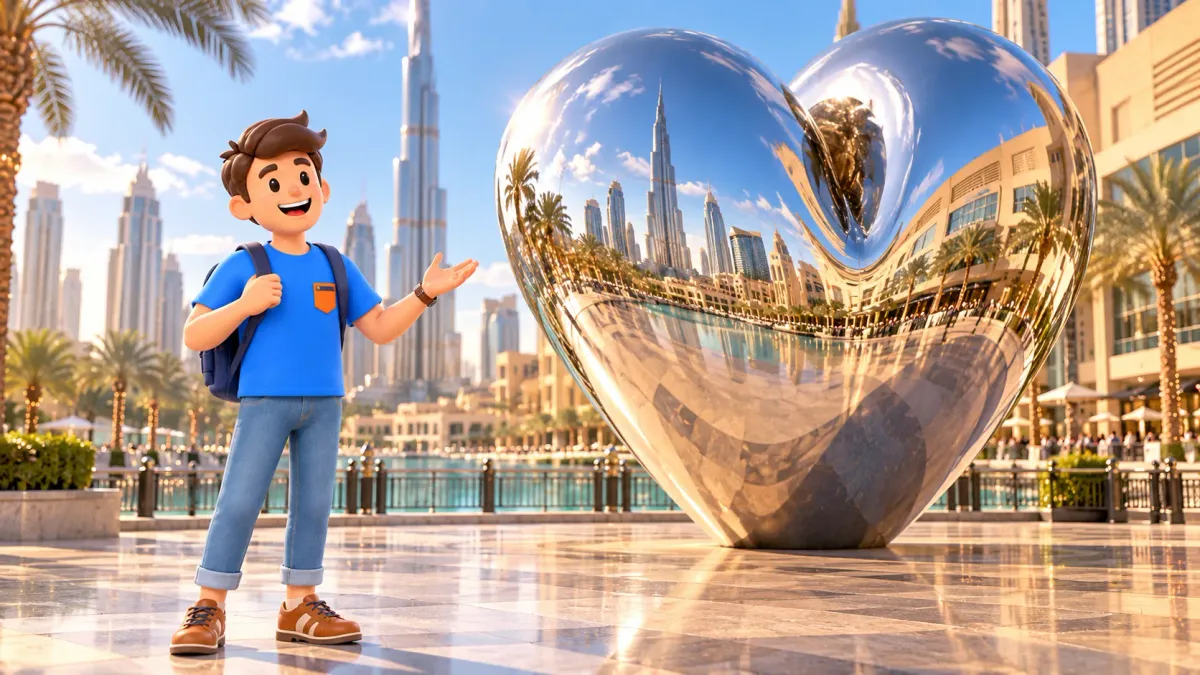
Downtown's sculptures can change the way you look at its skyline. A bronze wing gives a smooth tower a textured foreground. A steel seed head lets architecture remain visible through it. A polished heart folds the surrounding city into its own surface. The buildings are still there, but the subject becomes the relationship between work, viewer and place.
This short art walk links Wings of Mexico at Burj Plaza, the Dandelions near Burj Park and Love Me in the Dubai Mall setting. Keep roughly an hour and a half to two hours, with room for public paths, a pause and a possible queue for a photograph. The timing is an estimate, not a measured route or a guarantee of access.
Three works, three different ways to look
RoadMe can build a personal route or whole trip plan around your interests, available time and pace. Try planning the art walk in the app: it is much easier to connect these works with the rest of your Dubai stay than to coordinate separate lists of photo spots.
The outline begins at Burj Plaza, continues towards the park area and finishes around the mall-side setting of Love Me. Use the actual public connections available, including any relevant bridge or controlled access. The lake separates parts of Downtown; a straight line between works is not automatically a walkable shortcut.
Check the intended works and access before setting out, especially around events. Public art occupies a changing city rather than a permanently identical exhibition floor. A temporary restriction or changed viewing area should lead to a smaller plan, not an attempt to reach a closed space.
Spend time on the differences rather than making every stop the same pose. At the wings, think about the missing body; at the Dandelions, the material and empty spaces; at Love Me, the reflections and depth. These simple questions provide a route even if you know little about sculpture.
Choose comfortable outdoor conditions and keep water with you. If the day calls for a shorter outing, select two works and preserve a pause. The success of an art walk is not the number of sculptures you can include before your attention runs out.
Wings of Mexico: the viewer completes the image
Wings of Mexico is by sculptor Jorge Marín and belongs to his wider international project of winged works in public spaces. In Dubai, its placement at Burj Plaza brings the bronze wings into a recognisable relationship with Burj Khalifa in the distance.
The important absence is a body. The central space is left open, so a person near the sculpture can visually complete it. That makes the work approachable without a museum explanation. Participation is built into the composition rather than added only by social media.
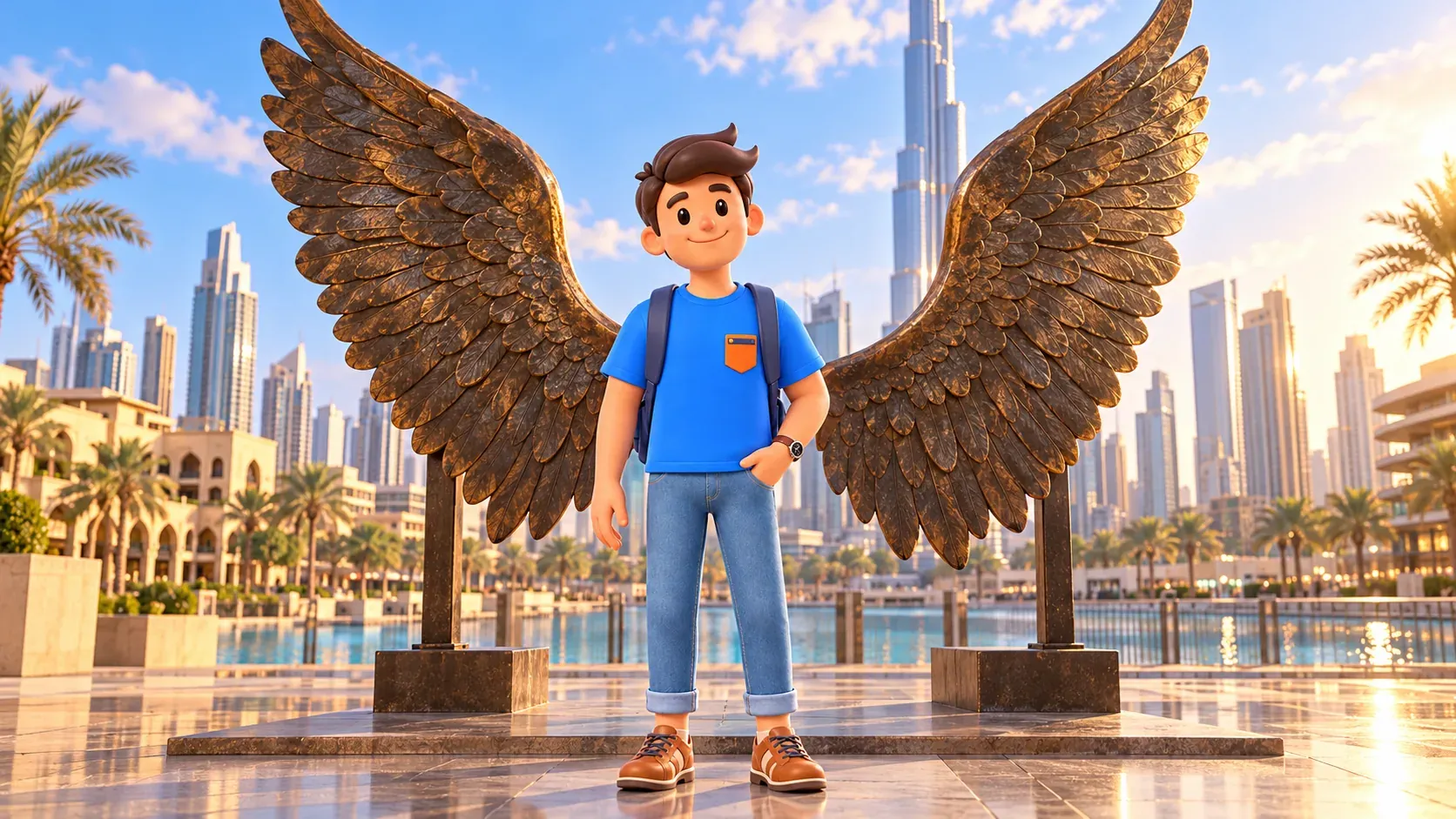
Before taking the familiar central picture, look at the bronze from the side. Layers of feathers, changes in relief and the curve of the wings give the surface a physical weight. That texture contrasts with the distant smoothness of the tower. A photograph can include the relationship instead of turning the work into a costume.
Use the visitor space according to the rules and conditions on the day. Do not climb or hang from parts of the sculpture, and let others take their turn. If several people are waiting, a single planned photograph is kinder than trying every pose while occupying the centre.
Then step aside and look again without a person in the middle. The empty space becomes noticeable once more. This second view is worth keeping in mind: the work changes through presence and absence even though the bronze itself does not move.
Dandelions: light-looking nature made from metal
The Dandelions by Polish sculptor Mirosław Struzik enlarge a fragile plant form into an urban-scale group. Created in 2017 for the area near Burj Khalifa, the composition uses slender stems and open spherical heads. A small natural structure becomes something you can compare with surrounding buildings.
Look closely enough to distinguish radial elements and their branching ends, but stay within permitted visitor areas. The head is not a solid ball. Architecture and sky remain visible between the pieces, making emptiness part of the sculpture's form.
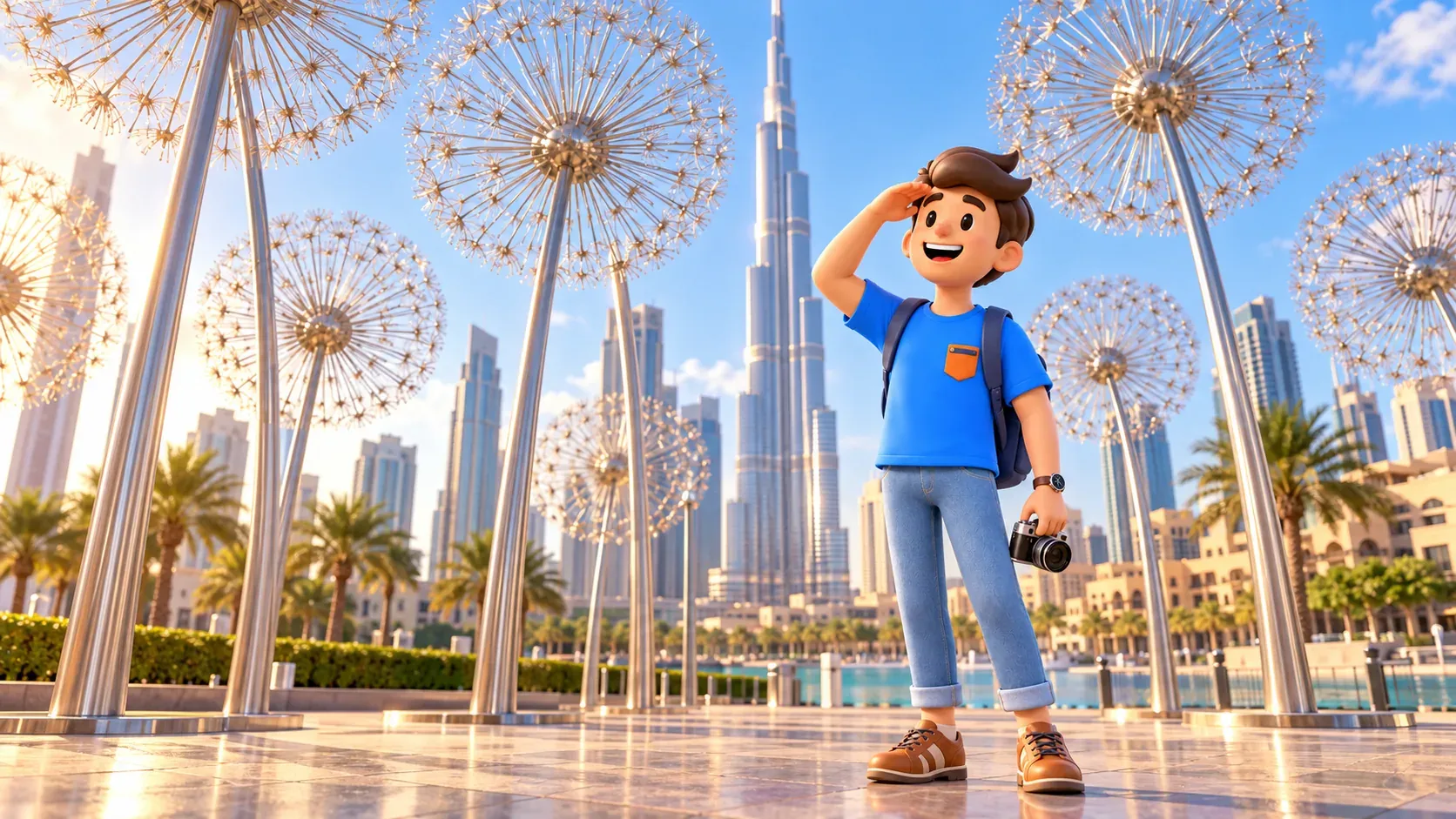
The steel material creates a useful tension. The familiar seed head suggests something light and temporary, while the construction is durable and engineered. You do not need to know the technical fabrication process to notice how a natural reference changes when its scale and material change.
Compare one head with the whole group. From one position the spheres overlap; from another they separate. The pattern becomes denser or more open as you move. That is a different kind of interaction from the wings: the viewer changes the visual relationship through position rather than by standing in an intended central place.
The work includes lighting, but you do not need to plan the route around an assumed illumination schedule. In daylight, the open geometry and the view through it are already meaningful. If an evening effect is your main reason for coming, verify the actual situation rather than treating it as guaranteed.
Love Me: the city enters a mirrored heart
Richard Hudson's Love Me turns a familiar heart sign into a large three-dimensional object. The Dubai work was commissioned for the Emaar collection in 2018 and is made from mirror-polished steel. Its rounded form occupies real depth rather than behaving like a flat graphic symbol.
The front view makes the shape immediately recognisable, but a side view reveals the volume. Smooth curves pass into each other without sharp edges. If access allows, change position enough to see that depth instead of leaving after the first straight-on image.
Reflection brings the surroundings into the work. Sky, buildings and people stretch and bend across the surface. The sculpture remains still, yet its appearance changes with the observer. In that sense, the material is an active part of what the work does, not just a shiny finish.
Notice the difference between looking at the heart and looking at the city inside it. You may see a familiar building fragment transformed into a curve or a patch of sky interrupted by the sculpture's outline. The point is not to find a single correct interpretation but to give your eyes time to separate those layers.
Keep a sensible distance and respect any barrier or instruction. Public visibility does not imply permission to touch, sit on or use the object as a support. A wider angle can show its relationship to the plaza while leaving room for other visitors.
An optional fourth stop: a hand as a public sign
Win, Victory, Love in Burj Park translates a three-finger gesture into a permanent urban object. The gesture is associated with Sheikh Mohammed bin Rashid Al Maktoum and Dubai's public symbolism. The work concentrates attention on the hand rather than a full figure.
If you include it, compare a brief human action with a fixed monumental form. From different viewpoints, fingers overlap differently while the overall contour remains recognisable. This offers another subject alongside figurative wings, a plant-derived structure and an abstracted heart.
A similar symbol appears at the Museum of the Future, but that is a different physical object in another city setting. Keep the Burj Park work within this route. Do not follow a familiar sculpture name to the wrong district simply because the imagery looks related.
The fourth stop is optional. If the first three have already provided a satisfying visit, use the time for rest or another look at your favourite. A sculpture route does not become stronger automatically by adding one more name.
Photograph less automatically, notice more
Try making one picture at each work answer a different question. At the wings, how does a person connect the bronze and the distant tower? At the Dandelions, how much space remains inside the form? At the heart, what has the reflection done to the surrounding architecture?
Give yourself a brief screen-free look first. You may discover that a side view or a detail is more interesting than the image you expected to copy. Follow current photography rules, keep paths clear and ask before making a close photograph of another visitor.
If you enjoy drawing, a small sketch can be useful even without artistic training. A feather, a radial seed head or the outline of a heart is enough. The act of choosing a line makes you notice which part of the form was holding your attention.
In a group, let each person choose a different detail and discuss them during a pause. One may be interested in surface, another in scale, another in the way people use the work. You do not need a shared favourite for the walk to feel like a shared experience.
With children, turn those questions into simple comparisons: rough and smooth, solid and open, close and far. Keep the task playful rather than making the route a test of artists' names. A remembered observation has more value than a hurried recital of labels.
Fit the art walk into a wider Dubai visit
Save the actual destinations, the intended start and a clear finish before leaving. Downtown's lake, landscaping and event arrangements affect how the works connect. Leave time to reach your next transport rather than assuming the last photo is the end of the practical journey.
For the district's architecture, our two-hour Downtown walk uses the Opera, park, water and Souk Al Bahar as its main subjects. Choose one focus or deliberately shorten both. Two complete routes added together are a longer outing, even when they share an area.
If you want contemporary art beyond outdoor landmarks, our three-day return-visit itinerary turns towards galleries and other architectural settings. An outdoor sculpture encounter can be the start of that interest without needing to stand in for a full gallery visit.
RoadMe can place art, heritage and other interests into a personal multi-day plan at your pace. Use the app to organise the whole trip more efficiently, so this short walk becomes part of a coherent holiday rather than another list to manage.
At the finish, keep one connection from each work: a person completing a space, a metal structure holding air and a mirrored surface reshaping a city. That is a richer memory than three versions of the same pose beneath the skyline.


