
After Wat Pho: the Flower Market and a Park above the River

After Wat Pho, another major temple is not the only way to continue your day. Head towards Pak Khlong Talat for flowers, working shops and a different scale of attention, then continue to Chao Phraya Sky Park for an open river view. The sequence moves from a religious complex to everyday trade and a contemporary public space. It gives the afternoon variety without asking you to begin another long indoor visit just as your attention starts to fade.
Allow around two and a half hours after leaving Wat Pho. The temple visit itself, travel there and your onward journey are separate. This is a daylight continuation with a short seated pause, estimated rather than measured time blocks, and a park finish during its actual access window. You can return to the original riverbank or finish across the water. Decide that before entering the park so the last part of the outing leads naturally towards wherever you want to go next.
A gentler continuation with two different subjects
Choose this walk if you still want to explore after Wat Pho but would enjoy a change from temple interiors. The market offers closer detail and activity; the Sky Park opens the view. You do not need to buy anything or fill the gap with another landmark. It is a useful choice when companions have different amounts of energy, because the central pause lets you agree how much of the second half you want to keep.
RoadMe can turn this idea into a personal Bangkok trip plan shaped by your interests, time and pace. Planning the whole journey in the app makes it much more convenient to balance major sights, everyday neighbourhoods and the breaks that help you enjoy them.
The allocation below starts at your actual temple exit, not at a generic map pin. It includes time to find the onward line and leaves a modest park visit. If Wat Pho has already taken most of your energy, shorten the market or make a drink stop the end. If you have more time, let one section grow rather than adding several new places. The outing should feel like a useful continuation, not an obligation created by being in the area.
| Time after leaving Wat Pho | Suggested focus |
|---|---|
| First 30 minutes | Orient yourself and walk towards the flower area |
| 30–70 minutes | Pak Khlong Talat at a browsing pace |
| 70–95 minutes | Short seated pause for a drink |
| 95–120 minutes | Continue to the Sky Park approach on the Phra Nakhon bank |
| 120–150 minutes | Park view and your chosen exit |
Leave Wat Pho with a new rhythm
Take a moment outside the temple to decide whether you want another few hours on foot. A rich visit can leave you ready for simpler scenes: a working shop, a drink, a stretch of water. Those are enough reasons to continue. Choose the actual route from the exit you have used, with a current map for streets and crossings. This article gives the sequence, without assuming all visitors leave through the same gate or follow an uninterrupted riverside promenade.
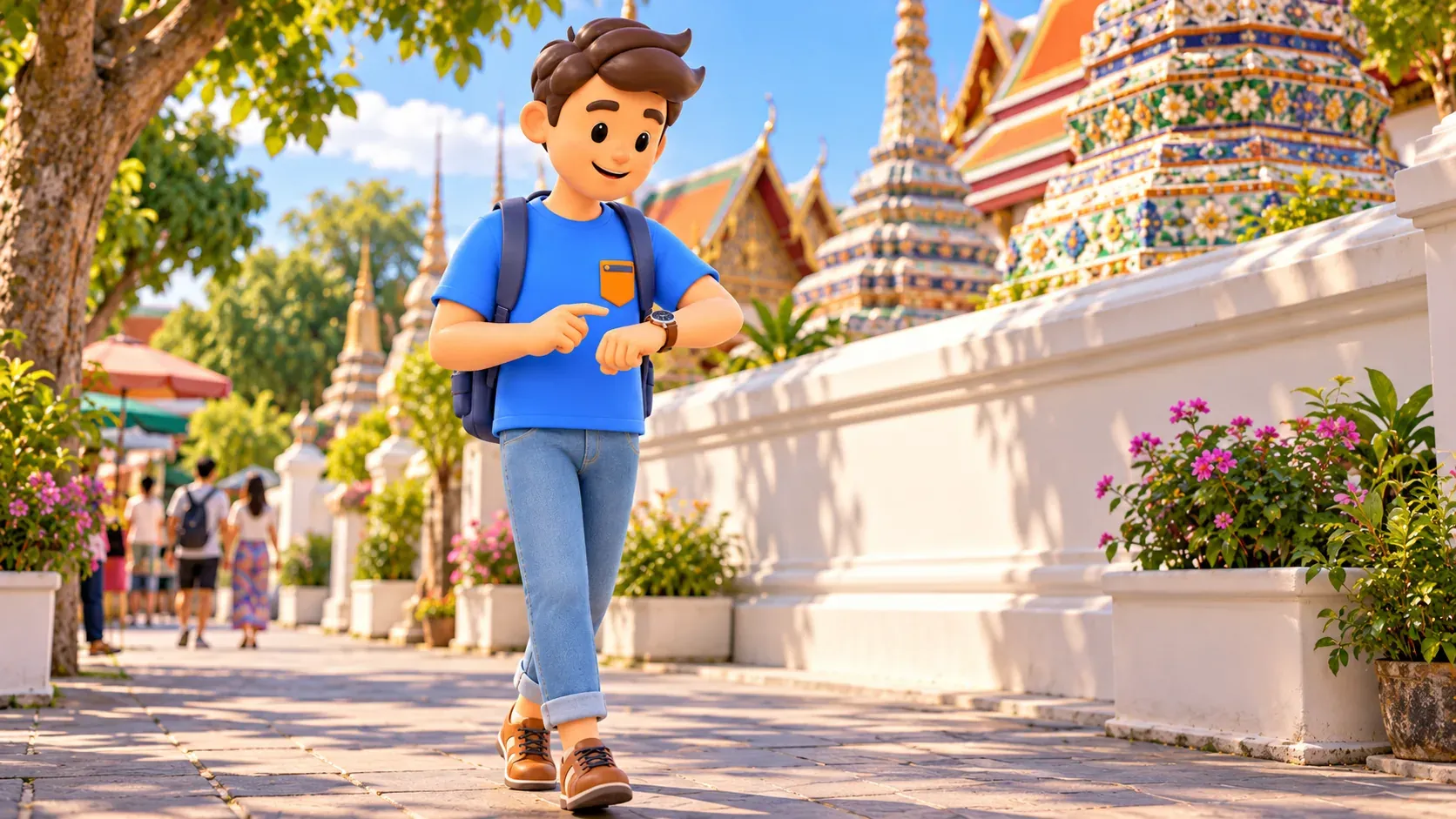
If you need food immediately, adapt the first part around a real meal. The small drink pause later is not a lunch allowance. Eating earlier may mean a shorter market visit or a later park finish, depending on current access. That is an ordinary planning choice, especially after a long morning. It is better to decide now than to reach the market hungry and discover that the whole rest of the afternoon has become a hurried search for somewhere to sit.
Pak Khlong Talat: look at a working flower trade
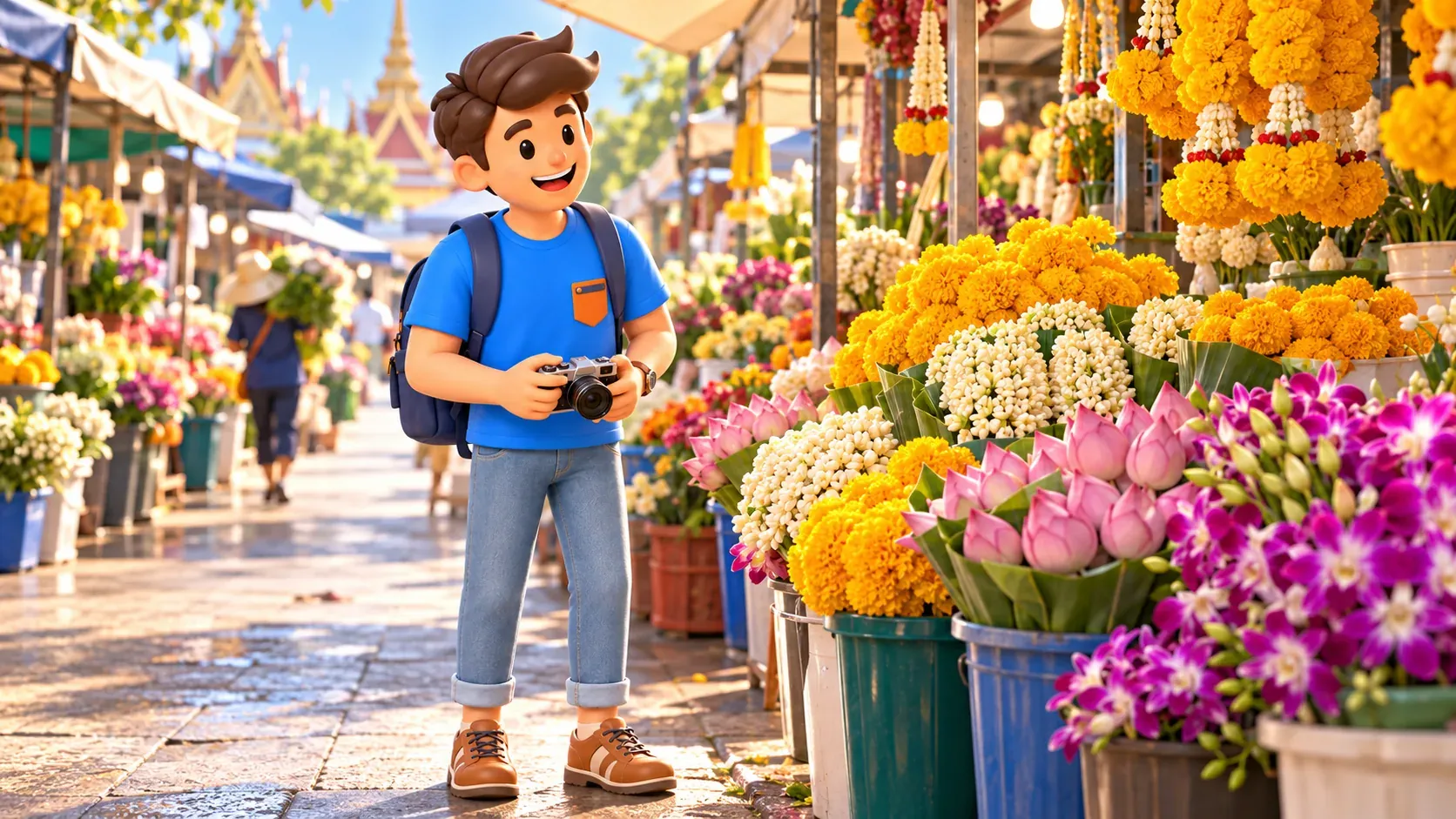
Pak Khlong Talat is a flower-trading area rather than a single exhibition hall with one prescribed entrance. Among the flowers associated with it are lotus buds, orchids and jasmine, alongside flower garlands used as offerings. That connection offers a quiet continuation after Wat Pho: objects and materials linked to religious life appear here within ordinary commerce. You do not need a long explanation of every variety to recognise the relationship between the temple setting and the work of arranging and selling flowers.
Begin with a wider look at the available shops and stalls, then choose a small stretch to browse. Notice differences between loose stems, bundled flowers and finished garlands. Shape, colour and arrangement can hold attention without another list of historical dates. Follow the public spaces and leave working aisles clear. If someone is moving stock, pause to let them pass. The market is rewarding partly because work continues around you; it does not need to stop in order to become a good travel experience.
A few details to notice without turning it into a checklist
Choose one comparison. How does a tightly packed group of buds look beside a finished garland? What changes when the same colour appears in a small arrangement and a larger bundle? Where do texture and repetition catch your eye? These questions make a short visit personal without requiring access to a workshop. You can stay with one detail, then look up at the larger scene again. A modest amount of attention is more useful than trying to identify everything before leaving.
Ask before close photographs of people or their work, and do not handle merchandise just to arrange a picture. If you want to buy flowers, agree on the item, quantity and price first. A small purchase can be a pleasant part of the outing if you want to carry it, but it is optional. Consider the rest of your day before choosing something delicate or bulky. Looking respectfully and leaving with a clear impression is already a complete way to visit.
The activity you see depends on the moment and the individual businesses. A general reputation for long trading hours does not promise that every stall, café or adjoining place will be operating when you arrive. For this after-temple walk, use what is available rather than waiting for an imagined peak scene. If you want to study the market’s working rhythms in depth, make that a separate outing with its own timing. Here, a short encounter provides the change of scale.
Take the seated pause before the river section
After browsing, a drink stop gives the second half a useful reset. Choose somewhere convenient along your actual route, check the menu and price, and sit if that is what you need. You do not need a famous café or a table with a river panorama. The point is to decide how the rest of the afternoon should feel. A practical, comfortable stop can do that better than another detour made purely to reproduce a photograph.

Use the pause to choose your finishing bank. Returning to Phra Nakhon may fit plans on the old-city side. Crossing to Thonburi can make sense if your next destination lies there. Neither choice needs to become a larger neighbourhood tour automatically. Check the onward journey from the exit you actually plan to use. A river crossing changes where you finish, so it is worth making that decision while seated rather than discovering at the far end that you need to retrace the whole way.
Find the Sky Park entrance, not just the bridge
Chao Phraya Sky Park occupies a former unused rail structure in the middle of Phra Pokklao Bridge. That detail is useful for both understanding and approach: it is an elevated linear public space, not a ground-level riverside garden. Head for the actual park access on the Phra Nakhon bank using available paths and signs. Being beside a bridge does not mean you are already at the right entrance. Leave time for the approach instead of counting only the visible stretch over the river.
Check the park’s current access window separately from the market’s trading activity. A late market visit does not establish late park access. If steps, lifts or other approach arrangements affect your choice, confirm the usable option for your day before making the elevated section essential. This outline does not guarantee a step-free entrance. You can still enjoy the earlier part and finish elsewhere if the approach does not suit you. A good continuation remains a choice you can adjust.
With RoadMe, work out a personal route that reflects how you want to spend the whole trip, from markets to river views and local streets. The app is a more convenient way to build a connected plan around your interests than piecing together separate lists afterwards.
A park above the river: let the view be the finish
The Sky Park’s interest includes its reuse of an unfinished transport structure as a planted public walkway between the two banks. The city has given an existing piece of infrastructure another purpose. You can see that idea while walking: a narrow garden and places to pause sit within a bridge setting. It is a different kind of Bangkok experience from both the temple and market, with a wider view and a contemporary urban story rather than another major admission.

Watch the river from a safe permitted position and give other park users space to pass. The final half-hour is for a modest look and your chosen exit, not half an hour at every viewpoint. You can notice boat movement, the relation of the banks and the contrast between planting and transport structures. Do not expect the isolation of a large riverside garden or a guaranteed empty seat. The setting belongs to an active city, and that relationship is part of its character.
Sunset is optional. Daylight can give a perfectly worthwhile ending, and weather or visibility may change what you see. If late light is important, make sure the actual park window and your onward plans leave a calm exit. Avoid turning the whole continuation into a race for one exact image. You already have a complete sequence of experiences. The view works best when there is still time to look, choose a few frames and leave at an ordinary pace.
Choose a bank and keep the next outing separate
For a return to the original bank, include the walk back through the park within the final allowance and shorten your viewing time if needed. For a Thonburi finish, leave by the appropriate far-side access and plan onward from there. Neither option includes an immediate boat connection simply because the river is below. Find the actual boarding point and suitable service if you want to continue on water, or choose another mode. Getting from a park exit to your transport needs its own time.
If the west bank interests you more deeply, our two-hour Kudi Chin walk is a separate neighbourhood idea. Adding it in full makes a longer day. For the earlier temple part, the two-day Bangkok plan offers a broader frame if it matches your visit. Keep enough room for each chosen experience instead of treating nearby routes as automatic additions.
The strength of this continuation is the change itself: from Wat Pho to the scale of flowers and working hands, then towards an open view above the Chao Phraya. You can leave with those few clear impressions. A shorter market visit or a choice to return to the same bank does not weaken the route. It shows that the afternoon has been shaped around the time, interest and energy you actually had.


