
Why Does Rome Have a Pyramid? Cestius and a Short Walk
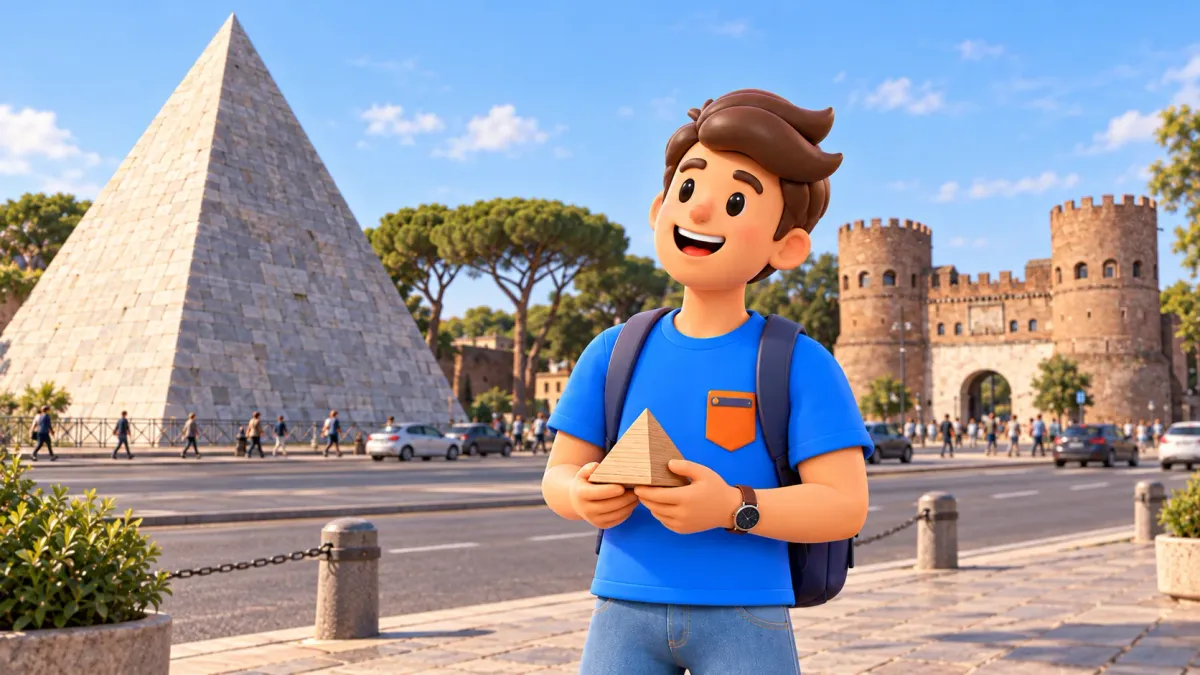
Rome has a pyramid because a Roman, Gaius Cestius, chose an Egyptian-inspired form for his tomb. The Pyramid of Cestius is a local ancient monument from the late first century BC, rather than a pharaoh’s tomb transported to Italy. Egyptian imagery appealed to Rome’s elite, and its striking shape became part of one person’s monumental commemoration.
Today it stands beside Porta San Paolo and busy urban roads. Allow about an hour outside to consider the tomb, move to the gate and take a pause. The neighbouring Non-Catholic Cemetery can be a separate extension when open and appropriate for a quiet memorial visit. Entering the pyramid is not a condition of enjoying this short outing.
An Egyptian outline with a Roman commission
In the age of Augustus, Egyptian motifs became part of Rome’s artistic vocabulary. A borrowed shape does not establish an Egyptian location or owner. Gaius Cestius was a Roman public figure and a member of the priestly college of the epulones. His tomb represents a Roman choice of an expressive model, rather than a foreign building unexpectedly arriving in the city.
RoadMe makes it much more convenient to work out a personal plan for the whole trip around your interests, dates, pace and budget. Let the app connect unusual historical discoveries, major sights and rest, giving a short pyramid outing a sensible place within your day.
The tomb is dated between 18 and 12 BC. Cestius’s will required construction within 330 days. That condition makes the building feel like a specific commission, rather than an anonymous ancient mystery. It does not justify inventing a construction record or claiming to know every private motive of the person who left the instructions.
Three points are enough for a first look: a Roman patron, an Egyptian form and the late first century BC. You need not study every office, heir and inscription before arriving. If the subject catches your interest, return to it separately. First see the outline itself and consider why it feels so unexpected within its present surroundings.
Look at two faces before collecting details
The pyramid is a little over thirty-six metres high. Its converging sides create a slender appearance, especially beside the lower line of the urban setting. Find an appropriate public pavement position where an edge and two faces are visible. The difference in light helps you read the volume without trying to circle through restricted or unsuitable ground.
The pale surface is marble facing. The structure behind it is different: a Roman concrete core with brickwork. Calling it a marble pyramid should therefore not suggest a solid mass of a single stone material. An expressive outer surface and a Roman construction system work together. This is one way the building belongs to Rome as well as referring to another architectural culture.
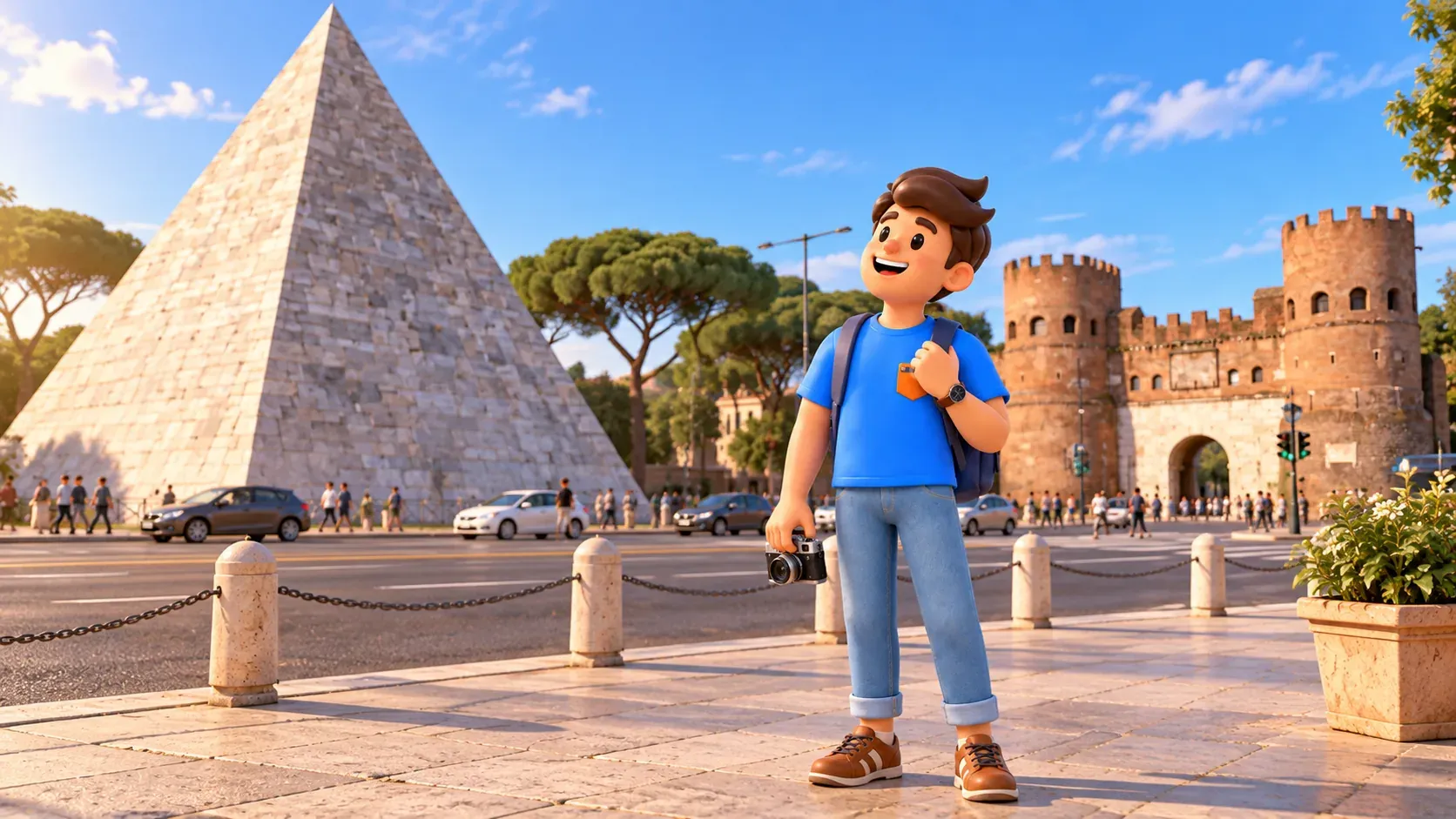
Compare the triangular silhouette with the rectangles of the facing, then return to the whole. Moving between those scales gives a short stop substance. Close contact with the ancient surface is unnecessary, and a photograph including a little of the street can explain the surprising relationship better than an isolated triangle against the sky.
The area remains a transport junction, rather than a secluded archaeological park. Use operating crossings and public pavements, without stepping into the road to remove traffic from a photograph. Finding a suitable position belongs within the outing. If traffic or barriers complicate a particular angle, another permitted view is more useful than insisting on reproducing somebody else’s image.
A tomb later absorbed into the city’s defences
Several centuries after its construction, the pyramid was incorporated into the Aurelian Walls. Tomb and defensive circuit belong to different periods and purposes. This is a revealing Roman relationship: a later city used an existing structure. The pyramid was not originally designed as a triangular gate tower, even though it subsequently became connected with a defensive system.
Do not expect today’s setting to preserve an uninterrupted line of masonry between every neighbouring structure. Later alterations and losses changed this stretch. For an introduction, notice the difference in form and function. One monument commemorated an individual; another urban layer controlled the city’s boundary and movement through it.
Later legend tried to explain the unusual shape through a familiar name, mistakenly associating it with Remus. That belongs to the monument’s reception, rather than its original purpose. The inscription naming Cestius returns attention to a particular Roman tomb. Reading every Latin line is unnecessary to distinguish its patron from a character in a later story.
Porta San Paolo has a neighbouring but different role
At the gate, notice the two rounded brick towers and the central arched passage. Its original name, Porta Ostiensis, referred to the road connecting Rome with Ostia. The later name San Paolo reflects the direction towards the Basilica of St Paul Outside the Walls. That basilica is not inside the gate and is not included in this short programme.
Under Honorius in the early fifth century, the gate was remodelled, with towers strengthened and raised and the entrance changed. Every visible detail cannot simply be assigned to a single initial phase. Compare the defensive outline with the smaller windows and arch. Understanding how a passage was organised is more useful here than memorising every building alteration.
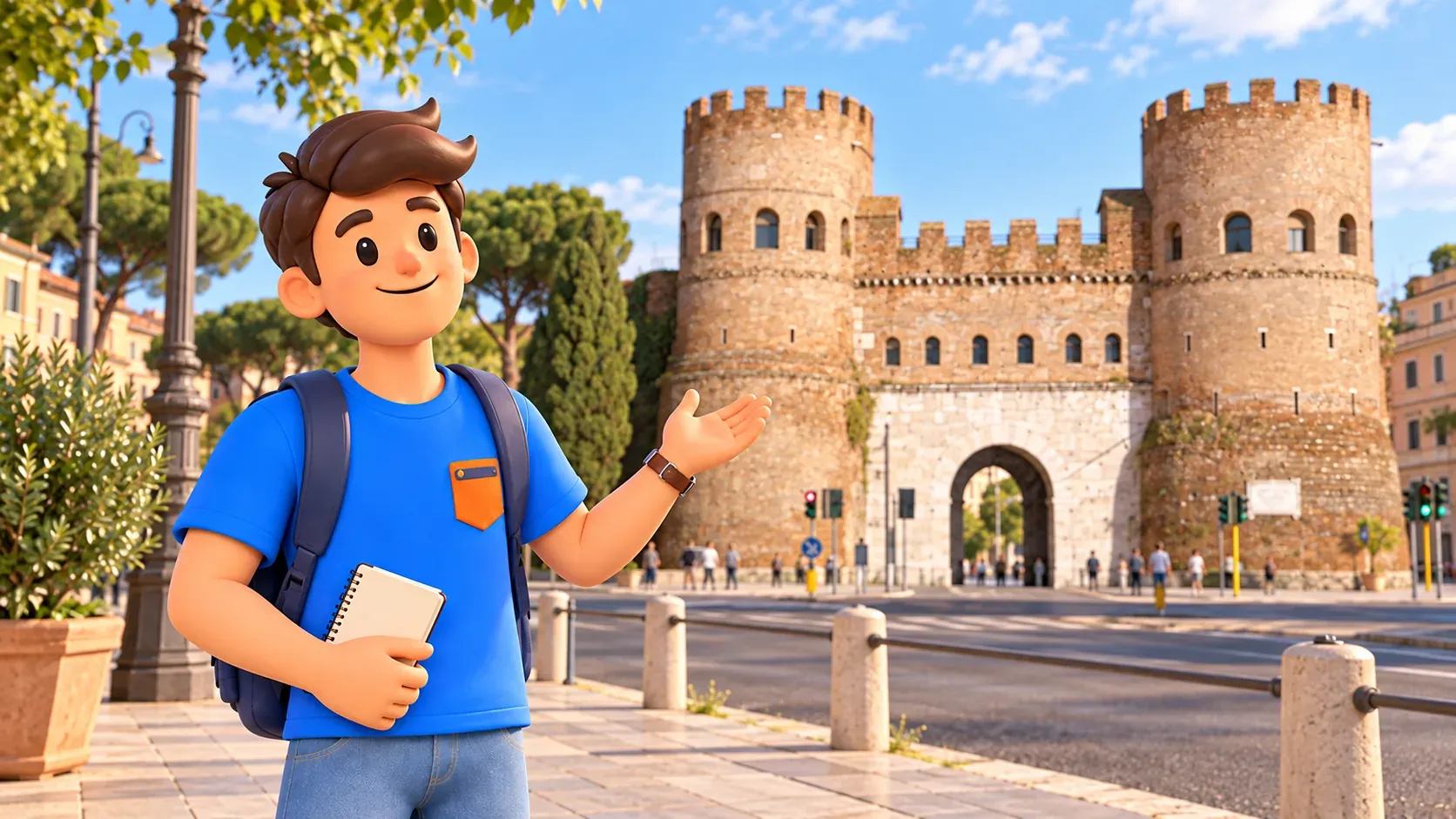
The gate contains the Museum of the Via Ostiense, but this programme stays outside. Looking at a façade and entering a museum are separate decisions. If the museum determines your interest, check current arrangements and redistribute the day. Neighbouring monuments do not create one combined admission or guarantee access to every historic room.
An hour outside with room to pause
Start at a public pavement view of the pyramid near Porta San Paolo. Allow twenty minutes for the overall form and one detail, ten for crossings and finding a suitable position at the gate, fifteen for its exterior and fifteen for a break in an appropriate available place nearby. The core programme totals approximately sixty minutes.
This is an editorial example, not a measured route or traffic forecast. The approach from a station or accommodation, return journey and full lunch are additional. If crossings take longer, move the finish while keeping the pause. Avoid compensating for every delay by abandoning the actual looking and merely passing the monuments on the way to the next item.
A 10:00 start gives an approximate 11:00 finish in the same vicinity. That suits an unusual piece of antiquity before another activity. Do not automatically add Testaccio Market, a hill visit and a substantial museum. Each needs its own time, rather than simply another name in the schedule. The short version already has a complete historical idea.
Inside the pyramid: a calendar is not an available place
A burial chamber with surviving painted decoration lies inside. An ordinary exterior visit does not grant admission. The monument’s management lists special openings and events. Dates, conditions and available places need separate checking; this programme does not assume a regular daily entrance that can casually be added on arrival.
A September–October 2026 calendar advertised free visits with mandatory booking. However, the official site also retains a notice dated 1 September saying places for the announced dates were exhausted. This is not a live availability check, but it is a good reason to distinguish a published timetable from an obtainable reservation. Management says any new opportunities will be announced separately.
If you already hold a confirmed session, build a day around its actual time and requirements. Without confirmation, the outside visit stands on its own. The neighbouring cemetery does not provide a route into the burial chamber. Having a view of the pyramid and physically entering the monument are different things, even when the two places appear close on a map.
The Non-Catholic Cemetery as a separate quiet extension
The entrance is at Via Caio Cestio 6, a street off Via Marmorata. This is an active, privately managed burial ground where ceremonies take place and relatives visit. Choose it for attentive time in a commemorative setting, rather than treating it as a picnic park or convenient back entrance to the pyramid.
For an optional extension, add ten minutes to reach the entrance, forty-five for a quiet introduction to a small available section including ordinary entry orientation, and ten to leave. The combined programme becomes approximately two hours and five minutes from the initial start. It does not promise the whole cemetery or every famous grave.
With the 10:00 pyramid start, you would reach the cemetery around 11:10, finish the main visit around 11:55 and leave around 12:05. This works only on a date when it is open and without additional delays. If closed, finish the shorter outing as planned. Another museum does not have to replace the extension immediately.
Let the hours and purpose determine the visit
Ordinary hours are Monday to Saturday, 09:00–17:00, last entry 16:30; Sundays and many holidays end at 13:00, last entry 12:30. There are nevertheless full holiday closures and a two-week closure in mid-August. Check the precise date: the word holiday does not always establish the same morning schedule.
Organised groups require advance arrangements, while independent visitors still follow local rules. Management requests a voluntary upkeep contribution, which should not be described as a compulsory museum ticket. Ceremonies, weather or other circumstances can change access. Uneven surfaces and architectural barriers also matter for visitors with particular mobility needs.
Limited personal photographs are allowed, but publication requires management’s consent. Putting the camera away may make the visit simpler. Keep eating, drinking and animated conversation outside the gates, and do not sit on gravestones. Quiet here relates to the place’s continuing purpose, rather than a tourist promise of an empty peaceful garden.

Decide whether to continue into Ostiense
For a longer museum contrast, consider our Ostiense and Montemartini half-day. It requires a different total duration and a museum calendar check. Choose it instead of the short version or expand deliberately, allowing the connections and rest. Adding a large museum to an already finished walk does not leave the original finish time intact.
Try RoadMe to develop a personal itinerary for the whole trip with your balance of antiquity, unusual districts and pauses. In the app, short outings and fuller days are easier to distribute, giving each experience the time that suits your own pace.
Finishing by the gate after an hour is a complete choice. The pyramid has already shown how Rome adopted expressive forms, while the neighbouring towers reveal another layer of city life. Let that relationship remain the memory, rather than feeling obliged to follow every unusual monument with several more before you can stop.


