
Why Paris Has an Egyptian Obelisk: Reading Concorde

The Egyptian obelisk in Place de la Concorde is more than an unexpected souvenir in the middle of Paris. Its arrival helped give a troubled French square a new centre: an ancient monument whose associations lay outside the rival regimes that had claimed this space. The fountains, façades and smaller ornaments then built a nineteenth-century composition around it.
You can understand that composition without entering a museum or making a circuit of every statue. Allow about 45 minutes to connect the ancient stone with the square around it, or 20 minutes for a smaller selection of views. The useful question is not simply how an obelisk reached Paris, but what Paris made it mean.
Start with the square around the stone
Orient yourself before moving towards the centre. The Seine lies to the south, the Tuileries to the east and the Champs-Élysées to the west. On the northern side, two classical palace fronts frame rue Royale, with the Madeleine beyond. These directions help you distinguish the fountains and understand why a single tall object can organise such a broad space.
RoadMe prepares a complete personal trip plan around your interests, travel dates, pace and budget, helping you give this square an appropriate place in your Paris days. Using the app makes planning and organising that whole trip more convenient and efficient.
Begin from a permitted pavement on the north-eastern side, near the Hôtel de la Marine side of the square. Look across the space before trying to inspect individual details. The obelisk supplies a vertical centre, the fountains balance it on either side, and the long northern façades provide a steady architectural background. You are looking at a designed relationship between objects, rather than a collection assembled at random.
Use marked pedestrian crossings and follow temporary signs. This remains a working urban space, and events can change the available views and paths. For example, the Salon d’Automne is scheduled in two temporary pavilions here from 28 October to 1 November 2026. Those event dates do not establish that every part of the square is accessible before or during the fair.
A royal square with several political lives
The square began as a setting for a monument to Louis XV. Its eighteenth-century design was entrusted to Ange-Jacques Gabriel, and the square was completed in 1772. The northern buildings make that royal ambition easiest to see: their controlled proportions give the open space a formal edge, while the gap between them preserves the route towards the Madeleine.
The eastern palace became the Hôtel de la Marine, associated with the Navy after its earlier role as the royal furniture repository. Its exterior belongs to this short reading of the square; an interior visit needs a separate allocation of time and the appropriate admission arrangements. Looking at a façade does not commit you to another museum stop.
During the Revolution, the royal statue disappeared and the space became Place de la Révolution in 1792. Louis XVI was executed here on 21 January 1793; Marie-Antoinette was also among those executed on the square. You do not need to search for an exact patch of pavement to recognise the weight of that history. It matters because replacing a king’s monument here could never be a purely decorative decision.
The name Concorde, first adopted in 1795, expressed a wish for reconciliation. Read that name as an aspiration shaped by political conflict. The square’s successive names and monuments reveal attempts to redefine the same public space, rather than one unchanged meaning carried from the eighteenth century to today.
What the obelisk brought from Egypt
The monument is the Luxor Obelisk, an Egyptian granite shaft from the thirteenth century BCE, associated with Ramses II. It originally stood as one of a pair at the entrance to Luxor Temple; its counterpart remains in Egypt. Its four faces carry hieroglyphs connected with royal praise and offerings, so the stone already had a ceremonial and political purpose long before it became a Paris landmark.
From a permitted close viewpoint, follow the shape upwards: the broad lower shaft narrows towards a pointed crown. The golden pyramidion visible at the top is a modern addition installed in 1998. It should not be confused with the age of the granite beneath it, or with the date when the monument was erected in Paris. One object therefore contains visibly different moments in its history.
The base introduces another change of place and period. The nineteenth-century pedestal is made from Breton granite, and two of its faces carry diagrams showing the transport and raising of the obelisk. Where those faces are visible, look for the relationship between a long horizontal load and the machinery needed to make it stand upright. The ancient inscriptions above and the engineering record below tell different parts of the journey.
That is a useful detail even if you cannot read a single hieroglyph. Instead of treating the whole monument as uniformly ancient, distinguish the Egyptian shaft, the French pedestal and the modern golden tip. The differences make its history legible in materials and shapes.
Why this monument became the centre of Concorde
The obelisk came to France as a diplomatic gift from Egypt under Méhémet Ali. Moving it required a specially adapted transport operation involving the Navy and the engineer Apollinaire Lebas. The decisive Paris date is 25 October 1836, when Lebas directed its erection on Place de la Concorde. Its long journey and its raising were separate achievements, which explains the attention given to machinery on the pedestal.
There was also a reason to choose an Egyptian monument for this particular location. France’s heritage account explains that its distance from French political history helped avoid the disputes a more directly partisan monument could provoke. An ancient foreign object offered a way to occupy the centre without simply restoring a French ruler’s statue.
That did not erase the obelisk’s original royal message. Ramses II’s monument remained a work of Egyptian kingship, and the French operation itself displayed technical ambition. What changed was its setting: a temple entrance object became the centre of a European public square. The interesting tension is between those meanings, not the idea that the stone somehow had no politics.
Look back from the pedestal towards the surrounding façades. The obelisk gives the eye somewhere to settle, while its slender shape leaves long views open around it. This helps explain its compositional role alongside the history of the gift. It provides a centre without behaving like a building that closes the space.
The fountains explain the nineteenth-century setting
Architect Jacques-Ignace Hittorff shaped the ensemble around the obelisk, including the two fountains inaugurated in 1840. Their matching forms establish a rhythm across the square, but their subjects differ. Locate them by direction before trying to identify figures: the Fountain of the Seas is south, towards the Seine; the Fountain of the Rivers is north, towards the Hôtel de la Marine.
The southern fountain brings together the Atlantic and Mediterranean, fishing and other maritime activities. The northern one represents the Rhine and Rhône, with references to wheat, wine, agriculture and industry. Seen together, they turn water into an image of resources, movement and prosperity. That subject connects the decoration to the ambitions of nineteenth-century France.
There is a material surprise as well. The fountains’ sculpted figures are cast iron, not simply bronze statues. Their intended colour scheme combines brown flesh, green clothing and golden attributes. Look for those contrasts wherever the view allows; identifying the colours can be more rewarding than trying to name every figure. The ensemble remains worth reading whether or not water is flowing when you visit.
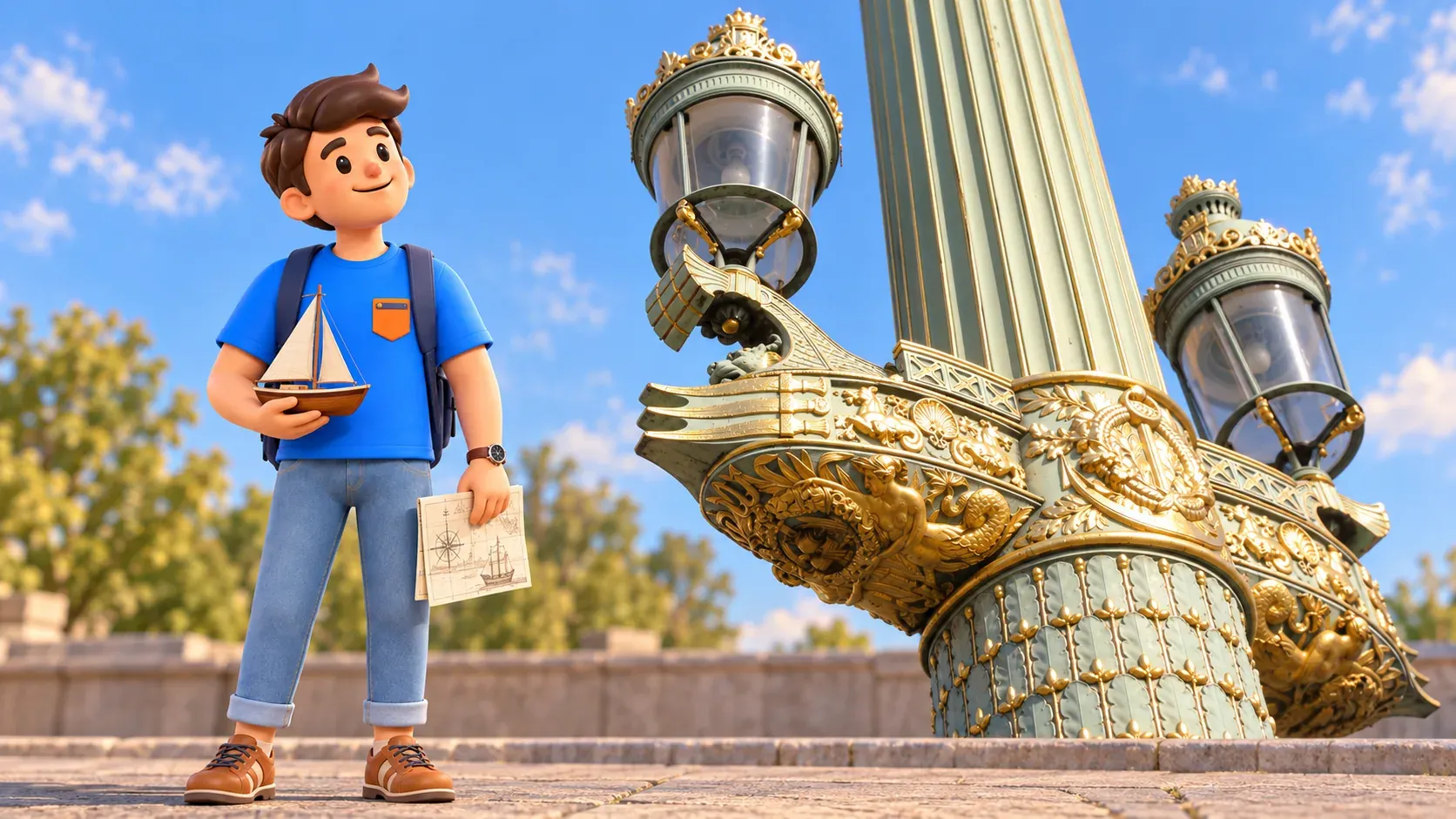
Two smaller details extend the same visual language. The rostral columns carry ship-prow ornaments, a maritime motif that connects with the fountains and the Navy’s presence on the northern side. The seated city allegories place French cities around the square. Choose one visible example or one ship prow, rather than turning the outing into a hunt for every object.
Give the composition forty-five minutes
For the longer version, reserve five minutes to orient yourself, ten for the obelisk and its pedestal, ten for the two fountain views, five for the northern architecture and longer axes, and five for a rostral detail or one city allegory. Leave the remaining ten minutes for walking and crossings. These are observation allowances, not opening hours or a promise that every viewpoint will be available.
Where the permitted paths allow, work from the north-eastern pavement towards a view of the northern River fountain, then approach the eastern side of the obelisk. Continue on the inner pedestrian route to a view of the southern Sea fountain. Return towards the eastern side of the obelisk before using the marked crossing east towards the Tuileries gate. Finish outside the garden; entering it is a separate choice.
This compact sequence is mostly about stopping and looking. Avoid a diagonal across traffic or an extra southern crossing to chase a photograph. If barriers interrupt the central section, keep to the available perimeter viewpoints and reduce the selection. The square’s main relationships can still be discussed without standing beside every object.
With only twenty minutes, allow five for orientation, five for the obelisk view, five for one fountain or a ship-prow detail, and five for movement to your stopping point. Do not compress the full circuit into that allowance. A smaller set of observations gives you time to notice how the ancient monument and nineteenth-century decoration work together.
Use RoadMe to build your full personal trip plan around your dates, interests, pace and budget, including the time this square actually deserves in your day. Keeping that wider plan in the app makes organising the trip more convenient and efficient.
On another day, the Louvre courtyards and Palais-Royal walk offers a separate way to look at central Paris through architecture. Give it its own time rather than automatically adding it beyond the Tuileries. Concorde already supplies a complete subject: an Egyptian royal stone, a difficult French memory and a carefully composed nineteenth-century public space.


