
Watts in Two Hours: Towers and the Historic Station
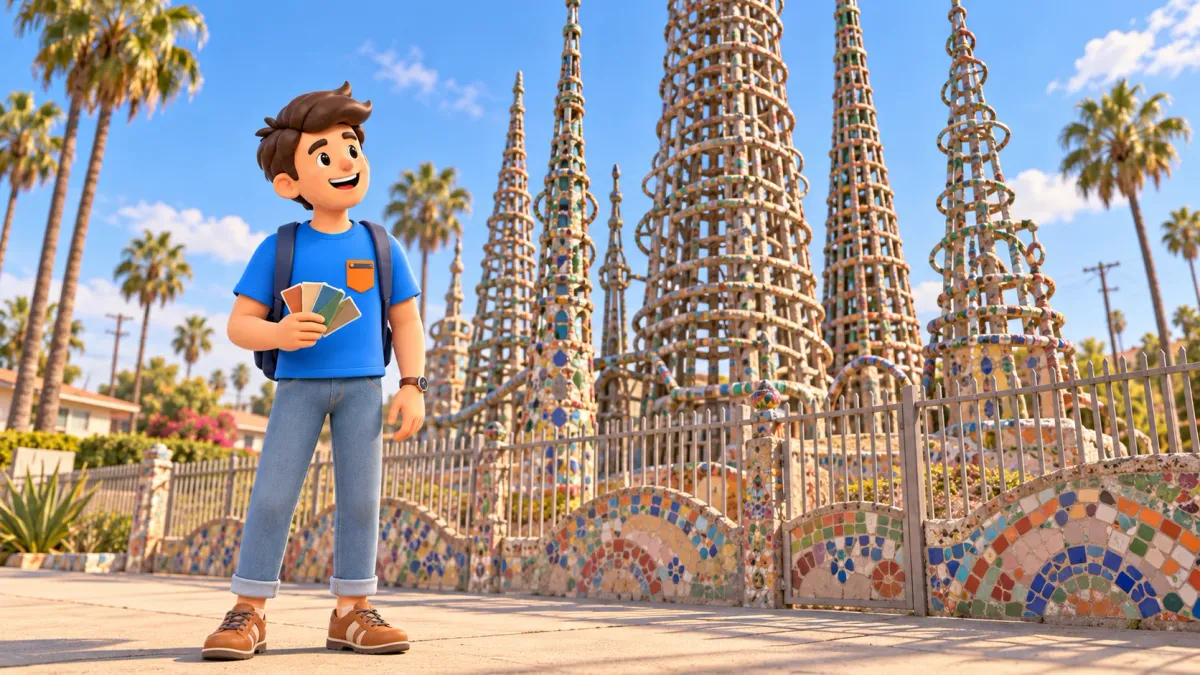
A short introduction to Watts can centre on two places: historic Watts Station and Simon Rodia's towers. The station offers a railway layer of the neighbourhood's history, while the towers provide its artistic image. They need an ordinary urban walking connection, and entering the towers' enclosure requires a place on a guided tour.
Two hours here mean a conditional programme with time to buy a ticket, not a guaranteed journey from every hotel and back. Start outside the historic station, continue to Watts Towers and decide beforehand whether you will return to the beginning. If the tour is your priority, its actual availability matters more than an attractive order of stops.
Check the tour before fixing the walk
The operator's schedule checked on October 17, 2026 lists tours on Thursdays, Fridays and Saturdays. Start times are 11 a.m., 11:30 a.m., noon, 2 p.m., 2:30 p.m. and 3 p.m. Sunday through Wednesday are closed to these public visits. This is not daily unrestricted admission around the bases of the towers.
Try RoadMe to prepare a personal walking or trip plan around your interests, dates, pace and budget. The app makes it much more convenient to connect art, neighbourhood history and the rest of the day in a programme that suits you.
Entry through the gates is only with a guide, and the tour lasts approximately thirty minutes. It is paid, with tickets sold at the Watts Towers Arts Center office on a first-come basis. The operator does not reserve individual places; advance notice of a large group is not a guaranteed reservation. Standard tour capacity is twenty visitors.
Payment is by cash or cheque. Do not count on paying by phone or bank card at the desk. Tours do not run on rainy days or federal holidays; after earlier rain, check availability with the centre. These conditions govern guided entry rather than promising that closed gates can be bypassed for an independent visit.

What two hours could look like
On an operating day, one option begins near the station around 10:30 a.m. Allow fifteen minutes for an exterior look, twenty to walk toward the towers and twenty-five for ticket purchase and waiting for a hoped-for 11:30 start. The tour then takes thirty minutes, followed by ten for a pause and twenty to return. Together that creates a two-hour window.
This is an editorial outline, not a field measurement or confirmation that the chosen departure has space. A full group, slower ticketing or a longer walk changes the calculation. Do not set another firm booking exactly two hours after starting. When the tour matters, a wider window is preferable to making up delays by rushing.
Travel to Watts is outside that calculation. Count leaving your accommodation, transport, the approach to the historic station and onward return separately. A transport stop containing Watts Towers in its name does not put you at the tour desk. The monument, station and permitted pick-up point perform different practical roles.
Watts Station: a historic building, not the Metro platform
The historic station's exterior reference is 1686 East 103rd Street. The building belongs to the Pacific Electric story and the early twentieth century. Its value for this walk is a chance to consider how transport organised the neighbourhood's development before the towers became its familiar artistic image.
Historic Watts Station and the modern 103rd Street/Watts Towers stop are different places. Do not treat the old building as a working ticket office or an unrestricted passage to the modern platform. Stay in public pedestrian areas. Railway rules still apply beside a historic monument.
This programme does not promise an open interior museum or entry to the station's rooms. An exterior look at the volume, scale and relationship with the street is enough. A brief stop supplies context without requiring entry through any open door. If barriers apply, select a permitted external viewing position.
The station is not a reason to take close-up photographs of passengers. Look at the building and its street setting instead. This is an everyday city neighbourhood where residents make ordinary journeys, not a stage provided for visitors. Keeping the passage clear and considering other people makes the stop work better for everyone.
Walk to the towers with ordinary city time
The towers stand on East 107th Street; California State Parks lists the monument at 1765 East 107th Street. Use available public pavements and permitted crossings, following current signs. This outline does not propose a shortcut along railway tracks, through service areas or across closed ground.
Twenty minutes is an allowance for the connection, not a compulsory pace suitable for everyone. Crossings, signal waits and personal requirements may extend it. If a particular step-free connection or surface matters, check the selected path beforehand. This article does not establish accessibility for every part of the link.
There is no need to seek extra compulsory landmarks on the way. The short walk already has two clear anchors. Arriving at the centre with time in hand is more useful than losing the tour window to another detour. If time becomes tight, shorten the initial station look while preserving an unhurried walk and normal crossing rules.
At Watts Towers: silhouette before detail
From an available public position, look first at the whole composition. The openwork verticals differ from a conventional tower climbed for a panorama. These are artistic structures, not an observation deck. The programme includes no climb, walking on metal elements or independent exploration of every connection.
California State Parks describes steel structures wrapped in wire mesh, covered with mortar and inlaid with tile, glass, shell, pottery and rocks. Those few materials explain the character: small individual pieces create a large silhouette. The long story of construction deserves a separate account and should not displace practical organisation here.
During the tour, remain with the group and follow the guide. Do not touch decoration, cross barriers or hang back to obtain a photograph without people. Being closer to details matters precisely because access is organised. It does not permit using the monument as an unrestricted exploration area.
Food and drinks are not allowed inside the enclosure. Take a necessary pause before entry or after leaving in an appropriate permitted place. Do not assume a thirty-minute tour can be interrupted to buy water and then rejoined without question. Preparation lets you listen rather than solve practical problems in the middle of the group.
In RoadMe, prepare a complete personal trip plan more conveniently, combining unusual art with the history that interests you and your preferred pace. Try distributing cultural experiences across your days while preserving time for walking and rest.

Choose a question rather than every detail
Before the tour, pick one subject you want to understand: the artistic idea, the materials or preservation. A focused question helps connect what you see with the guide's explanation without demanding the entire history in thirty minutes. Afterwards, compare one observation with your companions. Different interests can make a short visit substantial without adding more landmarks or leaving the permitted route.
If the tour does not happen
A full group, rain or a change in the centre's operation is a reason to revise the programme. An older visitor timetable is not grounds for arguing with staff. Check access with the operator and do not seek another way through a closure. Viewing from available public space and entering the gates are different experiences with different conditions.
If no place is available, decide whether you are prepared to wait for another tour and extend the visit. A long gap between departures does not disappear because you initially allocated two hours. Sometimes a limited exterior look or returning another day makes more sense. An unsuccessful tour attempt does not require compensation through a random lengthy neighbourhood circuit.
With a strict window, put the towers first and leave the historic station for the finish if time remains. That changes the sequence while retaining the walk's two subjects. Agree on it with companions beforehand so nobody waits at a different starting point while the group is assembling at the centre.
Give the neighbourhood respectful attention
Watts has a history broader than two landmarks or the familiar image of the towers. A short visit can acknowledge that without reducing surrounding streets to stereotypes. Neither an absolute safety promise nor dramatic stories should replace useful, checked information. Choose a clear daylight programme and current public connections.
Respect residential entrances and everyday routes. Do not enter private ground for another camera angle, block the pavement with a group or photograph somebody's windows. If you want to understand more, listen to the guide's available explanation and ask questions about the monument. Respectful interest is more useful than treating every encounter as local colour.
Take pictures within the centre's current rules. A few selected images can preserve the impression without constantly falling behind the group. It may be more helpful to remember one material or shape and then return to the overall view. A short tour can remain substantial without inspecting every decorative fragment.
Finish with a clear onward journey
Before starting, decide whether you return to the historic station, head toward the modern platform or meet transport at another permitted location. Those are different finishes. For general organisation, see Los Angeles without a car, while checking the approaches and actual connection for your particular day.
Bring water for time outside the enclosure, comfortable footwear and sun protection. Protect a pause and your onward travel in advance. A good result is noticing the relationship between the older railway setting and the artistic monument, walking between them without hurry and finishing with an understandable return plan.


