
Vista Alegre: a walk among palaces, gardens and historic glasshouses
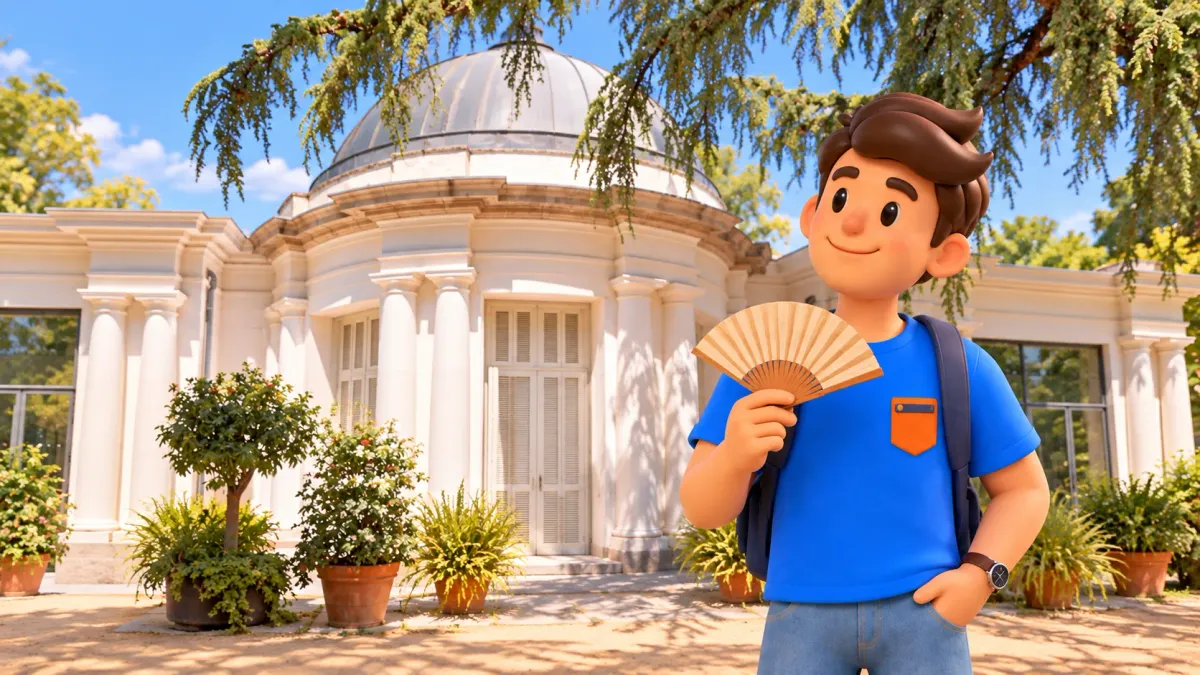
For a first visit to Vista Alegre, allow approximately two and a half hours and walk from Puerta Real on General Ricardos to the Arnedo exit. Between them, connect Estufa Grande, exterior views around the Old Palace, the landscape garden and the New Palace parterre. This is a walk through a changing historic ensemble in Carabanchel. Buildings matter, but so do their relationships with water and trees. You do not need a sequence of indoor admissions to understand why the grounds are interesting.
The important recent change is the Arnedo entrance, opened on 3 June 2026. It allows a finish on another side of the garden. Vista Alegre should nevertheless not be treated as one museum with permanent access to every palace and glasshouse room. Restoration continues, with separate restrictions in different areas. The main plan uses authorised garden routes and exterior views. Approaches, lunch and subsequent journeys are additional. Timings are editorial estimates without a timed field walk, rather than measured promises for every possible path.
Choose the time and the correct entrance
Start at Puerta Real, Calle General Ricardos, 179. The name Vista Alegre can also lead to nearby Palacio Vistalegre, a multipurpose arena which is a different destination. For this walk, you need the estate entrance. Oporto station on lines 5 and 6 and Vista Alegre on line 5 are useful transport references; add time from your selected metro exit to the gate. A palace marker inside the grounds is not an independent entrance from a city street.
It is more convenient to arrange this outing with RoadMe, which develops a personal trip plan around your interests, dates and pace. Choose gardens, architecture and relaxed walks to organise your Madrid days without continually assembling the programme by hand.
At the check date, 16 October 2026, the owner listed daily opening at 09:00. Closing varies: 18:00 from November through February and during October’s last week; 19:00 in March and the rest of October; 20:00 in April and September; 21:00 from May through August. The owner restricts entry fifteen minutes before closing. Choose a morning or another sufficiently long period for the whole walk, rather than calculating from the last possible admission. There must also be time to leave.
Entry is free until capacity is reached. Rules prohibit bringing food or drink, ordinary pet access, bicycles, skates and balls. Plan refreshment before visiting or after leaving, with a duration appropriate to the weather and your needs. Activities are not permitted on lawns and planted areas. This is a historic garden with a designated visiting route, rather than somewhere to settle on any attractive patch of grass. Weather warnings and ongoing works may also change the available route on the day.
A plan for two and a half hours
- 10 minutes — Puerta Real and orientation. Check the open route and current signs.
- 25 minutes — Estufa Grande, Old Palace and gallery. Select available exterior views, without requiring admission to buildings.
- 30 minutes — romantic garden, Ría and trees. Changing perspectives and short pauses on permitted paths.
- 30 minutes — New Palace and parterre. The overall façade and the geometry of its garden.
- 25 minutes — Arnedo garden. The restored connection and the water-supply theme near the Navarro waterwheel where approaches are open.
- 15 minutes — finish at Arnedo, 11, plus 15 minutes spare. Metro connections and a café table are additional.
The total is one hundred and fifty minutes, including connections and short pauses. It is a selective introduction to the authorised ensemble, not a circuit of the entire estate. Follow the entrance plan and current signs: works or temporary restrictions may change the available sequence. If Arnedo is unavailable, choose another authorised exit and reassess the time. Fifteen spare minutes are not a guarantee for any diversion. Finish with an understandable onward direction, rather than assuming every visible gate provides an exit.
A nearby interesting building does not automatically add an independent museum visit within each allocation. That can quietly turn a relaxed walk into a much longer programme. If a separate exhibition space is operating and interests you, establish its conditions and required time before extending the route deliberately. The basic idea remains simple: see different ways to compose a garden and understand how owners used them. An additional interior can be worthwhile, but is a conscious choice beyond the main plan.
Estufa Grande: creating a different climate
The name Estufa Grande recalls warmth. Historic plant houses sheltered species unsuited to Madrid’s ordinary winter air. Enthusiasm for exotic plants met the technical task of maintaining their environment. Instead of expecting one enormous glass palace, notice the building’s long arrangement and connection with the Old Palace. The surviving ensemble includes reconstruction and later alterations; it is not an entirely unchanged nineteenth-century greenhouse. Looking at the available exterior already introduces the relationship between architecture, cultivation and the carefully controlled world of a country estate.
The Queen’s Bath, Baño de la Reina, belongs to this story. A circular marble basin with concentric steps used the same heat and steam system that helped create the plant-house climate. This small detail shows practical infrastructure also enabling leisure. Its mention does not mean you can enter and examine the basin every day. The timing does not depend on seeing it, and no modern bathing experience is suggested. Treat it as an explanation of the estate’s design, with any actual viewing dependent on current access.
María Cristina de Borbón bought the property in 1832. She altered existing buildings, commissioned new ones and developed gardens inspired by landscape painting. That intention explains the relationship between architecture and greenery: buildings belonged to a view, while walking carried guests between different pictures. You need not memorise every architect to notice the arrangement. Look along the building, then turn towards the garden. The change of direction provides a direct introduction to the idea before any detailed historical explanation or additional interior visit.

Old Palace and gallery: recognise different periods
Palacio Viejo is associated with the earlier Casa de Baños, a leisure establishment with bathing rooms, halls and a garden for entertainment. The building later changed functions along with the estate. Read Vista Alegre as accumulated periods, rather than the scenery of a single royal season. Appearance, present use and original history can belong to different dates. Keeping that distinction in mind avoids assigning every visible detail to the queen’s private life or assuming a classical architectural form must come from the earliest phase.
The gallery connecting older buildings belongs to twentieth-century changes. Columns and repeated openings create a strong perspective, but classical design does not automatically make it contemporary with the original palace. Observe repeated supports, light between them and the upper enclosed corridor above the lower open section. It shows later architecture entering an existing ensemble. Educational buildings are not freely accessible museum halls simply because they occupy a historic estate. The suggested walk remains on authorised public routes, without promising access to every corridor or stair.
The romantic garden: follow a changing view
In the landscape section, notice curving paths and the alternation between open and more enclosed spaces. The experience develops through movement. What initially seems background may become the focus a few minutes later. This makes a romantic garden easier to appreciate than a list of plants and names. Pause on a permitted path, look back and compare that scene with the view ahead. Leaving the route for a lawn is unnecessary. Small changes in perspective supply the discovery without requiring every historic feature.
The Ría is an artificial water feature historically used for boating. That explains the garden’s design, without promising current boat hire or independent access to the water. At the Plaza de las Estatuas, distinguish the name from present remains: the historical marble statues have left their pedestals. Notice how a composition can still mark out space after losing some elements. Avoid mentally adding every item in an old account to the present garden. Looking at what survives is itself part of understanding its history.
The large Lebanon cedar is included in the region’s catalogue of exceptional trees. Its interest does not depend on a precise age or height. Look at the spread of the crown and the scale it gives the surrounding space. Measurements from earlier years should not be presented as today’s figures. For this outing, a pause at an appropriate distance and comparison with nearby silhouettes are enough. You can appreciate an important tree without approaching its trunk for a compulsory photograph or attempting a botanical inventory.
New Palace and parterre: a more ceremonial image
The New Palace, associated with the Marquis of Salamanca, presents another side of the ensemble. Its construction began under María Cristina, with Salamanca continuing work after acquiring the estate in 1859. Earlier working buildings also belong to the story: palace construction used foundations and walls from a soap factory. This connects the attractive estate with Carabanchel’s practical life. Leisure and representation did not emerge on an empty site. The history gives an ordinary exterior view more meaning without requiring a complete account of every owner.
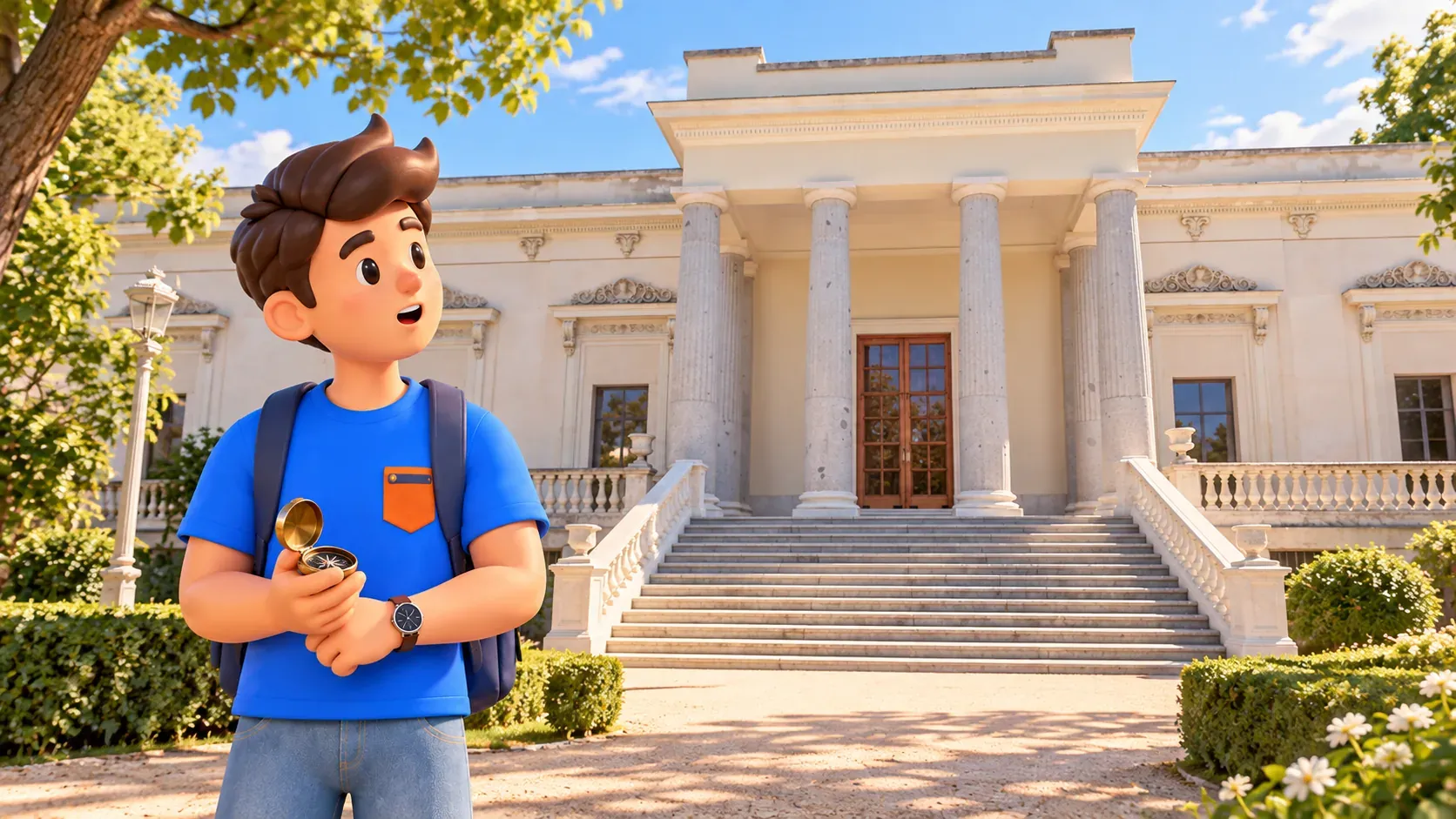
From a permitted position, study the portico and broad staircase. The columns were reused from a project for Plaza de Oriente; that does not mean they were removed from the existing Royal Palace. Then look towards the parterre. Its geometry introduces a different rhythm from the curving landscape garden. Exterior observation is enough for that comparison. The marquis’s historical collection is not evidence of a present museum display in accessible rooms. Make a separate decision if a current, confirmed interior opportunity becomes relevant to your visit.
To combine garden walks with art and historic neighbourhoods, try a personal itinerary in RoadMe. The app makes it easier to distribute your trip around your interests and pace, preserving time for each chosen experience and for rest.
Following the sale to the state in 1886, the estate was adapted for charitable and educational purposes. That helps explain alterations and the variety of its present territory. The gardens opened for visits in 2021, but restoration did not finish in a single event. News of a planned room refurbishment or future exhibition use does not confirm an exhibition is operating now. A visit focused on gardens and exterior architecture can remain satisfying while these changes take place gradually, with its expectations set accordingly.
Arnedo: finish through a new connection
Give the last section to the restored Arnedo garden and permitted approaches around the Navarro waterworks. The historic waterwheel lifted water using animal power, another trace of the estate’s working side. This is no promise of a functioning mechanism or ride. The June 2026 opening matters to the neighbourhood too: the historic garden now connects General Ricardos with the direction of Plaza de Carabanchel. Finish at the pavilions on Calle Arnedo, 11, following current signs rather than an older description with only one entrance.
After leaving, decide on lunch and onward travel. For a different comparison on another day, consider our walk through Molinos and Torre Arias. Vista Alegre supplies its own complete story, from plant-house climates and palace views to new public connections. Two and a half hours allow you to notice those relationships without turning the outing into a directory of every estate building. The garden remains an experience to enjoy, rather than an inventory that must be exhausted.


