
Quinta de los Molinos and Torre Arias: a walk through two different gardens

Quinta de los Molinos and Torre Arias combine into a walk of approximately three and a half hours. Begin at the Molinos entrance on Calle de Alcalá, move from former agricultural plots towards the northern landscape garden, then reach the neighbouring estate through its Entrequintas entrance. At Torre Arias, the emphasis shifts towards an older country property, its working life and its history. This is a complete outing in eastern Madrid, without a compulsory return to the first gate or an additional museum appointment.
Almond blossom is a wonderful extra reason to visit, rather than a requirement for the walk. It usually appears in February or March, with dates varying by year. In other months, trees, water, estate buildings and contrasting landscapes remain. The main plan uses open paths and exterior architectural views. Building admissions, children’s activities, guided tours and lunch are outside the three-and-a-half-hour allocation. Travel from the centre and the journey after finishing are additional too. The experience is comparing the estates at an enjoyable pace.
Choose a morning for both estates
For the combined outing, choose a morning from Tuesday to Sunday, starting around 10:00. Molinos normally opens daily, 06:30–22:00. Torre Arias has separate hours: at the check date, 16 October 2026, municipal tourism information listed 09:00–18:00 from October through March and 08:00–21:30 from April through September. The city’s park directory marks Monday closed except public holidays, so this plan avoids an ordinary Monday. A shared morning window is more useful than assuming the two neighbouring parks follow identical arrangements.
It is more convenient to fit these outings into your trip with RoadMe, which develops a personal plan around your interests, dates and pace. Choose nature, architecture and relaxed walks to create a connected Madrid itinerary with a suitable level of activity each day.
Both parks are free to enter. Check current notices before travelling: poor weather can cause temporary closures or barriers around particular areas. Parts of Torre Arias are undergoing restoration, and the palace is not open for an ordinary interior visit. This walk does not depend on entering it. Knowing that beforehand clarifies the purpose of the journey: understand former country estates, rather than arrive expecting a museum admission that is unavailable. Open paths and permitted views provide the basic experience.
For the start, use Suanzes station on line 5 and the Molinos entrance at Calle de Alcalá, 527. A large park marker is less precise than an agreed gate. The finish is the Torre Arias exit at Calle de Alcalá, 551, with Torre Arias station on the same line serving as a nearby reference. Metro approaches and travel need extra time. If meeting others, specify the first entrance fully so nobody begins at the opposite end of the grounds.
Distribute three and a half hours
- 15 minutes — Molinos entrance and orientation. Check the local plan and select open paths.
- 35 minutes — southern section. Almond planting and the former estate’s agricultural character.
- 45 minutes — northern section. Looser landscape, the water theme and exterior views of estate buildings, including Casa del Reloj where an approach is available.
- 30 minutes — connection between parks. Leave towards the east, use neighbourhood paths around Dr. Zamenhof and reach Entrequintas.
- 60 minutes — Torre Arias. A selective walk on open routes, noticing garden and working-estate history.
- 10 minutes — exit to Alcalá, plus 15 minutes spare. No new distant branch before finishing.
These allocations total two hundred and ten minutes, including internal connections and short pauses. They are editorial estimates without a timed field walk. In each park, choose a portion of available space rather than every path. Extend the outing for long blossom photography, sketching or a children’s activity. Identifying that priority beforehand is better than treating the very experience you came for as a delay. The timing should support the visit, not make an especially interesting place feel like an inconvenience.
The Entrequintas connection assumes that entrance is operating normally. If it is temporarily unavailable, avoid following an unverified shortcut beside a fence. Reassess the approach to Torre Arias’s main Alcalá entrance and add time, or leave the second garden for another day. Fifteen spare minutes help with a small delay, not any possible diversion. The combined walk should remain understandable on the ground. A revised plan is preferable to forcing the original calculation when a necessary entrance is closed.
Molinos: a garden that also worked
The southern section retains a more agricultural character. Look beyond an individual attractive tree to the rhythm of planting, the spaces between trunks and the pattern of open plots. Almond blossom makes this particularly striking, but even without flowers the landscape differs from a ceremonial city parterre. This was a country property where leisure coexisted with practical land use. That double purpose connects the first estate with the second and gives the walk a theme beyond finding somewhere green outside the centre.
Architect and urban planner César Cort Botí shaped Molinos in the twentieth century. It should therefore not automatically be assigned the same age as neighbouring Torre Arias. Cort combined architecture, vegetation and practical systems in his own estate on the growing city’s edge. In 2025, the complex received regional protection as a historic ensemble. The useful point is recognition of the place as a whole, including planting and its water system, rather than only an attractive building considered separately from everything around it.

Northwards: water, windmills and the Clock House
The northern atmosphere is more landscaped. Different vegetation, curved lines and water features replace an emphasis on regular planting. You need not find a rigid boundary: notice how movement changes and where your gaze goes. Follow open paths, selecting available exterior views. Not every building in a historic garden is a separate museum, and park hours are not admission hours for every structure. This section allows time to look without adding an assumed interior visit or a scheduled cultural activity to the main walk.
Los Molinos takes its name from two windmills brought from the United States in the 1920s to lift water from wells. They supported irrigation, rather than grinding grain. This short story changes the meaning of the name: the mills reflect the estate’s engineering, rather than merely a decorative reference to Don Quixote. Ponds and irrigation features also belong to a wider system. Understanding its historic operation does not guarantee every mechanism or fountain works today. Observe surviving elements without expecting a demonstration.
Casa del Reloj, the Clock House, stands out through its square tower and recalls earlier residential and agricultural functions. It belongs inside Molinos; similarly named places or accidentally attached addresses in other towns are unrelated. View it from permitted approaches without requiring entry. For the comparison, remember one idea: architecture here helps explain a twentieth-century estate, while Torre Arias represents a much longer sequence of country-house changes. You do not need an exhaustive architectural inventory to appreciate the different historical scales.
Molinos also contains Espacio Abierto, a cultural venue for children, teenagers and families. If its programme is your priority, choose a specific activity and check participation conditions beforehand. This is an additional visit rather than an automatic brief stop. The garden portion is enough for the main route. That avoids promising entertainment which follows another timetable, targets a particular age or requires booking. A family can adapt the whole outing around an activity, but should allow the time it actually needs.

Entrequintas: connecting two separate places
Torre Arias’s Entrequintas entrance opened in December 2024, improving its connection with Molinos. The parks did not become one continuously enclosed garden. First leave Molinos, follow neighbourhood connections towards Dr. Zamenhof and the adjoining area, then enter Torre Arias. Use current navigation and signs. The allocation of thirty minutes covers that complete transition, rather than an imaginary instant step through a shared doorway. It includes changing surroundings and finding the correct entrance without pretending the whole journey stays inside landscaped grounds.
The wooden walkway belongs to the approach within Torre Arias. Its design also relates to agricultural history: the city highlights the old threshing area and fields. Recall Molinos’s planting and look for a common theme. Country life involved growing plants, storing produce and managing water, as well as enjoying the view from a house. This makes the connection part of the route’s meaning. Even before the historic core, you can start comparing a landscape of work with the image of a garden designed for leisure.
Torre Arias: an estate beyond the palace façade
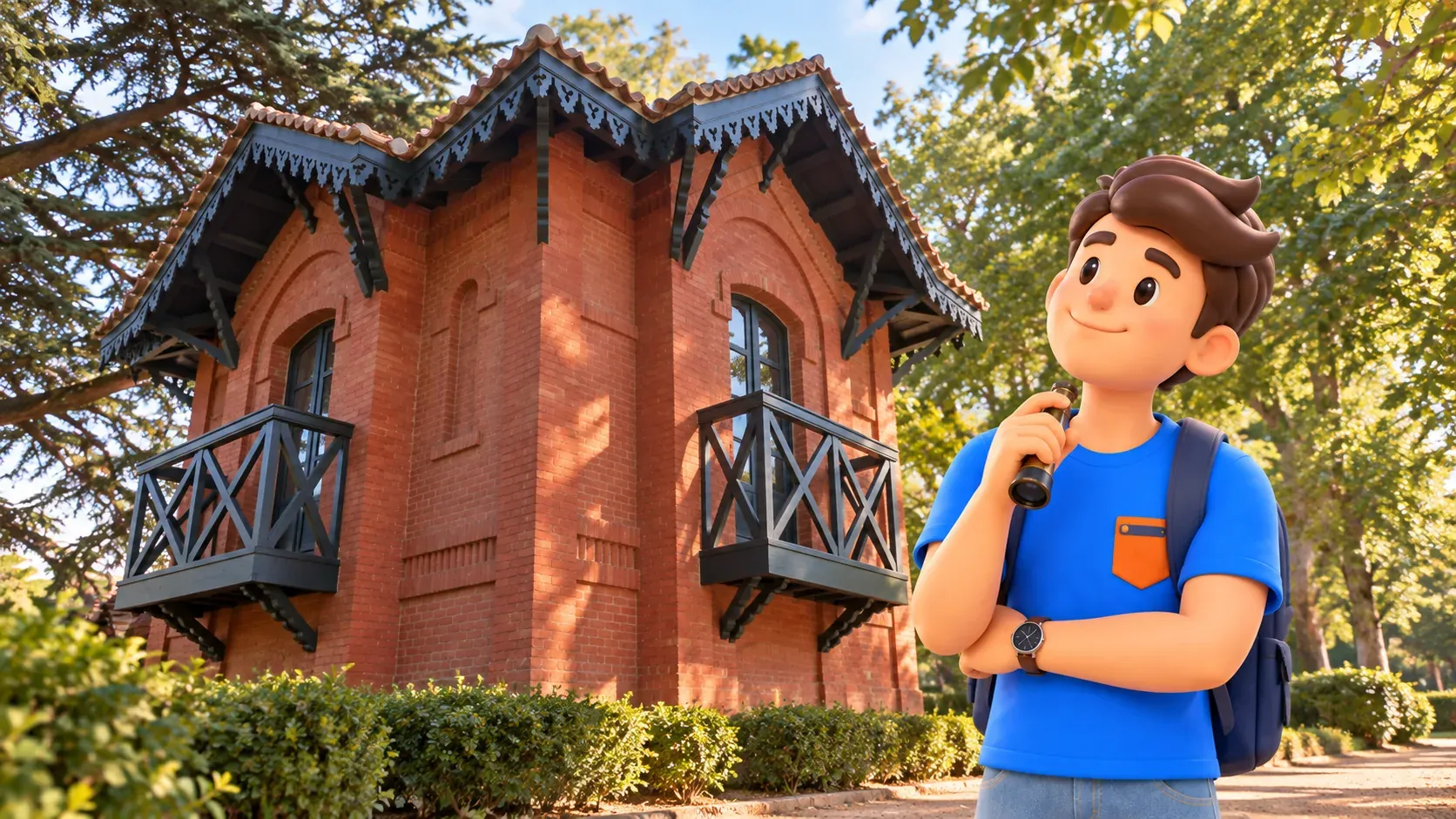
Torre Arias originated in the sixteenth century in old Canillejas, but the present palace is not an unchanged building from that period. Its appearance owes much to nineteenth-century alterations under the Marquis of Bedmar. Red brick and a clock tower make a distinctive country-house image. Where an open route permits a view, look at the overall silhouette. There is no need to approach a closed area for details. The plan includes no interior palace visit and makes no promise of access to restricted restoration areas.
The estate combined pleasure with productive work: gardens, vegetable plots, water supply and buildings for practical activities. Looking this way reveals more than one attractive façade. Compare a more ceremonial space with somewhere that suggests the working property, following permitted paths. Many old buildings are unavailable, and restoration continues to change the complex. Historical descriptions of stables, a greenhouse or agricultural buildings are not evidence that you can enter them. The value lies partly in reading how different purposes fitted together across the landscape.
To combine estate walks with museums and other neighbourhoods, try a personal itinerary in RoadMe. The app makes it easier to organise the journey around your preferences and pace, keeping space for the places that interest you and for unhurried breaks.
Torre Arias opened to the general public in 2016, and the estate and palace received historic-ensemble protection in 2022. Unlike Molinos’s strong blossom association, this part rewards attention to the overall organisation of an old property. Notice how garden and working elements coexist, with mature trees providing scale. An hour of selective walking can reveal the contrast without searching for every feature. Choose pauses according to the group’s interests: a tree, water element or building view. Particular bird sightings are not guaranteed, and a complete botanical list is unnecessary.
Finish at Alcalá and decide what follows
Leave by Torre Arias’s main Alcalá entrance with time before closing, then choose lunch in the area or a metro journey back. A restaurant table and travel to a later appointment are outside the two hundred and ten minutes. Ordinary pet access is prohibited at Torre Arias, so this is not a dog-walking itinerary. Consider actual surfaces and routes if anyone needs particular access conditions or a smaller amount of walking. The suggested combination can be shortened to one estate when that suits the group better.
For another day with theatrical garden architecture, consider our half-day walk through El Capricho. Today’s pairing has a different purpose: compare two neighbouring properties where nature, leisure and work developed differently. Blossom may enhance the experience but does not replace it. Beyond spring, the route still shows how former country life remains legible within contemporary Madrid, giving the outing a reason beyond the brief flowering season and leaving its pace open to your own interests.


