
Venice’s Scuole Explained: Confraternities, Art and a Three-Hour Walk
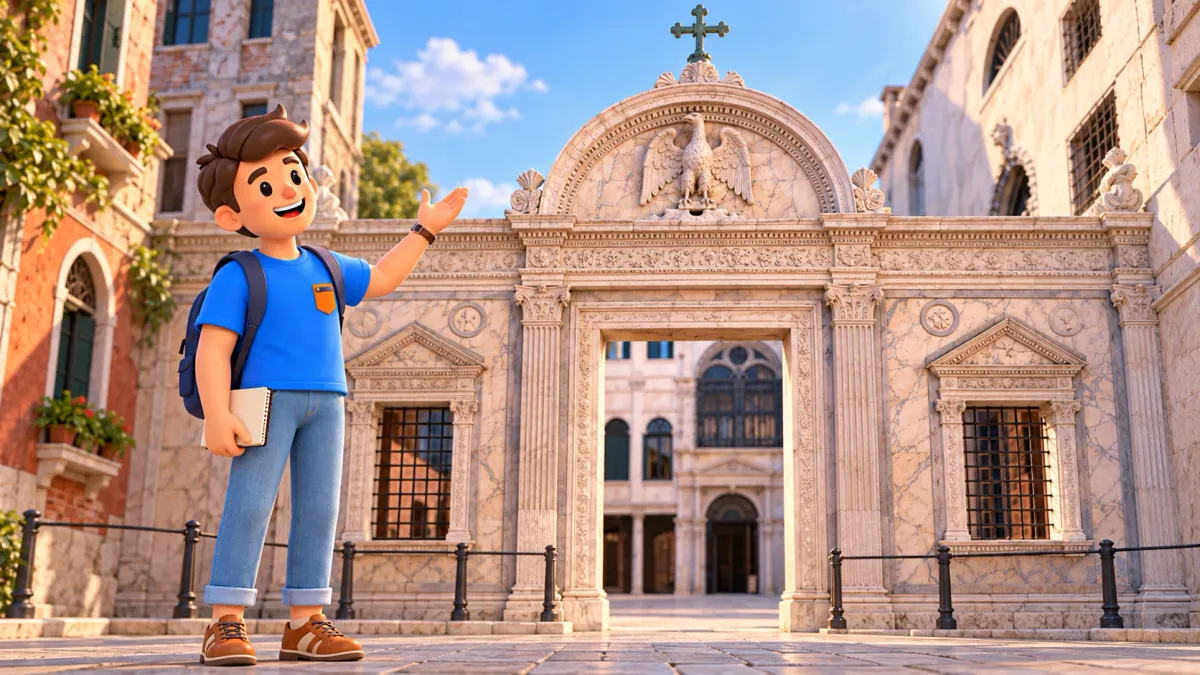
Venice’s scuole were historical lay associations connected with religious life, mutual support, trades or communities. Here, scuola should not be understood simply as an ordinary school with children’s classrooms. The word can describe an organisation and its headquarters. With that distinction, an elaborate portal becomes more than decoration: it introduces the organised life of a group within the city.
For an introduction, walk from San Giovanni Evangelista to San Rocco and Carmini. Allow approximately three hours, including coffee, all local walking and exterior observation. Interiors are excluded. Accommodation journeys, return and a full lunch are additional. The walk helps select a later visit rather than making every scuola another compulsory museum entrance on the same day.
A building represents a community
Separate three things: the association, its meeting place and a neighbouring church. They may share a dedication and history without being one building or one ticket. San Rocco makes that distinction particularly useful. Understanding their purposes reveals more than simply adding another recognisable attraction name to a list of places you have passed.
Try RoadMe to have a personal plan worked out for your whole trip around your interests, dates and pace. The app makes combining confraternity history, chosen art visits and rest across different days much easier, giving each theme suitable time.
Scuole reveal Venice beyond doges and private palaces. People organised for worship, mutual aid, professional interests or a shared community. These associations had responsibilities, rules and leadership. Their buildings expressed collective importance; art commissions represented more than an individual owner’s taste. They also conveyed how a group wished to present itself within the city.
Lay does not mean nonreligious: it distinguishes members from the clergy. A scuola could have a strong devotional identity while providing assistance. There is no need to choose between faith and society as explanations. In historical urban life, those concerns could belong together, with the particular relationship depending on the organisation and its period.
Grande and piccola describe historical status
Venice had different kinds of scuole: trade and professional associations, communities linked by origin, and devotional confraternities. Scuole grandi and scuole piccole refer to historical arrangements and institutional position. Grande does not necessarily identify the tallest façade, and piccola does not make a place less interesting. A traveller’s present-day judgement is separate from an earlier classification.
Do not infer the category from doorway size or window count. That needs institutional history. On the walk, notice how the association presented itself, where its entrance lay and how its building differed from the neighbouring church. Those observations suggest a next question: would you rather explore painting, meeting-space architecture or the community’s social history?
A scuola had its own statute, called a mariegola, setting out aims, duties and collective organisation. In this context, banca names a governing body rather than necessarily a commercial bank. A few understood terms are more useful than memorising offices: they show a durable association rather than an accidental gathering beside an attractive building.
Describing every scuola as an identical male club also oversimplifies. Carmini’s history includes a women’s community, while the later organisation’s statute explicitly refers to brothers and sisters. One example should not be projected onto every confraternity. It instead encourages attention to particular histories rather than replacing varied urban life with one convenient formula.
A three-hour walk with no required interiors
Start on the public approach to Campiello della Scuola at San Giovanni Evangelista, outside any access restriction. Continue through the San Stin and Frari area to Campo San Rocco. Afterwards use public streets through San Pantalon to Santa Margherita, then the Carmini scuola on the southwestern side of that square. The main walk ends there.
| Part of the walk | Estimated allowance |
|---|---|
| All outdoor walking, including the café approach | 35 minutes |
| Observation at three scuole | 75 minutes |
| Coffee and rest somewhere suitable | 25 minutes |
| Comparing impressions and relaxed pauses | 25 minutes |
| Flexibility | 20 minutes |
Total: 180 minutes, an editorial estimate without an author-measured trail. Local connections share 35 minutes and the three stops share 75, rather than receiving those allowances each. Accommodation access, transport waiting, return and a full lunch are additional. Buying coffee is not a condition of entering a square, but the programme deliberately leaves time for rest.
No Grand Canal crossing or boat journey links these stops. Small bridges and steps remain; the whole route has not been verified as barrier-free. Check individual turns on a current map. A historic portal does not grant entry to every courtyard. If access is closed, remain at the public boundary instead of looking for a service door.

San Giovanni Evangelista: institution and building have different ages
The San Giovanni Evangelista confraternity was founded in 1261, but that does not date every part of the present complex. The organisation moved, rebuilt and decorated over different periods. Venice often separates a community’s age from that of its visible stone. A medieval foundation does not make an entire later façade medieval too.
A memorable feature is the marble entrance-court screen created by Pietro Lombardo in 1478–1481. Above the opening, a semicircular top contains an eagle, the symbol of John the Evangelist. Do not confuse it with St Mark’s winged lion. Observe the whole outline, then the bird and framing, keeping the entrance clear and leaving stone details untouched.
Mauro Codussi’s grand staircase is another part of the complex, linked to a commission in 1498. It is inside and excluded from the three outdoor hours. Keep the names distinct: Lombardo’s portal and Codussi’s staircase explain different stages and tasks. If you later enter, that context helps reveal the arrangement rather than merely another photogenic feature.
The confraternity’s receipt in 1369 of a relic venerated as fragments of the Cross mattered to its commissions and public role. This is the institution’s religious tradition, not a demand that visitors share a belief or treat attribution as scientific proof. Understanding why an object mattered to its community is sufficient for this introduction.
Today the complex combines museum access with events. Interior admission depends on published opening dates rather than a familiar daily tourist hour. Observing the portal from a public position is separate. Current conditions decide whether you may proceed farther; a long-established association does not become an unrestricted, round-the-clock passage through an attractive building.
San Rocco: art commissioned by a group
At San Rocco, change the question: who commissioned the art, and for what place? The lay confraternity was founded in 1478. Its monumental headquarters is known for Tintoretto’s extensive biblical painting cycle. Here art relates to the collective religious space. The exterior walk explains why the interior matters, without replacing the experience of seeing paintings inside.
Identify the scuola building and distinguish it from the Church of San Rocco. A shared saint does not imply one doorway or identical admission conditions. Notice the building’s position in the square and its approaches. This observation needs neither an excursion purchase nor joining an entry queue if you have chosen an exterior introduction today.
The confraternity still exists and pursues charitable activities while caring for its artistic heritage. Think of an active institution with a visitor dimension, rather than an organisation disappearing when its paintings were completed. The building’s history and current uses connect without necessarily being identical. Tourism does not remove its other purposes or its own arrangements.
If painting particularly appeals, save a substantial interior visit for suitable time. Tintoretto deserves more than leftover minutes between exterior stops. Understanding the commissioner leads naturally to composition, light and images working within a room. That next step requires its own indoor allowance, which the main table does not conceal among ordinary pauses.
Carmini: assistance, rules and a building’s history
Follow public streets through San Pantalon to Santa Margherita. A café pause can fit here after checking menu, service and suitable seating. Find the Carmini scuola on the square’s southwestern side. Do not automatically substitute the neighbouring church: a shared history with Carmelite religious life does not make the two places one room or one visitor display.
Carmini recalls support within a community. The later sixteenth-century association included brothers and sisters, and its mariegola defined duties and shared life. Behind the façade stands a network of responsibilities as well as art. Imagine people for whom membership offered practical support, without inventing a particular charitable event or claiming to have witnessed historical life.
The building developed in stages. Francesco Caustello’s project was approved in 1627; Baldassare Longhena participated later in completion. Saying that Longhena made everything would flatten that history. Compare portals and window rhythm without confidently reconstructing every room from one façade. Visible symmetry need not reproduce the exact arrangement of the spaces behind it.
Choose a scale: first the whole building, then one entrance or window. Compare it with San Giovanni Evangelista’s portal and San Rocco’s setting. This need not become a competition for richest decoration. Notice different ways of presenting an association: an entrance boundary, headquarters prominent on a square, and meeting spaces related to ordinary urban surroundings.
Three questions to take away
Who associated here? What did the organisation do for members and the city? Which part are you seeing: façade, entrance, church or meeting room? These questions also help at other scuole without assigning identical statutes, membership and commissions to them. Each place retains a specific history that can be explored separately after the introductory walk.
Set art, architecture or urban history as interests in RoadMe to help work out a personal itinerary for your entire trip. The app makes spreading substantial visits and short walks between days much easier, preserving time for details you really want to explore.
Keep the rhythm if a portal is temporarily unavailable for close observation. Looking from a permitted public place or shortening the outing works better than entering a restricted courtyard to complete a list. Rain and high water may change duration. Do not settle on steps, bridges or canal edges; choose appropriate seating and leave passage clear.

Adding one interior visit
If you choose one scuola interior, add approximately 90 minutes to the main 180: roughly four and a half hours. Admission delays beyond the available margin extend that total. This does not promise every collection in full. The other two remain exterior stops; three nearby addresses do not mean three substantial interiors fit into the original three hours.
Choose a date from that institution’s calendar first. San Giovanni Evangelista opens its museum when rooms are not in event use. San Rocco’s exceptions override general hours: for example, it is closed on 19 October and 3 November 2026. Such limits need not cancel the outdoor theme, but they prevent automatically adding an interior whenever you have time.
Carmini also has its own admission conditions. A single city museum pass should not be assumed to include every scuola, nor a building’s ticket its namesake church. Ask about stairs, assistance, belongings and visiting format at your chosen institution. With a pushchair or wheelchair, interior levels and outdoor approaches matter alongside the distance between names.
For further painting, save the Tintoretto route through Venice for another day. For exterior observation, try the walk for reading Venetian façades. Today’s outcome is already valuable: behind buildings you notice people, rules and shared purposes. After that, scuola becomes more than another similar word on a museum sign.


