
Following Tintoretto in Venice: a manageable five-hour art walk
For a first Tintoretto itinerary in Venice, choose two substantial art stops: Madonna dell’Orto and the Scuola Grande di San Rocco. Between them, see the artist’s house from outside, walk across the city and have lunch. Allow around five hours from the first church to your finish on Campo San Rocco.
The main version suits Monday to Saturday when both venues operate normally. Check exceptions before choosing the date: San Rocco publishes shortened days and closures. Your approach to the first stop and journey after the finish are outside these five hours.
Why follow one artist across Venice?
Tintoretto connects ordinary neighbourhood life, religious spaces and major commissions. His paintings remain in settings for which they were made, so distance, wall height, light and room arrangement matter alongside their subjects. The city becomes part of looking at the art.
Try RoadMe for a fully worked-out personal trip plan based on your dates, interests and pace. The app makes it much easier to give Tintoretto proper time within your whole Venice holiday, alongside neighbourhood walks and rest.
You do not need specialist preparation. Start with one question: how does the artist guide your eye through light and movement? A few chosen stops then become a connected experience, with painting titles helping orientation rather than requiring you to memorise dozens of characters.
Agree the scope with companions. One person may concentrate on paintings, another on architecture and the streets between them. Lunch between the two interiors provides space to discuss what you have seen and decide whether everyone still wants the second substantial visit.
The five-hour plan: two interiors
Start at Madonna dell’Orto in Cannaregio and finish on Campo San Rocco in San Polo. Allow 60 minutes for the church including entry, 15 for the house exterior, 60 for all walking, 45 for lunch, 90 for the Scuola, 10 for its ticket, 10 for a short rest and 10 of flexibility. That totals 300 minutes.
The Scuola’s three principal rooms share the ninety-minute allowance; it is not ninety minutes each. Interior movement belongs to viewing time, while city walking has its own hour. These are planning estimates. Reconsider them if queues, mobility needs or a longer meal change the day.
On a normal suitable date, begin the art visit at Madonna dell’Orto around 10:30 and finish approximately 15:30. This is an example, not an admission promise for every date. Travel to the first church, transport after the finish and all boat waits are additional.
The Church of San Rocco beside the Scuola is outside the main programme. Add around thirty minutes if you also want it, making approximately five and a half hours. Check its hours and admission separately despite the buildings sharing a campo.
Check the calendar before planning the order
Madonna dell’Orto’s art visits run Monday to Saturday, 10:30–17:00, with last entry ten minutes before closing. Sunday worship is not an ordinary sightseeing opening. Use the shorter San Rocco version below for Sunday instead.
The Scuola Grande di San Rocco normally opens 9:30–17:30, with its ticket office closing at 17:00. It lists Christmas Day, New Year’s Day and Easter as closures, plus a separate calendar of exceptions. That calendar takes priority over generic hours in a website footer.
At our check on 17 October 2026, published exceptions were: 17 October, open until 14:00 with last entry 13:30; 18 October, open 13:30–17:30; closed on 19 October and 3 November. These changes do not automatically apply to other dates.
The main church-first itinerary therefore does not work on 17 October: you would reach the Scuola too late. On such a shortened day, choose its separate two-hour morning block and leave Cannaregio for another day. A complete closure is a reason to reschedule the art programme.
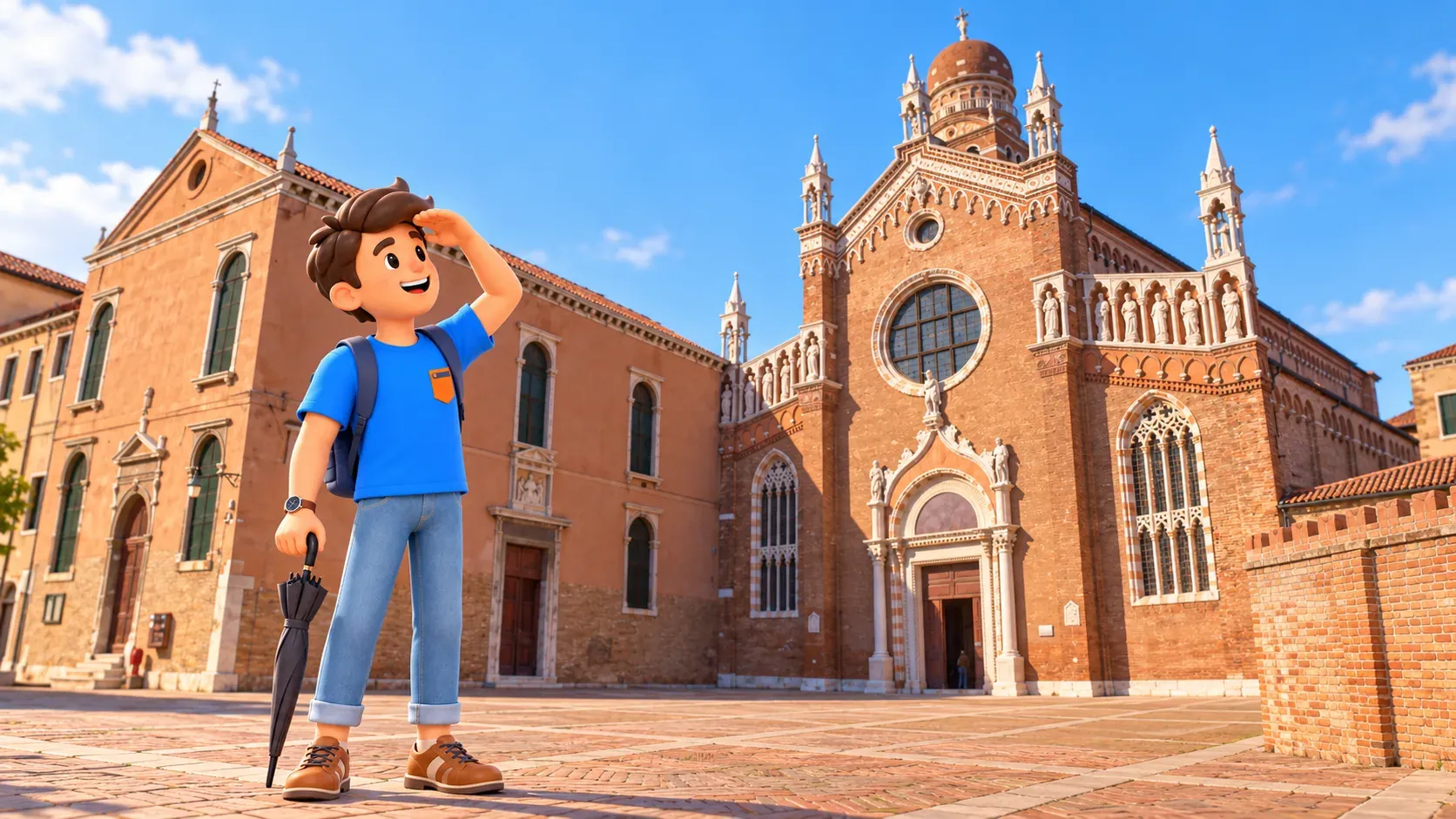
Madonna dell’Orto: start with a neighbourhood connection
The Gothic brick church stands in northern Cannaregio. Tintoretto worked nearby, painted for its interior and is buried here. That connection makes the first stop understandable: a place from his working life, still retaining its religious purpose.
Begin with the Presentation of the Virgin at the Temple. Notice how the staircase leads the eye upwards, while light and dark areas organise movement. You need not identify every figure immediately. First find the direction of the scene and its principal focus.
Next turn to the Last Judgement in the presbytery. Its scale and movement work differently, bringing several episodes into a large vertical space. Compare your response: where does the eye pause, where do you begin reading, and how close do you want to stand?
The Adoration of the Golden Calf offers another way to notice light and diagonals. These three works are useful anchors, not a compulsory complete list. Keep time for the church itself and a quiet acknowledgement of the artist’s burial, following signs about permitted approaches.
The church follows its own routine. During worship, do not try to complete an art route between people praying. Check photography conditions and respect permitted access. A ticket or pass does not open every working or restricted space.
The artist’s house: a brief exterior stop
After the church, head to Fondamenta dei Mori 3399, the house associated with Tintoretto’s life and workshop. This plan includes an exterior view. It does not promise an open house museum, access to rooms or a workshop visit inside.
The artist’s name was Jacopo Robusti. His nickname relates to his father’s trade as a cloth dyer. That small piece of context connects an ordinary city address with the craft environment from which a major painter emerged.
You do not need to tell his entire biography here. Compare the waterfront’s modest scale with the vast canvases still ahead, then continue while keeping residential entrances and the path clear.
Walking to San Rocco: a city break between paintings
Continue through the Mori and Misericordia area towards Ponte delle Guglie, then San Geremia and Lista di Spagna to the Scalzi Bridge. Cross the Grand Canal there towards Santa Croce, continuing through the Rio Marin area to the Frari campo and then San Rocco.
This pedestrian connection uses bridges without a required traghetto or water taxi. The hour covers all walking in the day, including short approaches around the venues. It does not allow several extra church interiors to be added without extending the programme.
The Frari serves as a wayfinding landmark with an exterior view in passing. Visiting the basilica is a separate substantial art experience. If that matters more than the second stop, plan a different day rather than quietly squeezing it into the spare minutes.
Place the forty-five-minute lunch between the interiors, choosing somewhere according to service time and actual progress. No particular restaurant or unmade reservation is essential. The aim is to eat calmly before the Scuola and retain attention for its paintings.

Why the Scuola Grande di San Rocco holds so much Tintoretto
A Venetian scuola was a lay confraternity with devotional and charitable purposes, not an art school in the modern sense. Its building supported meetings and the brotherhood’s public identity. The painting programme became part of that life.
Tintoretto worked on the ensemble for more than twenty years, beginning in the 1560s. The relationship between canvases and rooms is therefore central. These are not simply unrelated pictures on neutral walls: movement, ceiling and spacing between scenes shape their impact.
Orient yourself in the rooms actually available. The Sala Terrena is downstairs; the Sala Capitolare is upstairs, with the Sala dell’Albergo beside it. The last name refers to the brotherhood’s governing room, not a hotel bedroom. A historic staircase connects the levels.
How to use ninety minutes inside
Choose three art focuses, adapting their order to the permitted route. In the Sala dell’Albergo, stop before the Crucifixion of 1565. First take in the overall composition, then trace how light and movement connect its many figures.
Give the Sala Capitolare’s ceiling ensemble some time. Look from a comfortable permitted position and pause rather than forcing yourself to tilt your head back for too long. One chosen scene and its place within the room can be more useful than counting every painting.
Downstairs, choose the Annunciation or Flight into Egypt and compare space and mood with the upper rooms. These large canvases are teleri; calling the entire cycle frescoes is inaccurate. Equally, not every artwork in the building belongs to one artist.
RoadMe makes it much easier to turn an interest in art into a complete personal itinerary for your whole trip. The app works out a plan around your pace and preferences, leaving room for the paintings, neighbourhoods and breaks that matter to you.
If attention fades, finish after a few selected works. Returning to art on another day is reasonable. Skipping a final room does not reduce the visit’s value if it lets you look carefully at what you have already chosen.
After leaving, recall one detail without a photograph: a staircase direction, a bright figure amid a dark crowd or an unusual viewpoint. Compare it with your first church. That short conversation helps preserve your own experience even if secondary painting titles are forgotten.
Tickets, Sunday and a shorter option
The Scuola states that it has no internal online admission sales or in-house guiding service. Distinguish a third-party tour from ordinary entry. Ask what your purchase includes: the adjacent Church of San Rocco has separate admission or a combined option sold at the Scuola entrance.
The Chorus Pass includes Madonna dell’Orto under its network conditions; it should not automatically be extended to the Scuola. Check prices and concessions for your actual programme. A trip-planning app does not replace a museum ticket either.
For a short day, choose only the Scuola: fifteen minutes for arrival, the ticket and short local approaches, ninety for viewing and fifteen for rest and flexibility. That is roughly two hours starting and finishing on Campo San Rocco, without Cannaregio or lunch.
Add the Church of San Rocco for another thirty minutes if desired. Its normal Sunday opening begins at 13:30; check the Scuola’s separate calendar, particularly for 18 October 2026. The combined short version takes about two and a half hours, with travel to and from the campo additional.
Keeping the art day comfortable
Families can look for light, movement and spatial layers rather than turning the visit into a test. Choose duration around a child’s attention. A short visit with a few works is more approachable than promising a detailed explanation of the whole cycle.
The main route includes bridges and historic stairs. For reduced mobility, ask about specific approaches and upper-room access; this is not presented as a step-free itinerary. In rain or with less energy, one interior can be a better choice than the cross-city walk.
For another art day, use the San Giorgio Maggiore visit plan. For a walk alongside art, consider Accademia to the Salute. These are independent programmes with additional time, not unnoticed extensions of five hours already spoken for.


