
Ternes and Courcelles: An Architecture Walk Beyond the Main Boulevards
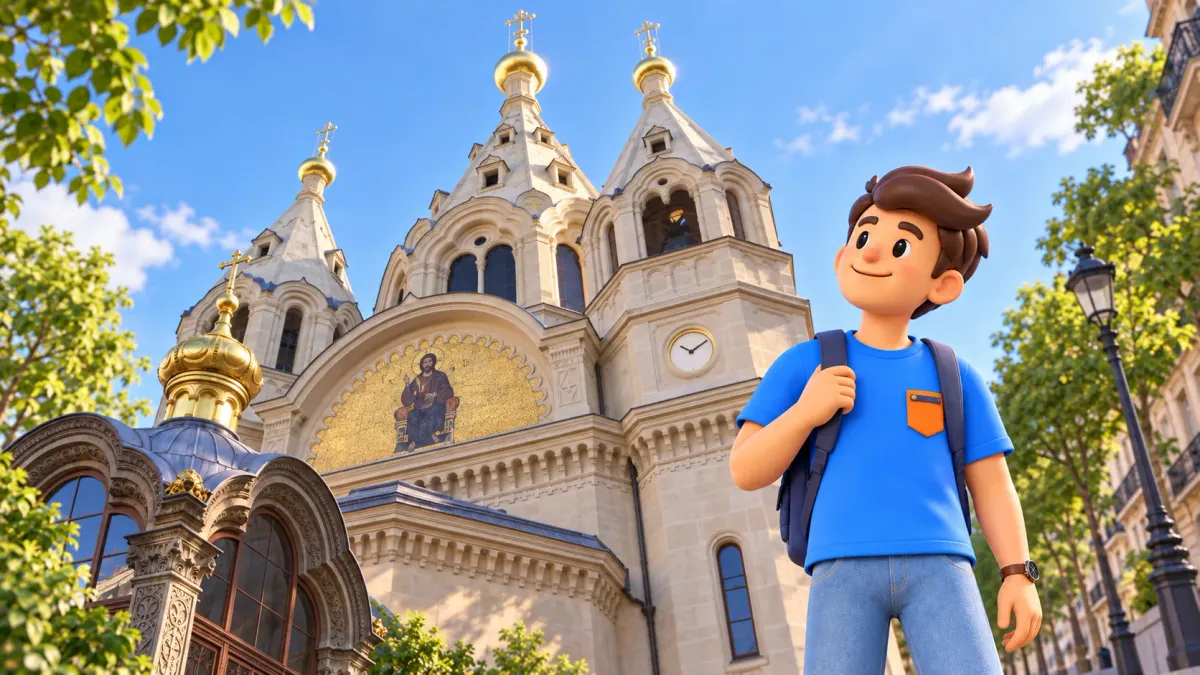
A gold-topped cathedral, an Art Deco concert venue and a pale stone church make an unexpectedly varied walk around Ternes and Courcelles. The buildings stand close enough to compare on foot, yet each expresses a different idea of what an important urban address should look like. This western Paris outing rewards looking up, changing position and noticing how a special building meets an ordinary street.
Allow about two hours for the main route, including a proper pause. It follows public pavements from Place des Ternes to Saint-Ferdinand-des-Ternes, with Alexander Nevsky Cathedral and Salle Pleyel along the way. Exterior observation is the foundation; a church interior is an optional addition when visiting conditions permit. You can also choose a shorter loop that returns to Ternes.
A two-hour walk with three contrasting buildings
Begin on the public pavement at Place des Ternes, near the Métro station. Follow Boulevard de Courcelles, turn into Rue Pierre le Grand and continue to Rue Daru. After the cathedral, walk southwest along Rue Daru towards Rue du Faubourg Saint-Honoré and Salle Pleyel at number 252. Return towards Place des Ternes, then take Avenue des Ternes westwards and turn into Rue d’Armaillé for Saint-Ferdinand.
For a Paris day built around your interests, try RoadMe: the app develops a complete personal itinerary around your dates, pace and budget. Planning walks, cultural visits and rest together in the app makes organising your trip more convenient and efficient.
The street route is approximately 1.4 kilometres. Thirty-five minutes are reserved for walking and crossings, with the rest devoted to buildings and a break: the point is to observe, rather than cover distance quickly. These are planning estimates. Count travel to the starting point, your Métro exit and any later journey separately.
| Part of the exterior walk | Time allowance | What to do |
|---|---|---|
| Orientation at Ternes | 10 minutes | Identify Boulevard de Courcelles and the first turn |
| All street walking and crossings | 35 minutes | Follow the public street sequence between stops |
| Alexander Nevsky Cathedral | 15 minutes | Look at the silhouette and entrance composition from Rue Daru |
| Salle Pleyel | 15 minutes | Observe the Art Deco street façade |
| Rest or refreshment pause | 25 minutes | Choose a suitable available place along the route |
| Saint-Ferdinand-des-Ternes | 20 minutes | Compare the stone frontage, arches and reliefs |
| Total | 120 minutes | Finish beside Saint-Ferdinand, with interiors excluded |
The main walk finishes at the church, rather than returning to its starting point. If you want to reach Ternes Métro again, allow another 15–20 minutes for roughly 600 metres along the streets. Decide this before using the two-hour allowance to plan a later booking.
Rue Daru: a cathedral revealed by a smaller street
The approach through Rue Pierre le Grand gives the cathedral a useful setting. Coming from the wider boulevard, you encounter a more concentrated view of the building at 12 Rue Daru. Stand where you can look comfortably without occupying an entrance. Notice how the gilded tops lift the eye above the pale stone and how the large mosaic above the doorway draws it back towards the façade.
Alexander Nevsky Cathedral was consecrated in 1861. Roman Kouzmine designed it, and Ivan Strohm directed construction. Its Russo-Byzantine architecture introduces a different visual language into the surrounding Paris streets: layered shapes, rounded decorative outlines and gold against stone. That date places its distinctive architectural language within the nineteenth-century city and gives the street view a clearer historical setting.
Choose two views. First study the overall silhouette, allowing the different roof forms to separate against the sky. Then move your attention to the entrance and its mosaic. A close photograph alone can lose the relationship between these parts; a wider view helps explain how the building announces itself. Remain on the public street unless an actual visitor entrance is open and welcoming.
As checked in October 2026, ordinary individual visits are offered on Tuesdays, Thursdays, Fridays and Sundays from 3 pm to 6 pm, outside services. If seeing the interior matters to you, check the cathedral’s current arrangements for your date and allow about 30 additional minutes. A worship service has its own purpose and should not be treated as a sightseeing slot.
Inside, where a quiet visit is permitted, the emphasis shifts towards icons, frescoes and gilding. Follow staff guidance and ask about photography before taking pictures. Groups arrange visits in advance; ordinary tourist access to the crypt is for groups by appointment. The two-hour street plan does not depend on reaching that separate space.
Salle Pleyel: music expressed through an Art Deco address
Continue along Rue Daru to Rue du Faubourg Saint-Honoré. Salle Pleyel stands at number 252, a short transition from the cathedral. Here the comparison changes from religious symbolism to a building created for musical performance. Look at the street façade as a composition: its divisions, openings and decorative rhythm provide a quieter contrast to the cathedral’s layered silhouette.
The present venue opened in 1927. Its name comes from the Pleyel piano company, founded in 1807, but the history of that brand and the history of this particular hall are different. Remembering the building’s date helps place its Art Deco character within the twentieth-century city, rather than merging every famous musical association into one address.
Take a moment to compare how the two buildings attract attention. At Daru, the upward movement and gold-topped forms are central to the impression. At Pleyel, concentrate on the street frontage and the arrangement of its architectural elements. You do not need specialist vocabulary to make the comparison: choose a shape, an opening or a repeated line that stays in your memory.
Pleyel is closed to the public when there is no event. On event days, doors normally open one hour before the performance; follow the conditions on your actual ticket. A box office does not guarantee remaining seats, and the façade stop does not include a free visit to the auditorium. If a concert appeals to you, give it a separate place in the day.
Return to Ternes and notice the buildings between stops
Make your way back towards Place des Ternes, then follow Avenue des Ternes westwards. This connecting stretch is useful precisely because it is an ordinary urban street. Between landmark stops, look for the way façades repeat window levels, frame entrances and distinguish a ground floor from the storeys above. Compare the broad avenue with the smaller streets you have just used.
Keep your attention selective. One doorway or a change in the rhythm of windows is enough for a brief observation; there is no need to identify every building. An attractive residential entrance remains private. Continue on the pavement, cross at appropriate crossings and resist apparent shortcuts through courtyards or gated passages.
Use the 25-minute pause where an available café or suitable resting place works for you. A full meal needs longer, and a purchase or seat is not guaranteed by the route. This break is also a chance to compare impressions with a companion: which building seemed most expressive, and did its age match your first guess?
Saint-Ferdinand: old architectural forms in a twentieth-century church
Turn from Avenue des Ternes into Rue d’Armaillé and approach the frontage near Rue Saint-Ferdinand. The heritage address is 5 Rue Saint-Ferdinand; the parish contact address is 27 Rue d’Armaillé. For the exterior stop, use the public pavement facing the building and allow space for people arriving to pray.
The pale stone façade has three strong vertical bays, rounded openings and monumental reliefs above the doors. Look first at how the openings become part of the bell-bearing wall, then at the reliefs closer to the entrance. The composition offers another way of directing the eye upwards, with a different balance of mass and ornament from the cathedral.
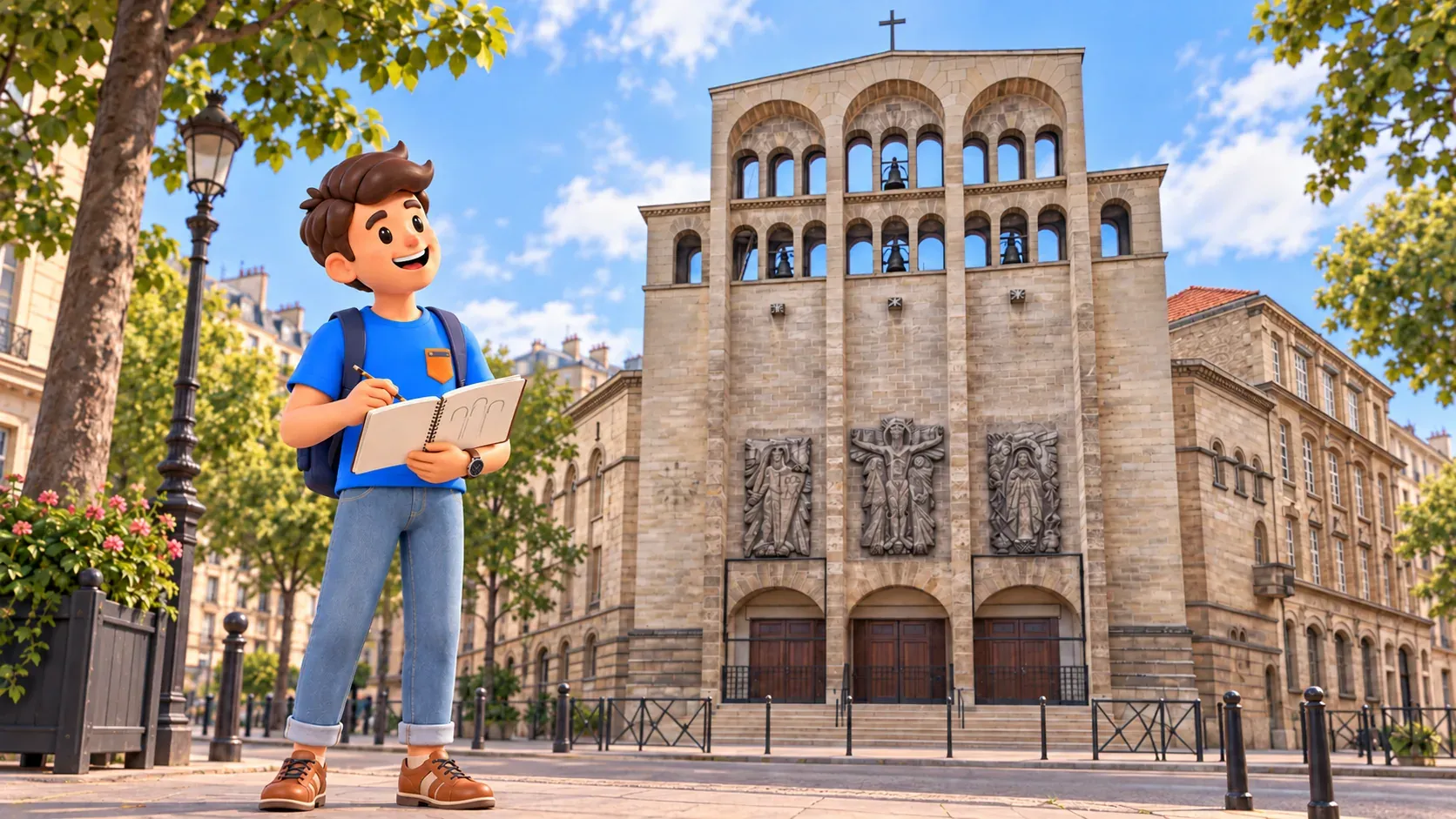
Today’s church was built between 1937 and 1957, with construction interrupted by the war, and inaugurated in October 1957. An earlier church had opened in 1847, but that date does not describe the present frontage. The current building’s Neo-Romanesque forms show how a twentieth-century project could draw on older architectural traditions without belonging to the medieval period.
If a quiet interior visit is appropriate, three Byzantine-inspired domes over the nave add another layer to the comparison. These are interior features, not details promised from the pavement. Allow about 20 minutes beyond the exterior programme, and accept an outside-only stop when prayer or the day’s arrangements make sightseeing unsuitable.
As checked in October 2026, the parish lists church opening from 7 am to 9 pm on Tuesdays, 7 am to 8 pm Wednesday to Friday, and 8 am to 8 pm Saturday to Monday. During school holidays, the stated pattern is 8 am to 8 pm daily. Opening, staff reception, Mass and adoration are separate arrangements: an open door does not mean the building is an unoccupied visitor space.
The owner identifies access to the Saint-Joseph chapel via 25 Rue d’Armaillé. That information does not turn the contact address into a guaranteed doorway for every visit, or establish step-free access throughout this walk. If assistance or a particular entrance matters, confirm it with the parish beforehand.
Choose the shorter loop or one considered addition
With about 75 minutes, keep Ternes, Daru and Pleyel, then return to Ternes. This roughly 800-metre loop allows 20 minutes for walking, 10 for orientation, 15 at the cathedral exterior, 10 at Pleyel and a 20-minute pause. Leave Saint-Ferdinand for another occasion rather than rushing westwards and calling the longer route complete.
For ballroom history, an optional street detour towards Salle Wagram at 39–41 Avenue de Wagram adds about 15 minutes, making the exterior programme 135 minutes. The historic hall dates from 1865. Its celebrated decoration is inside; this addition identifies the address and its cultural history, without promising that the ballroom can be admired from the street. An interior visit requires a separately confirmed event or arrangement.
If both church visits suit the date and are permitted, adding 30 minutes at Daru and 20 at Saint-Ferdinand brings the base programme to 170 minutes. Neither crypt nor concert is included. Choose one interior if that gives your preferred subject enough time, and retain a margin for your own pace.
To give architecture, music and relaxed walks the right share of your stay, try a personal trip plan in RoadMe. Bringing your interests and daily pace together in the app makes arranging the whole journey easier than assembling each day from separate ideas.
Choose daylight for the exterior version and check each church’s current visitor arrangements if you hope to enter. Wet weather may justify the shorter loop; concert halls and working churches should not be assumed to provide drop-in shelter. For a different outing among greenery and collectors’ houses, use our Parc Monceau two-hour walk on another day, with its own route and visiting conditions.


