
From Ramesses II to the Egyptian House: Strasbourg’s unexpected Egypt
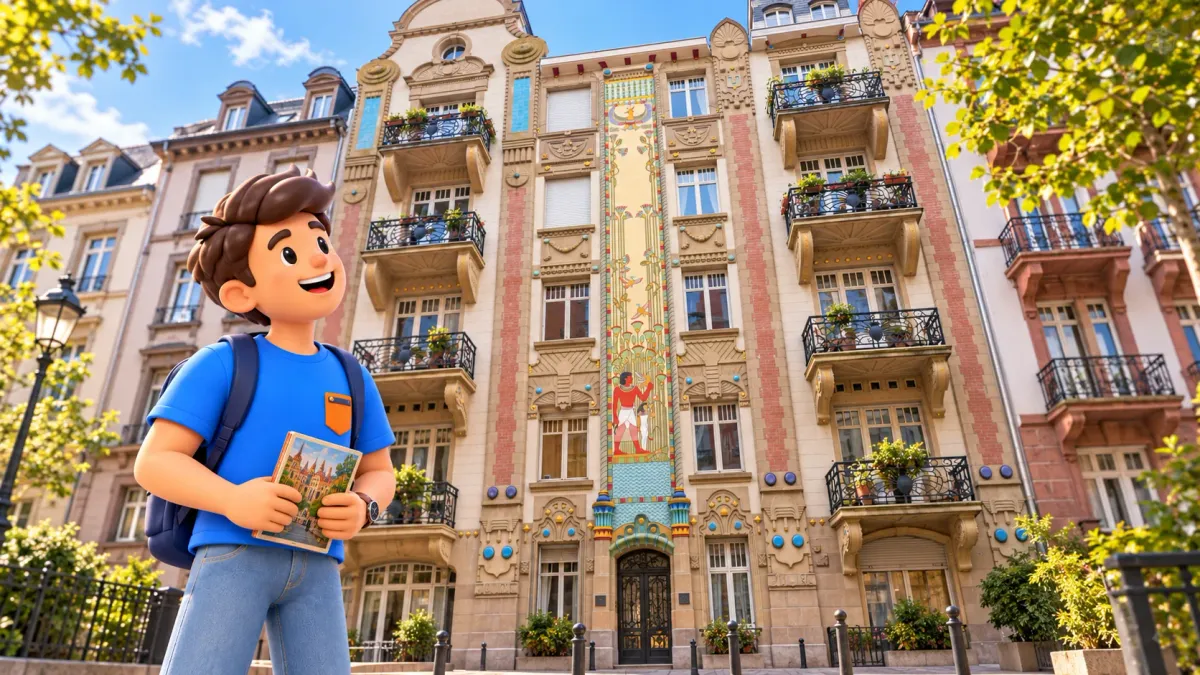
A painted Egyptian figure among tall papyrus stems is an unexpected sight on a Strasbourg residential street. The Egyptian House provides one starting point for exploring that surprise. Another connection lies in the university’s scholarly history: an original statue of Ramesses II found at Tanis and brought to Strasbourg in 1938.
The two belong to different stories. One is a modern European facade imagining Egypt; the other is an ancient object studied by researchers. This selective outing links the Palais universitaire exterior with the Egyptian House in roughly one and a half to two hours. It works entirely outdoors; seeing the statue itself requires separately confirmed access.
Choose an exterior walk before adding an interior
Begin at the Palais universitaire on place de l’Université, where the building supplies a setting for the research story. Continue through the Neustadt towards the République area and rue du Général-Rapp, finishing at the Egyptian House. These are separate neighbourhood anchors, rather than two adjacent doorways.
RoadMe makes it much easier to develop a personal route or whole trip around your interests. Try the app to combine architecture, the history of discovery and comfortable pauses into a day at your own pace.
The exterior plan does not depend on a museum opening or a university room being available. You can consider the palace’s public image, walk between the two settings and read the house’s painted facade. The statue’s story adds depth without pretending that it can be seen from outside.
If a specific Palace event has actually been confirmed, adapt the order to its meeting point and start time. Otherwise, keep the outdoor sequence as the main plan. Arrival, return from the different endpoint and any interior programme need additional time beyond the suggested walking budget.
Ramesses II: an ancient object with a Strasbourg research history
The university’s Ramesses II is an original seated pharaonic statue, distinct from the plaster casts associated with the Adolf Michaelis collection. Its importance is not simply as impressive decoration in a grand room. It also records a connection between archaeological work in Egypt and scholarship in Strasbourg.
The Egyptology Institute recounts Pierre Montet’s discovery at Tanis in 1933. Another closely related seated statue was found there as well. Researchers considered similarities in form and complementary inscriptions when proposing that the two had formed a pair. It is a useful glimpse of how interpretation develops through comparison.
The institute records that Egypt gave the Strasbourg statue to France in 1938. It arrived that year and was placed in the Aula of the Palais universitaire, where an inauguration took place on 15 July. These details describe the institution’s account of the object’s journey, rather than a general judgment about every museum collection.
Later movements within the palace and a return to the earlier setting in the early 1990s are also part of that account. Historical placement is not proof of an unrestricted visitor entrance today. Keep the object’s documented journey separate from the practical question of whether a particular event includes it.

What the palace adds even when you stay outside
Look at the Palais universitaire from an available public viewpoint. Its formal facade places learning within the city’s monumental architecture. The visible rhythm of openings, stonework and sculptural detail can prompt a question: how does a university announce the importance of knowledge before anyone enters?
You need not identify every figure to consider that public statement. Compare the building’s ordered scale with what you will later see on the residential house. The first presents an institution; the second makes an individual building memorable through colour and a surprising scene. Neither exhausts the character of the Neustadt.
Think, too, about the distinction between an object and its setting. A statue from an ancient Egyptian context gains another layer when studied and placed in a European university. The building does not become ancient Egyptian, and the object does not become a modern imitation merely because its surroundings have changed.
Allow roughly 20–30 minutes for the exterior and the research story. Do not search for the statue through windows or assume an open academic door is a visitor invitation. The walk’s value here is a connection between place, scholarship and the way an institution presents itself to the city.

The Egyptian House is a residence from 1905
The Egyptian House stands at 10 rue du Général-Rapp. Municipal heritage sources date the design to 1905 and name architect Franz Scheyder and painter Adolf Zilly. It belongs to the varied residential architecture of the Neustadt, where private buildings could use a more playful decorative language than official institutions.
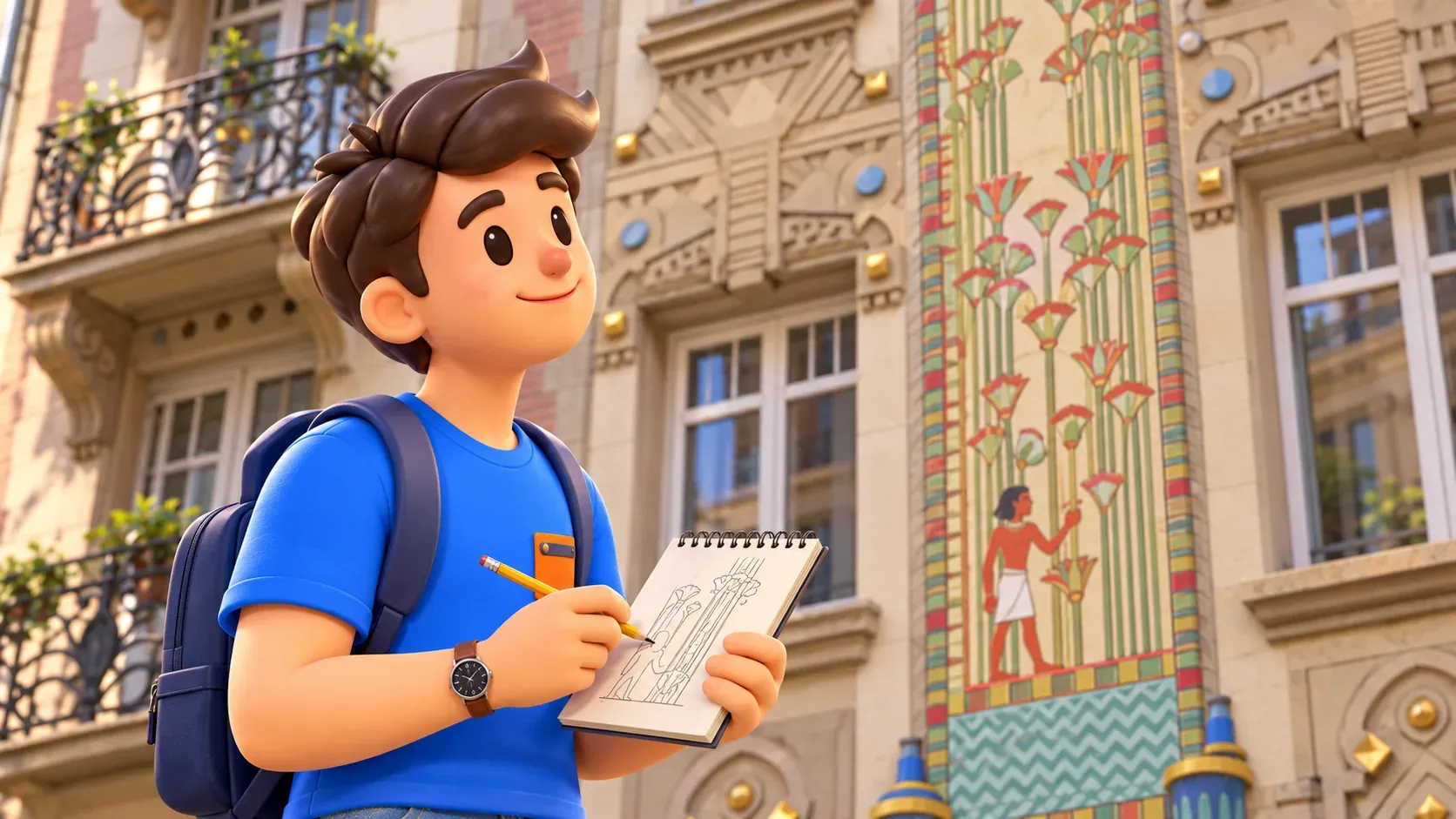
The tall painted panel borrows freely from archaeological imagery. A marsh-hunting scene includes Egyptian figures, papyrus and lotus. The municipal Art Nouveau booklet describes a man standing in a boat with a bird and a stick, accompanied by a woman. Those features explain a subject; they do not identify the figures as Ramesses or Cleopatra.
Look beyond the Egyptian associations to the building around them. Curved iron balcony railings and sculptural ornament connect the house with Art Nouveau. The mural sits within a modern urban facade, alongside windows and the ordinary functions of a residence, rather than forming part of an ancient temple.
The house is therefore useful evidence of early twentieth-century European taste and imagination. Its decoration can be enjoyed while recognizing that it adapts an idea of Egypt. No ancient Egyptian settlement, royal visit or museum inside the building is needed to explain why this street corner is worth noticing.
Read the facade in three changes of scale
Begin with the whole painted strip. Its height draws the eye through several floors and gives the frontage a strong centre. Notice how the composition occupies a narrow urban surface, with the windows and balconies still shaping the larger building. This is a facade to inhabit as well as an image to look at.
Next, follow a few plant lines and the relationship between the human figures and surrounding reeds. You do not need to translate imagined hieroglyphs or name every motif. It is enough to see how colour and vertical stems connect distant parts of the panel, giving movement to an otherwise fixed wall.
Finally, compare the painting with the curved ironwork and stone details beside it. Different materials offer different effects: a broad coloured field reads at a distance, while finer railings and carved ornament reward closer attention. Choose a comfortable public viewpoint rather than stepping into the roadway for a perfectly frontal photograph.
With children or companions, ask which line first caught their eye: a reed, a balcony curve or the outline of a figure. Different answers are useful. They show how the same facade can support several ways of looking without requiring an exhaustive explanation of every decorative part.
Allow roughly 15–25 minutes. Respect the residential entrance, keep the doorway clear and do not ring for access or enter a lobby to improve the view. The outing needs no private threshold, balcony visit or conversation with residents to become a complete architectural stop.
Understand what is and is not open to ordinary visitors
The university currently places Egyptology among its collections that are not open for ordinary visits. They serve teaching and research. A collection webpage, academic timetable or online image does not establish daily museum access. The university’s existence as a working institution also does not mean every room is closed to every event.
Guided Palace visits are among the university’s advertised themed offers. Before making one central to your day, check the actual current programme for a date, language, meeting point and scope. In particular, confirm whether the statue is included. No available slot or reservation for it has been established here.
The Adolf Michaelis Museum is a separate collection associated with plaster casts. Its own visitor page currently announces temporary closure. Older hours lower on that page do not override the notice, and the museum should not be treated as an automatic substitute for seeing the original pharaonic statue.
Watch the dates on historical reports, too. The institute’s Karlsruhe-loan article was published in December 2016. Its presence online does not mean the statue has just left Strasbourg or remains away today. Old school programmes likewise do not create a current public workshop or permission to handle objects.
For broader choices, our guide to public visits and university collections explains the distinction between a collection’s existence and an actual visiting opportunity. That distinction keeps this Egyptian theme enjoyable without building a day around an entrance that has not been confirmed.
Give the links and pauses enough room
For the two-anchor outdoor version, allow around 20–30 minutes at the palace, 25–40 for the public-street link with ordinary crossings and observation, and 15–25 at the house. Add roughly 20–30 minutes for a pause and buffer. These editorial estimates suggest about one and a half to two hours, longer at a slower pace.
The link is not a measured navigation track or an audited step-free route. Choose actual available pavements and crossings. No ticket purchase is required by the exterior plan; a cafe, transport or a separately selected event has its own conditions and costs.
RoadMe can work out a personal plan for your whole trip around your interests, available time and budget. Planning in the app is much more convenient for fitting this themed walk, your other wishes and rest into a coherent day.
If time is short, the house alone can be a brief exterior stop during another walk. If an interior event is confirmed, add its full duration and stated arrival allowance, and reconsider the order. Do not squeeze a real programme into a walking estimate that was designed without it.
Two ways a city can encounter another culture
The most useful comparison is between studying an original object and adapting an image for a modern building. Both connect Strasbourg with Egypt, but they answer different questions. One leads towards excavation, inscriptions and scholarly interpretation; the other towards design, taste and the transformation of historical imagery into residential decoration.
Neither needs a fictional mummy museum or a compulsory list of Egyptian symbols. A few careful observations give the theme substance. You can leave with an appreciation of the painted facade and a clearer understanding of why the university’s statue matters, even on a day spent entirely outside.
For a wider architectural outing, our Art Nouveau walk around the Egyptian House offers another focus. Finish this version on rue du Général-Rapp, counting the journey onwards separately. A personal choice of what to explore is more rewarding than trying to enter every collection attached to an interesting story.


