St Mark’s Lions in Verona: How to Spot the Venetian Trace
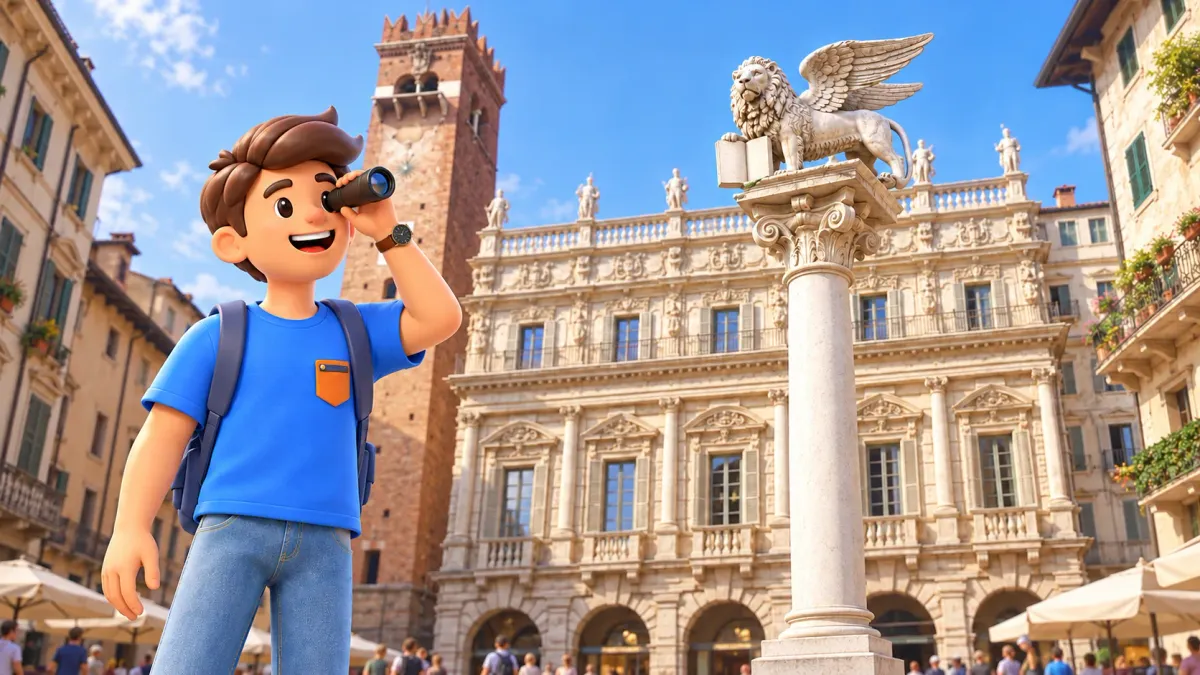
It is easy to cross Piazza delle Erbe while looking everywhere except up. Market stalls draw your eye, café tables fill the edges, and richly decorated façades compete for attention. Above this everyday activity stands a winged lion with a book. Once you notice it as more than an attractive detail, a different story emerges: how a city displays authority, loses a symbol and eventually brings the image back.
You do not need a full day of heraldry to enjoy that story. Start with the column in front of Palazzo Maffei, spend time understanding what you can actually see, then compare the setting with nearby Piazza dei Signori. This is a small observation walk, roughly an hour and a half including a break, rather than a hunt for every lion in Verona.
One emblem changes the way you see the square
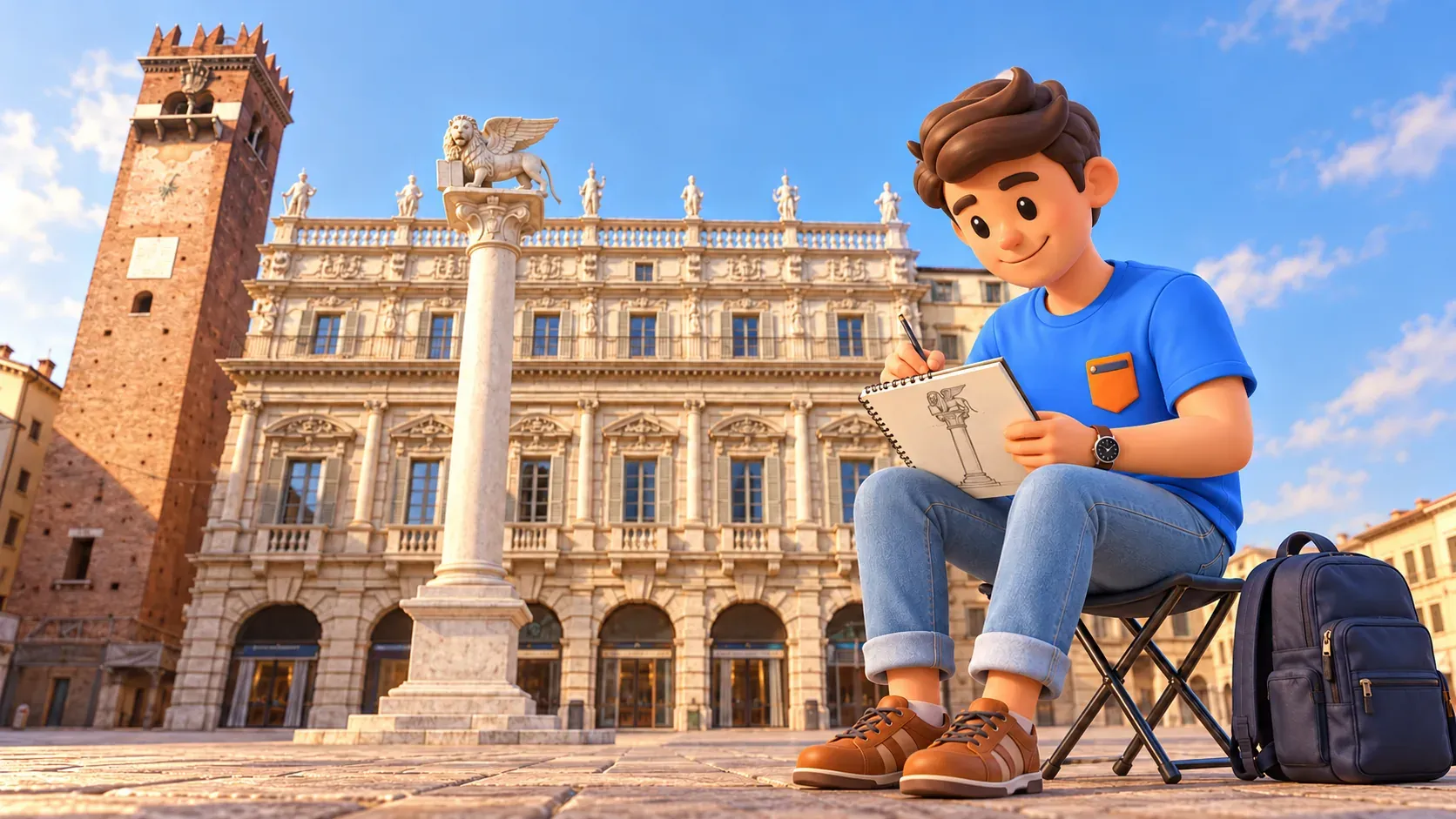
The clearest starting point is the northern end of Piazza delle Erbe, in front of Palazzo Maffei. A winged lion stands above a white marble column with an open book beside its front paw. The figure represents the evangelist St Mark and also serves as an emblem of the Venetian Republic. Here in Verona, its public position recalls the city’s period under Venetian rule.
RoadMe makes it much easier to turn an idea like this into a personal walking route or a complete trip plan, shaped around your interests and pace. Try choosing history and relaxed walks so your Verona day has both a clear theme and room to enjoy it.
That is enough background to begin. You do not need a memorised sequence of rulers before looking at the monument. Instead, ask why a political emblem occupies such a prominent place in a working square. Its height makes it visible beyond the people immediately beside it, allowing a relatively small sculpture to become part of the whole space.
Begin with an overall view, then move closer when the flow of people allows. From farther away, the relationship between the column, the palace and the square is clearer. At a shorter distance, the capital and the division between support and sculpture become more noticeable. Neither position is the single correct one; changing distance is part of the experience.
The column and the lion are not the same age
The most useful historical distinction is also the simplest: the column dates from 1523, while the lion now on top dates from 1886. The earlier lion was destroyed by the French. Describing the entire visible monument as an untouched sixteenth-century work therefore misses an important part of its story.
A replacement does not make the place uninteresting. It changes the questions you can ask. The column speaks about the original decision to display the emblem; the later sculpture shows that people chose to restore its presence. The monument brings together continuity and interruption rather than preserving a single unbroken moment.
This is also a useful lesson for looking at historic cities more generally. An old location, a familiar image and an old piece of material are three different things. They sometimes coincide and sometimes do not. Once you separate them, you stop needing every attractive object to be an intact survivor in order to find it meaningful.
In 2022, Verona’s municipality reported the completion of conservation work on the column and lion, noting their different ages and differing surface deterioration. That is a practical reminder not to date stone by its colour alone. Lighting, weathering and treatment can change its appearance, while an older photograph may show a condition that no longer matches the present surface.
Two dates are enough to carry away: 1523 for the column and 1886 for the current figure. There is no need to turn your pause into a chronology test. The rewarding point is that a public symbol can return after a loss, and that its renewed presence becomes another layer in the city’s history.
Look for wings, a book and the relationship to the street
Start with the wings. They help distinguish this familiar Venetian emblem from the many other lions used in European architecture. Then look for the open book near the front paw. In this monument it is the Gospel associated with St Mark. Together, these features explain why the figure has a religious identity as well as a political role in this particular public setting.
Small details may be difficult to see from ground level. You do not have to claim you have read an inscription that remains indistinct through a phone screen. Recognising the outline of the body, the feathered wing and the book is already a useful observation. Return your eye to the square afterwards and notice how much visual weight the raised figure carries.
Avoid turning a single feature into a universal code for every lion you encounter elsewhere. The position of a book alone is not enough evidence for a confident account of another monument’s history. Its setting, date and documented story matter too. Here, the secure starting point is the combination of St Mark, Venice and a prominent civic space.
If you enjoy drawing, make a quick outline using the column’s vertical line, the body’s horizontal line and the wing’s diagonal. If you prefer photography, take one view that includes the setting before making a tighter picture. You will preserve both the detail and an explanation of where it belongs, rather than returning with an attractive animal that could be anywhere.
Why another lion does not automatically mean Venice
Animal imagery is widespread, and similar names can encourage quick assumptions. Verona’s Porta Leoni offers a good caution. It is a Roman gateway whose later name refers to a Roman sarcophagus with two lions that once stood nearby. The name does not turn the gate into a monument to the Venetian Republic or identify those animals as St Mark’s winged lion.
You do not need to add Porta Leoni to this short walk. It is helpful here as an example of how a word can mislead when it is separated from its setting. A lion may belong to a funerary object, a religious image or a statement of government. The animal alone does not tell you which explanation applies.
That makes the theme more rewarding than a tally of lions found. Ask three questions instead: what exactly is represented, where has it been placed, and what do we know about the date of the object? If a weathered carving does not provide clear answers, leave the question open rather than inventing a removed emblem or a dramatic episode.
It also helps to resist photographs from a different city. A caption mentioning St Mark can refer to Venice itself, where the celebrated bronze lion has a separate history. Verona’s sculpture above Piazza delle Erbe is a different object. Keep the place and material attached to the story you are reading.

A small walk between two neighbouring squares
Begin at the Maffei end of Piazza delle Erbe and allow about 20–30 minutes for the column and its immediate setting. This includes looking from more than one comfortable distance and taking a moment away from the main stream of people. It is our suggested allowance for attentive looking, not an official minimum visit time.
Next, move to neighbouring Piazza dei Signori. Give the short transfer and comparison another 15–20 minutes. There is no requirement to find a second identical lion there. Instead, look at how another public space uses buildings and monuments to express memory. A change of setting can make you more aware of choices that disappear when the whole centre becomes one continuous backdrop.
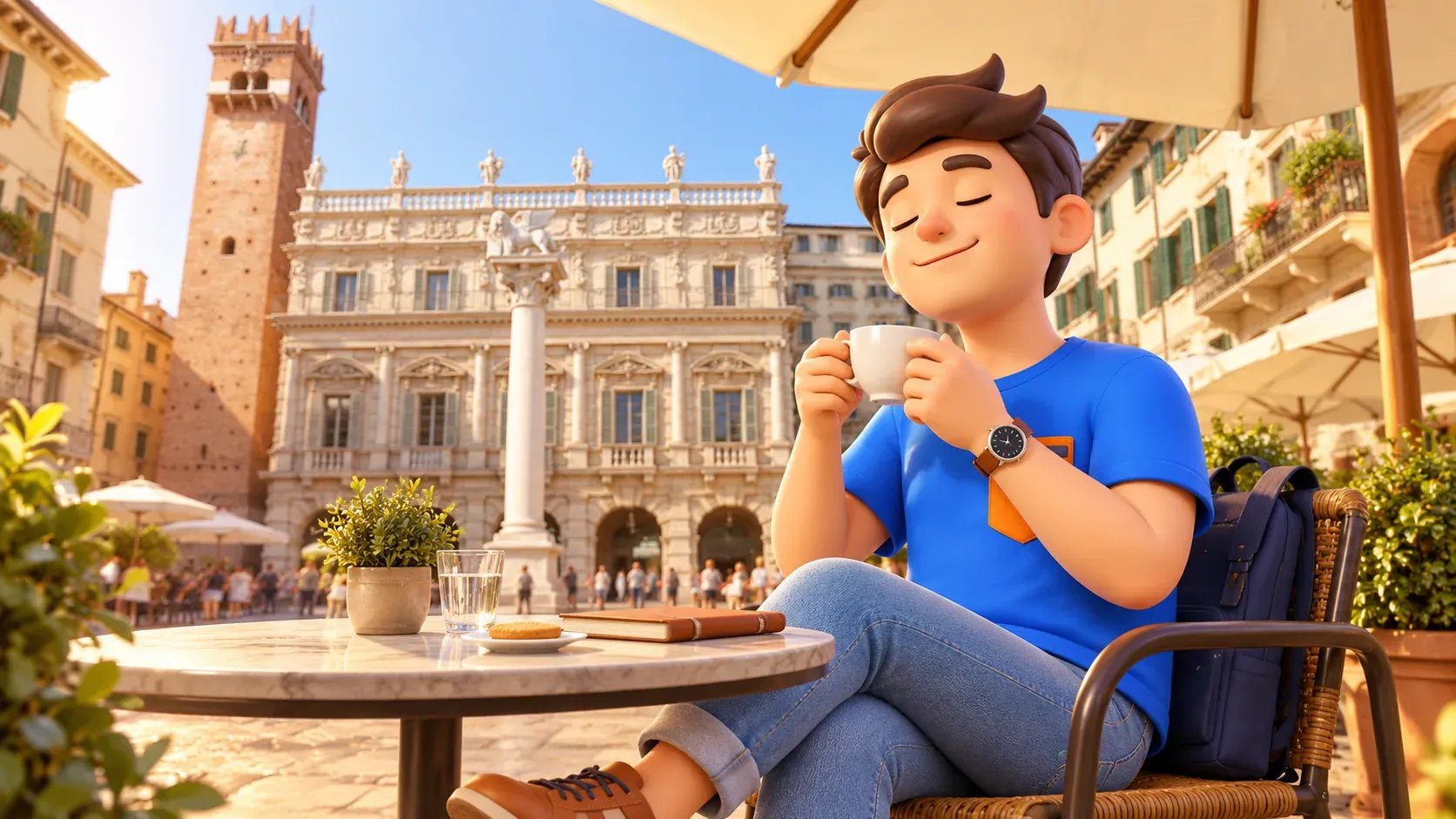
Add a 25–35-minute break nearby and a 15–20-minute margin. The resulting allowance is 75–105 minutes within this small part of the centre. It excludes travel from your accommodation, the return journey, waiting for a table, shopping and any indoor visits. With only forty minutes available, keep the column and a calm look around Erbe; a shorter complete experience is still worthwhile.
RoadMe makes it easier to fit this stop into a personalised day, connecting the places that interest you in a route at a suitable pace. Choose architecture, history, museums or unhurried exploring, and let those preferences shape your wider trip plan.
This version does not require entering Palazzo Maffei, climbing a tower or visiting a museum. Any indoor attraction is a separate choice with its own opening arrangements and time requirement. A museum next door may be geographically close while still changing the rhythm of the whole afternoon.
Choose the moment to suit your day
Think about light, energy and the rest of your plans rather than expecting an empty square at a guaranteed hour. Market activity, visitors and events can change the scene. An early start may suit a quieter rhythm, but it is not a promise of solitude. If the lion is strongly backlit, try another permitted viewing position without blocking a passage.
With children, the question “why does this lion have wings?” may be more useful than a list of dates. Find the book together and compare the sculpture with an ordinary animal in a drawing. Adults can carry the extra distinction between the date of the column and the date of the current lion without making the stop feel like an examination.
If walking is tiring or mobility is limited, consider the paving, crowds and the breaks you need. The proposed observation does not involve a climb, but that does not guarantee an effortless approach to every viewpoint. Choose a comfortable place where the whole composition is visible and reduce unnecessary movement.
Do not climb onto the base for a picture or step backwards while watching only a screen. Stop somewhere safe before framing the image. Binoculars or a camera zoom can help with distant details, but neither is necessary to understand the symbol. The clearest discovery may come from looking at the monument in its surroundings.
Choose a different continuation if the theme catches you
If the square itself becomes the main attraction, continue with the walk through several eras on Piazza Erbe. It widens the frame and puts the lion beside other parts of the urban setting. That is often a more natural next step than travelling farther solely to collect a similar emblem.
If authority and commemoration interest you more, Scaliger Verona offers a separate theme for another walk. Comparing different ways of expressing power can be fascinating, but it does not require completing every related route on the same day.
You may finish with a very modest discovery: the next time you notice the winged silhouette, you will see both an emblem and the history of a physical object. The older column and later figure will no longer collapse into one vague idea of “ancient Verona”. A single well-chosen pause has made the city easier to read.