
Scaliger Verona: a walk from Castelvecchio to the palaces and Gothic tombs
Verona offers an unusually readable way into medieval history: you can walk from a ruling family's fortress to its urban palaces and elaborate tombs without leaving the historic centre. A castle explains protection, a square suggests government, and a funerary monument shows how power hoped to be remembered.
This walk follows the Della Scala family, usually called the Scaligeri in Italian. Begin at Castelvecchio, make a short excursion onto Ponte Scaligero, then continue through Corso Cavour and Piazza delle Erbe towards Piazza dei Signori and the Scaliger Tombs. Allow roughly two and a half to three hours for the outdoor version, including a proper pause. The castle museum is an optional addition that can turn it into a half-day.
Plan three main stops, with room between them
RoadMe makes it much easier to turn an interest in medieval Verona into a personalised plan for your whole trip, shaped around your interests and pace. Try choosing history and architecture as your themes while keeping enough room for breaks.
The route works for a first encounter with the dynasty or a return visit after the Arena. Its three anchors are the castle and bridge, the palaces around the square, and the tombs. You do not need to enter every neighbouring church or visit every courtyard. The connection between these places is what makes the walk satisfying.
Start outside Castelvecchio on Corso Castelvecchio and finish beside the railings near Santa Maria Antica. This is a linear route, not a circuit. Getting to the castle, returning there afterwards and travelling to dinner are additional journeys. The brief bridge excursion returns to the castle bank before the walk continues through the old town.
As a planning estimate, allow 35–45 minutes for walking, 60–70 minutes for outdoor stops, 30–40 minutes for a break and around 25 minutes of flexibility. That gives approximately 150–180 minutes. Long photography stops, a museum queue or a sit-down lunch will require more time.
Choose in advance whether you want the castle museum. If you do, check its visitor calendar and begin with enough time for the galleries. If you do not, the outdoor itinerary does not depend on the museum opening. Any local closure or restriction still takes precedence over the suggested sequence.
Begin with Castelvecchio's defensive presence
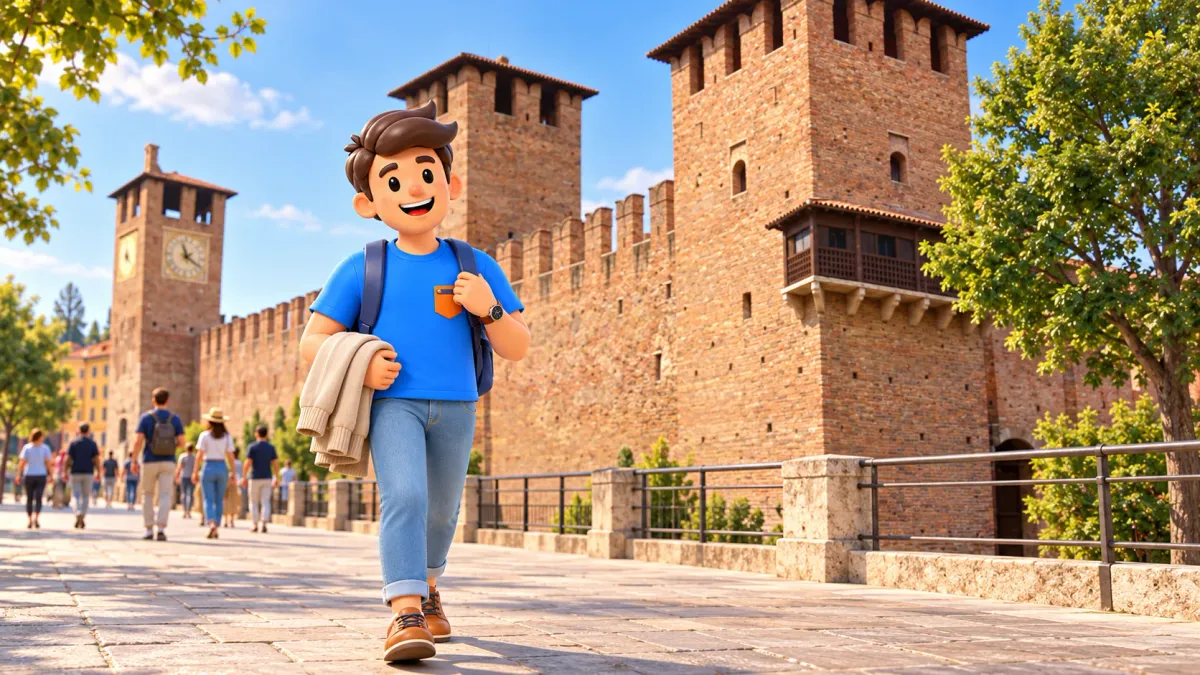
Castelvecchio was built in the fourteenth century for Cangrande II della Scala. Its brick walls, towers and position beside the Adige make an immediate impression. This is a more defensive face of Verona than the one suggested by market stalls and painted houses. You can understand the scale before learning any detailed chronology.
Keep Cangrande II separate from Cangrande I, the earlier ruler associated with patronage and the famous equestrian sculpture. The similar names can otherwise turn an entire family into one imaginary medieval character. This walk needs only a few distinctions, but that one will help when you reach the tombs.
Stand back on a safe stretch of pavement to appreciate the length of the street-facing wall. Then look more closely at the openings, projecting features and changes between stone and brick. A useful question is simply how the building separates itself from the surrounding city. You do not need to identify every construction phase.
The building now houses an art museum. Think of that as a substantial visit rather than a quick tour of empty knightly rooms. Allow perhaps another hour and a half to two hours if you choose the galleries, adapting the visit to the collection, current circulation and your interests. This is a suggested visitor allowance, not a compulsory ticket duration.
The outdoor route does not promise access to every courtyard, gallery or upper walkway. Some experiences belong to the museum visit. Outside, your subject is the castle as a large urban structure; inside, the collection and its presentation become part of the story. Decide which experience you want instead of assuming both fit into the same short stop.
Take a short bridge excursion over the Adige
Ponte Scaligero, also called Ponte di Castelvecchio, extends the castle's brick language across the river. Its battlements and unequal arches make it an especially strong visual connection between fortress and crossing. The present structure also carries a later history: it was destroyed during the Second World War and subsequently reconstructed.
For this itinerary, walk onto the bridge, pause where you can stay clear of other pedestrians, then return to the castle side. You do not have to cross all the way to the opposite bank. Continuing towards the Arsenal and Borgo Trento would create a different walk, while today's main story leads towards the old seat of government.
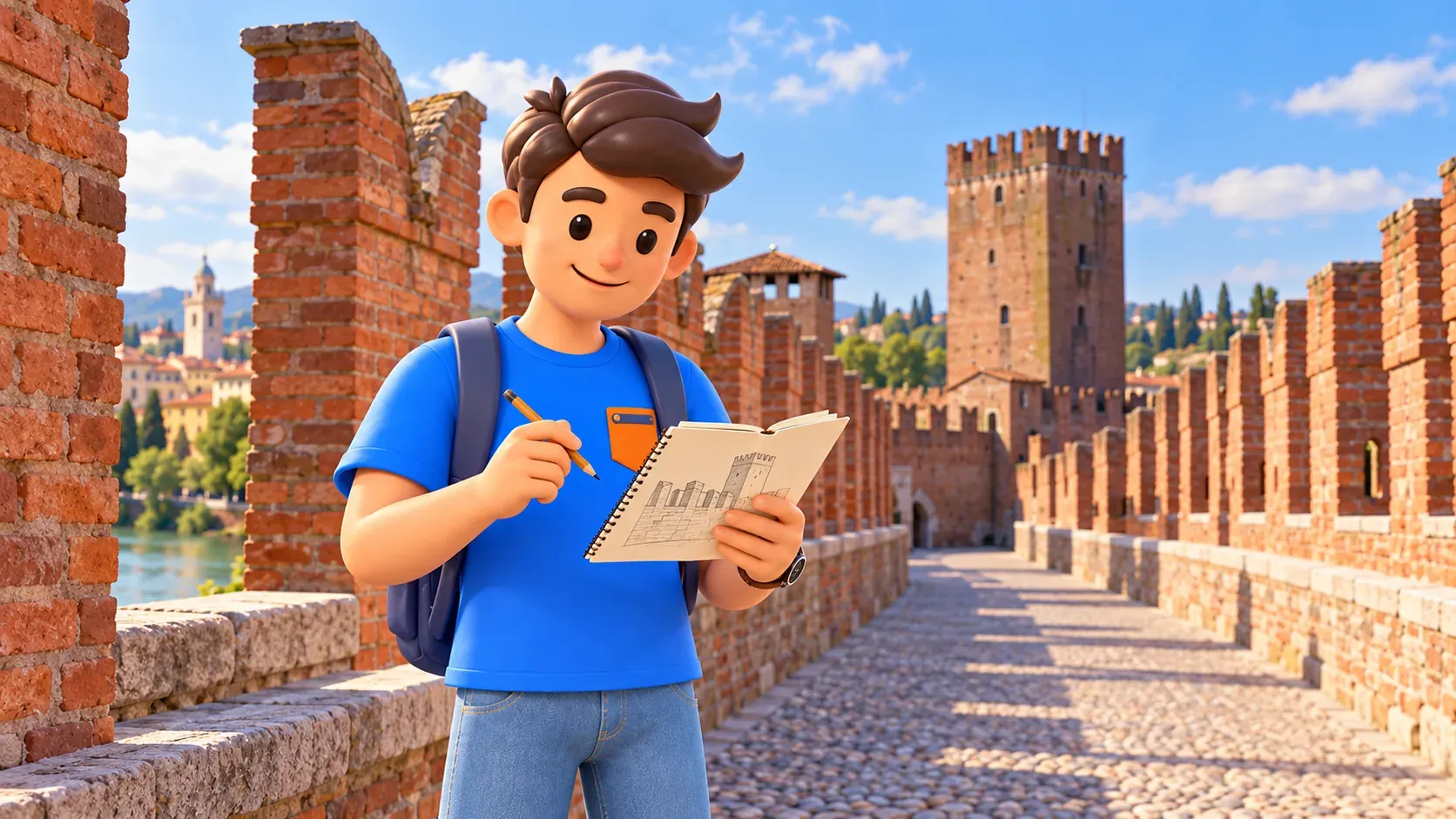
Look first at the bridge as a continuation of the fortress and then at the water moving underneath it. A few steps change the relationship between towers, brick parapets and riverbanks. You can enjoy those views from the normal pedestrian surface without climbing anything. Wait for space rather than turning a narrow passage into a photography set.
Wind on the river may feel different from conditions between the houses. If the bridge is uncomfortable, make this a shorter stop and keep your longer break for the centre. A brief look already establishes the relationship between the castle and the crossing.
Use Corso Cavour as a transition between periods
Return to the city-facing side of the castle and follow Corso Cavour towards Porta Borsari. Continue along Corso Porta Borsari to Piazza delle Erbe. The walk deliberately passes buildings from several periods. A Roman gateway does not become a Scaliger monument simply because it stands on a medieval-themed route.
This transition provides a useful contrast. Around the fortress, walls and separation dominate. Along the central streets, entrances, shopfronts and domestic windows return to the foreground. Later façades are part of the experience too: Verona kept changing after the dynasty, absorbing older buildings into subsequent city life.
At Piazza delle Erbe, resist the temptation to examine everything at once. The present square combines many historical layers on the site of the Roman forum. Pause briefly, identify the passage through Arco della Costa towards Piazza dei Signori, and save your main attention for the next space. The fountains and painted façades deserve another occasion.
A coffee break works here or near Piazza dei Signori. Read the menu and service conditions before choosing a table. Do not assume that every arcade is a public resting place or that counter service and table service have identical arrangements. Let the break restore your energy instead of becoming another attraction to complete.
Read Piazza dei Signori as a place of government
After lively Piazza delle Erbe, Piazza dei Signori offers a more contained setting. Buildings associated with civic authority face a shared space, making the relationship between architecture and government easy to consider. The interest lies in their arrangement as much as in any single attractive doorway.
The square includes palaces associated with Cangrande and Cansignorio. However, its whole appearance should not be treated as an unchanged fourteenth-century scene. The Renaissance Loggia del Consiglio belongs to a later period. Seeing that difference helps you recognise the dynasty's legacy alongside subsequent changes and rulers.
Begin with the overall space, then move towards its edge and choose a window or entrance to study. As a small personal exercise, find one feature that feels ceremonial and another that feels restrained. You do not have to guess an exact construction date. You are comparing the language of an urban residence with the fortress you saw earlier.
The statue of Dante explains the square's other familiar name, Piazza Dante. It adds a literary dimension without requiring you to turn this outing into the poet's complete biography. Here it is enough to notice how cultural memory shares the space with the architecture of political power.
The palaces also have present-day functions. An impressive portal does not imply free access to an administrative building, and an open door is not an invitation to explore every interior. Base the visit on façades and public passages, respecting barriers and staff directions.
Finish at the Scaliger Tombs
To combine castles, art and walking without overloading the day, RoadMe can help build a personalised route or complete trip plan around your interests. The app makes it more convenient to organise these experiences into a manageable day with the breaks you actually need.
Continue to Santa Maria Antica and the neighbouring Arche Scaligere. These are the Della Scala family's funerary monuments, rather than triumphal arches or another set of city gates. Understanding the name matters: you have arrived at a place of burial and commemoration.
The contrast with the castle is striking. Here height and carved detail replace the long defensive wall as the main impression. Sarcophagi rise above ground beneath Gothic canopies, figures and mounted rulers. The monuments preserve memory while making the family's status visible to people passing along the street.
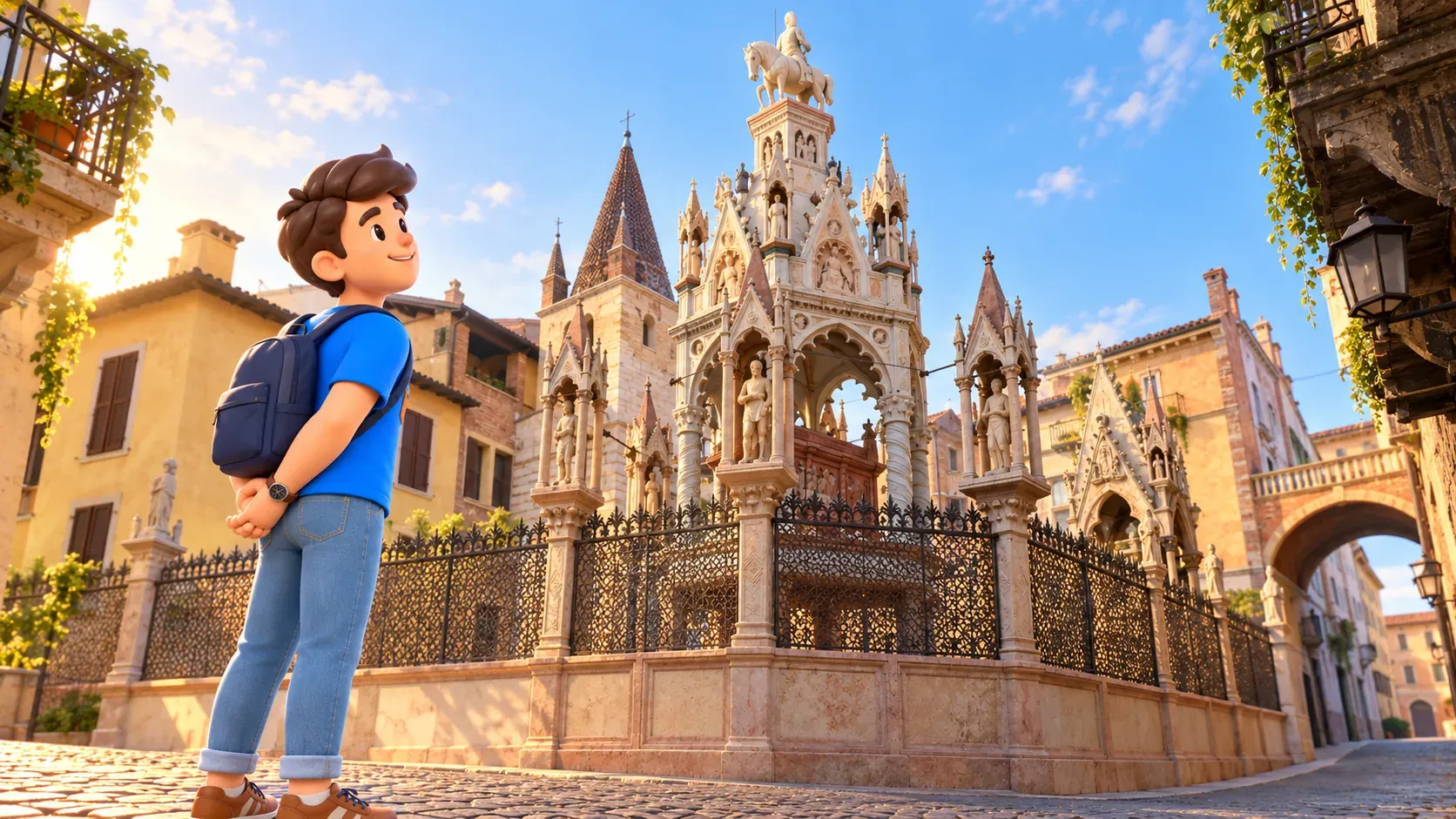
Start with the whole composition through the railings, then choose one monument and follow it from its base towards the figure above. You do not need to memorise every family member. The ladder pattern in the ironwork is an accessible detail to notice: it connects with the Della Scala name and becomes a recognisable family emblem.
Cangrande I's monument supplies a link back to the beginning. The equestrian figure above his tomb is a copy; the original is kept in the Castelvecchio Museum. If you included the museum, that detail ties the two ends together. If you did not, it offers a reason to return on another day.
Viewing from the street is the basis of this itinerary. Entry within the enclosure follows a separate calendar and should not be assumed daily. At preparation, the published October 2026 programme listed Saturday and Sunday visits until 1 November, with a midday break. That is a dated arrangement, not a permanent schedule for later seasons.
Check the current calendar and admission conditions if you want to enter. The tourist information also warns that there is no ticket office at the tombs, so clarify any required ticket or entitlement beforehand. If the enclosure is closed, the monuments remain visible through the railings; there is no need to search for a way in through neighbouring doors.
Let the route end without adding another checklist
You can finish here and return to Piazza dei Signori for a café stop or continue with your own plans. With children, a simple final question can bring the outing together: where did the rulers defend themselves, where did they govern, and where did they want to be remembered? It turns three stops into a story.
The basic route uses city streets and does not require a tower climb or museum staircase. Nevertheless, uneven paving, thresholds and narrow sections can slow progress. Do not treat that as a promise that every optional interior is accessible; check the individual building if mobility conditions are important to your visit.
Rain can make stone surfaces and the open bridge less comfortable. You can divide the outing into a castle-and-museum day and a separate square-and-tombs walk. Do not expect continuous cover beneath arcades: they do not shelter the entire route and may contain tables or busy pedestrian passages.
For another day with a different emphasis, use our Adige riverside walk from Ponte Scaligero to Ponte Pietra. Keeping that as a separate block allows the Scaliger story to retain its own pace and a clear finish.


