
A Green Venice Walk to Sant’Elena
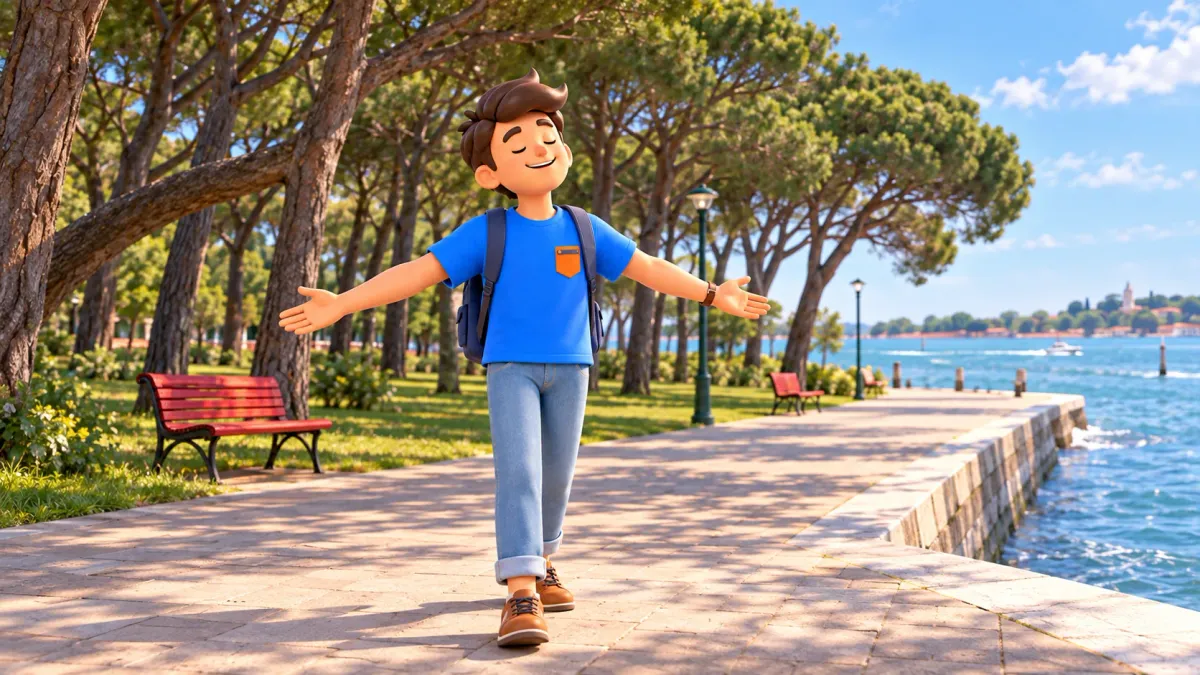
Allow around two and a half hours for a green walk from the public waterfront near Giardini to Sant’Elena’s pine park, the church exterior and back towards the local waterbus landing. This estimate includes outdoor stops, connecting walks and rest. Going inside the church adds roughly half an hour, provided the particular visit is separately confirmed.
The appeal is a change in Venice’s density: trees, more open spaces and a long view across the lagoon after the tighter streets of the centre. This is a city park and residential neighbourhood, rather than a woodland trail or beach. Biennale pavilions, travel to the start and the wait for your return boat are outside the basic time allowance.
Choose a complete walk or a shorter green break
Start on the public waterfront in the Giardini area. Identify your actual landing before travelling: Giardini and Giardini Biennale appear as nearby transport names, but they do not replace a precise location. If walking from St Mark’s, count the entire approach separately. A pleasant waterfront journey still takes time, even when it feels like part of the holiday.
Try RoadMe for a fully worked-out personal Venice plan based on your dates, interests and pace. The app makes it much easier to fit a green walk around museums, other neighbourhoods and rest throughout the trip than to keep rearranging the day from disconnected ideas.
The full version suits a change of scene without a long exhibition visit. Follow public outdoor spaces towards the pine park, continue to the church if you want that historical stop, then return towards Sant’Elena’s landing. Finishing near transport is practical, but the wait and waterbus journey still need their own block after the walk.
If rest is the priority after a busy morning, arrive directly at Sant’Elena and use the shorter ninety-minute option. Water, trees and an unhurried pause are enough. Leave the church and a separate architectural visit for another day. This is a worthwhile outing in its own right, rather than an unsuccessful attempt to complete a longer sightseeing list.
Agree on the main purpose with your companions. Someone may want to walk, another to sit in shade, and a child to play briefly. Those wishes do not need three separate itineraries. Choose a suitable meeting point and resting place, then distribute the remaining time according to how everyone feels. There is no need to inspect every corner.
A two-and-a-half-hour outdoor budget
The figures below are editorial estimates, not measurements made on site. All connections are counted separately, including the return from the church towards the landing area. Time in the park allows slow observation and small movements, rather than requiring you to sit on one bench throughout. No pavilion admission or museum visit is included in these blocks.
| Part | Estimate | Purpose |
|---|---|---|
| Public waterfront near Giardini | 20 minutes | Begin with water and a wider view |
| Sant’Elena pine park | 35 minutes | Trees and paths |
| Church exterior | 20 minutes | Short historical stop |
| All connecting walks and return | 35 minutes | Church approach and landing area |
| Resting pause | 25 minutes | Sit and recover |
| Flexibility | 15 minutes | Changes of pace and small delays |
That makes 150 minutes. An optional church interior adds an estimated thirty minutes, bringing the outing to about three hours. This is a planning allowance, not an official visiting duration. Church, cloister and garden should not be treated as one automatic admission. A full lunch also needs extra time beyond the short resting break.
For the shorter version from Sant’Elena’s stop, allow twenty minutes by the water, thirty-five in the park, twenty to rest and fifteen for local walking. Total: ninety minutes, without the church. If a family outing slows down, preserve this compact purpose rather than trying to catch up with the longer plan by rushing at the end.
Giardini: public walking space and an exhibition
At the beginning, distinguish Castello’s public green spaces from the Biennale exhibition grounds. Walking beside the Giardini does not mean visiting the pavilions or being able to pass straight through them. The exhibition has its own calendar, entrance and conditions. This route uses public outdoor sections and does not depend on an exhibition ticket.
The gardens have a history of their own, linked to nineteenth-century changes in eastern Venice. The Biennale has held exhibitions here since 1895. For this walk, that relationship between greenery and culture is enough context. A detailed pavilion visit needs another purpose and time allowance, otherwise the park becomes a hurried connection between displays.
Do not expect a single “Giardini” sign to explain every possible entrance. Save the pine park as your next destination and choose a public pedestrian route. A fence, ticket desk or access check is not an invitation to find a way through a service area. Return to the appropriate city path and continue from there.
After a substantial exhibition, lower the demands of the next block. You can simply reach the water, sit and finish. Attention needs rest as much as feet do. Insisting on adding the church, stadium and several more sights after hours of art can refill the very time you hoped to leave open.

The pine park: everyday space with a memory
Parco delle Rimembranze is also known as the Sant’Elena pinewood or Pineta. It took shape in the early twentieth century, alongside a newer part of the city. Its commemorative meaning concerns the fallen of the First World War. That gives an ordinary park walk another layer: everyday recreation and civic memory share the same landscape.
Stop on a path and notice how the trees mediate between housing and open water. You do not need to identify every species or assemble a botanical checklist. Look at the shape of the canopies, the changing light and the lagoon visible between trunks. After the stone centre, this change of space may be the outing’s main experience.
Benches and play areas make a break possible, but do not promise a vacant seat or working equipment in a particular spot. Individual sections can change. If something is fenced off or marked closed, choose another available area. Preserving the restful purpose matters more than reaching one specific playground at any cost.
Bring drinking water. A fountain listed in a park description is not proof that every fountain works on your travel day. Likewise, avoid postponing an important toilet stop until the last minute on the strength of a facilities list. Find out which services are actually available rather than making them an essential, unverified link in the outing.
For a small snack, use an appropriate place and follow local instructions. Do not feed birds for a photograph or leave packaging by a bench. A broad green space does not mean every part is suitable for a noisy picnic. A modest pause is enough to enjoy the setting while leaving it ready for the next person.
The lagoon edge: give looking some time
By the water, remember the difference between a city promenade and a beach. The purpose here is walking, watching boats and enjoying the open view, rather than swimming or climbing down to the water. The Lido is visible across the lagoon, but it is a separate island and journey. Seeing a shoreline does not establish a pedestrian connection to it.
Use the comfortable public path and avoid approaching the edge for a better picture. With a child, agree beforehand where you will stop and how far they may move away. On a windy day, sitting among the trees may be more pleasant than sitting by exposed water. Swap those blocks according to conditions; their order matters less than comfort.
Choose a simple observation if you enjoy having a focus: three different boat silhouettes, the colour of water in sun and shade, or one quick sketch. A break does not have to become a photography project. If you do not want to record anything, sitting and looking is sufficient. Time without a new task still belongs to the journey.
If water, greenery and slower neighbourhoods are what you want from Venice, ask RoadMe to create a personal plan for the whole trip around those interests. It is easier to arrange the days in the app so that walks and visits leave room for your pace and real rest.

Sant’Elena’s church: an optional historical stop
For the longer version, continue along public avenues through the Viale Piave area towards the bridge and church, keeping the stadium as a separate nearby landmark. Do not route yourself through sports or service premises. Save the landing for the return: reaching the church is not the end of the walking if your boat leaves from beside the park.
The religious complex began in the twelfth century with a hospice for pilgrims, then changed with its monastic communities. For an exterior stop, notice the brick façade and Renaissance portal. Do not assume the surrounding residential neighbourhood is as old as the church itself. These parts of the scene belong to different periods of the city’s development.
Choose an interior visit separately. Available institutional schedules differ, while the local association links visiting opportunities to volunteer availability. If the interior is your main reason to come, confirm the relevant arrangement before setting out. Entry is not needed for the basic green walk, so a closed door does not remove the outing’s purpose.
The cloister and garden should not automatically be added to an ordinary church visit either. Access to one space does not establish permission for every neighbouring area. Avoid promising a full monastic-complex tour to your companions without confirmation. Keep the twenty minutes for the exterior, and add time only for a visit that is actually available.
The nearby Pier Luigi Penzo stadium is another reminder that this area has uses beyond sightseeing. Sporting events can change pedestrian flows and arrangements. If quiet matters most, check events for your date and choose a different time where appropriate. Do not expect a permanently empty neighbourhood because a photograph shows one calm afternoon.
Prepare for the return as well as the walk
Before leaving, choose your return direction and check the waterbus timetable for the day. Do not board the first arriving boat simply because it stops at a familiar name. Keep your accommodation address handy and identify any change of boat before leaving the park path for boarding.
Choose daylight with sufficient margin. Do not rely on every green section being accessible around the clock or on one unchanging park schedule. Season, weather and current restrictions may affect individual paths. If light is fading or conditions become unpleasant, shorten the outing and return calmly towards your chosen transport.
For a pushchair or limited mobility, check the specific bridges and route for your date. An older municipal accessibility description helps with geography but does not establish today’s ramp status. Reduce exposed waterfront time in heat, consider surfaces in rain and consult current municipal information when high water is forecast.
Do not add San Pietro simply because it appears among nearby sights. There is no direct bridge from Sant’Elena to it; the route goes back through Castello. Save the Arsenale-to-San-Pietro walk for another outing. The four- or five-day Venice plan helps give this green break a place of its own.


