
Rialto in the Morning: Market to San Polo Walk

Start a Rialto morning on the San Polo side of the Grand Canal: see San Giacomo’s clock, step out towards the water, visit the market, then follow the neighbourhood lanes to Campo San Polo. Allow two to three hours for the whole walk. For the fish market, choose Tuesday to Saturday; it closes on Sundays and Mondays.
This is a compact way to experience a working market and the streets around it. You can buy something, watch briefly or pause for coffee without committing to a food tour. Museum visits and church interiors are outside the plan. All timings below are planning estimates rather than measurements from a walk on the ground.
Choose your morning before choosing your route
The first decision is what you want from Rialto. A working fish market, a view of the canal and a neighbourhood walk are different reasons to come, with different calendar implications. Monday can work for produce and architecture, but not for fish stalls. On Sunday, treat this as an architectural walk or move the market experience to another day.
The city tourism portal, checked on 17 October 2026, lists the fish market Tuesday–Saturday, 7am–2pm, and the produce market Monday–Saturday. Those are general hours, not a promise that every trader stays until closing. For this walk, an arrival around 8–10am gives you a straightforward morning plan without aiming for the final trading minutes.
Try RoadMe for a personal trip plan built around your dates, interests and pace, including a suitable morning for Rialto. The app makes it much easier to connect this walk with the rest of your trip than assembling each day from separate recommendations.
No particular hour guarantees empty lanes, a boat delivery or a photogenic scene. Come for the market as it is that day. Decide whether breakfast happens before the walk or during it: a sit-down breakfast is a real part of your available time, even when the café is only a short distance from the starting point.
There is also a recent layout change to consider. A municipal decision dated 29 September 2026 moves permanent produce trading towards Pescaria, with temporary use of Casaria possible during phased works. Follow current signs rather than old stall diagrams. Approval of the new arrangement does not mean the entire project is already finished.
A simple route from San Giacomo to Campo San Polo
Begin outside San Giacomo di Rialto, on the market side of the bridge. Combine the church square and nearby Gobbo di Rialto with a short waterfront stop around Bancogiro and Erbaria. Continue to the Pescaria market area, then leave through Campo delle Beccarie and head inland towards Sant’Aponal and Campiello dei Meloni. Finish at Campo San Polo.
These are stages to help you understand the shape of the morning, not turn-by-turn directions through every lane. Add your journey from the station or accommodation separately. If you arrive from the other bank, crossing Rialto Bridge can be part of that approach. If you are already in San Polo, there is no reason to cross twice simply to start correctly.
| Stage | Estimated time | Focus |
|---|---|---|
| San Giacomo and Gobbo di Rialto | 20 minutes | A small square and historical context |
| Bancogiro and the canal | 15 minutes | A brief waterfront view |
| The market | 35 minutes | Browse without blocking trading |
| Lanes towards Campo San Polo | 35 minutes | Walking and short stops |
| Campo San Polo | 20 minutes | An open finish |
| Coffee and flexibility | 25 minutes | A pause as needed |
That adds up to about two and a half hours. For a two-hour version, shorten the coffee pause and time in the lanes; for a slower morning, allow three. Keep the sequence flexible rather than treating each number as an appointment. A purchase, conversation or wait for a companion can change the balance without spoiling the walk.
If you have a timed admission later, work backwards from it to set your departure from Campo San Polo. The end of a walk and the start of a museum visit should not touch on the schedule. Allow for getting there, finding the correct entrance and any checks. With little spare time, finish at the market instead.
San Giacomo and the Gobbo: a place for public news
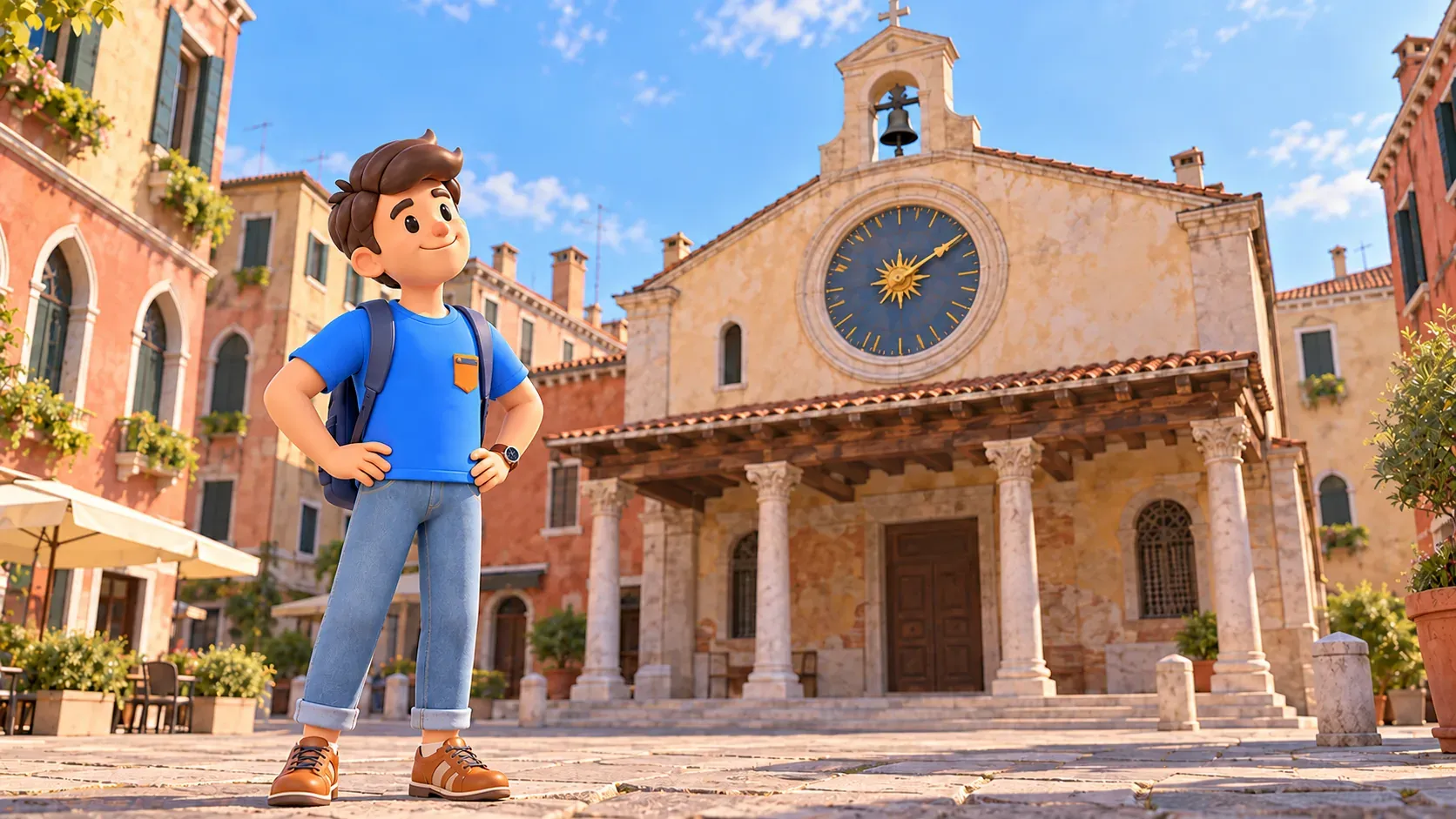
San Giacomo di Rialto gives the morning a manageable starting point. Look at its large clock and portico, then turn to take in the surrounding space. You do not need a full architectural history to appreciate the close relationship between the church, the square and the market approaches. Choose a few details and actually look at them.
Nearby, the Gobbo di Rialto is a crouching figure supporting a stone platform. Public orders and proclamations were read from above. This small monument adds another dimension to a trading district: people gathered here for information as well as goods. A brief pause makes that function easier to imagine without needing a long list of historical dates.
With children, try a small observation task: find the clock, then work out what the figure is carrying. With adults, ask why a market needed both visible time and a place for announcements. Neither question requires you to inspect every neighbouring façade. It gives the stop a purpose and leaves attention for the rest of the morning.
Agree on a specific meeting point before anyone separates for photographs or coffee. “Rialto” covers too much ground to be useful when one person is by the bridge and another is in the market. Choose a visible landmark and a time, so a short independent look does not become an extended search for each other.
Bancogiro and Erbaria: a brief view of the water
From the square, make your way out towards the Grand Canal around Bancogiro. Spend a few minutes looking across the water and noticing movement along it. The open view helps place the market in its setting: trading lanes sit close to the city’s main waterway, rather than forming a completely separate attraction inland.
Choose one view rather than collecting every possible photograph of the bridge. If the waterfront is busy, skip the photo stop and continue. Poor light or a group in the foreground need not determine the success of the morning. The market and the change of scale in the interior lanes are still ahead.
Erbaria and Pescaria are useful orientation names, but avoid treating them as an unchanging diagram of individual stalls during the works. Look at how trading is organised on your day. You can shorten the waterfront section if food is your main interest, or give it a little longer if water and architecture matter more to you.
At the market: leave room for the people shopping
Before stopping, watch how people move. Where are customers choosing produce, paying or making space for a trolley? Pick your place after that brief observation. You will see more comfortably without occupying the part of the aisle needed for work. A group should avoid spreading across a narrow passage while everyone decides where to go next.
One small question is enough to make browsing worthwhile. Compare the shapes of different fish, or notice which vegetables are grouped together that morning. The selection changes; an ingredient from a guide is not guaranteed to appear. If you want a name or information about origin, ask when the trader is free and expect a brief conversation.
You do not have to buy something to justify looking. If shopping is part of your plan, think about where your purchase goes afterwards. Fresh fish needs appropriate storage and preparation, which fits poorly with a full day of museum visits. Even a simple bag of fruit should suit the walk you will actually take, rather than an imagined market picnic.

Ask before taking a close photograph of someone. Make wider photographs quickly from a place that leaves access to the goods clear. Do not handle produce for a picture or ask traders to rearrange their display. The market is interesting because it is working, so a considerate visit leaves people able to continue that work.
A tasting, cooked breakfast or guided introduction is not automatically part of browsing. Choose those as separate experiences if you want them. For this morning, an ordinary market visit provides enough to observe. Anyone uncomfortable with fish displays can spend more time on produce and the surrounding spaces, then start the neighbourhood section earlier.
Through the lanes to Campo San Polo
Leave the trading area through Campo delle Beccarie and turn your attention inland. Keep Sant’Aponal, then Campiello dei Meloni and Campo San Polo as broad orientation points. Check individual turns on a current map as you go. A short walk does not need to become a test of how well you remember a street sequence.
If you want art, history or another walk after Rialto, let RoadMe build the personal plan for your whole day around your interests and pace. It is much easier to use a connected itinerary in the app than to invent a new continuation after every square.
Choose details that interest you: a shop sign, the arch of a passage or a reflection in a narrow canal. You do not have to stop at every old-looking doorway. Stay on public routes, keep entrances clear and avoid following residents into private courtyards. A quiet lane is still somewhere people live and move through.
Campo San Polo offers a broad finish after the trading aisles and small streets. The square and district take their name from the church dedicated to St Paul. Look across the whole space before choosing a place to pause. Going inside the church is a separate choice, requiring additional time and a check of visiting conditions.

Coffee, weather and the rest of your day
Put coffee in the middle or at the end according to how you want to rest. Before ordering, check whether you are choosing counter service or a table; do not assume the conditions are identical. If you want a long break, give it extra time rather than trying to recover the minutes by rushing the remaining walk.
In rain, allow for exposed sections and wet surfaces around the market. For high-water warnings, check current city information rather than photographs from another visit. This is not a verified step-free route: bridge approaches and access with a stroller or mobility limitations need individual assessment. Ending at the market remains a perfectly workable shorter version.
Before leaving, recheck your weekday and any current market notices for your date. After Campo San Polo, choose one next activity and allow time to reach it. If this is your first visit, compare the morning with our one-day Venice plan. A transition and a proper pause help this walk remain a distinct experience within the day.


