
Half a day in El Capricho: Madrid’s garden of unexpected buildings
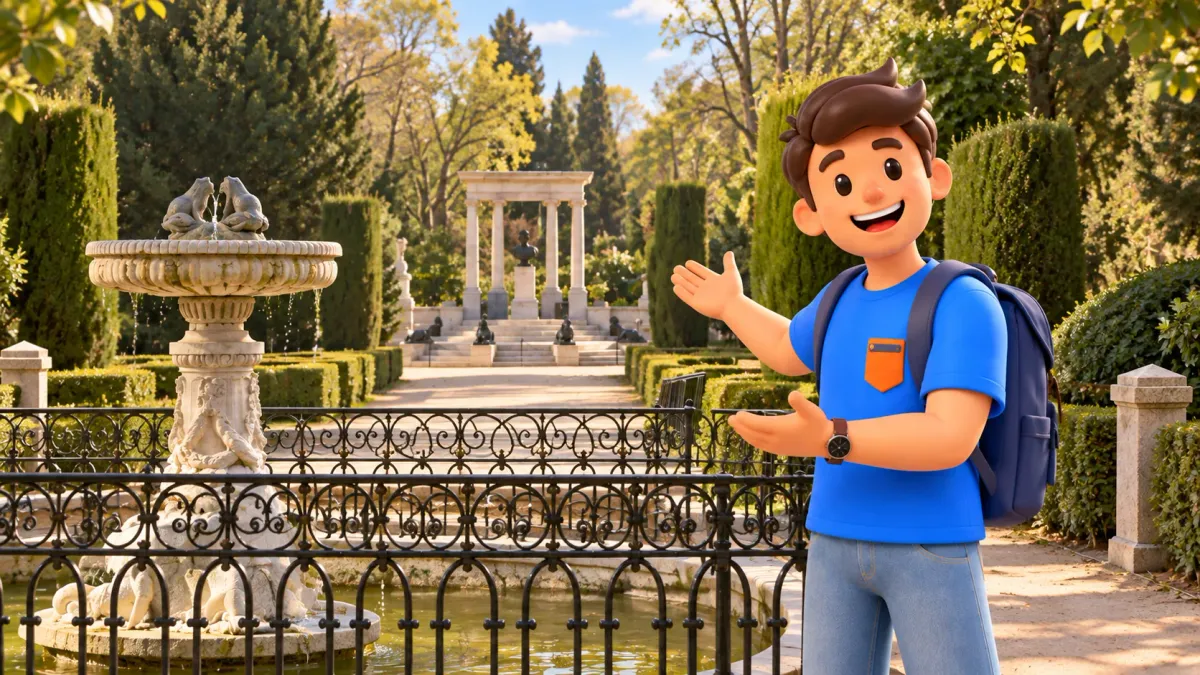
Visit El Capricho for a garden that keeps changing its mood. A formal perspective gives way to a winding path; classical columns are followed by a miniature fort, then something resembling a rural house. For a first visit, allow approximately three hours inside and another hour for a relaxed finish with lunch outside. This makes a self-contained half-day in Alameda de Osuna without adding a race through central Madrid’s museums. The variety comes from a small succession of scenes rather than a long list of admissions.
The essential condition is the day of the week. Ordinary independent access is on Saturdays, Sundays and public holidays; this is not a park to enter casually on any weekday. The plan below follows open garden paths and views buildings from outside. The bunker and any palace visit have separate conditions and are excluded from the main calculation. Timings are editorial estimates, without a timed field walk. Travel from central Madrid and the journey back are additional to the four-hour outing.
Choose the day before choosing the details
El Capricho lies in Barajas, away from the familiar Sol, Prado and Retiro sequence. Make it the main experience of a free morning when garden architecture and small discoveries appeal. If you have only a short gap between two central museums, travelling out may occupy too much of that gap. Give the garden a suitable half-day in the wider itinerary first, then decide which corners interest you. This also makes it easier to agree on the purpose of the outing with other people.
It is more convenient to arrange these outings with RoadMe, which develops a personal trip plan around your interests, dates and pace. Choose gardens, architecture and relaxed walks to build a connected itinerary suited to your own journey.
At the check date, 16 October 2026, normal hours were Saturdays, Sundays and public holidays, 09:00–21:00 from April through September and 09:00–18:30 from October through March. The garden closes on 25 December and 1 January. Admission is free, with a capacity limit. Published hours do not override temporary weather closures, so check the city’s current notices before travelling. Avoid a last-minute arrival that leaves insufficient time to enjoy the garden or return calmly to the exit.
Eating inside is prohibited, as are bicycles, roller skates and ball games; an ordinary outing with a pet also conflicts with the visiting rules. Plan lunch beyond the gates rather than a garden picnic. For children, observation works better here: find a round and a straight shape, compare two façades or notice how paths change. Wear shoes for garden surfaces. Check particular slopes, steps and connections for your own access needs, rather than assuming every route is equally suitable.
A four-hour plan with three hours inside
- 20 minutes — entrance and orientation. Start at the garden gate on Paseo de la Alameda de Osuna, 25; the metro approach is additional.
- 35 minutes — Exedra and palace parterre. Read the formal perspective and view the palace exterior.
- 45 minutes — Templete de Baco and Abejero. Follow open paths between two different architectural ideas.
- 30 minutes — Fortín and the water landscape. A small fort and paths near the artificial watercourse.
- 35 minutes — Casino de Baile and Casa de la Vieja. A pleasure pavilion and a rural scene before returning.
- 15 minutes — exit. Finish the garden portion approximately three hours after starting.
- 45 minutes — lunch outside, plus 15 minutes spare. Extend the outing if waiting for a table takes longer.
The allocations total two hundred and forty minutes. Connections and short stops are already included in each section. This is a selective walk, without a promise to see every structure or enter any particular building. Check the plan at the entrance and current barriers. If some paths are unavailable, preserve the sequence of experiences: formal garden, looser landscape, several unexpected buildings, then the way out. The idea works without collecting every numbered feature or completing a rigid line regardless of local conditions.
The relevant metro name is El Capricho, on line 5, but the station is not the garden gate. Allow separate approach time and check current transport conditions. Our starting point is the real entrance, rather than an internal pavilion’s map marker. Leave through an authorised open exit as well. The garden buildings are not independent, round-the-clock street destinations. Giving a companion the entrance as a meeting point is clearer than choosing an attractive structure that cannot be reached before entering.
The Exedra and palace: understand the setting
The first theme is ordered space. At the Exedra, also known as the Plaza de los Emperadores, a semicircle, columns, busts and an emphasised centre create an outdoor stage. Pause before moving to the next name. Notice how the straight path relates the small structure to the longer view. The Exedra’s central pavilion is different from the separate Templete de Baco, which comes later. Keeping those two features distinct makes the garden easier to understand without memorising an architectural catalogue.
Behind this arrangement stands the estate’s patron, the Duchess of Osuna, María Josefa Alonso Pimentel. In the late eighteenth and early nineteenth centuries, the garden developed as a place for art, conversation and entertainment for the household and its guests. Nature formed part of a composed experience. Moving between scenes explains that idea without a long historical lecture: one place encourages looking down an axis; another invites a turn among trees and a surprise. The sequence is itself part of the pleasure.
Continue towards the palace parterre, observing clipped hedges and the relationship between façade and garden. El Capricho combines French, English landscape and Italian gardening approaches. This is a useful way of looking, rather than a guarantee of access to every historic section. Entering the maze or particular lower areas is not required by this plan. Announcements about a new cultural space in the palace also do not substitute for confirmation of its actual visiting arrangements. The exterior remains the reference point for this walk.
Baco and Abejero: different kinds of curiosity
Leave the ceremonial axis for open paths through the landscape section. The small Templete de Baco introduces a classical theme among greenery. Its value does not depend on identifying every detail: notice how the columns and silhouette sit between trees. A pavilion can become a reason to change the direction of your gaze and the speed of your steps. There is no need to climb onto a closed platform or go around a barrier. The idea can be appreciated from an available path.
The Abejero brings a different story. The pavilion was associated with observing bees, making the insects’ small world an activity for estate visitors. Compare that intention with the nearby classical temple image: entertainment could involve an imagined journey into antiquity or curiosity about living nature. A historic function does not mean an unrestricted bee demonstration operates inside today. The main plan views the building from outside and promises neither admission nor working hives. This distinction preserves the story without inventing a present-day attraction.
The Fortín, water and Casino de Baile
The small Fortín resembles a military structure but belongs to the garden’s designed scenery. Distinguish it from the Civil War bunker: different buildings, different periods and different visiting conditions. Here, a military image becomes part of an estate’s pleasure landscape. Instead of searching for a large defensive complex, notice the modest scale and its relationship with water and vegetation. An exterior view provides the relevant experience, without assuming unrestricted access to the interior. This is a garden discovery rather than an underground visit.
An artificial watercourse connects the landscape experience with the Casino de Baile. The name describes a historic dancing pavilion, rather than a current gambling establishment. Water and a building made for entertainment recall the estate’s varied leisure activities. Do not plan a personal boat ride from old descriptions of how guests were entertained. A former use of the water is not evidence of a service offered to visitors now. Looking from the banks is sufficient for the suggested outing.
The city reported completion of restoration at the Fortín and Casino de Baile in April 2026. That explains their relevance, but restoration news is not an admission ticket. Observe them from permitted areas and follow signs on the day. Water levels, equipment operation, seasonal planting and viewing angles can change. A satisfying walk does not require recreating a photograph taken in a different month or year. Allow the actual garden to supply its own light, textures and small discoveries.

A rural house, with the bunker as a separate choice
Casa de la Vieja closes the sequence with the image of an old rural house. Within an aristocratic garden, this simplicity was also deliberate: the building evokes farming life and the land. The contrast becomes especially noticeable after classical columns and a dancing pavilion. Compare a ceremonial impression with a domestic one, without turning the pause into a complete inventory of building details. Seeing the exterior supplies a meaningful final scene before returning towards the gates. Another indoor attraction is unnecessary to complete that thought.
To combine this garden with art, history or other neighbourhoods, try a personal plan in RoadMe. The app makes it easier to organise the trip around your preferences and distribute different experiences across days, leaving space for connections and rest.
The Posición Jaca bunker is a separate option for an interest in twentieth-century history. Built in 1937, it is associated with the headquarters of the Republican Army of the Centre. The city periodically offers free guided visits requiring advance reservation. Ordinary garden admission does not automatically provide access underground. If you secure a suitable confirmed reservation, add the tour and required arrival time beyond the garden plan, or shorten the walk deliberately. Do not hide an additional appointment inside the spare fifteen minutes.
Treat the bunker, palace and garden as separate decisions. For the palace, look for confirmation of actual opening and visiting arrangements, rather than only an announcement of a new space. The basic walk keeps its main experiences outdoors. Skipping an additional interior therefore does not undermine the outing or create a need to hurry between two fixed tours. It leaves you free to spend longer on the part of the garden that turns out to interest you most.

Lunch beyond the gates and a relaxed finish
Finish the garden portion with time before closing, then leave for lunch. Check a chosen café’s hours and arrangements beforehand if it matters to the day; waiting and service may require more than forty-five minutes. The eating restriction means you cannot automatically transfer that break to an attractive garden bench. Thinking about this before travelling is easier than explaining to a hungry group why a packed meal must remain in the bag. Lunch outside belongs to the plan, not to an improvised exception.
For another day with larger green space and relaxed lakeside time, consider our half-day plan for Casa de Campo. El Capricho offers something different: a compact historic garden where contrasting buildings shape the walk. There is no obligation to add another major sight afterwards. A handful of carefully noticed scenes already forms a complete encounter with an unusual side of Madrid, leaving the rest of the day available for whatever pace suits your trip.


