
Paris with kids: three family day plans with one activity
A Paris day with children works well around one shared curiosity: animals, space or aquatic life. Give the main visit room, then add a nearby walk, a meal and a proper pause.
These are three separate alternatives: Jardin des Plantes with the evolution gallery, the northern part of La Villette with one science exhibition, or the Tropical Aquarium at Porte Dorée with a small local garden. Choose one for a day. Each allowance covers roughly four to five hours from a Métro station to the finish, including meals and every movement within the programme. Travel from your accommodation, airport journeys and dinner are additional.
Choose a family day around one interest
Plants and natural-history specimens: about four and a half hours. Choose Jardin des Plantes and Grande Galerie de l’Évolution for looking closely at leaves, impressive museum specimens and questions about nature. The permanent gallery welcomes a broad public. Adapt the explanations to your child’s interest; the animals inside are museum specimens rather than a live zoo collection.
Space exploration: about five hours. At Cité des sciences et de l’industrie, make Mission spatiale your main exhibition. The owner recommends it from age eight. Afterwards, explore a small part of the northern park. For younger children whose interest is brief visual observation, consider the garden or aquarium alternative. The recommendation belongs to this exhibition, not the entire science institution.
Tropical aquatic environments: about four hours. Aquarium tropical shares the Palais de la Porte Dorée’s setting. Give it one focused visit, followed by a meal and a short pause in a nearby public square. This suits a shared interest in fish movement, habitats and looking through the glass rather than lengthy museum reading.
Try RoadMe to work out a personal day-by-day Paris trip around your dates, interests, pace and budget. Using one considered programme in the app is much more convenient and effective when family visits need to fit naturally around rest.
Day option one: plants and the evolution gallery
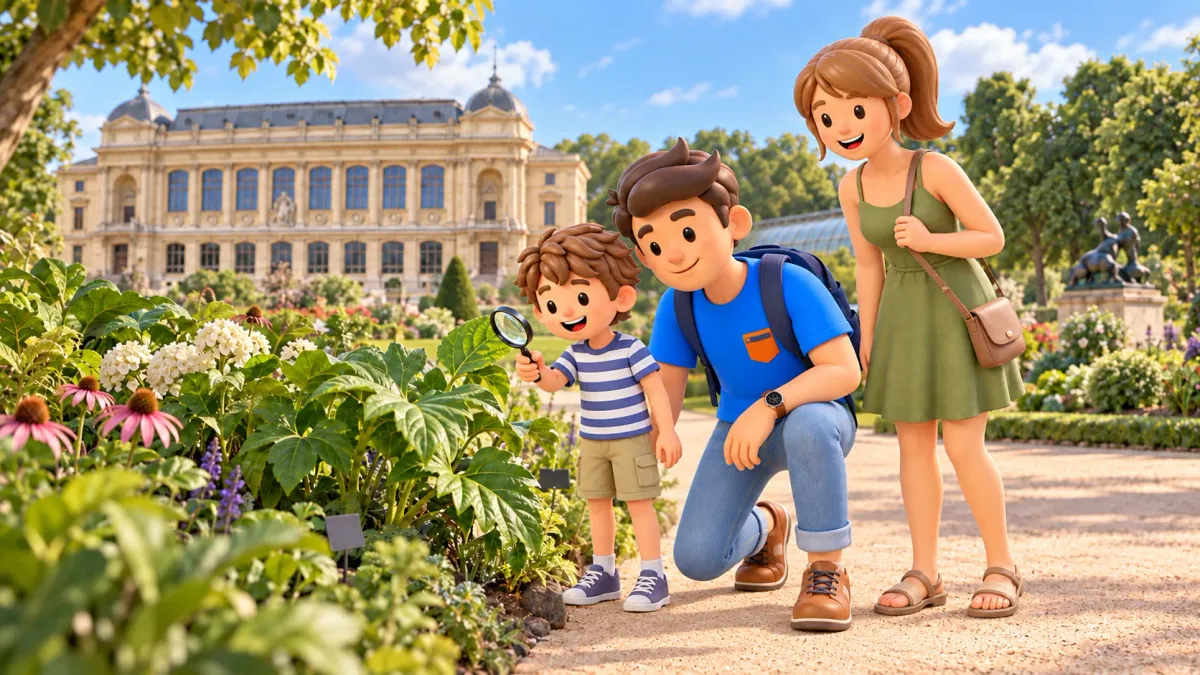
Start at Gare d’Austerlitz, served by Métro lines 5 and 10. Approach the public garden entrance on the Place Valhubert side and follow selected central paths west. The long perspective leads your gaze towards the gallery façade. Choose a few plant beds and a small section of the École de botanique; the maze hill and specialist gardens are not essential.
Jardin des Plantes began as a royal medicinal garden and opened to the public in 1640. It helped train physicians and apothecaries. That brief history gives the planting a purpose beyond decoration: learning through observation shaped the place. You can continue that habit without needing an expert explanation of every plant.
Compare two leaves still attached to plants, looking at their edges, size or colour from the path, then read one label. Leave plants in place. Autumn leaves and fruit, or winter branches, can prompt a question without a botanical quiz.
For Grande Galerie de l’Évolution, follow the operating visitor signs from the Esplanade Milne-Edwards side. The institution’s address is 36 rue Geoffroy-Saint-Hilaire; it identifies the gallery without replacing directions to its entrance from the garden. Jules André’s zoology gallery opened in 1889, and the transformed evolution gallery reopened in 1994. The stone exterior and scale of the interior give today’s visit a longer historical setting.
Inside, begin with a marine theme and the procession of African savanna animals. A large specimen attracts attention immediately. Follow that impression with one comparison about body shape or environment, using the museum’s interpretation to explain what you see. Choose a few stops that hold your child’s interest. These scientific specimens present biodiversity and change over time, rather than the behaviour of living zoo animals.
The gallery uses changing light and naturalistic sound, including a simulated storm. Allow 105 minutes with short pauses for selected themes; every level and separate temporary programmes need more time.
The remaining allowance is 45 minutes for garden observation, 45 for all movements from the station to the finish, 45 for a meal, 15 for admission checks and 15 for a separate rest. Together, that makes 270 minutes. These are editorial planning estimates, not measured walking times or a queue forecast. Approximately 9.30am–2pm is one example, with the gallery visit arranged around the admission time you select.
Afterwards, use an available western public garden exit towards rue Geoffroy-Saint-Hilaire. Continue south to rue Censier, then west towards rue Monge and Censier–Daubenton on Métro line 7. Place lunch and the pause along this part of the programme. Adding the mosque, Roman arenas, zoo or another gallery would change both the time allowance and the family day’s main focus.
Day option two: one space exhibition and a nearby walk
Begin and finish at Porte de la Villette on Métro line 7. This is the northern station selected for the programme; Corentin Cariou is a different station near another approach to the complex. Follow public pedestrian paths south and southeast towards the designated visitor bridge across the water surrounding the building. This approach crosses the building’s moat, not the Canal de l’Ourcq. The institution’s address is 30 avenue Corentin-Cariou.
Cité des sciences opened in 1986 in a former slaughterhouse and livestock-market district. Bernard Tschumi designed La Villette’s cultural park. Red architectural structures and substantial science buildings make that transformation visible alongside the indoor visit.
Mission spatiale explores how people travel beyond Earth and live during space missions. Replicas of Orion and the I-HAB habitat module, plus a multimedia game about an astronaut’s day on Mars, introduce real technologies and constraints. A separate virtual-reality experience is not included automatically.
The exhibition is recommended from eight and presented in French, English and Spanish. Consider that language choice if your child expects to read independently. Look at an object together before choosing a short explanation. You do not need to try every device or study every part of the exhibition for the visit to have a clear purpose.
Allow 135 minutes for this indoor block, including short pauses. Add 40 minutes for selected northern park observation, 45 for all movements, 45 for a meal, 20 for a separate rest and 15 for entrance checks. The total is 300 minutes. Set your arrival at the station before your actual exhibition slot, leaving enough time for the approach and checks. Earlier building opening does not mean earlier exhibition admission.
After the exhibition, change the scale of your attention. Follow permitted northern park paths for an exterior view of La Géode, then return towards the northern station. The mirrored sphere opened in 1985 and gathers reflections of the sky and buildings. It is an exterior stop here; a film screening needs its own admission and time. The southern music complex, a complete park tour and a long canal walk are outside this allowance.
An ordinary Expositions ticket excludes Cité des enfants, whose spaces have separate tickets and sessions. The planetarium and Argonaute submarine also require the appropriate time reservations. Mission spatiale remains the chosen activity for this programme. A ticket offering several exhibitions does not oblige the family to cover them all. Use lawns only where access is permitted, and choose a bench or another allowed area for rest.
Day option three: the Tropical Aquarium and a small square
Start at Porte Dorée on Métro line 8. Use the public pavements around place Édouard-Renard and avenue Daumesnil towards the palace at 293 avenue Daumesnil. This is Aquarium tropical in eastern Paris, a separate venue from Aquarium de Paris near Trocadéro. The programme includes the palace exterior and one aquarium visit; it does not add the Immigration Museum.
The palace was built in 1929–1931 to Albert Laprade’s design. Geometric forms, the colonnade and sculptural decoration explain its Art Deco appearance. Alfred Janniot’s relief includes plants and animals worth noticing from the forecourt. It was commissioned for the building’s original colonial programme, so understand it as an artistic representation of its period rather than a neutral account of history.
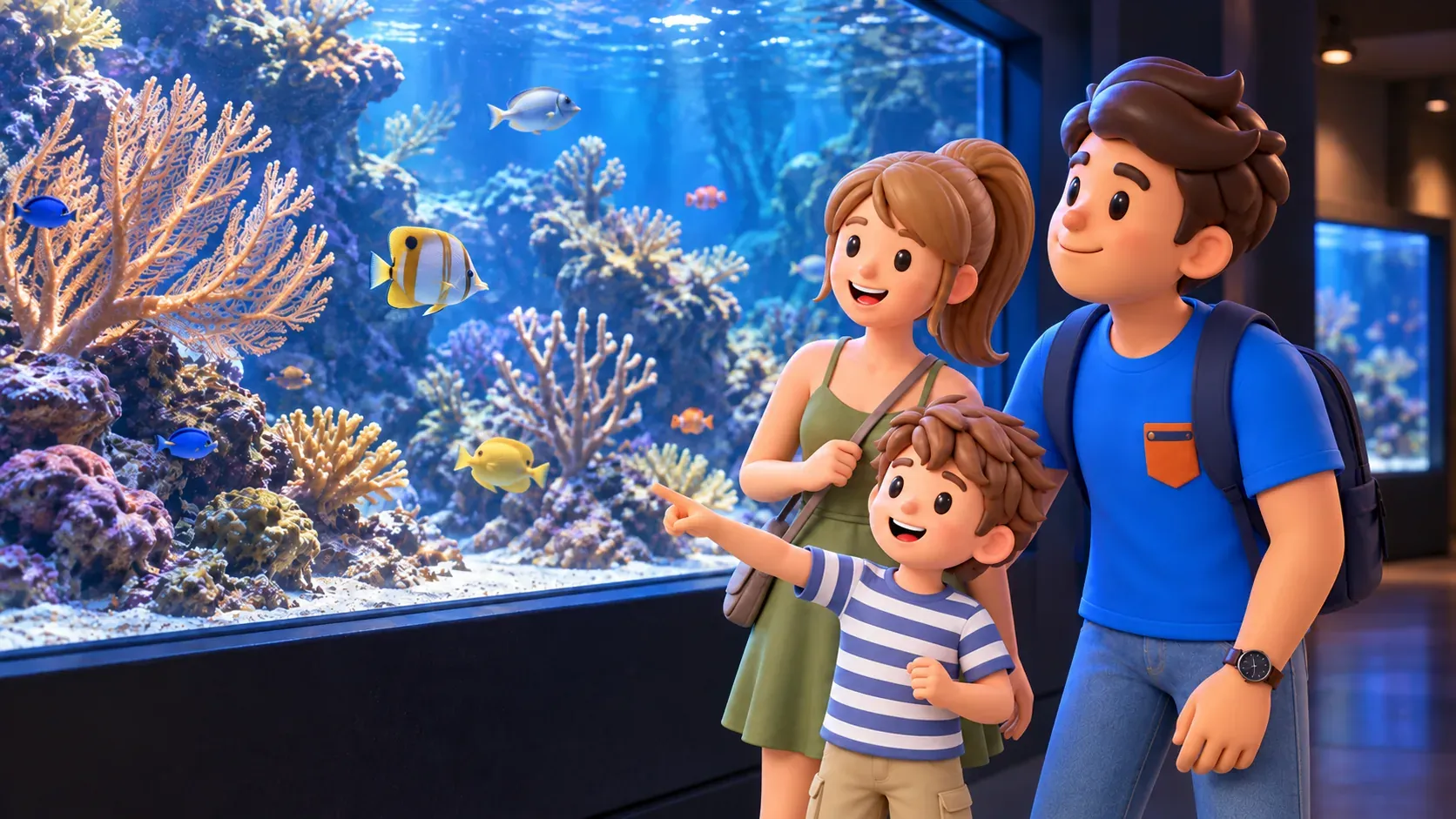
Inside, compare two tropical aquatic environments: freshwater and marine settings offer different movement, planting and shelter to observe. Let your child describe one detail before reading the interpretation together. Avoid making the visit a search for every listed inhabitant. Animal visibility varies, and a few sustained observations can be more rewarding than moving quickly between all the tanks.
Give the aquarium 90 minutes, including a short pause inside. Rivage offers space for reading, play and rest; additional screenings and activities follow their own programmes and are not needed for this plan. Afterwards, allow 45 minutes for a meal and 35 for a short walk or rest in Square Van Vollenhoven. Another 20 minutes covers the palace exterior, 35 all movements, and 15 admission checks. Together, these blocks total 240 minutes.
For example, reach the station at 10am, allow around ten minutes for the approach, twenty for the façade and fifteen for checks before a 10.45am aquarium slot. Those minutes are estimates, so choose an available slot with suitable breathing space. An 11am entry adds waiting: shorten optional outdoor time or extend the outing. Starting at the station and entering the aquarium are separate moments.
After the aquarium and lunch, use public paths and marked crossings towards the small square at 5 rue Marcel-Dubois, then return to Porte Dorée. This is a local pause, rather than a Bois de Vincennes or lake circuit. The square has a playground and toilets, but follows daytime opening hours. Choose a suitable available place for your child’s break and preserve the return allowance.
Check tickets, dates and the family pace
Conditions were checked on 13–14 October 2026. The evolution gallery opens 10am–6pm except Tuesday. Ordinary permanent-collection admission is paid for adults; children can enter free with age proof. Free garden access does not include other galleries, the zoo or glasshouses. The paleontology gallery has been closed since 19 January 2026, with reopening announced for summer 2027.
Regular Cité exhibition hours are Tuesday–Saturday, 10am–6pm, and Sunday until 7pm. Mission spatiale closes at 6pm through 17 October, then opens daily until 7pm through 1 November; exceptional Monday openings are announced for 19 and 26 October. Booking is strongly recommended. Children’s concessions depend on age, so do not assume all children enter free.
The aquarium opens Tuesday–Friday, 10am–5.30pm, and weekends until 7pm; Monday is closed. Last admission is one hour before closing. Visitors under 26 enter free with valid supporting proof and identification; everyone, including each child, needs an admission ticket. Advance online booking is strongly recommended. Check seasonal hours for gardens and the square. Pushchair arrangements inside a venue do not establish an easy journey through every station and approach.
Use RoadMe to prepare a complete personal trip around the family’s interests and pace. The app makes it much more convenient to coordinate walks, substantial visits and rest across your stay, taking dates and budget into account.
For another day, explore the Jardin des Plantes walk with one museum or La Villette’s architectural programme in more detail. Finish at your chosen station after one shared discovery, a meal and an unhurried pause.


