
Paris for Photography Lovers: An Exhibition and a Camera Walk
A photography exhibition can change what you notice in Paris afterwards. A carefully framed portrait may make you look at the space around a subject; a documentary sequence may prompt you to consider what one photograph leaves out. Give those ideas a little room on the streets rather than immediately moving to another gallery.
Three venues offer different starting points: the Maison Européenne de la Photographie, or MEP, in the lower Marais; the Fondation Henri Cartier-Bresson farther north; and LE BAL near Place de Clichy. Choose one exhibition programme, then a nearby walk with a camera or phone. The aim is a satisfying half-day with time to look, eat and rest.
Choose the exhibition before choosing the walk
Try RoadMe for a complete personal route or trip plan shaped around your interests, dates, pace and budget. Having visits, journeys and pauses worked out together in the app makes your Paris day much more convenient and efficient to use.
Choose MEP for the current season’s approach to photographic composition and fashion. Consider the Cartier-Bresson Foundation for documentary work, press images and their changing meanings. LE BAL is particularly interesting if you want to examine the relationship between a photographer and a subject. These are questions to guide your choice, rather than permanent labels for every future exhibition.
Read the actual programme for your date. A collection containing a famous photographer’s work does not mean those pictures are always displayed. The Foundation is closed from 5 to 20 October 2026 and announces reopening on 21 October; confirm that reopening before using its plan. For a visit during the closure, choose one of the other venues.
| One chosen programme | Arrival | Exhibition | Walking + photo stops | Break + reserve | Total |
|---|---|---|---|---|---|
| MEP and lower Marais | 20 min | 120 min | 15 + 35 min | 40 + 10 min | 240 min |
| Foundation and upper Marais, after reopening | 15 min | 90 min | 20 + 40 min | 30 + 15 min | 210 min |
| LE BAL and nearby streets | 15 min | 90 min | 30 + 35 min | 25 + 15 min | 210 min |
These are planning allowances, not guaranteed queue or viewing times. Travel to the venue and onward transport come separately. MEP and the Foundation are roughly 1.2 km apart, while LE BAL is about 4.1 km from the Foundation. Their positions help you choose a neighbourhood; they do not make three exhibitions and a camera walk one comfortable afternoon.
MEP: composition, then stone and river light
MEP opened in 1996 in the Hôtel Hénault de Cantobre, with restoration and a modern extension by Yves Lion. The setting connects a historic Marais residence with contemporary exhibition spaces. Think of the building as a frame for changing photographic approaches, rather than a promise to see every celebrated work in its collection.
From 30 September 2026 to 17 January 2027, PENN & FASHION follows Irving Penn’s fashion photography. Silhouettes, volume and texture give you a useful viewing theme: notice how a background and a subject’s shape work together. Choose several images to study slowly, then compare them. You can appreciate the decisions within a photograph without reconstructing the photographer’s entire career.
The visitor address is 5/7 rue de Fourcy. Regular hours are Wednesday and Friday 11am–8pm, Thursday 11am–10pm, and weekends 10am–8pm; Monday and Tuesday are closed. Installation periods and exceptional dates also affect access. Ordinary admission is paid unless you qualify for an exemption. Online tickets are recommended, although individual exhibition booking is not compulsory. The box office closes thirty minutes before exhibitions close, and rooms clear fifteen minutes before closing.
An 11am start on Wednesday or Friday gives an example finishing around 3pm. After twenty minutes for arrival and admission, allow two hours to view the exhibition. Complete any bookshop visit before leaving: it normally requires an admission ticket, and every exit is final. MEP’s current visitor FAQ says there is no café and the courtyard is not public. Keep your longer meal or rest outside.
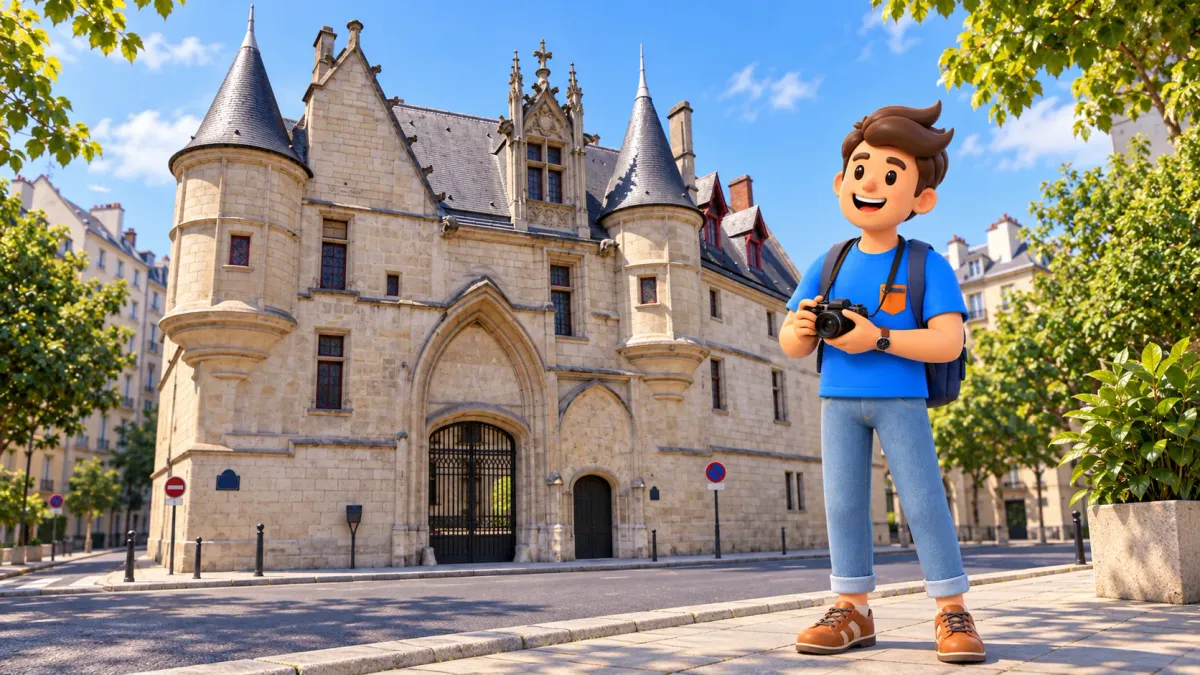
For the walk, take rue de Fourcy south towards rue du Figuier and the exterior of Hôtel de Sens. The building also houses Bibliothèque Forney; these are two names for the same architectural stop. Look at the contrast between broad stone walls, pointed roofs and round turrets. Try a general view before selecting one small detail, staying clear of doors and pedestrian crossings.
Continue to the upper Quai de l’Hôtel de Ville and the right-bank end of Pont Marie. The public-street sequence is only about 400–500 metres in practice, including approaches. Its interest comes from changing subjects: a building, a street edge, then water and more open light. Stay on the public approaches; neither a library room nor MEP’s courtyard is a shortcut. Allow the table’s fifteen minutes for moving and thirty-five for observations.
The Foundation: photographs in their changing context
The Fondation Henri Cartier-Bresson began in Montparnasse in 2003 and opened its present Marais premises in November 2018. Use the exhibition entrance at 79 rue des Archives. Its mission includes preserving Cartier-Bresson’s and Martine Franck’s work, but there is no permanent gallery displaying their photographs. Archives and research services are separate from an ordinary exhibition visit.
Two exhibitions are announced for 21 October 2026–7 March 2027. Martine Franck — Images, presse et luttes féministes explores feminist mobilisations and the role of press images in the 1970s. Susan Meiselas — Nicaragua, Histoire, Mémoire considers photographs from 1978–79 and their subsequent life in public memory. They invite attention to context: who made an image, where it circulated and how its meaning changed.
The ninety-minute allowance means choosing an emphasis within the visit. Read some accompanying texts, follow a sequence and return to a photograph after learning its background. Seeing images together can reveal something that disappears when each becomes an isolated phone-screen picture. Leave a little time to consider what you would ask about your own street photographs.
After confirmed reopening, regular visiting hours are Tuesday to Sunday, 11am–7pm, with last admission at 6.20pm. Mondays and installation periods are closed; exceptional holiday arrangements also apply. Ordinary exhibitions are paid, with eligibility-based exemptions. The bookshop is normally free to enter, but that does not establish access during the October closure. An 11am start produces a suggested 2.30pm finish.
Outside, follow rue des Archives to rue Eugène Spuller, then rue Perrée beside the Carreau du Temple. This former clothing market now has cultural and sporting uses. Observe its façades from the street; the walk does not require entering the hall. Return via rue Caffarelli, rue de Bretagne and rue des Archives. The loop is about 600 metres, plus the museum approach.
Use one repeated feature as the link between your photographs: windows, vertical supports or contrasts between neighbouring surfaces. Forty minutes of camera stops and twenty of movement leave room to change position without rushing. A façade photograph can also prompt a question about a building’s current role, rather than becoming a collection of decorative details alone.
LE BAL: the encounter behind an image
LE BAL opened in 2010 in premises that had once housed a cabaret and dance hall. Its programme examines documentary images through photography, film, video and other media. That reuse offers a small connection between the venue and its work: a place formerly built around encounters now asks how encounters become images.
From 19 June 2026 to 3 January 2027, L’Espace entre nous — Dans la collection du Wilson Centre for Photography explores relationships between photographers and their subjects through Michael and Jane Wilson’s collection. Compare a seemingly spontaneous image with a visibly arranged one. What suggests trust, distance or cooperation? The useful question is not simply whether a photograph looks beautiful, but what relationship made it possible.
Find 6 impasse de la Défense, reached from avenue de Clichy near Place de Clichy Métro. Regular hours are Wednesday noon–8pm and Thursday to Sunday noon–7pm; Monday and Tuesday are closed. Last admission is thirty minutes before LE BAL closes. Exhibition entry is ordinarily paid, with concessions and exemptions for eligible visitors.
On Thursdays with BAL LAB events, the exhibition closes at 6pm, one hour before the evening programme. Events are announced at 7pm on 15 October and 26 November 2026; they are dated occasions, not a daily evening service. Their tickets do not include exhibition access. Starting the half-day at noon leaves the suggested ninety-minute gallery visit comfortably before that exception.
Afterwards, leave the impasse, follow avenue de Clichy south and use crossings at Place de Clichy. Make a short detour of about 100 metres along rue Biot, then return to the square. Continue west along boulevard des Batignolles and up rue des Batignolles to Place du Docteur-Félix-Lobligeois. Sainte-Marie’s façade is an exterior endpoint; ordinary church entry is outside this plan.
The route is about 1.4 km with doorway and square circulation. Give thirty minutes to walking and crossings, plus thirty-five to photographs. Compare the scale of the busy junction with narrower streets and the final square. Look for a foreground, a middle distance and a background in one view, while leaving space for people to pass. The complete outing can finish around 3.30pm.
Take the camera without letting it organise everything
A phone is enough for this walk. Choose a small sequence: one wider setting, one detail and one relationship between shapes. Look before raising the camera, and review your selection during the break. A few considered photographs will tell you more about what interested you than repeatedly stopping for the same composition.
Ask staff about the current exhibition’s photography and equipment rules. MEP allows photographs of displayed works for private use, without flash, extra lighting or selfie poles. Publishing such images online requires prior written permission under its visitor regulations; personal-photo permission does not authorise public reuse. At the Foundation and LE BAL, ask rather than assuming a general permission or ban.
Travel light. MEP refuses suitcases and bags larger than A3. LE BAL refuses suitcases and scooters, accepts bags up to 50 × 40 × 40 cm, and has small lockers for small belongings; availability is not guaranteed. Outdoor photography should keep entrances and pavements clear. Ask before taking a close portrait, and accept a refusal without trying to capture the same person covertly.
Keep the rest of the day personal
If time is shorter, reduce the local walk and one viewing emphasis. MEP can become a three-hour outing; LE BAL can stay near Place de Clichy rather than continuing to the final square. Preserve a break and your onward travel margin. For another day, the Batignolles walk through two parks provides its own programme, rather than an automatic extension after the exhibition.
Use RoadMe to work out the full personal plan for your stay around photography, your other interests, dates, budget and preferred pace. Try the app for a more convenient and effective way to fit cultural visits, travel and proper breaks into the whole trip.
End by selecting one picture from your walk and one idea from the exhibition. The connection between them may be a shape, a question about context or a more attentive way of looking at another person. That gives this half-day a clear memory, even when its street route is short.


