
Crystals, Minerals and Dinosaurs in Paris: Choose One Museum
For a Paris visit centred on minerals, choose the cabinet-style Mineralogy Museum at MINES Paris–PSL or the Trésors de la Terre display in the Jardin des Plantes. For ancient animals, the current alternative is Sur les traces des dinosaures, an exhibition inside the Grande Galerie de l’Évolution. Give one subject a proper visit, then add a short garden walk nearby.
The Galerie de Paléontologie et d’Anatomie comparée is closed for works from 19 January 2026, with reopening announced during 2027. It cannot be the main museum in a present-day outing. The dinosaur exhibition occupies a different building and has its own calendar and ticket.
Choose a question, then a three-hour outing
Choose MINES for an extensive mineral collection presented in historic rooms and cases. Choose Trésors de la Terre for a more concentrated introduction to crystals, minerals and meteorites. Choose the dinosaur exhibition for fossil evidence and the work of palaeontologists. These are three alternative programmes, each with one principal visit.
You do not need specialist knowledge. Begin with a question you can explore by looking: how specimens differ, what a crystal’s shape tells you, or how a fossil helps reconstruct a vanished environment. The exhibition labels can take that curiosity further. A small number of careful comparisons gives the museum time a purpose.
Try RoadMe for a complete personal trip plan built around your interests, dates, pace and budget. Organising your days in the app is more convenient and efficient, helping this scientific visit fit alongside meals, rest and other Paris discoveries.
| One programme | Time allocation | Total |
|---|---|---|
| MINES and Luxembourg Garden | 15 minutes arrival and admission, 90 museum, 10 connection, 35 garden, 20 rest, 10 exit | 180 minutes |
| Trésors de la Terre and Jardin des Plantes | 15 minutes arrival and admission, 60 display, 20 connections, 45 garden, 30 rest, 10 exit | 180 minutes |
| Dinosaur exhibition and Jardin des Plantes | 15 minutes arrival and admission, 75 exhibition, 15 building and path connections, 35 garden, 30 rest, 10 exit | 180 minutes |
These are planning estimates, not measured visits or queue forecasts. Travel from your accommodation and a substantial restaurant meal are extra. On a suitable morning, a local start around 10:00 gives an approximate 13:00 finish. MINES opens only in the afternoon on Wednesday–Friday, so its sequence needs adjusting, particularly in winter.
MINES: minerals in a historic cabinet setting
The Musée de Minéralogie de MINES Paris–PSL is within the school at 60 boulevard Saint-Michel, close to Luxembourg station on RER B. Enter at the school reception and ask for museum directions. The collection is upstairs; following a location pin into another part of the campus does not establish visitor access.
The museum has occupied the Hôtel de Vendôme since 1815. Rooms arranged in succession and Hungarian oak display cases give it the character of a scientific collection developed over generations. Minerals, rocks, meteorites, gems and synthetic specimens offer different ways to investigate the material world.
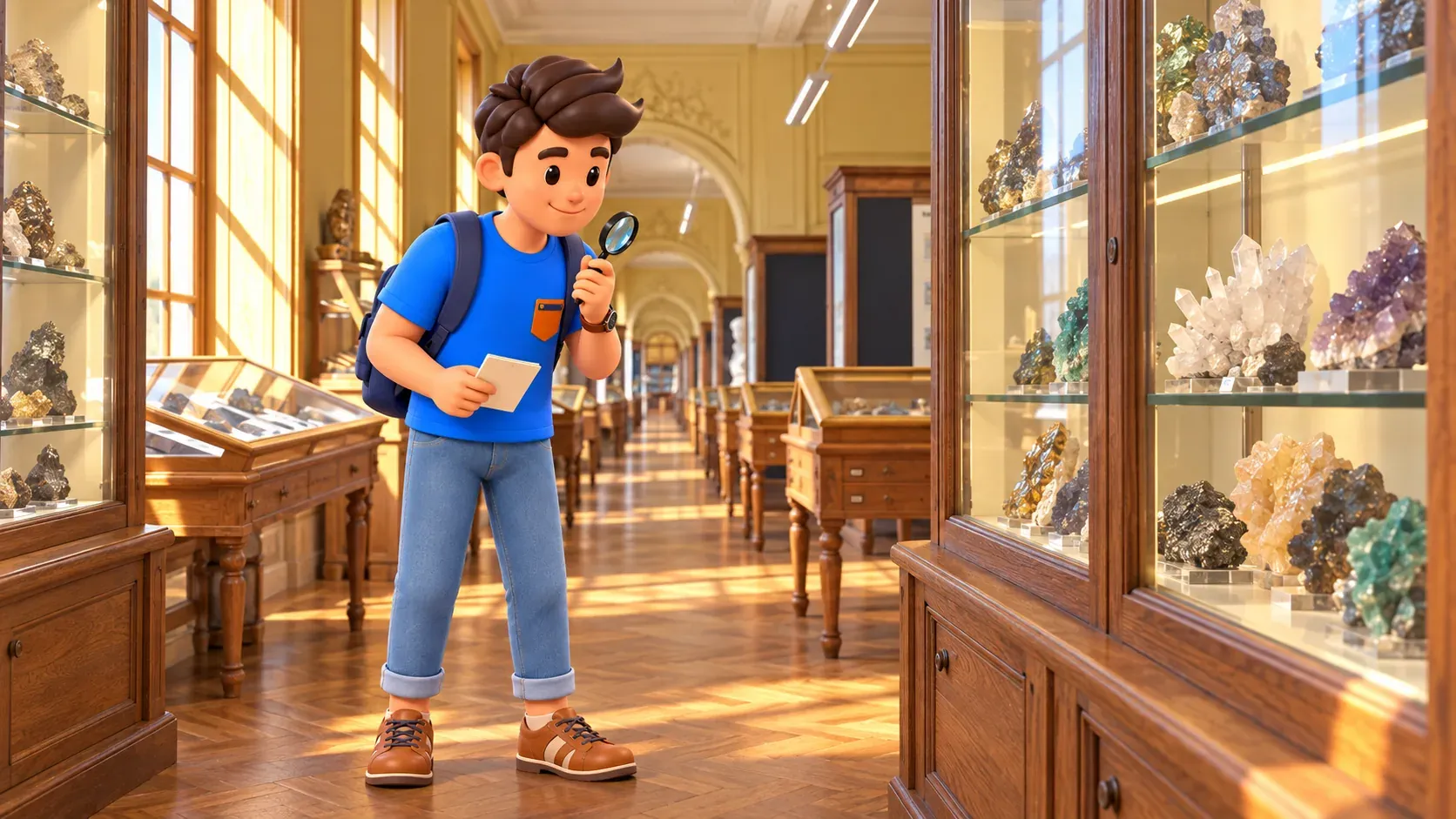
Use the 90-minute allowance selectively. First compare a few specimens by shape, surface and colour, then read their labels. Look at where they came from and how they are classified. The museum also connects its collections with research into resources used in modern technologies, so a striking object can lead to questions about materials in everyday life.
The setting deserves attention alongside the contents. Notice how cases organise specimens and how successive rooms shape your route. Keep the old furniture intact: the museum asks visitors not to pull drawers or lean on cases. Some displays may be temporarily inaccessible during renovation, so leave room to change your selection.
As checked on 14 October 2026, Tuesday opening is 10:00–12:00 and 13:30–18:00. Wednesday–Friday opening is 13:30–18:00; Saturday is 10:00–12:30 and 14:00–17:00. It closes on Monday, Sunday and public holidays, with an exceptional closure on 10 November 2026. Last entry is one hour before closing. A morning visit must fit within its morning session.
Admission to the school and museum requires a valid ticket, which you can buy at the reception kiosk. Capacity is limited, so check the current admission arrangements before your visit. Allow time at reception within the arrival allowance, particularly if you are fitting the museum into a morning session.
For visitors who need assistance, a lift is available with help from reception staff after requesting access by intercom. Some museum aisles are narrow, so contact the museum about your needs before visiting and ask reception for assistance on arrival. There is no luggage storage or air conditioning, so pack lightly and adjust expectations in hot weather.
Give Luxembourg Garden its own place in the MINES plan
After a Tuesday or Saturday morning museum visit, leave through the school’s boulevard Saint-Michel entrance and follow the public pavement north towards the Royer-Collard garden gate. The street connection is roughly 60 metres in the map model. The ten-minute allowance also covers leaving the museum floor and school; it is not an estimate of walking alone.
Inside the garden, choose a modest walk on open public paths, followed by a pause where space is available. Compare tree forms, planted areas and the organisation of paths. The suggested 35 minutes is a local continuation, not a tour of the whole garden. Leave lawns and plants undisturbed and follow the signs at gates.
Luxembourg Garden is free to enter, but its hours change through the seasons. In the calendar checked on 14 October 2026, closing is 18:45 for 1–15 October, then 18:15 through the last Saturday of October and 17:15 from the final Sunday to month-end. December closing is 16:30. Check the period covering your visit rather than treating an October hour as permanent.
For a Wednesday–Friday visit during short winter days, put the garden before the afternoon museum. Keep the same three-hour allowance but reverse the outdoor and indoor parts. This preserves daylight and avoids relying on a late garden pause after the gates close. Delays or reduced stamina can shorten the optional walk.
Trésors de la Terre: crystals and Earth’s history
The Galerie de Géologie et de Minéralogie is in the Jardin des Plantes, with the official visitor address at 36 rue Geoffroy Saint-Hilaire. Follow signs for the named gallery and Trésors de la Terre, along allée Haüy. It is separate from the MINES museum; the public garden’s free admission does not include the display.
The gallery building opened in 1841, while the current Trésors de la Terre presentation opened in 2014. Giant crystals and thematic displays bring the collection’s scientific questions into a compact visit. Meteorites extend the story beyond Earth to the Solar System.
For the suggested hour, begin with a crystal that draws your attention, then compare it with a few smaller specimens. Notice repeated forms and differences in colour. Use the explanations to distinguish appearance from identification: mineral species are recognised through several criteria, including chemical composition and crystal structure. Colour alone is not a complete explanation.
This option suits a concentrated introduction followed by a longer garden pause. Allow 15 minutes for arrival and admission, 60 for the display, 20 for local connections, 45 on selected public garden paths, 30 for rest and 10 to leave. Stay near the chosen museum and return towards its street approach. Specialist gardens, greenhouses and another gallery need their own conditions and time.
The calendar checked on 14 October 2026 gives 10:00–18:00 daily except Tuesday through 25 October. From 26 October 2026 to 28 February 2027, opening is 10:00–17:00, still closed on Tuesday. Last entry is one hour before closing. The gallery is currently temporarily inaccessible to wheelchair users; confirm a suitable alternative if this affects your choice.
Ancient animals: choose the current dinosaur exhibition
Sur les traces des dinosaures opened on 16 July 2026 in the Petite Galerie, on the first floor above ground level of the Grande Galerie de l’Évolution. The visitor address is 36 rue Geoffroy Saint-Hilaire. It is an exhibition in the evolution gallery, not access to the closed paleontology building.
The subject is fossil fieldwork and the discoveries of Angeac-Charente. Fossils, skeletons, landscape reconstruction and illustrations by Mazan connect the evidence with an environment from around 140 million years ago. The display invites you to consider how excavations and laboratory study help explain ancient life.
Give the exhibition about 75 minutes. Follow one discovery from the idea of a dig to the interpretation of its remains, then look at how the reconstruction relates to that evidence. Allow another 15 minutes for movement within the building and between public paths. The garden walk, rest and exit make the full programme three hours.
The exhibition opens on Wednesdays, Saturdays and Sundays outside school holidays, and every day except Tuesday during school holidays in all French zones. Check the actual date. The host Grande Galerie de l’Évolution opens 10:00–18:00, closes on Tuesday, 1 January, 1 May and 25 December, and ends access to its ticket desks one hour before closing.
Select the dinosaur exhibition ticket: it includes the Grande Galerie de l’Évolution, but does not include the mineral gallery. A complete tour of the permanent evolution collection needs extra time beyond this exhibition-focused allowance. Check the exhibition calendar for your intended date before arranging the rest of the day, then keep the visit focused on the discoveries that interest you.
Keep the garden pause flexible
The Jardin des Plantes opens 08:00–18:30 through 24 October 2026, then 08:00–17:30 from 25 October to 28 February 2027. Entry ends and evacuation begins fifteen minutes before closing. These are garden hours, distinct from the mineral gallery’s seasonal change on 26 October. Severe weather can close public areas.
Use RoadMe to prepare a complete personal day-by-day itinerary for your Paris trip around your interests, dates, pace and budget. Keeping the plan in the app makes organising the whole stay more convenient and efficient, including time to pause after a museum.
Keep the main scientific subject and reduce an optional walk if it absorbs more time. For a separate, broader outing through the garden and surrounding streets, the Jardin des Plantes walk with one museum adds neighbourhood stops. This three-hour choice works through close observation, one collection and a nearby change of setting.


