
Paris on a Hot Day: A Short Garden Walk and One Museum
A hot day in Paris can still hold a garden, an interesting collection and time to enjoy both. The useful change is to reduce the ground you cover. Choose one small area, give the outdoor part a suitable place in the day and keep a shorter version ready. A museum should be a visit you want, with enough time to look.
Two combinations work well geographically: a selected part of Parc Monceau with Musée Cernuschi, or the western Luxembourg Garden with Musée Zadkine once its access is confirmed. Each has a roughly two-and-a-half-hour plan and a 100-minute version centred on the museum. Pick one district; travel from your accommodation and onward journeys sit outside these allowances.
Choose a garden and a museum that match your interests
Try RoadMe to develop a complete personal Paris trip plan around your dates, interests, pace and budget. Using the app makes it more convenient and efficient to arrange short walks, cultural visits and proper breaks across your stay.
Cernuschi is the choice for Asian art, a collector’s house and a brief walk among Monceau’s trees. Zadkine offers sculpture and the setting of an artist’s workplace, with a small Luxembourg section nearby. Let the subject decide the museum, then use the weather to decide how much garden belongs with it.
These are planning estimates, including slow movement, crossings and orientation. Distances describe the selected public approaches and garden paths, with museum circulation counted inside the visit. They are not a survey of continuous shade or a guarantee of a step-free journey. The fifteen-minute entry allowance leaves some room for checks; an actual delay may require a shorter visit or a later finish.
| Choose one outing | Main programme: 150 minutes | Short programme: 100 minutes |
|---|---|---|
| Monceau–Cernuschi | 25 walking + 25 garden observation + 15 shaded rest if available + 15 entry + 70 collection; about 450 m outdoors | 10 avenue approach and return + 15 entry + 65 collection + 10 rest if available; about 220 m, no park loop |
| Western Luxembourg–Zadkine, after access is confirmed | 25 walking + 25 garden observation + 15 shaded rest if available + 15 entry + 70 collection; about 600 m outdoors | 10 street approach + 15 entry + 65 collection + 10 rest if available; about 250 m, no garden loop |
A full meal takes additional time. If a suitable resting place is unavailable, finish sooner or revise the plan rather than spending the pause searching through exposed streets. Both programmes can lose the garden entirely when conditions make it uncomfortable.
Monceau: a few trees, a rotunda and a clear exit
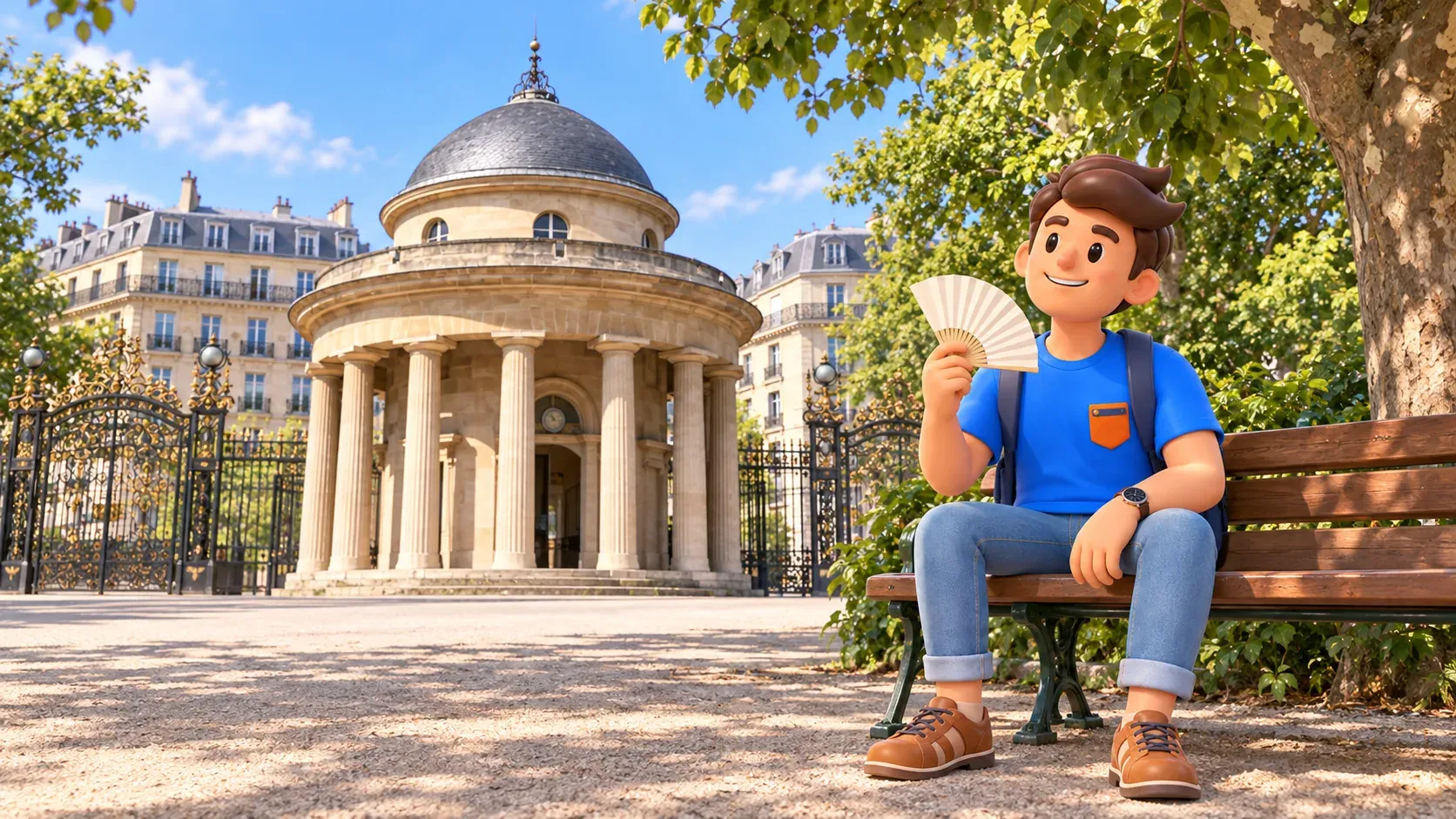
Start at the northern entrance from Boulevard de Courcelles, beside the round stone rotunda. Look at its columns and compact circular form from the public approach. This is the surviving Barrière de Chartres, connected with the city’s tax wall, whose construction reduced the garden in 1787. A park landmark therefore carries an older story about the boundary of Paris and the movement of goods.
Inside, follow available paths towards Allée de la Comtesse de Ségur and the eastern exit to Avenue Vélasquez. Keep the garden section small. Choose a tree canopy, the curve of an avenue or the relationship between foliage and surrounding façades, then stop for a while if a permitted shaded seat is available. There is no need to circle the park to make this a worthwhile visit.
Monceau’s scenery reflects successive ideas about gardens. An Anglo-Chinese design developed from 1773, and Adolphe Alphand reshaped the park in an English landscape style in 1861. That history helps explain its variety: a walk can move between different impressions instead of following one formal axis. For this outing, noticing that change is enough; hunting down every ornament would add walking.
The Naumachie’s colonnade belongs to a different part of the park from the entrance rotunda. Its secured area and associated sandbox remain inaccessible following damage to the columns in the 2019 storm. Stay on permitted paths outside barriers and omit a view if it is screened. Filming and events can also restrict individual avenues, so follow current signs towards an available exit.
Check the dated gate calendar before choosing an evening. The published October 2026 periods give daily hours of 7am–8pm. For 1 May–31 August 2027, the city lists 7am–10pm, followed by 7am–9pm in September. Those dated periods allow different arrangements, but they do not tell you when the air will become comfortable on your particular day.
For a separate outing in more suitable walking weather, our two-hour Monceau walk among gardens and collectors’ houses explores a longer exterior sequence. Keep that programme on another occasion rather than adding its streets to this short garden-and-museum plan.
Cernuschi: give a small selection of Asian art your attention
Leave by the eastern connection and use the visitor entrance at 7 Avenue Vélasquez. The short avenue also provides a public approach from Boulevard Malesherbes, around numbers 111–113. After the collection, finish at the Vélasquez–Malesherbes junction. Together with the selected park paths, this gives approximately 450 metres of outdoor movement, excluding your journey to the starting gate.
The house’s tall windows, medallions and sculpted details provide a brief architectural pause before entering. Henri Cernuschi’s Asian collection helped make the address a centre of interest in Japanese art during the late nineteenth century. The public museum opened in 1898. The transition from collecting to public display gives the visit a useful theme: how objects become part of a wider conversation about art.
Use the seventy-minute collection allowance selectively. Choose a few works that attract you, read their labels and compare material, surface and form. You might attend to the silhouette of one object, then the treatment of detail in another. Looking closely at a modest selection makes more sense here than trying to complete every room before the clock runs out.
The permanent collection is free. Temporary exhibitions have separate paid admission arrangements, with booking strongly advised by the museum. Choosing an exhibition would change the content and timing of this plan; free collection access does not include everything happening in the building.
Regular opening is Tuesday–Sunday, 10am–6pm. The cash desk closes at 5.15pm and rooms are cleared from 5.45pm; the cash-desk time is not a stated universal last entry to the free permanent collection. The museum closes on Mondays, 1 January, 1 May and 25 December. Allow your full viewing time before rooms clear.
For the 100-minute option, approach along Avenue Vélasquez from Malesherbes and return to that junction afterwards. Approximately 220 metres of outdoor movement replaces the park circuit. Keep sixty-five minutes for selected works and a short rest only where staff permit and a place is available. Otherwise, bring the finish forward.
Zadkine and Luxembourg: an artist’s setting beside a short garden walk
Confirm the museum’s current access before committing to this alternative. At the 14 October 2026 check, its owner displayed a notice of closure through 19 October inclusive and a new collection route from 20 October. The notice does not state a year, so treat reopening as something to confirm directly rather than assuming the date guarantees admission.
Once the museum is confirmed open, start at Porte Vavin on the Luxembourg Garden’s western side. Follow a short loop on permitted western paths, then return to the same gate. This keeps the garden close to your next stop. Looking along a tree-lined path can be enough; crossing the broad central spaces to collect another famous view would lengthen the exposed part.
The garden’s free public access follows seasonal gates. Its annual table gives a 7.30am opening from May through September, while closing changes by period. For example, it closes at 9.30pm in the second half of June, but at 8.15pm in the second half of August. Check your actual date and any additional notices rather than borrowing one summer evening’s hours for the whole season.
Rest in an available permitted place, keeping to paths and respecting restrictions on lawns and planted beds. Shade can move during the visit. Choose the position that is comfortable when you arrive, not one that looked shaded in an older photograph. The broad garden and its decorative water do not provide a continuously cool route.
From Porte Vavin, follow the public pavement on Rue d’Assas towards the visitor approach at 100 bis. Enter the museum passage only during permitted museum access. The route finishes at the museum’s street approach; the compound is not a shortcut through the block. Including the small garden loop, the selected outdoor distance is approximately 600 metres.
Ossip Zadkine moved to the Rue d’Assas workplace in 1928; the museum was inaugurated in 1982. That connection adds intimacy to looking at sculpture: you are visiting a place associated with making art as well as displaying it. Compare a few forms from different angles and notice how the surrounding space changes their appearance. The garden within the museum follows its admission and closures.
Ordinary hours are Tuesday–Sunday, 10am–6pm, with last entry at 5.30pm. Mondays, 1 January, 1 May and 25 December are closed. Permanent collection access is free without an individual reservation; group visits and guided speaking arrangements have separate requirements. The closure notice takes precedence over this ordinary schedule.
Travel lightly: Zadkine has no cloakroom or storage for bulky items. Suitcases of any size and bulky bags over 40 cm are prohibited. Folding seats can be requested from reception, subject to availability and the museum’s rules. For the 100-minute version, omit the Luxembourg loop and keep the approximately 250-metre approach from Porte Vavin along the public street.
Put the outdoor section where the day allows it
If the morning is suitable, take the small garden section before a museum visit after its 10am opening. If it is already too hot, go directly to the confirmed open museum instead of waiting outside. A later version can put the museum first and leave the garden conditional on the weather; allow sufficient collection time before closing.
Use RoadMe to work out a complete personal trip plan with the cultural interests and daily pace you prefer. The app makes arranging visits, short connections and rest across your dates and budget much more convenient and efficient.
Neither museum should be treated as a promise of air conditioning in every room. Carry drinking water, check current municipal heat guidance and reduce outdoor effort during the hottest part of your chosen day. Available shade and a manageable approach matter more than completing the original duration.
Keep the next journey separate, and decide whether to continue only after this visit. One garden impression and a few works seen attentively already give the outing substance. When conditions demand a shorter day, the museum-centred version preserves that purpose without asking you to keep walking.


