
Paris for Book Lovers: Richelieu and Nearby Streets

Paris has a place where a short library visit can become a proper reading break. At the Bibliothèque nationale de France’s Richelieu site, the Salle Ovale welcomes visitors into a spectacular room lined with books. You can look around, choose something to read and then step back into the neighbourhood through Galerie Vivienne and, when accessible, Galerie Colbert.
Allow about two hours for this compact outing. Its focus is the pleasure of being among books, followed by a little architecture and time to pause. Choose the BnF museum separately if original works and collections particularly interest you; it changes the length and character of the day.
A two-hour outing built around the Oval Room
Try RoadMe to turn your interests, travel dates, pace and budget into a complete personal trip plan. Planning in the app makes it much more convenient to give reading, architecture and rest their own place in your Paris days.
Start at the public entrance at 5 rue Vivienne. After the Oval Room, return to the street and cross towards the Galerie Vivienne entrance at number 6. Follow its open main passage to 4 rue des Petits-Champs, then continue a short distance west to Galerie Colbert’s entrance at number 6 on that street.
The entire outing involves roughly 0.5–0.8 kilometres of movement, including circulation inside the library and passages. This is a planning estimate, with most of the time reserved for reading and looking. The timetable below suits an ordinary daytime visit from Tuesday to Saturday; queues or a particularly absorbing book may require an adjustment.
| Part of the outing | Allowance | Purpose |
|---|---|---|
| Arrival at 5 rue Vivienne | 10 minutes | Security checks and orientation |
| Salle Ovale | 45 minutes | Architecture and a reading pause |
| Short connections | 15 minutes | Street crossings and finding entrances |
| Galerie Vivienne | 20 minutes | Glass roof, mosaics and windows |
| Galerie Colbert, if open | 15 minutes | The public rotunda |
| Final pause | 15 minutes | Rest and decide what comes next |
These allowances total 120 minutes from arrival at the library to the final pause. Transport, a full meal, extended shopping and a museum visit take additional time. On Sunday, use Colbert’s fifteen minutes for more reading in the Oval Room or a longer rest, rather than depending on its doors being open.
Enter a palace that became a library
Richelieu grew around Cardinal Mazarin’s former palace. The royal library established itself here in 1721–1722, and the complex developed as its collections expanded. Its September 2022 reopening followed more than a decade of renovation. That layered history helps explain why a library visit includes the atmosphere of a historic palace as well as places designed for present-day readers.
Keep 5 rue Vivienne as your arrival address for this public outing. The address 58 rue de Richelieu serves research access, groups and other dedicated arrangements, including access for visitors with disabilities. If you need assistance or a particular accessible approach, confirm it with BnF before travelling; this complete street-and-passage route has not been certified as barrier-free.
Follow the signs for the Salle Ovale once inside. Its free public access is distinct from admission to the museum and research rooms. You can enjoy the room without a reader’s pass or advance booking. Allow time for entrance checks and follow staff instructions; a seat may not be available immediately.
Look up, then settle into a book
The Oval Room works best when you give its architecture a few minutes before sitting down. From the permitted public ground-level areas, follow the curve of the book-lined walls towards the great skylight. Circular windows and slender iron columns organise the upper part of the room. The repeated details make an immense interior feel coherent rather than simply large.
Jean-Louis Pascal began the project in 1897; Alfred Recoura completed it in 1932, and the room was inaugurated in 1936. The long development is a useful reminder that Richelieu contains several architectural periods. The Salle Labrouste is another room, now used by the INHA research library, with its own access conditions.
The public collection includes books about arts and heritage, comics and graphic novels. Choose one subject that already interests you: illustrations, theatre, maps or an artist’s work. Consulting a book here means reading it on site. The visit does not promise a particular language edition, a free seat on arrival or a loan to take back to your accommodation.
A useful division of the forty-five minutes is a short look around followed by a longer spell with one book. A reader who enjoys graphic novels can follow a visual sequence; someone interested in architecture might study drawings or photographs. Ask the librarians for guidance when needed, and keep the room’s working atmosphere in mind while moving between shelves and seats.
Keep conversations quiet and circulation clear. For photographs in reading rooms, ask staff about the required authorisation. Public sharing requires BnF’s prior written agreement, even when a picture was permitted for private use. The upper galleries visible in many photographs are architectural features, not an invitation to explore every level. You can appreciate the room fully from the public visitor area.
Galerie Vivienne: carry the attention into the street
Return through the public exit to rue Vivienne, then cross at an appropriate pedestrian crossing to the gallery entrance at number 6. Although the destinations are very close, this connection is outdoors. Put away anything you were reading before crossing, and use the change of setting as a small break between the library and the passage.
In Vivienne, look at the mosaic patterns underfoot, then the repeated arches and glass roof. A view along the corridor makes the relationship between those surfaces easier to notice. Dark shopfronts frame the walk at eye level, while daylight gives the roof a different role from the shelves and skylight you have just seen inside BnF.
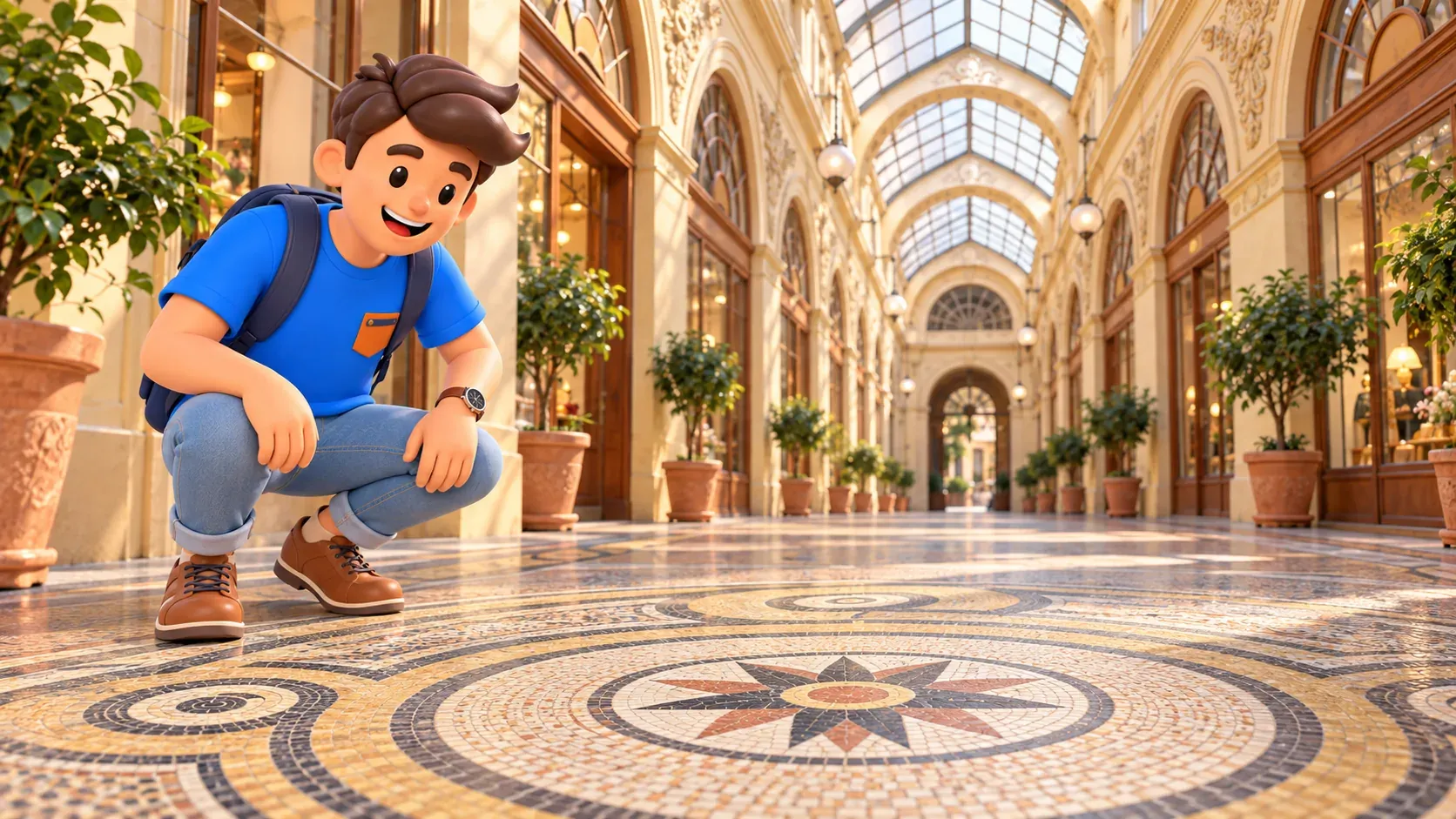
This nineteenth-century commercial passage turns an ordinary journey between streets into a place for looking. Choose one floor motif and one arch detail to remember. Twenty minutes allow a slow architectural crossing and a glance at appealing windows; browsing several shops or selecting a book needs a longer stop.
Galerie Vivienne is free to enter daily from 08:30 to 20:00. Its entrances are at 6 rue Vivienne, 4 rue des Petits-Champs and 5–7 rue de la Banque. Individual businesses keep their own hours, so an open passage does not guarantee an open bookshop or café. You can enjoy the architecture without making a purchase.
For this route, leave at 4 rue des Petits-Champs. Keep the passage clear while looking overhead or examining a mosaic, and follow any current local arrangements. The gallery provides shelter for this part of the walk, while the short connections before and after it remain city streets.
Colbert: a different purpose beneath glass
From Vivienne’s rue des Petits-Champs exit, walk west to Galerie Colbert at number 6. Its other entrance is at 2 rue Vivienne. The public rotunda offers a brief change of atmosphere: rather than continuing a shopping itinerary, you are approaching a space associated today with art-history institutions.
INHA dates the gallery to 1826 and identifies Jean Billaud as its architect. It began as a commercial passage, with a prominent rotunda using glass and metal. That short history makes the comparison with Vivienne worthwhile. Similar architectural materials can support different present-day activities: shopping beside one corridor, study and institutional work around another.
Allow fifteen minutes for the public space if access is available. Admission to the public rotunda is free. INHA lists ordinary gallery opening Monday–Saturday, 08:00–20:00; Sunday is outside that schedule. Suitcases and large-capacity bags are prohibited, and security checks apply. Public access to the rotunda does not include offices, classrooms or the research library.
If you cannot enter, finish on the public street and retain the pause. There is no need to search for a side door or compress another attraction into those minutes. The Oval Room and Vivienne already form a complete outing; Colbert adds a comparison when the day’s conditions allow it.
Choose ninety minutes or a longer museum day
For a shorter version, allow ninety minutes: ten for arrival, forty in the Oval Room, ten for connections, twenty in Vivienne and ten for a final pause. Leave out Colbert and extended browsing. This keeps a real reading stop rather than reducing the library to a quick look through its entrance.
If original objects and the history of collections are your main interests, consider the BnF museum. It is on the first floor, with lift access, and has a separate ticket, normally paid. Its subjects extend beyond books to manuscripts, prints, maps, music, performing arts and antiquities. Choose two or three areas of interest before going in.
Visit the museum while you are still at Richelieu, before leaving for the passages. Keeping the whole two-hour outing and adding a fifteen-minute ticket-and-arrival margin plus ninety minutes in the museum produces 225 minutes: three hours and forty-five minutes. Allow roughly four hours at a slower pace. Alternatively, make the museum your main visit and shorten the Oval Room, adjusting the plan instead of treating every room as obligatory.
Reserve museum admission in advance as BnF recommends, and check any partial gallery closures. Fragile works rotate, so a particular manuscript seen in an older photograph may not be displayed. Temporary exhibitions have their own admission arrangements; free Oval Room access includes neither the museum nor an exhibition.
Build the wider day in RoadMe around the subjects you enjoy and the time you want to spend with them. Its complete personal plan makes it easier to combine this reading break with the rest of your trip at a comfortable pace.
Check the room’s calendar before setting out
The Oval Room ordinarily opens Tuesday 10:00–20:00 and Wednesday–Sunday 10:00–18:00, closing on Monday. Check holidays and dated notices separately. At the October 2026 check, BnF announces early closure at 17:30 on Friday 16 October and at 17:00 on Tuesday 20 October 2026. Those exceptions concern the Oval Room, not automatically every space on the site.
The museum ordinarily follows the same Tuesday and Wednesday–Sunday opening pattern and also closes on Monday. The current Richelieu visitor information says its museum and exhibition cash desks close one hour before the spaces. This is a cash-desk rule; confirm the admission arrangements for your ticket and avoid planning a visit around the final minutes.
After the last pause, you can end near rue des Petits-Champs. If covered arcades appeal more than a museum, our Paris covered-passages walk offers a separate two-and-a-half-hour outing heading north through four passages. It shares Vivienne, so choose it for another day or deliberately plan the longer route with time for the connection.
For this visit, one book and a few architectural details are enough. Time spent reading gives the library a purpose beyond its appearance, and the neighbouring galleries let you carry that slower attention back into Paris.


