
Paris Before a Show: Short Walks Near the Theatre
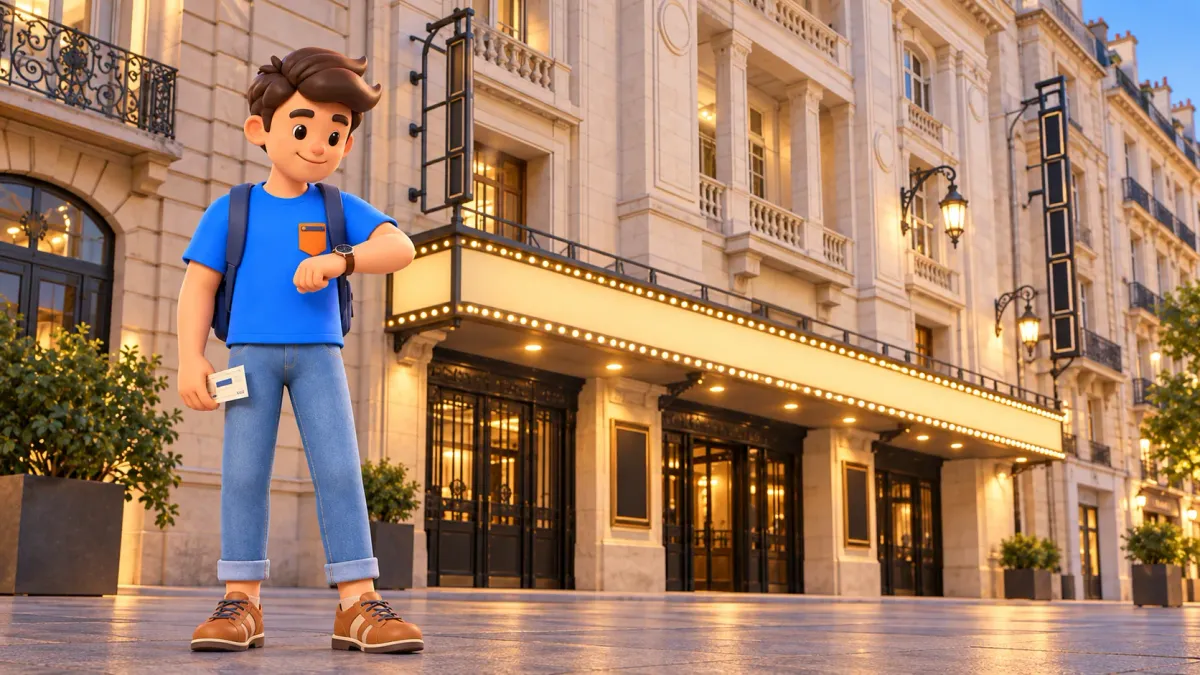
A theatre booking gives a Paris day a useful finishing point. Before the performance, you can look at an opera-house façade, follow a small Left Bank street or pause beside an old city gate. The pleasure comes from arriving with time to notice the neighbourhood and enough energy left for the show.
Choose the walk that belongs to your actual venue: Mogador, Odéon Paris 6 or Théâtre de la Renaissance. These are three alternatives in different neighbourhoods. Each ends at its theatre and keeps the arrival period separate from the outdoor programme. Check the performance date, address and start time on your ticket before deciding where to begin.
Work backwards from the time on your ticket
Let the ticket’s exact show time set the clock. A matinée needs the same calculation as an evening performance. First reserve the theatre’s arrival period, then place the walk before it. Travel from your accommodation, a full meal, the performance itself and the journey afterwards need their own time.
Build your personal Paris trip plan in RoadMe around your interests, dates, pace and budget, including the day’s sightseeing, rest and booked show. The app makes planning the whole trip more convenient and efficient, with room for the activities you most want to enjoy.
| Your theatre | Main outdoor programme | Theatre arrival period | Total before the show | Short option, including arrival |
|---|---|---|---|---|
| Mogador | 60 minutes; about 1.2 km | 60 minutes | 120 minutes | 90 minutes; about 250 m outdoors |
| Odéon Paris 6 | 60 minutes; about 0.7 km | 30 minutes | 90 minutes | 60 minutes; about 150 m outdoors |
| Renaissance | 45 minutes; about 0.4 km | 30 minutes | 75 minutes | 50 minutes; about 100 m outdoors |
These are planning allowances: movement, crossings, looking and pauses, rather than continuous walking times. Add time for your pace or any earlier arrival instruction attached to the booking. If you are delayed, shorten the outdoor programme first. Once the theatre’s arrival time approaches, head to the entrance.
For example, a Mogador ticket starting at 20:00 gives a main walk from 18:00 to 19:00, followed by the arrival period from 19:00 to 20:00. This illustrates the arithmetic; it does not establish a performance on your date. Keep the actual ticket as the reference throughout the day.
Before Mogador: from the opera square to Rue de Mogador
Begin on a public pavement at Place de l’Opéra with a view of Palais Garnier. Give its exterior ten minutes: take in the overall mass, then choose one column, sculptural group or roof detail. You are looking at the building from the street, so an interior visit needs its own time and the appropriate admission arrangements.
Continue west along Boulevard des Capucines, turn north into Rue de Caumartin, then east along Boulevard Haussmann. Turn north into Rue de Mogador and finish at the theatre’s frontage at number 25. Use marked crossings and leave entrances clear when stopping. The public-street route is approximately 1.2 km, with 25 minutes allowed for movement and crossings.
The remaining 35 minutes comprise the ten-minute Garnier stop, ten minutes for street architecture or the optional Édouard VII detour, and a fifteen-minute pause. Look upwards at the changing rooflines, then bring your attention back to the entrances and windows. A short break can simply mean putting the camera away and resting; it does not require ordering anything.
Mogador’s history adds a different theatrical scale to the opera-house setting. Designed by Bertie Crewe, the building was constructed between 1913 and 1919 and opened in 1919, initially as the Palace Théâtre. Its British music-hall connections help explain why this Paris theatre has a character distinct from the monumental opera house nearby.
At Mogador, the theatre opens one hour before the performance, and that hour is the arrival allowance used here. The auditorium doors close five minutes before the start; arriving late does not guarantee immediate admission. Bring the original ticket, printed or displayed on your smartphone, rather than a photograph or screenshot. Leave large luggage elsewhere: the theatre does not accept it in the cloakroom.
If you need particular seating or mobility arrangements, contact the theatre before purchasing. A street approach and an attractive façade do not answer questions about reaching your seat. Confirm the accommodation you need for the selected performance, then leave enough time to follow the staff’s directions on arrival.
An optional passage around Édouard VII
If access is open and permitted, replace the ten-minute street-view stop with a brief detour through the Édouard VII area. From Boulevard des Capucines, approach along Rue Édouard VII, then leave towards Rue Bruno-Coquatrix and Rue de Caumartin. The central space is private, although described by its property owner as open to the public; no dependable daily opening clock is established for every passage.
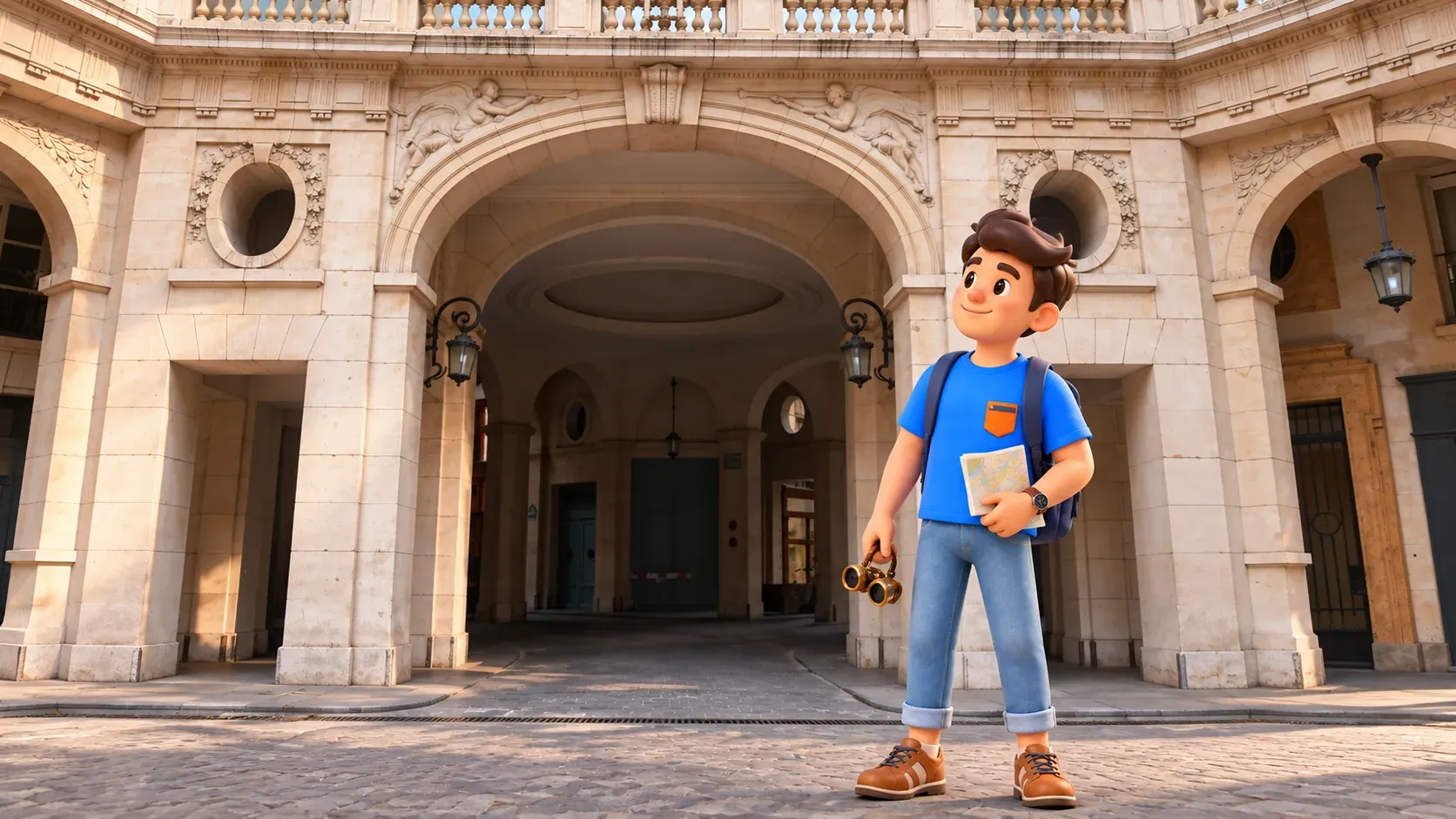
The arched approach gives you a smaller architectural scene to examine: a stone vault, ornamental window surrounds and the transition from boulevard to enclosed space. Keep this a short look within the existing allowance. If a gate or instruction prevents access, continue on Boulevard des Capucines to Rue de Caumartin; the main walk still works.
A passage visit does not include admission to Théâtre Édouard VII. If that is your booked venue instead, use its own address, 10 Place Édouard VII, and its ticket instructions. Its published ticket-collection advice is 45 minutes before the performance, so the arrival calculation must change with the theatre.
For the shorter Mogador programme, start at the Boulevard Haussmann–Rue de Mogador junction. Allow five minutes to approach along Rue de Mogador, ten for street and theatre details, and fifteen for a pause. This thirty-minute outdoor interval covers about 250 metres and preserves the full sixty-minute arrival period: start ninety minutes before your show.
Before Odéon: Saint-Sulpice, Rue Férou and a palace street view
First check that the ticket is for Odéon Paris 6. The institution also performs at Ateliers Berthier, at 1 Rue André Suarès in the 17th arrondissement. A Berthier booking belongs to a different neighbourhood; this walk finishes at Place de l’Odéon in the 6th. The venue label matters as much as the theatre’s name.
For the main route, begin at Place Saint-Sulpice. Spend ten minutes with the square and church exterior, then take the public connection along Rue Henry de Jouvenel to Rue Férou. Follow Rue Férou south to Rue de Vaugirard, turn east, and pause to look at the Palais du Luxembourg from the public street. Continue to Rue Rotrou and turn north towards Place de l’Odéon.
The route is approximately 0.7 km. Its hour comprises fifteen minutes for movement and crossings, ten at Saint-Sulpice, ten for the palace street view, fifteen for a pause and ten at the theatre exterior. You stay outside the church, garden gates and palace interiors. That makes the itinerary easier to fit before a performance without adding another admission or visit calendar.
Notice the shift from a broad square to a narrower street, then from a palace frontage to a theatre. Look at the proportions of doors and windows rather than trying to collect every monument nearby. Rue Férou connects the stops naturally; there is no need to widen the circuit into a complete Saint-Germain outing while watching the clock.
The Odéon opened in 1782, designed by Charles de Wailly and Marie-Joseph Peyre. Fires in 1799 and 1818 brought rebuilding, so its history is longer and more complicated than an untouched eighteenth-century façade. The classical composition gives the final stop a clear shape: look at the columned front and its relationship with the square.
Finish the walk thirty minutes before the time on your ticket. Odéon allows access to seats from that point and carries out security checks at both venues. Follow any earlier instruction for assistance or a particular event. Travel without large luggage and check the current bag rules rather than treating the cloakroom as general suitcase storage.
The shorter option begins near the palace street viewpoint on Rue de Vaugirard and continues via Rue Rotrou to the theatre, roughly 150 metres. Give it five minutes for movement, five for the palace view, five for the theatre and fifteen for a pause. With thirty minutes reserved for arrival, begin sixty minutes before the show. A separately booked theatre tour belongs in another time slot.
Before Renaissance: a city gate and a small street detour
For a performance at Théâtre de la Renaissance, begin beside Porte Saint-Martin on the public pavement. The gate, built in 1674 to a design by Pierre Bullet, introduces an older layer of Paris than the theatre. Take ten minutes to compare the arch’s overall shape with its relief decoration while leaving a clear path for pedestrians.
Walk towards the west end of Rue René Boulanger, make a short eastward detour along it, then return and approach the theatre’s actual frontage at 20 Boulevard Saint-Martin. Rue René Boulanger provides the street interlude; it is not the show entrance. Keep to public approaches and omit private impasses. The small out-and-back circuit is approximately 0.4 km.
Allow ten minutes for movement, ten at the gate, five on Rue René Boulanger, five for the theatre façade and fifteen for a pause: 45 minutes outdoors. Then retain thirty minutes for theatre arrival. Boulevard Saint-Martin has steps and raised pavement sections; choose your approach with your own walking needs in mind.
The present theatre building was begun in 1872 by architect Charles Delalande and inaugurated on 8 March 1873. The earlier Renaissance company’s nineteenth-century history belongs to another building. Here, the useful comparison is close at hand: a monumental city gate followed by a theatre built for a different kind of gathering.
The auditorium is upstairs without a lift. If that affects your visit, contact the theatre before buying a ticket. Published ticket-collection guidance asks you to come approximately thirty minutes before the performance, which is the reserve used here. Box-office hours do not establish show times, and a backstage programme for school classes is a separate activity.
For the shortest version, go directly from the gate to the theatre, about 100 metres. Allocate five minutes each to movement, the gate, the façade and a pause: twenty minutes outdoors, plus thirty for arrival. Begin fifty minutes before your ticket time. Skip the Rue René Boulanger detour, and let the two nearby façades provide the whole outing.
Give the performance its place in the day
Eat earlier if you want a full meal. The short pauses above cannot guarantee a café table or service within fifteen minutes. Before setting out, have the original ticket ready, confirm the entrance address and decide which outdoor stop to drop if your earlier activity runs over.
Use RoadMe to create a personal plan for your whole Paris trip, bringing your interests, dates, pace and budget into each day’s walks, meals and cultural outings. Planning in the app is more convenient and efficient when a booked performance has its own place alongside everything else you want to do.
For another day with more time to explore entertainment architecture, consider our Grands Boulevards theatre and cinema walk. Give that complete outing its own allowance. On your performance day, the short local walk can be enough: a few details remembered clearly, a pause, and an unhurried arrival at the theatre.


