
Parc Georges Brassens and Nearby Streets: A South Paris Walk
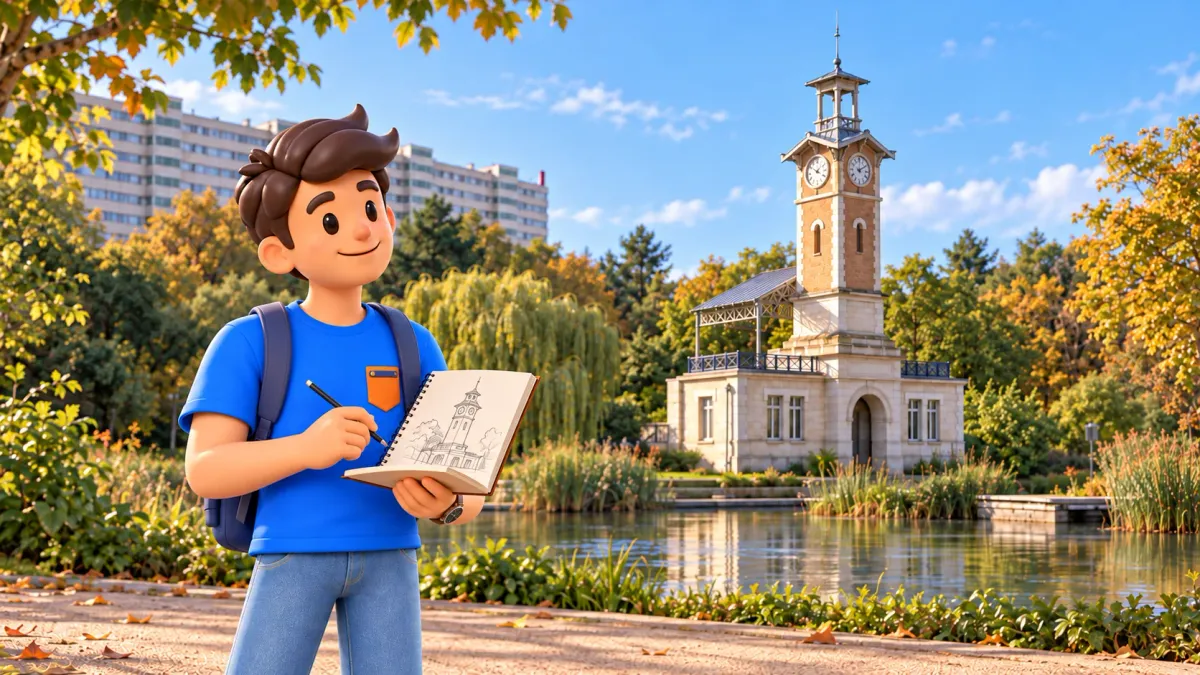
A walk around Parc Georges Brassens brings together three kinds of south Paris: a modern parish church, a working artists’ community and a public garden on former slaughterhouse land. The interest lies in their proximity and different uses. You move from residential streets to a private gate, then into greenery where older buildings still explain the neighbourhood’s working past.
Allow about two and a half hours from Convention metro station to your return to public transport. The church and La Ruche are exterior stops in the basic programme. The park provides most of the walking and all the planned rest. On Saturday or Sunday, a book market beside it can extend the outing to roughly two hours and 55 minutes.
A neighbourhood walk with time to stop
Begin at Convention on metro line 12 and head towards Notre-Dame-de-la-Salette at 38 rue de Cronstadt. Continue to La Ruche at 2 passage de Dantzig, staying on the public approach. Then follow the neighbourhood streets towards the park entrance at 2 place Jacques-Marette. Inside, choose a few paths around the pond and clock tower before moving towards the Brancion side and the old horse-market halls.
The final part returns you to transport: Porte de Vanves on line 13 or Convention on line 12, depending on your next destination. Decide which suits you before starting. This is a connected local walk of approximately three to four kilometres, including selected park paths; the distance increases if you explore more of the garden.
Try RoadMe for a complete personal trip plan built around your interests, dates, pace and budget, giving this neighbourhood walk a comfortable place in your day. Having the whole plan together in the app makes it more convenient and efficient to use as you travel.
The following 150-minute outline includes movement, observation and a proper pause. It is a planning estimate, not a measured walking time or a guarantee of entry. Add the journey from your accommodation and a restaurant meal separately.
| Stage | Time to allow |
|---|---|
| Convention to the church | 20 minutes |
| Church exterior, or a permitted quiet look inside | 15 minutes |
| Walk to La Ruche through nearby streets | 10 minutes |
| La Ruche from the public gate | 10 minutes |
| Walk to the Jacques-Marette park entrance | 10 minutes |
| Selected park paths and historic structures | 40 minutes |
| Bench break or short snack | 25 minutes |
| Leave towards your chosen metro station | 20 minutes |
Notre-Dame-de-la-Salette: a different idea of a church
Notre-Dame-de-la-Salette offers a change from the tall stone churches associated with central Paris. Architects Colboc and Dionis du Séjour built the circular concrete church between 1963 and 1965. Its dome rests on sixteen supporting pillars, and the plan was intended to give worshippers good visibility. An adjoining sanctuary dates from 1858; the older sanctuary and modern church are distinct buildings.
Use the rue de Cronstadt approach for this stop. The address at 27 rue de Dantzig also belongs to parish activities, but office reception hours do not establish when the church can be visited. Start by looking at the entrance and the building’s relationship with the street. Even an exterior stop introduces an architectural tradition different from both La Ruche and the park’s surviving industrial buildings.
If entry is permitted, a brief quiet visit can reveal how the dome and supports organise the space. Check the current parish information and avoid services or prayer periods; this remains a place of worship. The route works entirely from outside, so a closed door need not disrupt your afternoon. Transfer unused minutes to the park instead of waiting for an opening.
La Ruche: an artists’ community behind a private gate
At 2 passage de Dantzig, La Ruche remains a place where artists work. The foundation describes a community of about fifty artists and explicitly states that independent visits of the site are unavailable. For this walk, the stop ends at the gate and public street. Studios, gardens and the rotunda are private spaces, and a view of the rotunda through the gate is not guaranteed.
Sculptor Alfred Boucher founded La Ruche in 1902 to provide young artists with working space. He reused elements from the dismantled 1900 Universal Exhibition, giving the community an architectural history of reuse as well as an artistic one. Its name, meaning “the hive”, evokes the creative activity of its occupants. That idea still gives the address meaning today.
A short stop is enough to connect the place with the neighbourhood. Read any information visible from the public side, look at the approach and consider how a working community survives within residential Paris. Keep entrances clear, avoid photographing private interiors and do not follow someone through an opening gate. An ordinary visit does not include a conversation with an artist.
Organised group visits can be arranged with the foundation. Special openings and exhibitions have their own confirmed dates and conditions; they require a different plan. An old announcement is not an invitation to enter today. If your main interest is meeting the artistic community, arrange that visit first and rebuild the surrounding walk around it.
Entering the park through its working history
From La Ruche, allow ten minutes to reach the Jacques-Marette entrance via the streets around rue de Dantzig and rue des Morillons. The connection is about 400 metres, with time for crossings and orientation. This approach makes the transition clear: a private place of creation gives way to a public landscape.
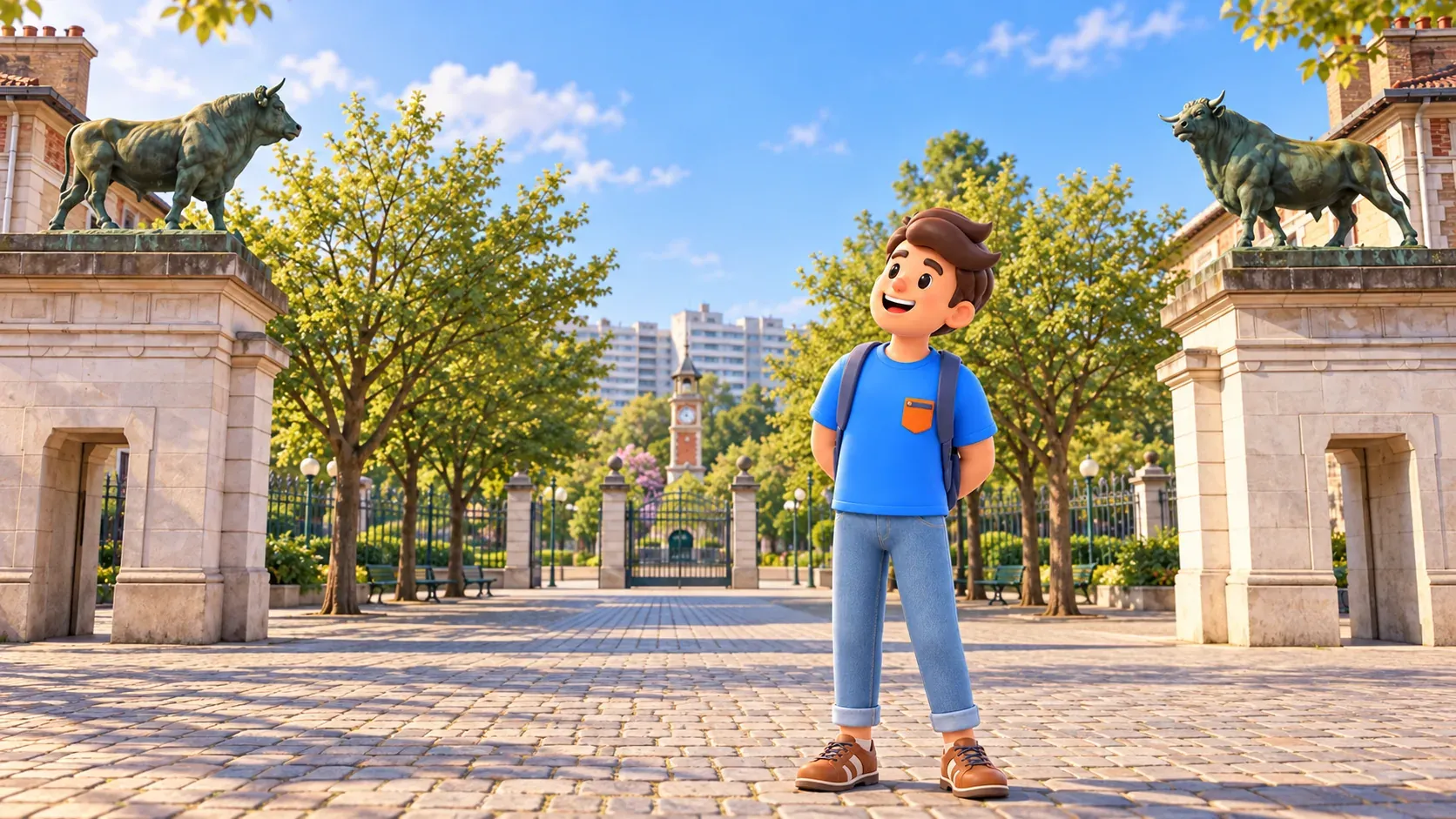
Parc Georges Brassens opened in 1985 on land formerly occupied by the Vaugirard slaughterhouses and horse market. The entrance pavilions, auction clock tower and horse-market hall preserve parts of that earlier complex. Their survival lets you read the park as a transformation of a working site rather than a garden detached from its surroundings.
Pause at the entrance pavilions before heading towards the water. The two bull sculptures above them provide an immediate clue to the former use of the land. Compare their solid silhouettes with the trees along the entrance axis. They are distinct from the horse-head decoration at another entrance near rue des Morillons and rue Brancion.
Then look for the clock tower by the pond. Its brick shaft and pale trim rise above a compact building, making it an easy point of orientation. Enjoy the relationship between the old structure, water and planting from the public paths. This itinerary does not include access to the tower or a climb to a viewpoint.
Choose a small circuit, then sit down
Give the park forty minutes of unhurried movement rather than trying to see every feature. Begin around the pond, choose an open path through the planting and turn towards the Brancion edge. The landscape has changes in level, a small watercourse and a bridge, so a short distance can still produce several different views.
For a botanical pause, look at the scent garden or aromatic planting if it lies on your chosen circuit. Leaves, textures and the way plants occupy a bed are worth noticing even when flowers are absent. Strong fragrance or a full rose display depends on the season. Stay on public paths and respect barriers rather than stepping into beds for a closer photograph.
For another connection with the site’s history, consider Albert Bouquillon’s Porteur de viande, installed in 1991. The sculpture recalls the physical work once carried out here. Looking at its posture after seeing the surviving buildings gives the former slaughterhouse landscape a human dimension, without requiring a complete sculpture tour.
The park’s name honours singer and poet Georges Brassens, who lived nearby. A bust by André Greck and paths named after songs keep that connection present. Choose one of these small reminders along your way, then take the planned 25-minute break. A bench, a little water and a snack are enough; a full lunch needs additional time.
The book market is a weekend option
On the Brancion side, the old horse-market halls give the outing another possible focus. The book market at 104 rue Brancion normally operates on Saturdays and Sundays from 9am to 6pm, according to its operator. Check current announcements for exceptions before travelling specifically for it. On weekdays, plan an exterior look at the area rather than expecting stalls or access inside an empty hall.
The market began in 1987 and is managed by the association Les Pages Parisiennes. Its offer extends beyond old and second-hand books to material such as prints, comics and photographs. The appeal is the chance to browse within a reused historic setting; you do not need a rare-book collection or an intended purchase to give the stop a purpose.
Add 25 minutes for a selective browse, bringing the programme to 175 minutes. Pick a subject, inspect a few tables and leave room to walk back to transport. If you prefer to remain within 150 minutes, replace an equal amount of park wandering or rest. A longer search through specialist stock will naturally take longer.
Opening times and a comfortable finish
Park hours vary by season and day of the week. Checked on 14 October 2026, the published schedule for 1–24 October is 8am–7.30pm Monday to Friday and 9am–7.30pm Saturday and Sunday. From 25 October 2026 to 28 February 2027, closing moves to 5.45pm, with the same weekday and weekend opening times. Confirm the relevant period and any local closure notices for your date.
The market’s 6pm finish does not extend the park’s winter opening. If you stay later at the stalls, use public streets for the return instead of relying on a crossing through locked park gates. An early afternoon start gives the walk breathing room, especially when daylight and park hours are shorter.
For church interiors, consult the current parish timetable and worship schedule separately. Visit only when sightseeing is permitted, keeping the exterior stop as the basis of this itinerary. A church opening time is also not a promise of uninterrupted sightseeing.
For a trip combining green neighbourhoods, art and major museums, use RoadMe to work out a personal day-by-day plan around what interests you and how much walking you enjoy. Keeping visits and pauses together in the app makes the whole trip easier to organise and more convenient to follow.
The basic public-street and park walk needs no admission purchase; food, books, events and arranged visits are separate. The city lists toilets and drinking-water points in the park. Check transport access, gradients and the paths you intend to use individually, since the whole route has not been confirmed as step-free.
In persistent rain, shorten the exposed stops and park circuit rather than depending on an unbooked indoor refuge. For another outing in southern Paris, our Montsouris and Cité Universitaire half-day walk pairs a different landscape with residential architecture. Give it its own day or time allowance; it is not an extra stop within this 150-minute programme.


