
Parc André Citroën and Javel: A Modern Paris Walk

Javel offers a different view of western Paris: a contemporary park occupies former factory land, an unusual church uses reinforced concrete, and a metal bridge draws the walk back towards the Seine. The three stops make sense together because they reveal successive ways of shaping a working neighbourhood, rather than a collection of unrelated sights.
Allow about two and a half hours for Parc André Citroën, Saint-Christophe-de-Javel and Pont Mirabeau. The programme includes observation and pauses, with a shorter two-hour version if needed. It works as an outdoor walk: church entry is conditional, and neither a balloon flight nor a greenhouse visit is required to complete it.
A 150-minute walk from the park to the Seine
Try RoadMe for a complete personal trip plan shaped around your interests, dates, pace and budget. Using the whole itinerary in the app is much more convenient, helping this neighbourhood walk fit efficiently around journeys, meals and the other experiences you want from Paris.
Use the park’s municipal address, 2 rue Cauchy, as your meeting point. Begin with a selective loop through its main public area, then return to the Cauchy exit. Follow rue Cauchy, rue André Lefebvre and rue Saint-Christophe to the church. Afterwards, head towards rue de la Convention and Pont Mirabeau, finishing back towards the Javel area on the Left Bank.
The street connection from the Cauchy gate to the church approach is about 570 metres; the next connection to the bridge viewpoint is about 398 metres. Together they cover roughly one kilometre. Including a chosen park loop and a local transport approach or return, expect approximately two to three kilometres overall. That total is a planning range, rather than a surveyed distance.
| Stage | Time | How to use it |
|---|---|---|
| Arrival and orientation | 10 minutes | Find the Cauchy entrance and check local notices |
| Compact park loop | 60 minutes | Glass structures, landscape and a brief rest |
| Walk to the church | 15 minutes | Public streets and crossings |
| Saint-Christophe-de-Javel | 20 minutes | Exterior, or a quiet visit when permitted |
| Walk to Pont Mirabeau | 10 minutes | Continue towards the river |
| Bridge and Seine | 25 minutes | Views, sculptural details and a pause |
| Finish towards Javel | 10 minutes | Return towards local transport |
These allowances total 150 minutes. They include slower walking at crossings, but exclude travel across Paris and a full restaurant meal. For 120 minutes, reduce the park to 45 minutes, the church to ten minutes outside, and the bridge pause to twenty minutes. Keep both connecting walks and the arrival and finish allowances unchanged.
Understand why a carmaker’s name belongs to a park
André Citroën established a munitions factory at Javel in 1915, then converted it to automobile production after the First World War. Production and other industrial activities later left the site in stages. The park opened in 1992 on this former industrial land, giving the neighbourhood a public landscape with an entirely different purpose.
That history changes how you look at the open space. Today’s lawn, planted areas and glass buildings do not describe a preserved factory that you can tour. They represent a new use of its land. Keep that distinction in mind: the value of this stop lies in understanding an urban transformation through the place people use now.
Start with an overall view before exploring smaller corners. Where can you see a long line across the park? Where do planted areas interrupt it? How do the large glass structures relate to the surrounding buildings? These simple questions make the visit rewarding without needing a detailed history of automobile manufacturing or a list of every designer.
Read the park through glass, plants and water
The central lawn, canal, large greenhouses and themed gardens give the park several scales. A broad view reveals its geometry; a closer path brings attention to leaves, textures and the relationship between planting and built edges. Choose a few contrasts rather than trying to visit every themed area in one hour.
Near the glass structures, look from permitted public paths at their repeated frames and transparent surfaces. Their crisp outlines help explain the park’s contemporary character. An exterior look belongs to this walk. Enter a greenhouse only if current arrangements explicitly permit it; a photograph of visitors inside does not establish ordinary daily access.
Water is part of the design, but moving jets are not the only reason to stop. Notice how a basin or channel changes the space around it, and how planting sits beside a hard edge. If fountains are inactive, these relationships remain visible. Keep to dry visitor paths and do not make water play a promised family activity.
Use part of the hour simply to sit in an available permitted place. A pause allows the whole composition to settle after the closer observations. With children, comparing a glass frame with a leaf shape offers a small activity without collecting plants or turning the outing into a lesson. Then orient yourself towards the Cauchy exit.
Link the park to a working neighbourhood
The transfer to Saint-Christophe is short enough to preserve the park’s unhurried rhythm. Leave through the Cauchy gate and use the public street route through rue André Lefebvre towards rue Saint-Christophe. Fifteen minutes allows for crossings and a slower pace; it is more useful here than treating a routing estimate as a deadline.
Give the streets a little attention too. The shift from an arranged garden to everyday façades and junctions explains the church’s setting. This is a functioning neighbourhood, so stop out of the main pedestrian flow for photographs. Follow current crossings and diversions rather than trying to maintain an exact line through barriers.
The church entrance is at 4 rue Saint-Christophe. The parish also lists 28 rue de la Convention, which is its parish address. Use the church entrance for this stop and keep the distinction when checking directions. Once you have located it, decide whether conditions allow an interior visit or whether today’s observation will remain outside.
Saint-Christophe-de-Javel: concrete and an industrial context
Charles-Henri Besnard’s church was built between 1926 and 1930. Its construction used moulded reinforced-concrete elements assembled on site, an innovative method placed in the service of a traditional Gothic spatial arrangement. Art Deco decoration adds another layer. Those different influences make it an interesting comparison with the much later glass structures in the park.
From the public approach, compare the red brick with the pale concrete and the patterned areas around the entrance. Notice the large figure of Saint Christopher on the façade. These are useful details even when the door is closed: the exterior already conveys a conversation between familiar religious forms and newer materials.
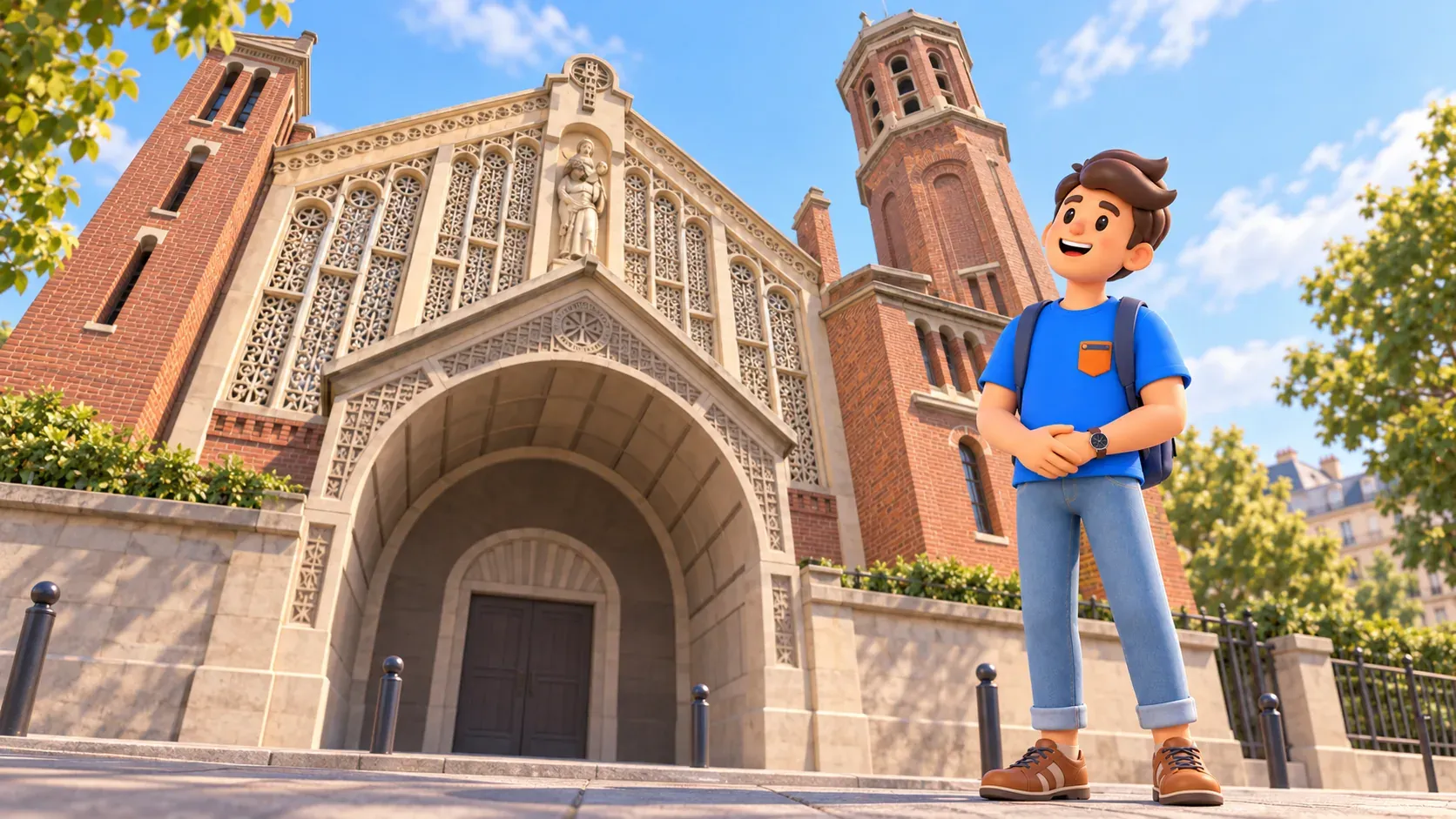
If a quiet visit is permitted, choose a few interior observations. Look at how the structure leaves space for decoration, then notice the relationship between painted surfaces and stained glass. Images of modern transport connect the patron saint of travellers with Javel’s industrial surroundings. They give a local meaning to the decoration without requiring a full catalogue of the artworks.
As checked on 14 October 2026, the parish allows independent visits Monday to Friday from 9:30am to 7pm, and Saturday from 9:30am to 6pm, except during services or celebrations. It does not offer ordinary self-guided visits on Sunday. For a Sunday walk, make the exterior your baseline; a separately announced guided event has its own date and conditions.
Check the current service calendar before entering, keep voices low and follow the parish’s instructions. If a celebration is taking place, continue with the exterior version. The twenty-minute allowance can cover looking at the façade and its surroundings instead, so the outing does not depend on interrupting worship or waiting for a door to open.
Pont Mirabeau: end with the river and the metalwork
From the church area, continue towards rue de la Convention and the bridge. The ten-minute allowance covers the short connection and urban crossings. Remain on public pavements at the upper street level; the walk does not require finding a continuous route along lower river landings.
Pont Mirabeau was built at the end of the nineteenth century to connect what are now quai André-Citroën on the Left Bank and quai Louis-Blériot on the Right Bank. Its metal structure adds a third architectural material to the day. Four bronze allegories represent Paris, Commerce, Navigation and Abundance, linking its decoration to the city and river.
Choose an allowed pavement viewpoint and compare the overall span with one sculptural detail. Some features are easier to see from a distance than directly above them. Do not lean beyond barriers or step into traffic to reproduce a photograph. Give yourself time to look along the Seine as well as at the bridge itself.
Guillaume Apollinaire’s poem bearing the bridge’s name appeared in 1913. You need not recite it to appreciate the stop: the association adds a literary layer to an engineering structure. After the precise garden lines and church decoration, the moving river provides a different rhythm. Crossing the entire bridge and continuing into the opposite district is optional.
Keep the ending clear. A short view from the bridge and a return towards Javel complete the selected route. Do not automatically add the Île aux Cygnes or another long riverside programme. Decide on an extension after the pause, with fresh attention to the distance, remaining daylight and your group’s energy.
Choose the date and keep optional activities separate
Use RoadMe to organise the whole trip day by day around architecture, gardens, your dates, preferred pace and budget. A complete personal plan in the app makes coordinating visits and transport easier and more efficient, with proper time for rest throughout the stay.
Ordinary park access and the exterior walk are free; meals and optional activities are separate. Check the park’s dated municipal calendar before starting. From 1 to 24 October 2026, it opens at 8am on weekdays and 9am at weekends, closing at 7:30pm. From 25 October 2026 to 28 February 2027, the closing time becomes 5:45pm, with the same opening times. Choose daylight and leave enough time to exit.
At the 14 October check, the city still displayed a closure notice for Jardin Eugénie-Malika Djendi, although its stated end date was 12 October. This programme excludes that side garden. An elapsed notice date does not confirm reopening; follow current signs and use the main public park areas that remain available.
The balloon is a separate ticketed activity. Its tethered flight rises up to 150 metres and lasts about ten minutes in the air, but arrival and waiting take additional time. Flights depend on weather and may stop. Check the operator’s actual conditions and the park gates before planning it; the fixed 120- or 150-minute walk does not promise a flight.
In rain, shorten the park rather than treating the church as guaranteed indoor shelter. For particular mobility needs, assess the street connections and transport separately: the park’s accessibility listing does not certify this entire outing. On another day, our Paris Rive Gauche walk through libraries and reused industrial buildings explores a related transformation in the 13th arrondissement. It has its own route and travel time.


