
Palm Jumeirah Without a Waterpark: Al Ittihad Park and the View from Above
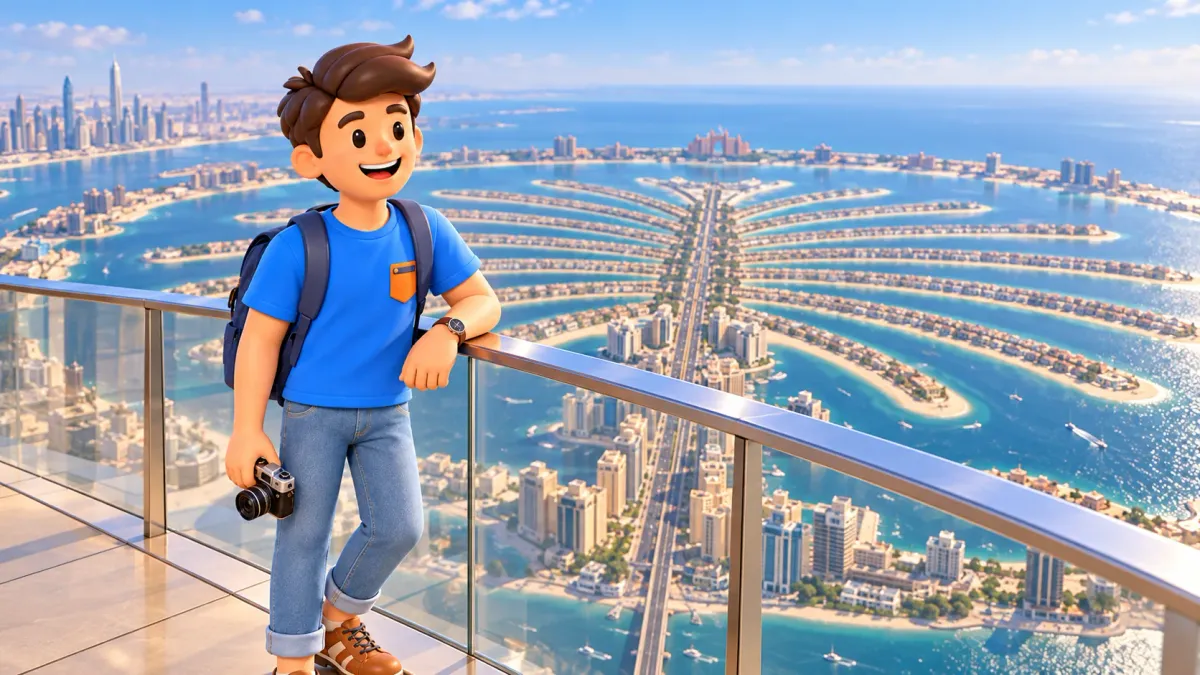
Palm Jumeirah is easy to recognise on a map and surprisingly difficult to understand from an ordinary pavement. At ground level, you meet buildings, paths and individual pieces of waterfront. From above, the trunk, branches and protective crescent become a single design. Pairing those scales gives the island a clear story without building the day around a waterpark.
This plan combines a manageable section of Al Ittihad Park with a confirmed visit to The View at The Palm and a proper pause. Allow roughly two and a half to three and a half hours according to your start, ticket and pace. The duration is an editorial estimate, not a measured route. The aim is to understand an artificial island while leaving time to enjoy an ordinary landscaped place.
Choose the viewpoint visit, then give the park its own time
RoadMe can create a personal route or whole Dubai trip around your interests, dates and pace. Prepare this Palm visit in the app: combining the park, viewpoint and rest is much more convenient than coordinating several separate attraction lists.
Begin with the actual visit you want at The View. Check the current admission products, time conditions and availability. A general name does not explain every level or experience sold within a viewing attraction. Choose the offer that matches your interest, then make its confirmed time the anchor rather than planning around an assumed walk-in.
You can walk in the park before or after the viewpoint. Beforehand, it gives you a close-scale introduction; afterwards, it lets you compare the visible island plan with the place under your feet. Pick the order according to the ticket and comfortable outdoor conditions. Neither order requires a full park circuit or a trip to the far end of the Palm.
Leave real time between the park section and the entrance you will use. Save the public approaches, not only two place names. The park and tower belong to the trunk area, but actual doors, levels and pedestrian links still determine the journey. A useful half-day includes ordinary movement as well as the moments shown in photographs.
Keep the scope small. The Palm is a whole constructed landscape, not a compact square containing every well-known resort. Adding a distant attraction changes the day. This plan is complete with planting, a higher view and a pause. More time can deepen those themes rather than automatically send you to another address.
Al Ittihad Park: a local landscape on artificial land
Al Ittihad Park opened in 2012 as a Nakheel project associated with the UAE National Day. Its planting idea drew on vegetation found in the country's deserts, mountains, wadis and coastal areas. That makes it a useful counterpoint to the Palm's engineered form: an artificial island presents reminders of several natural environments.
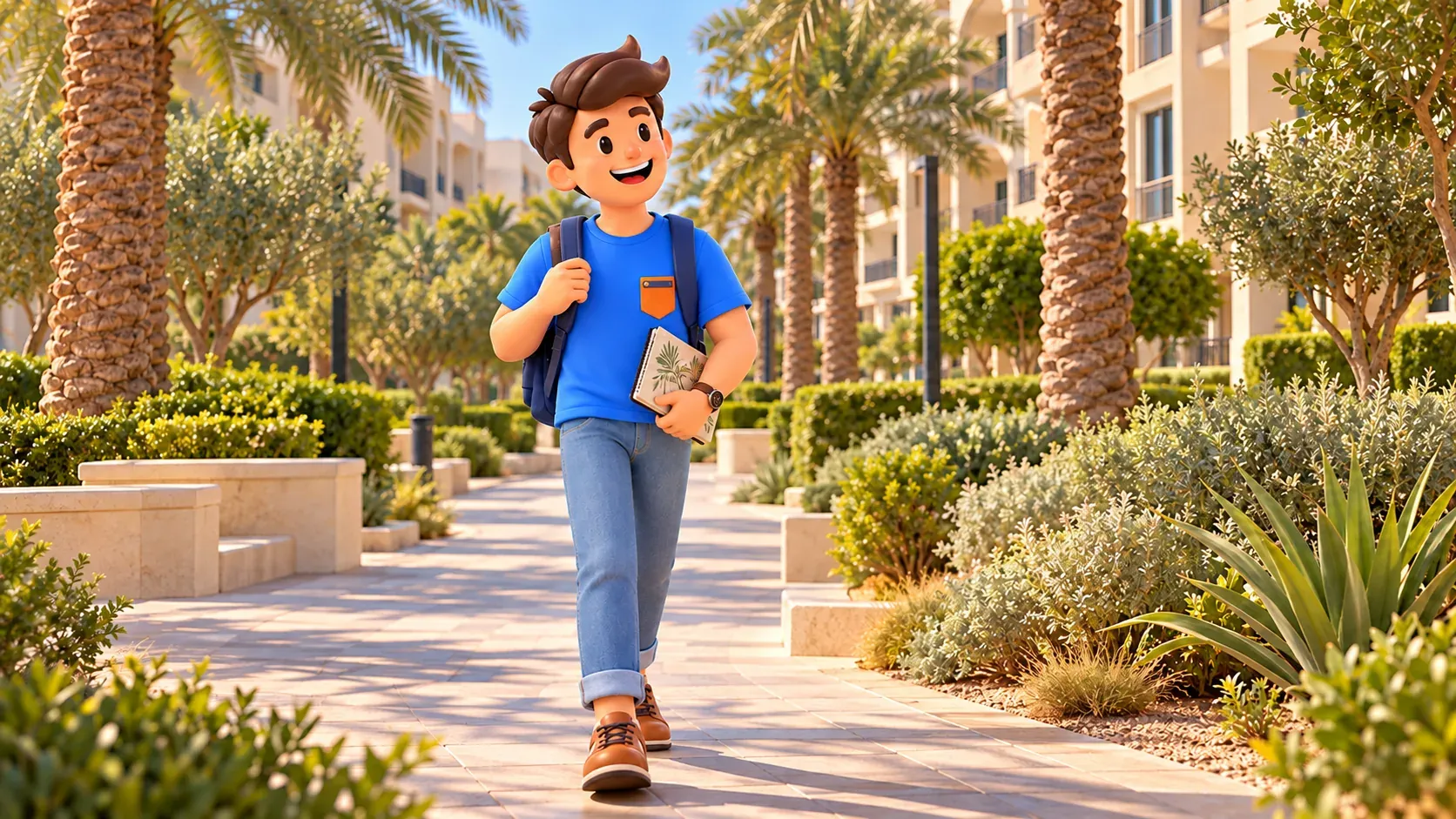
The original collection included more than sixty varieties of trees, shrubs and other plants. Adaptation to the local climate and relatively modest irrigation needs were part of the selection. Read that as the history of the landscape concept rather than a guarantee that you will identify or find every original variety on the day of your walk.
Look at differences you can see without being a botanist: crown shape, leaf size, density and the way planting creates a shaded edge. A park visit becomes more interesting when you choose one comparison. You do not need to name every species to notice that the design has a subject beyond simply producing a tropical holiday image.
The park sits beside Golden Mile residential development on the island's trunk. Its role includes everyday walking as well as a visitor's stop. Keep attention for that ordinary use. The same place can be a landscaped introduction to the UAE for a traveller and part of a regular neighbourhood routine for someone who lives nearby.
Walk a section, not the entire running route
The park was planned with a running route of about 3.2 kilometres. That background explains its elongated everyday character, but it does not set a compulsory tourist distance. Choose a section that suits your group and the conditions. A short walk with attention to planting can be more valuable than completing a circuit while watching the clock.
Notice how planted edges and open parts change the experience. A tree group can make a small enclosed space, while another stretch exposes more of the residential setting. The useful question is what happens at walking height. This is the scale that a famous aerial image of the island cannot explain.
Keep the walk connected to your main appointment. If you have a timed visit ahead, finish the chosen park section with enough space for the approach. If the park comes later, allow it to slow the day down. It should not become a rushed final task squeezed between leaving the lift and reaching your transport.
With children, compare two leaf or crown shapes from the path without picking or disturbing plants. With adults, notice which parts give shade and which reveal a longer view. Simple observation provides a shared purpose while leaving room for conversation. The park does not need a separate entertainment programme to justify its place.

The View: turn the map image into a real landscape
The View at The Palm opened in 2021 in Palm Tower. From around 240 metres above ground, its central subject is the island itself. What remains fragmented at street level becomes readable: the central trunk, branching fronds and crescent around them. The viewpoint is closely tied to this landscape rather than only offering another high city photograph.
Begin with the overall form instead of immediately searching for individual hotels. Follow the central axis outward, then the repeated branches. Ask how much of the view is land and how much is water. The familiar palm image becomes more concrete when you recognise how those alternating edges create the shape.
The branch pattern is both an image and a practical arrangement of waterfront land. The trunk provides the main connecting part, while the fronds extend the edge along the water. You can appreciate the visual idea and the urban purpose together. That is more informative than treating the island as only a symbol seen from above.
Look beyond the Palm as well. The taller groups towards Dubai Marina offer a contrast between concentrated vertical building and land spread horizontally into the sea. The viewpoint itself belongs to a tower, but the main subject is a constructed landscape. Holding those two scales together gives the visit a clear architectural question.
The crescent is part of the engineering story
Palm Jumeirah was announced in 2001. Its formation used marine sand, while stone materials created the protective outer edge. The project involved shaping land and preparing it for later development, not simply drawing a palm outline on the water. Construction and protection needed to work together as the new territory took form.
The outer crescent has a different role from the branches. It protects the inner coastal environment from waves. From the viewpoint it may look like a thin curved line, but its layered stone construction is part of what allows the island environment inside it to exist. The image becomes more meaningful when the boundary is read as protection rather than decoration.
The breakwater stretches for roughly eleven kilometres, with openings allowing water exchange between the inner waters and the sea. You do not need to reconstruct its whole engineering section during a visit. Simply recognising that the curve has a task changes the way you read the panorama and the relationship between open sea and developed land.
Keep observation and precise technical explanation separate. It is possible to see a broad form and discuss the purpose described for it without claiming to measure the island or assess its engineering performance from the gallery. A good visit can leave a question to explore later, alongside a more accurate visual understanding.
A pause helps connect the two scales
After the main visit and walk, choose an available place to rest or have a drink. The pause need not depend on one restaurant. It gives you a moment to put the ground-level and elevated impressions together. Which part of the island only made sense from above, and which part became interesting only while walking?

A simple sketch can use a trunk, several branches and an outer curve. It is a conceptual note, not a navigation map. Add one thing remembered from the park, perhaps a crown shape or the contrast between a shaded and open section. The two drawings describe different qualities of the same island.
Companions may prefer different scales. One person might enjoy the large plan, another the planting and another the distant skyline. The pause allows those interests to meet without requiring one shared favourite. With children, a question about the palm outline is enough; the visit does not need to become a lesson in every stage of reclamation.
Allow time after the pause for the actual onward route. The Palm's strong visual identity can make distances feel less concrete than they are. A realistic finish keeps this outing relaxed. If you have already seen the park and understood the island form, there is no requirement to add another major attraction before leaving.
Keep the rest of the trip varied
This version suits visitors interested in urban ideas, landscape and a manageable walk. It can also offer a different rhythm between larger attraction days. Choose it because those subjects appeal to you. A waterpark, aquarium or other resort experience can have its own day if that matches the people travelling; it need not be added to this small plan.
RoadMe can place this Palm visit in a personal multi-day itinerary, balancing your interests, pace and time for rest across the whole trip. Use the app to organise Dubai more efficiently, so viewpoints, neighbourhood walks and bigger visits fit together without rebuilding the plan every evening.
For another pairing of park and panorama, the Zabeel half-day explores Dubai Frame and its green setting. The Marina-to-JBR walk follows a different coastal transition. Choose these as separate parts of the trip, leaving the Palm enough time to be both a recognisable plan and a place experienced on foot.


