
One Day in Paris: A First Visit without Trying to See Everything

A first day in Paris can give you three very different experiences: the interior of Notre-Dame, a walk and a proper lunch around the Tuileries, and a view from the Eiffel Tower. The river joins the morning stops, while one metro journey takes you to the afternoon visit. This itinerary makes room for sitting down and actually looking at the places you came to see.
The example runs from 9:30am to 5:30pm, built around a prepaid 3:30pm elevator ticket to the Eiffel Tower’s second floor. All times are planning estimates, including walking, entry checks and breaks. Start above ground at Cité station and finish on an open public path outside the tower. Your journey from your accommodation, airport transfers, dinner and the trip back need their own time.
Choose three anchors for your first visit
The cathedral introduces stone, height and filtered light. The Tuileries provide a change of pace after walking along the Seine. The tower then helps you understand the city as a whole: the river and streets you have seen at ground level form a larger pattern.
This day suits travellers comfortable spending several hours on their feet who want both interiors and outdoor space. A full Louvre visit would require a different allocation of time; squeezing it between the cathedral and tower would consume the lunch, transfers and entry buffers.
For a personal plan for your whole trip, try RoadMe: the app builds your days around your dates, interests, pace and budget. It makes connecting this first introduction with the rest of your visit much more convenient.
The paid tower visit is the fixed appointment. Find a suitable ticket before setting the other hours; 3:30pm is an example rather than a promise of availability. If your ticket is for a different time, adjust the earlier stages around it and retain a separate allowance for the first security check.
The day at a glance, including the gaps between sights
The eight hours below account for every stage from start to finish. The metro allowance includes reaching the station, finding the platform, waiting and walking to the tower after you get off. The cathedral block includes its queue. If delayed, shorten optional stops while protecting breaks and entry buffers.
| Time | What the block includes |
|---|---|
| 9:30–9:45am | Cité station exit to the cathedral forecourt. |
| 9:45–11am | Waiting, entry and Notre-Dame’s interior. |
| 11am–12:15pm | The full walk via Pont Neuf to the Tuileries, with brief river stops. |
| 12:15–1:15pm | Lunch around the garden or Rue de Rivoli. |
| 1:15–2pm | About 30 minutes looking around the garden and 15 sitting down. |
| 2–3pm | Concorde station, the metro and the walk to the tower. |
| 3–3:30pm | A short pause and grounds security before the ticket appointment. |
| 3:30–5:15pm | The first and second floors, elevator waiting and descent. |
| 5:15–5:30pm | Leaving the controlled site and a final look from an open public path. |
Have breakfast before the start and bring a small day bag, comfortable shoes and accessible tickets. A suitcase creates a practical problem: Notre-Dame does not admit suitcases, and the tower has no luggage storage for large bags. Before leaving, check the operator’s information for your date and current metro service. The itinerary assumes the usual Line 8 route is operating.
Morning: go inside Notre-Dame
From Cité on Metro Line 4, reach Rue de Lutèce and turn south along Rue de la Cité towards the western forecourt. The cathedral’s address is 6 Parvis Notre-Dame–Place Jean-Paul II. Locate the marked visitor queue first, then take a moment to look at the three carved entrance portals.
Notre-Dame developed between the 12th and 15th centuries. Its Gothic architecture brings together high vaults, supporting columns and stained-glass light. The cathedral reopened to the public in December 2024 after the 2019 fire. Its rebuilt spire reproduces the 19th-century design associated with Viollet-le-Duc’s restoration: the building’s history includes later transformations as well as its medieval origins.
Ordinary admission is free. An individual free reservation is optional, and the cathedral’s dedicated reservation page says places are released only a few hours before a visit. You cannot rely on securing this ordinary reservation several days ahead. Check closer to the visit; new places appear regularly, but a suitable slot is not guaranteed. The cathedral does not authorise third parties to sell ordinary admission.
As checked on 13 October 2026, weekday hours are 7:50am–7pm, with Thursday opening until 10pm; Saturday and Sunday hours are 8:15am–7:30pm. Last admission is 30 minutes before closing. Services affect the visitor experience, so the morning example cannot promise unrestricted access to every area on every date. Follow staff directions and treat the interior as a working place of worship.
Allow roughly 45 minutes inside, with another 30 for waiting and entry in this example. If the queue clearly exceeds that allowance, choose whether the interior or the later schedule matters more. A careful look at the western façade is the honest fallback; it does not become a completed interior visit. The towers, treasury and other separate visits are outside this day’s plan and outside ordinary cathedral admission.
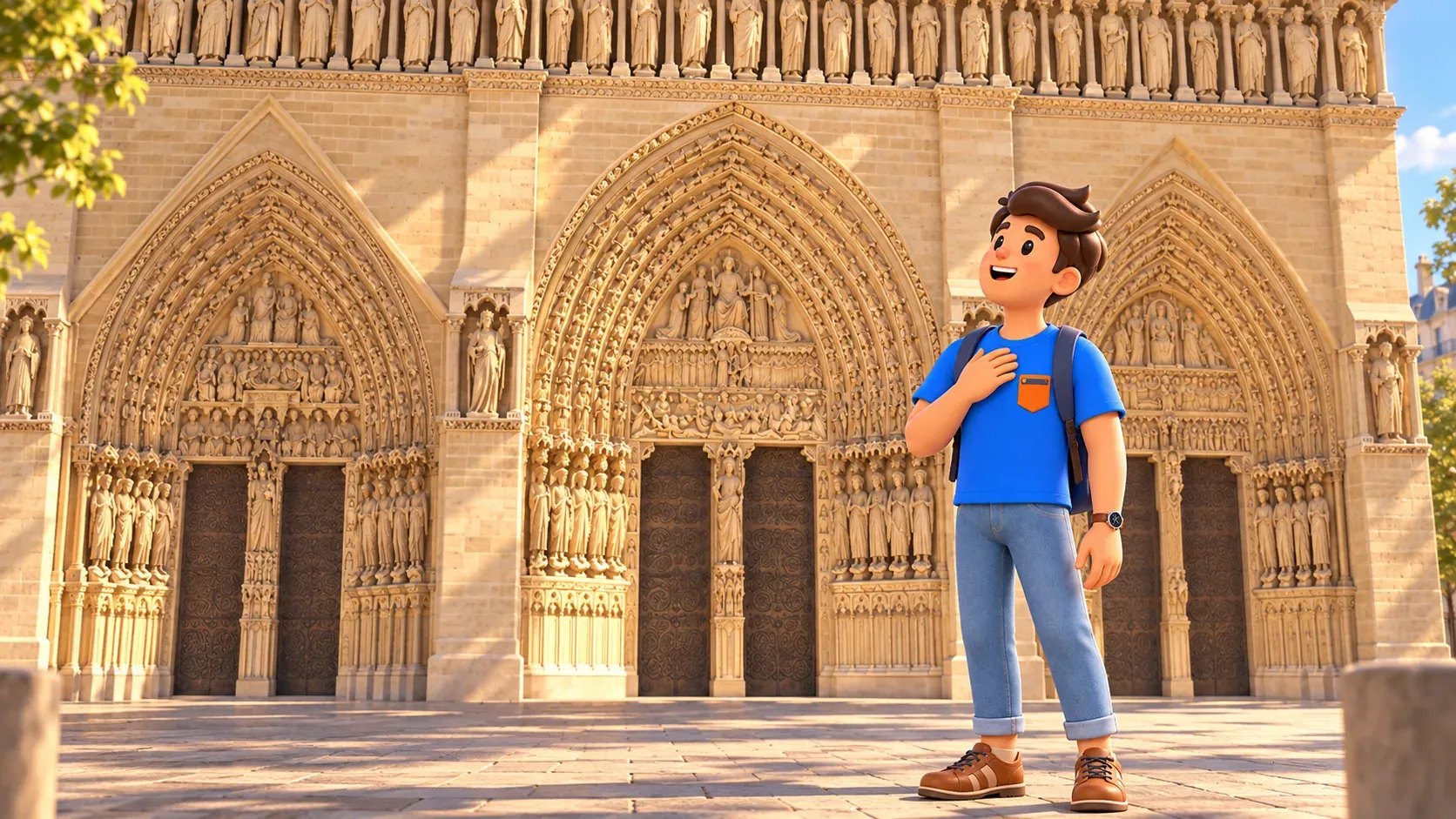
A loop behind the cathedral is unnecessary here. In October 2026, work continues around the eastern end of the island, where the park is closed. Return towards the north side instead. For a different day devoted to the island, use our two-hour Île de la Cité walk; its outdoor stops should not automatically be added to today’s timetable.
Walk west with the Seine as your guide
Head north along Rue de la Cité, turn west onto Quai de la Corse and cross Boulevard du Palais at the marked crossing. Continue west on Quai de l’Horloge to Pont Neuf. Take the bridge’s northern arm onto the Right Bank; you do not need its southern arm towards the Left Bank for this connection.
Pont Neuf is Paris’s oldest surviving bridge. Construction began in 1578 and it opened in 1607 under Henri IV. Its name means “New Bridge”, a useful little contradiction to remember as you pass.
On the Right Bank, continue west along Quai du Louvre, then use Rue de l’Amiral-de-Coligny and Rue de Rivoli towards the Tuileries. Enter through a marked public garden gate. This connection needs neither museum admission nor access through the Louvre’s courtyards. You may notice the palace along the way, but seeing its exterior is not a visit to its collections.
The 75-minute block includes the full walk and brief stops. Choose a couple of river views rather than photographing every bridge. Stay on upper pavements and use pedestrian crossings; descending to lower river paths adds complexity to this simple connection. The illustrations convey the atmosphere of the stops, rather than supplying a navigational map.
The Tuileries: lunch, a royal garden and time to sit
Start with lunch around the garden or Rue de Rivoli. The hour includes choosing a place, ordering, eating and paying, so a more elaborate restaurant meal may take longer. Look at the menu before settling in and choose something that suits your budget. Service times vary.
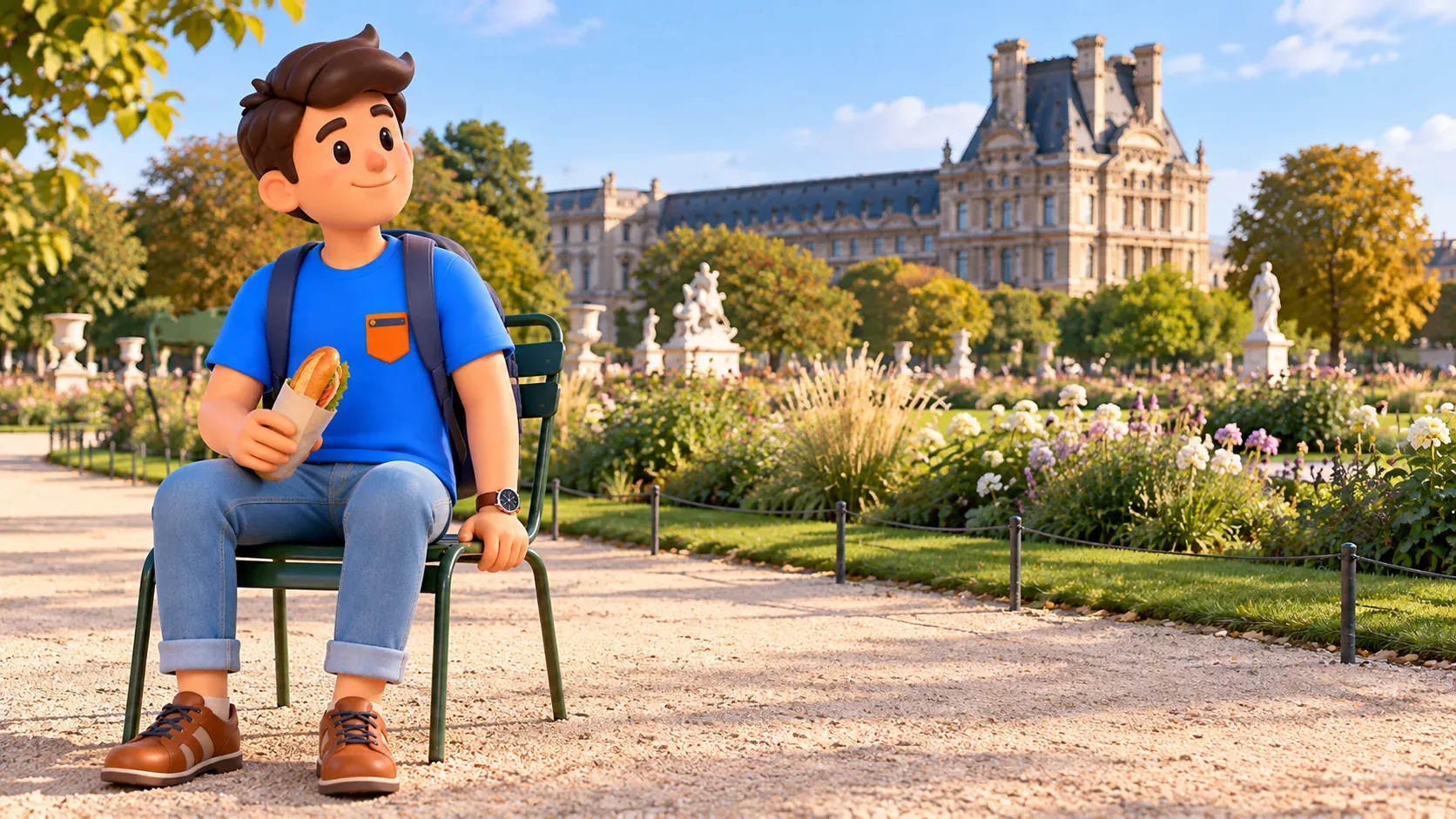
Catherine de’ Medici created the garden beside her palace in 1564. Its name recalls the tile workshops that once occupied the area. From 1664, André Le Nôtre reshaped it into formal perspectives, pools and ordered plantings. The Tuileries Palace burned in 1871 and was not rebuilt. The open space therefore tells you about both a surviving garden and an absent building.
Spend about half an hour noticing the central axis, sculpture and the change from flowerbeds to tree-lined spaces. Then sit for around 15 minutes if a seat is available. Notice how the formal composition accommodates everyday visitors.
The garden is free. The Louvre, its owner, gives October hours of 7am–9pm, with visitors asked to leave from 30 minutes before closing. These conditions were checked on 13 October 2026 and refer to the garden. The Louvre museum’s Tuesday closure does not imply that the Tuileries close on Tuesdays.
If this break reveals that you prefer a slower pace, organise the rest of your trip more conveniently in RoadMe. Its personal day-by-day plan uses your interests and budget, giving you less manual planning to do before the next outing.
Metro to the Eiffel Tower: be downstairs at your slot
Leave towards the garden’s western end at Place de la Concorde. Use marked crossings to reach Concorde station and take Line 8 towards Balard. Ride to École Militaire without changing: on the usual route, Invalides and La Tour-Maubourg lie between the two stations. Walk northwest along Avenue de la Bourdonnais towards the tower’s signed grounds entrance.
The hour from the garden accounts for station access, ticketing, waiting and the final walk, rather than just time on a train. This is not a verified step-free itinerary. If you need a continuous route without stairs, prepare the transport stage separately; choosing an elevator at the tower does not solve access throughout the whole day.
Aim to reach the site around 3pm. The tower’s operator advises arriving 15–20 minutes before the electronic ticket time for the initial grounds security check. The 3:30pm appointment means being downstairs in the appropriate ticket queue after that first screening. Follow the ticket and on-site signs. Gardens and the esplanade behind screening are free; the ascent on your selected ticket is paid.
The tower was built for the 1889 World’s Fair. Its iron lattice exposes the structure: your eye moves through the supports, up to the platforms and towards the narrowing silhouette. After the cathedral’s stone vaults, this is a different way to experience architecture. On the second floor, find the Seine first and follow its curves to connect the panorama with the morning walk.
The elevator ticket to the second floor allows a first-floor visit but excludes the summit. A second-floor ticket cannot be upgraded to the summit at the tower. The operator recommends roughly 90 minutes for the first and second floors; this example allows 105 minutes for visiting and descending, separate from the earlier grounds check. Elevator queues can extend the visit, so 5:15pm remains an estimate.
For 13 October 2026, the tower’s calendar lists 9:30am–11pm. Weather and operating restrictions may affect access. If no suitable ascent ticket is available, keep an exterior view and finish earlier rather than relying on a guaranteed ticket at the counter. Our two-hour Eiffel Tower area walk offers a separate outdoor approach for another outing.
Finish with a view, and adjust the day honestly
After descending, leave the controlled site for an open public path on the Champ de Mars side. The final 15 minutes cover leaving and looking back. Path and lawn repairs continue in the park, so follow open passages rather than assuming every lawn is available. The planned 5:30pm finish is outside the tower, not back at your accommodation.
In rain, shorten the outdoor pauses and allow a more sheltered lunch; this cannot become a completely indoor day. In poor visibility, reconsider how much the ascent matters to you. If cathedral entry runs late, trim the extra walking while protecting your tower buffer. A museum, Montmartre or an evening cruise needs its own allocation: decide on it once you know how much time and energy remain.


