
Montmartre in Half a Day: Sacré-Cœur, Squares and Side Streets
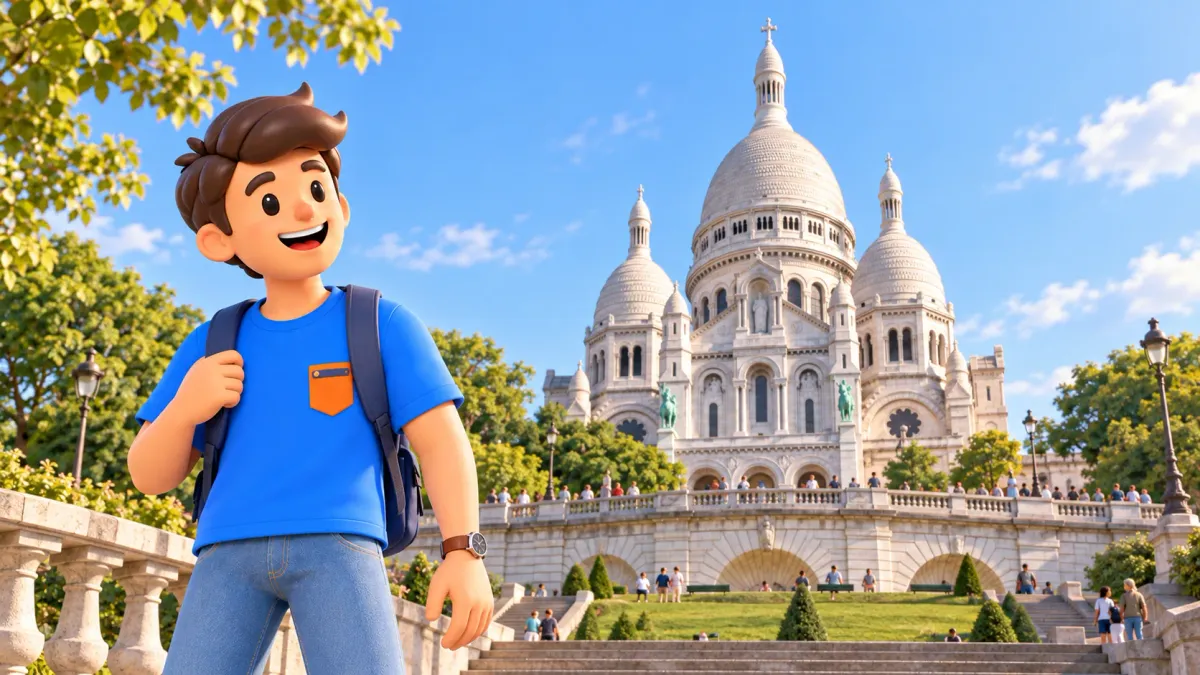
Give Montmartre half a day if you want to see Sacré-Cœur, spend time around Place du Tertre and explore the streets between its better-known sights. The hill changes the experience: a short line on a map can mean a climb, while a quick look at the panorama can easily become a long pause. Choosing your pace is part of planning the walk.
This route starts outside Sacré-Cœur, continues to Place du Tertre, Clos Montmartre and rue de l’Abreuvoir, then reaches Place Émile-Goudeau and the Bateau-Lavoir. It finishes at Place des Abbesses. The main itinerary uses public streets and exterior stops. Allow extra time to reach the starting point, visit a museum or climb the basilica’s dome.
A half-day route through Montmartre
Starting at Sacré-Cœur gives you the broad city view first, before the walk moves into smaller squares and streets. The route explores the upper hill and gradually returns towards Abbesses. It is not a continuous descent: slopes, uneven surfaces and occasional steps remain part of the area, and the actual path matters more than the apparent distance.
Keep the main sequence simple: Sacré-Cœur → Place du Tertre → rue des Saules and the vineyard → rue de l’Abreuvoir → Place Émile-Goudeau → Place des Abbesses. Allow time for the streets between these anchors. This gives you different sides of Montmartre without repeatedly returning to the same place because another photograph has reminded you of an alley you missed.
To work out a personal Paris plan around your interests and pace more conveniently, try RoadMe. The app builds a day-by-day programme, so you can give Montmartre the attention that suits your own trip.
If art is your priority, spend longer around Tertre and the Bateau-Lavoir. For architecture and views, give more attention to Sacré-Cœur and the upper streets. A café can be a proper part of the outing rather than something postponed until the entire list is complete. Agree on this with your companions before setting off: taking photographs, following history and resting need different amounts of time.
Allow approximately three to four hours with a break. This is a planning estimate, not a timing measured on the ground. A queue, a long meal or an indoor visit can extend it. Keep the final part of your day flexible, so enjoying a particular street does not feel like falling behind a schedule.
Sacré-Cœur: the square and the view first
Outside the basilica, look across Paris before turning your attention to the building. Separating the two helps: a panorama draws your gaze into the distance, while architecture invites you to notice arches, domes and the pale façade. You do not need to identify every famous landmark on the horizon to appreciate the hilltop setting.
The first stone of Sacré-Cœur was laid in 1875, and the basilica was consecrated in 1919. These dates place a seemingly separate world above Paris within a comparatively recent period of the city’s history. Its Romanesque-Byzantine appearance is a useful contrast to the Gothic buildings that many visitors associate with the capital.
Admission to the basilica itself is free. The dome is a separate paid visit reached by stairs, without a lift. Keep these possibilities distinct: you can enter the church without climbing, or remain outside and enjoy the square. The main walking route works with either choice; the dome is an addition rather than a condition of seeing Montmartre.
For an indoor visit, allow for entry checks and services taking place inside. Give it its own time allowance. Treat the dome as a separate priority, since the extra climb affects both energy and the remaining programme. Opening arrangements can change, especially during events or maintenance, so confirm the applicable information for your intended day.
The journey up to the starting square also comes before the main walk. The funicular helps with the principal climb from the lower side of the hill. It accepts applicable transport tickets and passes, including the Métro-Train-RER Ticket; check your chosen ticket and its conditions. Using it does not remove the slopes from the rest of Montmartre.
Place du Tertre: watch the artists at work
Head from the basilica towards Place du Tertre. After the open panorama, this is a closer scene of people, easels and café terraces. Make an initial circuit and decide what interests you: portraits, city views or the process of painting. The stop then has a purpose even if you are not planning to buy anything.
Artists were visiting this square in the nineteenth century, and painters and portraitists still work here today. Its value is the link between Montmartre’s artistic reputation and a working contemporary scene. The present square also depends on visitors; enjoy what is happening now rather than expecting an untouched setting from the past.
If you want a portrait, agree on the price, format and approximate time beforehand. Add that time to your plan, particularly when several people are being drawn. When watching, leave room around another person’s easel. Ask before photographing somebody at work, and keep the routes between tables and artists clear for other people.
Ten minutes or a much longer stay can both make sense. The right duration depends on your interest. A short stop suits visitors who want to continue through the streets; a longer one allows more observation and conversation. Buying a painting is one possible experience, not a requirement for enjoying this part of the walk.
The vineyard and rue de l’Abreuvoir
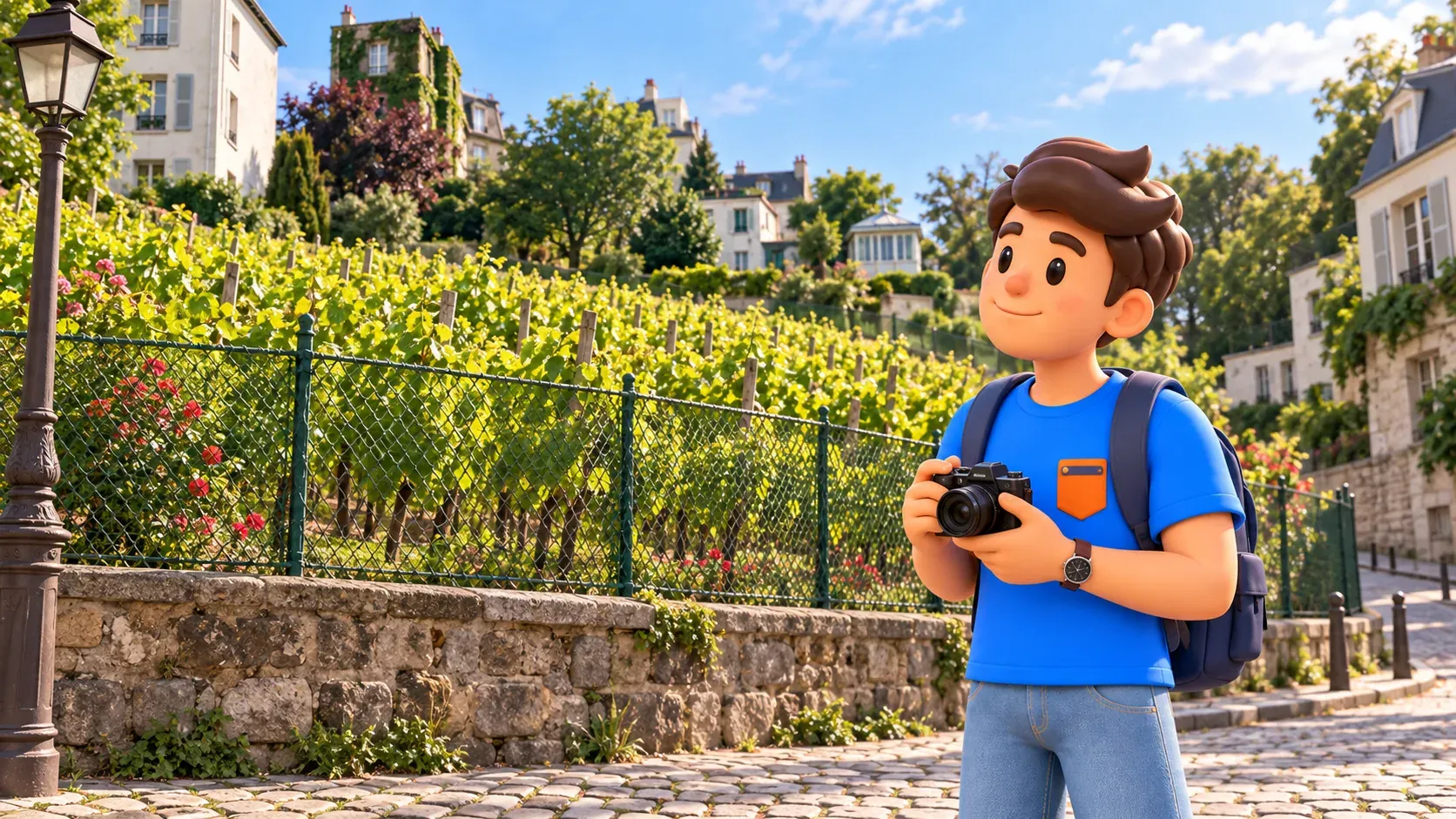
Follow rue Norvins and rue des Saules towards Clos Montmartre, near the junction of rue des Saules and rue Saint-Vincent. A vineyard among urban streets introduces a different side of the district. For this itinerary, observe it from public space through the boundary fence rather than assuming you can walk between the vines.
The modern vineyard is linked to residents who helped protect the site from development and replanted vines during the 1930s. It is a small but meaningful piece of neighbourhood history: local people took part in preserving their landscape. The vines are therefore part of a living district as well as an unexpected photograph in Paris.
Access inside is through organised visits and is not included in this route. Do not base the half-day plan on an assumed stroll among the rows or a tasting on arrival. If that experience matters to you, arrange it separately. An exterior stop keeps this part of the walk independent of a guided-visit appointment.
Return towards rue de l’Abreuvoir. Look at the street’s line, the combination of buildings and greenery, and the changing perspective as you move. It is easy to linger for a photograph, but leave room for walking too. Choose a suitable place for one image, then experience the remaining stretch without stopping at every doorway.
Continue through the streets around rue Girardon and rue d’Orchampt towards Place Émile-Goudeau. Check the path on your map and follow signs locally: a short straight-line distance does not guarantee a convenient route on a hill. The streets are part of the experience, while private doorways, courtyards and stairs remain outside the suggested public walk.
The Bateau-Lavoir and the return to Abbesses
At Place Émile-Goudeau, pause by the Bateau-Lavoir. This address belongs to Montmartre’s artistic history: Pablo Picasso moved here in 1904. That connection is enough to see an apparently ordinary building as a place where artists lived and worked. You do not need a full biography to understand why the address became significant.
The Bateau-Lavoir is an exterior stop in this plan. It does not include entry to a studio or a meeting with an artist. Look from the square and give the surrounding space a few minutes. After Tertre, this stop separates two impressions: today’s work for visitors and the history of an artists’ neighbourhood.
From the square, take rue Ravignan down towards rue des Abbesses and Place des Abbesses. This is a convenient finish for choosing a café and talking over what you have seen. Notice the Art Nouveau Métro entrance by Hector Guimard: its plant-like lines give the route another architectural detail after the substantial forms of Sacré-Cœur.
You do not have to move on immediately. If you are tired, sitting at a table may be the best continuation of the outing. If there is plenty of energy left, first work out the journey to your next destination and decide what you actually want to add. A decision made after a pause can better reflect the whole group’s mood.
Breaks, slopes and the rest of your trip
For planning, allow about an hour for walking, an hour and a half for selected stops, and another half-hour to an hour and a half for rest. Together, that gives roughly three to four hours. These are editorial estimates. Museum visits, the dome and the journey up to the starting point need separate allowances.
Choose one indoor priority before leaving. If it is the dome, reserve a separate block and spend less time at other stops. If it is a museum, build a suitable part of the day around that visit. A nearby entrance does not automatically create time for an additional attraction. Check the start and end of your available window before adding it.
In a group, agree on a specific meeting point when people want to pause separately. One person may watch painters at Tertre while another looks at work or rests at a table. A clear time and landmark preserve that freedom and let you continue together. Meeting on another street can involve an extra climb or walk, so make the arrangement practical.
Pay particular attention to slopes and surfaces in wet weather or when you are tired. Comfortable walking shoes are useful here. Specific access requirements need checking along the actual route; the overall itinerary is not a guarantee of step-free travel. The funicular helps with one part of the climb rather than every feature of the district.
Do not automatically attach a long programme across Paris to this half-day. Decide whether you want more art, a change of setting or rest. On another day, the Île Saint-Louis walk among quays and mansions offers a different scale and a riverfront setting.
For a more convenient trip built around your preferred themes, let RoadMe prepare a personal plan using your dates, interests, pace and budget. Try a programme that arranges walks, larger visits and rest around your own preferences.
A good half-day can leave a handful of memorable scenes: Paris from above, a painter working, vines behind a fence or a detail at the Métro entrance. Their importance will differ from one traveller to another. Choose yours and leave enough time for Montmartre to feel like an experienced walk rather than the final item in an overfilled day.


