
Miró Beyond the Museum: Seeing the Artist in Barcelona’s Public Spaces
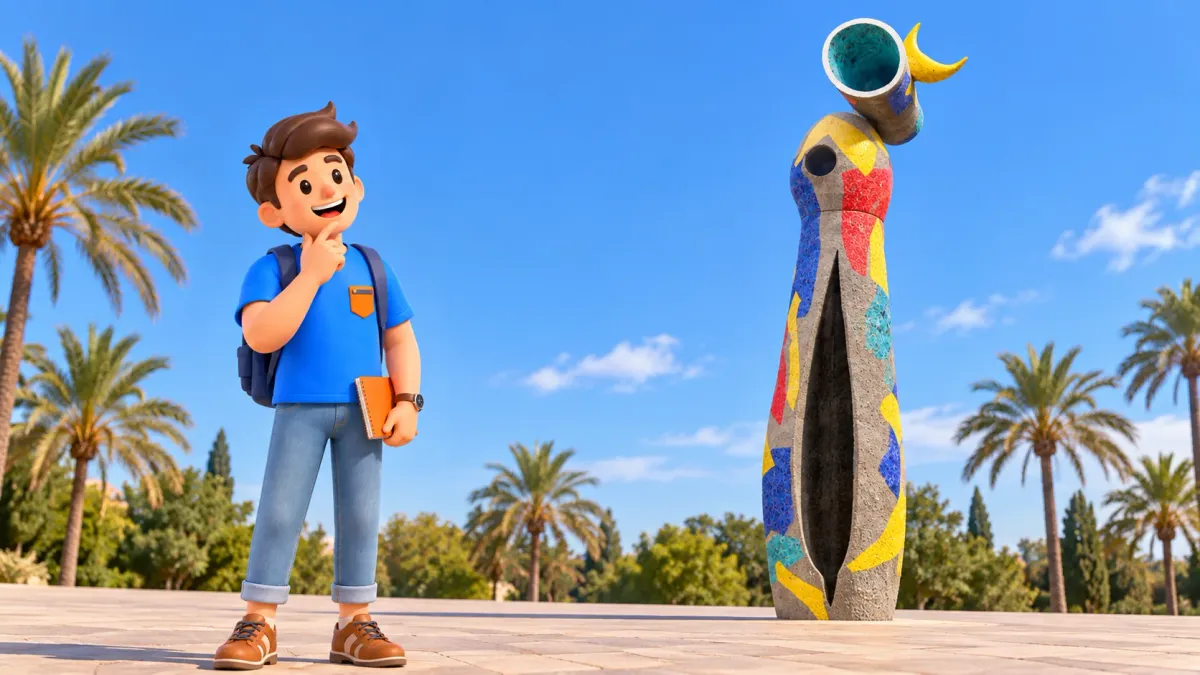
Meeting Joan Miró in Barcelona can begin in a museum, but the city offers another way to look. A work appears during an ordinary walk, alongside trees, passers-by and residential streets. More than the background changes: you look from a distance, move closer, notice the life around it and then return to a patch of colour.
Two different examples help explain that presence: the tall Dona i Ocell sculpture in Parc de Joan Miró and the Pla de l’Os mosaic created for La Rambla’s pavement. The second needs an important qualification. In October 2026, the mosaic was covered for protection during works. Here it appears as public-art history, rather than a promise of an unobstructed view today.
What changes when a work enters the city?
In a museum gallery, attention is usually already directed towards art. Outdoors, ordinary activities continue around it: people travel, rest, talk and look about. The work becomes part of that movement. It can attract someone who had no intention of exploring the artist’s career that day.
That does not make the encounter less meaningful. The city reveals relationships between the work’s size, open space and the human body. The contrast is particularly clear between a vertical form that draws your gaze upwards and an image conceived in the plane of the pavement. One artist can address very different kinds of attention.
There is no need to begin with a large vocabulary. Ask where the work directs your eyes, what colour does and what changes with distance. That is enough for a first independent encounter. History adds context, but should not replace observation in advance with a compulsory feeling or one correct response.
To combine art with ordinary city life, try RoadMe: the app prepares a personal plan around your interests, dates, pace and budget. It makes giving these encounters room on suitable days much more convenient than collecting every cultural idea into one tiring itinerary.
Dona i Ocell: begin with the silhouette
Dona i Ocell, usually translated as Woman and Bird, was inaugurated in 1983. It stands in Parc de Joan Miró near Plaça d’Espanya, rather than within the Fundació Joan Miró on Montjuïc. The artist’s name connects different places without turning them into one neighbouring complex with a shared entrance.
Start with the vertical outline. An elongated form, a dark incision and an unusual finish with a tilted hollow cylinder and yellow crescent do not produce a literal portrait of a woman with an ordinary bird on her shoulder. The title suggests a direction for thought without requiring an illustration from a textbook.
That provides an accessible beginning for someone without specialist knowledge. You may notice an organic shape, an unexpected curve, a coloured patch or the relationship between weight and apparent lightness above. You do not have to pass a decoding test immediately. Several associations can exist alongside a known title.
Look first from farther away, then give attention to a smaller section. How does the upper part separate from the sky? What does the black vertical mark do to the overall volume? Which colours appear before others? Those questions are more precise than a general verdict of liking or disliking, although personal preference still belongs to the experience.
Ceramic colour has a surface
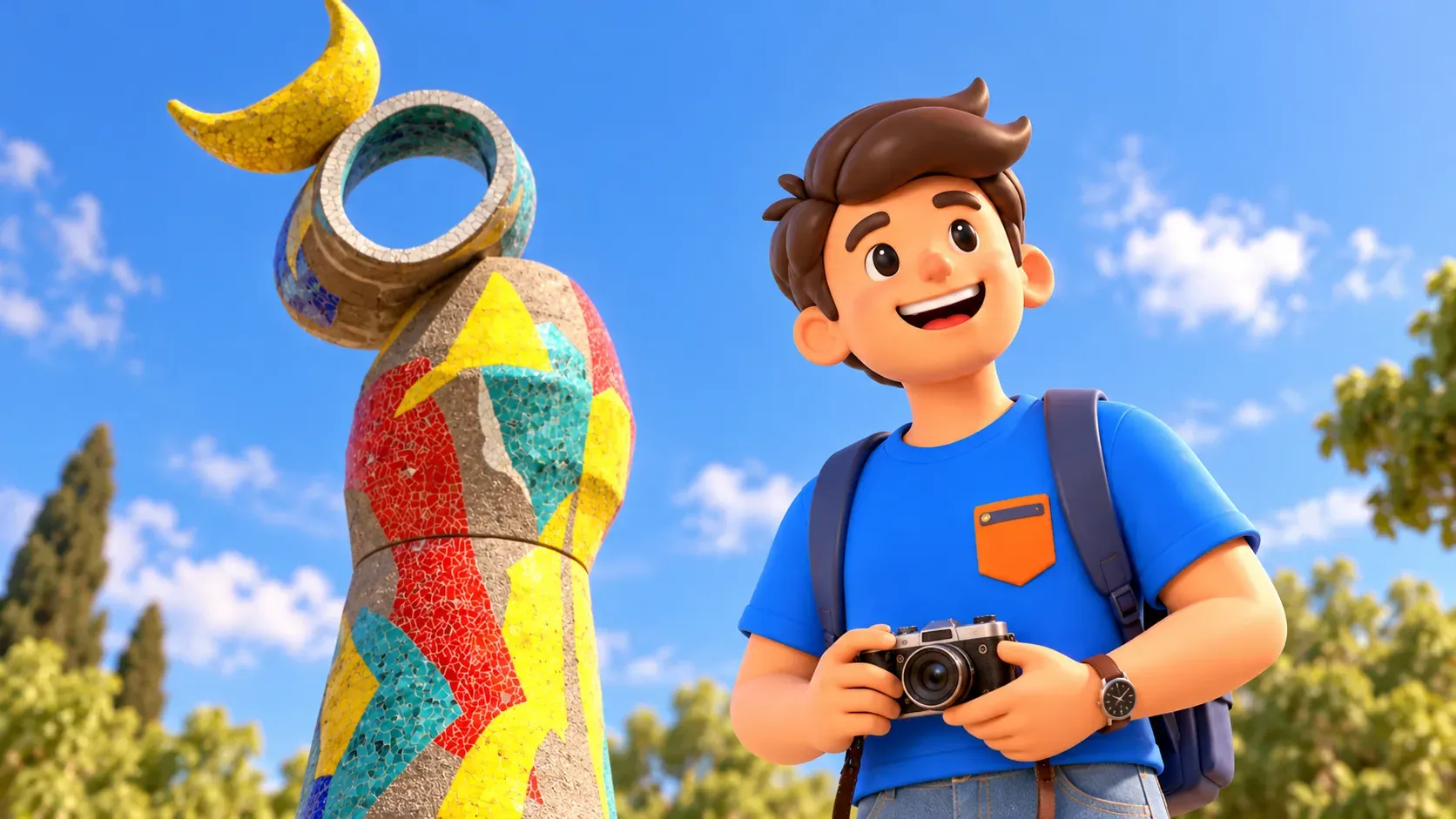
Material matters as much as broad shape. The coloured ceramic uses trencadís, with ceramicist Joan Gardy Artigas involved in its execution. Collaboration is worth remembering: Miró’s name identifies the work, while its material realisation also involves another maker’s skills. It is not necessary to picture one isolated artist manufacturing everything alone.
A surface divided into small pieces receives light differently from a flat colour on a screen. From farther away, you see a large red, yellow or blue area; nearer, the pieces and joints become noticeable. The scale of looking changes what attracts attention. An apparently continuous patch reveals an internal structure of its own.
Notice where colour meets a quieter grey surface too. The contrast makes the colours more apparent and helps the volume become legible. You do not need every material’s technical name to distinguish the underlying texture from ceramic sheen. Nor should the whole sculpture automatically be described as one continuous mosaic covering.
Trencadís does not prove an attribution to Gaudí. The technique is familiar from other celebrated Barcelona places, but this is Miró’s work with Artigas’s collaboration. A shared way of handling ceramics does not make different works identical in their ideas, period or artistic language.
The park is more than a neutral backdrop
Parc de Joan Miró occupies the former city slaughterhouse site. That provides another example of a changed urban function: a place with very different everyday work became public green space. You do not need to find that past in every coloured fragment, but it helps explain that the setting has a history too.
The park contains different kinds of space, including open areas and greener sections, trees and places for varied activities. It is not one empty pedestal devoted exclusively to the sculpture. A walk can include looking at art and an ordinary pause in city life. Those activities need not compete to be the only correct use of the park.
The name does not mean that Miró designed the entire landscape. The sculpture and the park dedicated to the artist are related, but they involve different questions of authorship and organisation. A small distinction prevents the familiar habit of attributing everything near a celebrated name on a map to that person.
Choose an ordinary permitted viewing position. Do not reach the sculpture through areas outside normal circulation or expect water conditions to match an old photograph. A historical basin setting does not guarantee its state on a particular day. Safe public space around the work is enough to understand the form.
The Rambla mosaic: a different kind of gesture
The 1976 Pla de l’Os pavement offers another encounter with Miró. Black lines and bright areas form a composition conceived within the plane of everyday movement. That is a significant contrast with a tall sculpture read against the sky. The relationship between art and the walking body changes.
An older view helps explain the idea. Passers-by, surrounding paving, façades and the coloured form occupy one space. Meeting the work did not require entering a gallery and stopping before a frame. It became part of an ordinary city journey, even when someone did not immediately recognise an artwork.
Read that older image as older, however. An on-site report published in October 2026 showed that the mosaic had already received protective covering during La Rambla works. This article does not offer it as a presently visible stop or a surface to walk across now. Being able to use a street and being able to see a particular work are different things.
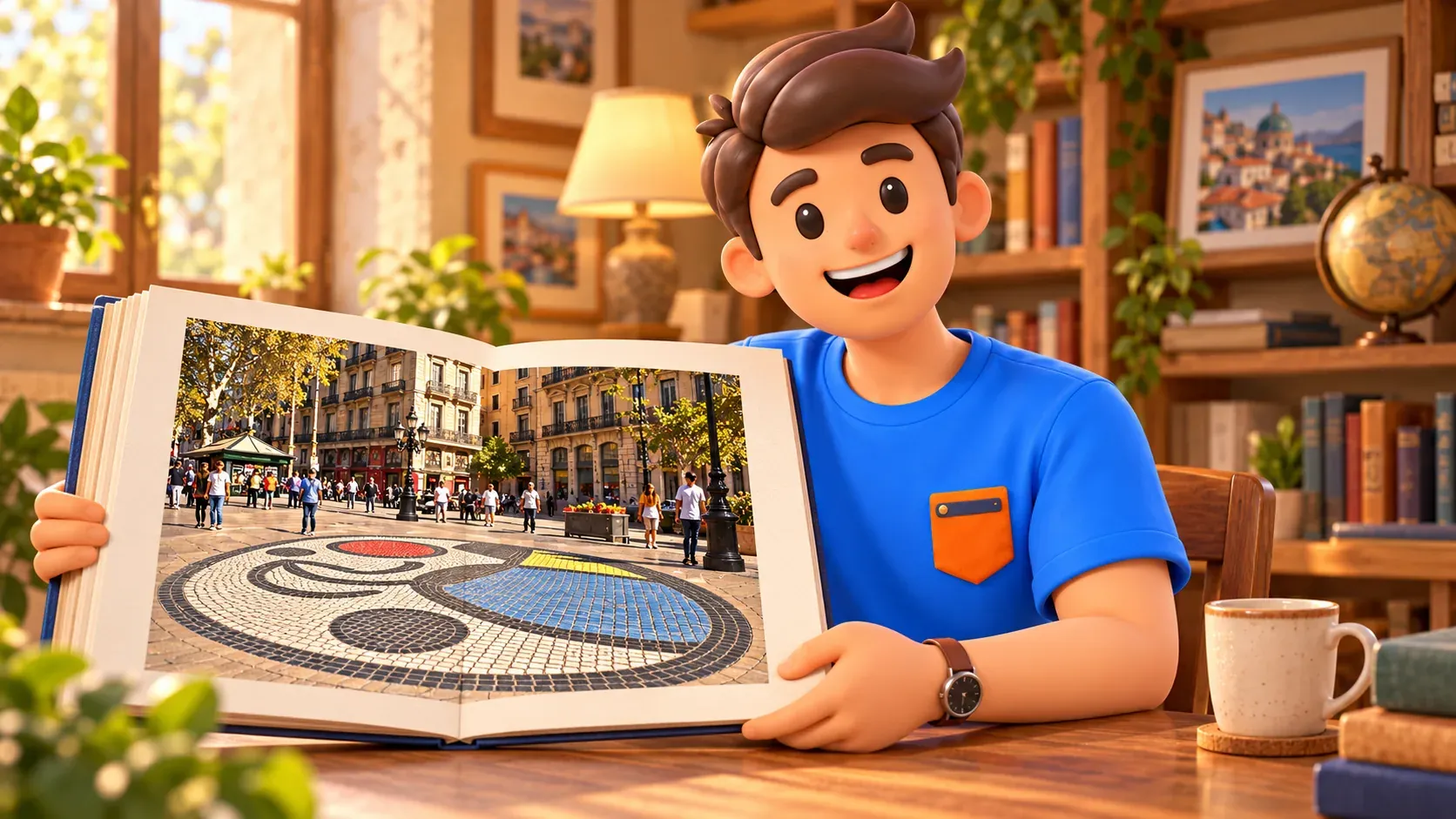
The restriction does not erase the artistic history. Sometimes the lack of an open view makes it easier to distinguish a work from its photograph and a walking plan from knowledge about a city. Do not infer an exact uncovering date from the overall street-works schedule: protection, restoration and completion of the surrounding space may involve different stages.
Looking without compulsory symbol decoding
Begin with three observations: line, colour and position. A line can divide areas or connect them. A colour can come forward against a quieter background. Position changes the direction of attention: upwards towards a sculpture’s finish, or historically downwards towards a pavement image. That is already a useful conversation without a complete dictionary of symbols.
Titles remain helpful without exhausting the experience. If Woman and Bird first suggests a plant or a fantastic object, hold that association and compare it with the title. Interest often grows from the difference between a first impression and the information supplied by context. You do not have to suppress one to accept the other.
For a small drawing, use ordinary lines and patches without presenting your page as an exact copy of the artist’s work. A few circles, curves and differently sized elements can help you notice compositional relationships. It is a traveller’s personal note, rather than a conservation exercise or an attempt to manufacture an authentic work.

With company, ask one simple question: what did you notice first? Answers can differ even from the same viewing position. There is no need for a vote on the correct interpretation. Compare how people distribute attention instead, and keep one detail that you might have missed on your own.
How the city encounter differs from a museum
A public work provides a strong meeting with one form in an urban setting. A museum allows a deeper view of the artist’s development, relationships between works and different scales of making. Neither must completely replace the other. A park may be an introduction that leads to a museum day, or an independent experience in its own right.
The important thing is not to promise that two city examples explain Miró’s entire career. They show particular ways of being present in Barcelona. That is enough for a useful first conversation, rather than a complete catalogue. Limiting the examples helps keep a walk from dissolving into an endless inventory.
If you choose the museum, check its own programme and arrangements. Parc de Joan Miró and the foundation on Montjuïc are different locations. During its protective covering, the Rambla mosaic remains historical context; it does not need to become an obligatory stop on today’s trip simply because the artist’s name is familiar.
Let RoadMe prepare a personal day-by-day plan around your interests and preferred pace, giving art the right place in your trip. It is a more convenient and effective approach than manually linking every work by one artist regardless of distance or the kind of experience you want.
For more outdoor encounters, see our guide to Barcelona’s public art. After meeting Miró, one useful habit is enough to keep: notice not only the colourful object, but also how it changes your view of the sky, the surface and the ordinary movement of the city.


