
Why Milan Has Two Porta Ticinese Gates: How to Tell Them Apart
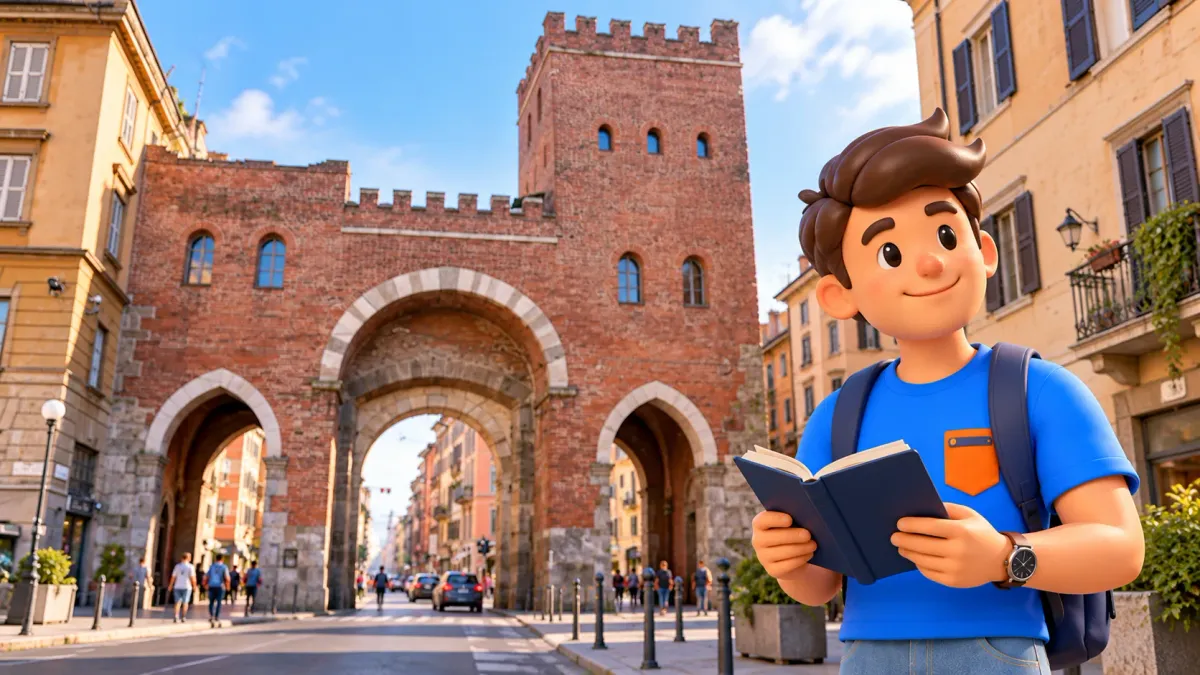
Milan has two surviving gateways called Porta Ticinese because the same southern road crossed different city boundaries at different times. The medieval gate stands farther north on Corso di Porta Ticinese, near San Lorenzo. The neoclassical gate by Luigi Cagnola stands farther south on Piazza XXIV Maggio, beside the Darsena area, on the line of the later Spanish fortifications. They are separate monuments, not opposite sides of one building and not an old gate moved down the street. Seeing both turns a confusing name into a small lesson in how Milan grew.
One name describes a direction as well as a landmark
The historical road led towards Ticinum, modern Pavia. A useful way to understand the repeated name is to think of a route whose point of entry changed as the city developed. The place outside one boundary could belong to a later, larger enclosure. Today both monuments sit within the city, making that earlier separation less obvious. Their differences are easier to read when you look at the street between them rather than expecting two matching structures.
Try RoadMe for a personal Milan trip plan based on your interests, dates, pace and budget. Preparing the whole stay in the app is more convenient and helps give neighbourhood history, major visits and time to rest a sensible place together.
For a meeting or a saved map location, use the full landmark name. “Porta Ticinese Medievale near Via Edmondo De Amicis” points to the brick gateway. “Porta Ticinese on Piazza XXIV Maggio” points to Cagnola’s columned monument. Simply saying “meet at Porta Ticinese” can leave two people waiting at different places. This distinction is useful before the history even begins, especially when one person is arriving from central Milan and another from the canals.
The quick distinction: brick gateway or classical columns?
| What to identify | Medieval Porta Ticinese | Neoclassical Porta Ticinese |
|---|---|---|
| Location | Corso di Porta Ticinese, near De Amicis and Molino delle Armi | Piazza XXIV Maggio, by the Darsena area |
| First visual clue | Brick structure, a round central opening and pointed side passages | Classical columns, a triangular pediment and separate former toll houses |
| Historical setting | Medieval wall circuit, with later rebuilding and restoration | Early nineteenth-century monument at the later city boundary |
| Name to remember | Camillo Boito’s nineteenth-century restoration | Luigi Cagnola’s neoclassical design |
Use this as a way to recognise the two buildings, not a substitute for seeing them. At the older gate, brick and stone openings organise a compressed threshold in the street. At the southern gate, the columned composition and surrounding square create a more monumental sense of arrival. The contrast gives you something clear to compare even if you do not normally pay much attention to architecture.
The medieval gate also contains a nineteenth-century idea of the past
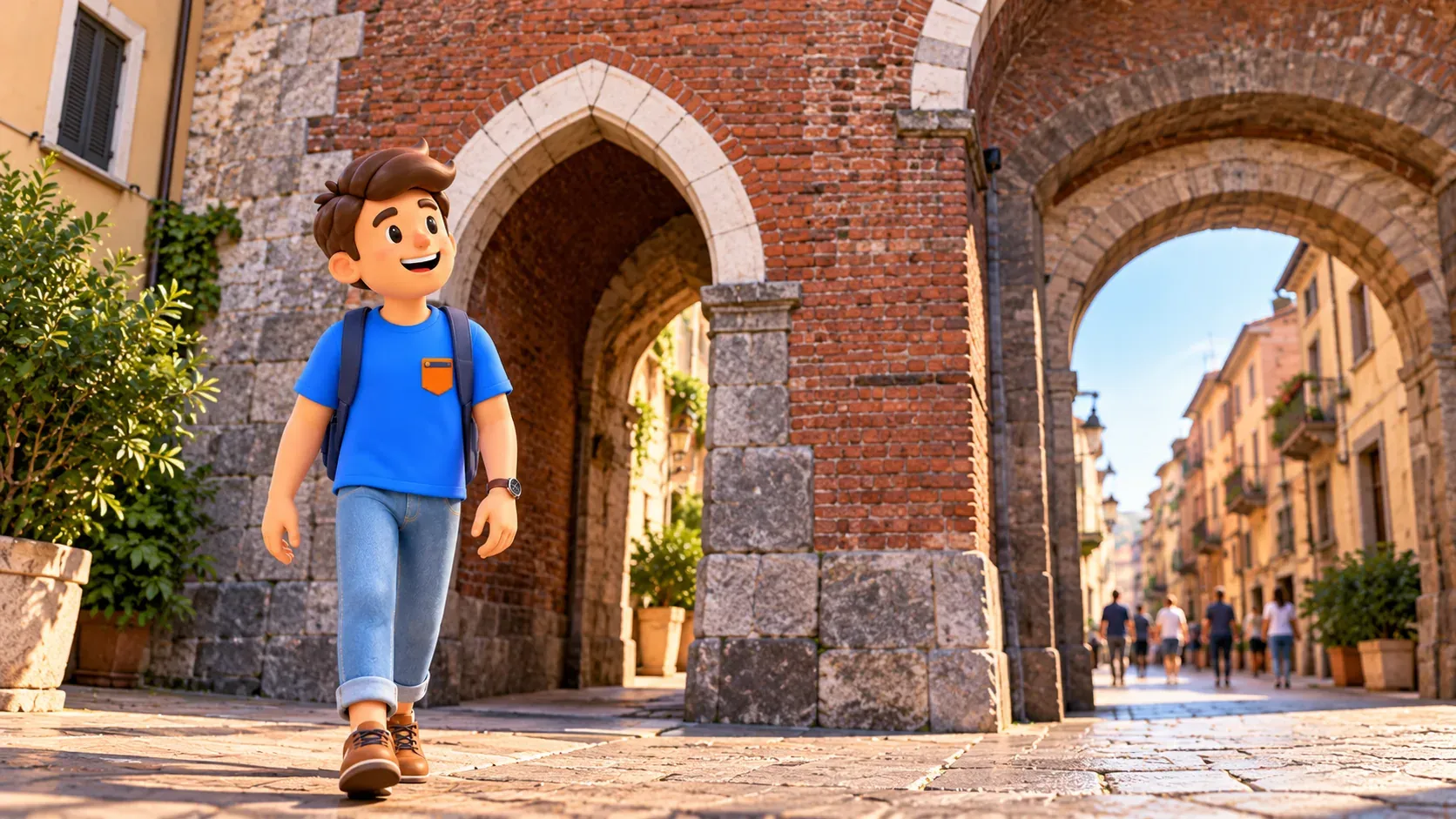
The northern gate belongs to the medieval wall circuit. Its history includes fourteenth-century rebuilding under Azzone Visconti, so “medieval” already describes a sequence rather than a single unchanged moment. The central opening has a rounded stone arch, with brickwork around it. Begin with that broad shape. You can recognise the gate without attempting to identify every repair, brick or sculptural detail from pavement level.
Its present appearance owes much to Camillo Boito’s intervention in 1861–1865. Buildings attached to the structure were removed, two pointed pedestrian openings were added at the sides and battlements completed the upper profile. Those striking features are not all untouched survivals from the Middle Ages. The restoration helped shape the way later generations would imagine a medieval gateway, as well as making an old monument more legible within the changing city.
This does not make the gate uninteresting or historically empty. It gives it another story. Compare the large rounded opening with the pointed side passages, then consider how the crenellated outline influences your first impression. A building can preserve an old urban threshold while also recording later choices about how history should look. You do not have to decide which period is the only authentic one in order to appreciate the layers.
From the public pavement, look at the relationship between monument and adjoining buildings. It is a surviving fragment of a former boundary, not an isolated castle placed in a park. A passage through the permitted public route offers a different impression from a frontal view. The spaces above the arches are not a walk-in visitor museum. Do not treat a visible window, doorway or staircase as an invitation to enter the building.
The southern gate belongs to a later boundary
Continue south in your mental picture of the city, beyond the medieval circuit towards the later Spanish fortifications. A gateway existed at this outer boundary before the neoclassical monument. Cagnola’s early nineteenth-century design therefore replaced an entrance associated with a later enclosure; it did not require moving the surviving medieval gate. The same road and repeated name connect the two, while their positions explain why both can remain visible today.
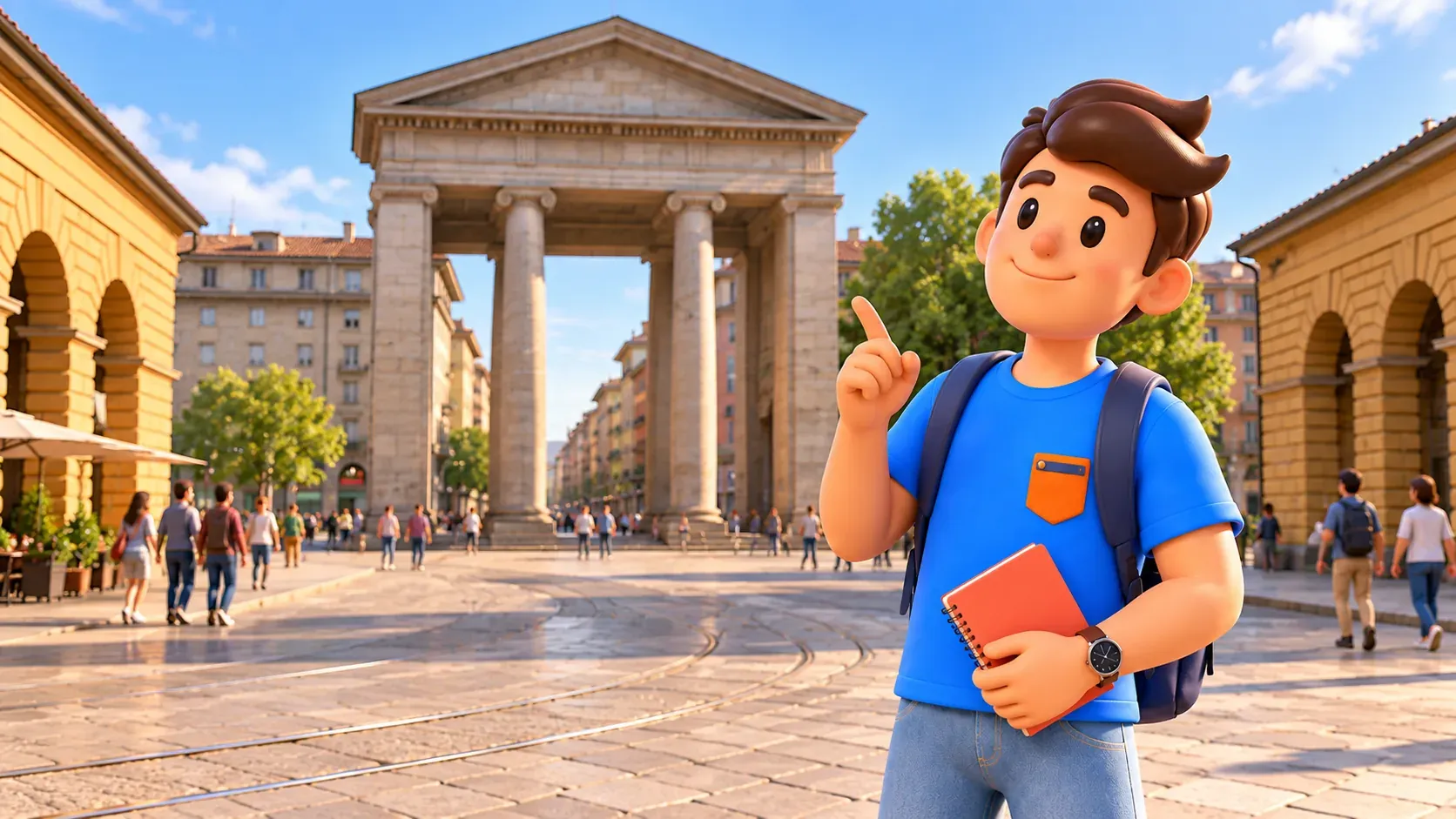
At Piazza XXIV Maggio, columns and a triangular pediment give the structure a classical language. Classical style does not make it an ancient Roman building. Nor are these the Columns of San Lorenzo, which stand farther north. Recognising that difference prevents an easy mix-up between three striking sights along the same general axis. A short walk can connect different periods without turning all the stonework into one Roman monument.
The smaller former toll houses belong to the southern ensemble. They are separate from the main columned structure, rather than the medieval gate’s side towers reappearing in a new form. The regional heritage account records both ceremonial and customs functions here. Goods and people approached Milan through roads and waterways near the Darsena. The monumental entrance therefore belonged to ordinary movement and control as well as to the public image of the city.
Look at the gate from a pedestrian position that includes some of its setting. A tight photograph of the columns can hide the square and the former toll houses, making the ensemble harder to understand. A wider view makes their separation clearer. There is no need to stand on tram tracks or in a carriageway to obtain symmetry. An ordinary angled view can explain more than a perfectly centred photograph.
A changed dedication adds another short historical layer
The neoclassical project belongs to the Napoleonic period and was associated with the victory at Marengo. For a time the gateway was known as Porta Marengo. In 1815, after the Napoleonic wars, its dedication changed to one honouring peace. This is a compact reminder that a monument’s meaning can be revised without replacing its entire architectural form. The name on an old print may therefore differ from the one you use to find the building today.
Keep the distinction between two kinds of change. Boito altered how the medieval structure looked; the southern monument also received a changed public message. Neither story is simply a matter of an old building surviving untouched. Both invite you to consider what later inhabitants chose to preserve, add or reinterpret. A little context makes visible details more interesting without requiring a complete chronology of every ruler and restoration.
You may also encounter the nickname Porta Cicca in descriptions of the district. It is not the most reliable way to tell these two landmarks apart. For practical orientation, retain the explicit medieval label and the square name. You can enjoy a local nickname without relying on a disputed explanation of its origin or treating it as a third monument that must be found.
Make the comparison a manageable ninety-minute outing
For a short, focused version, start at the medieval gate on Corso di Porta Ticinese near the junction with Via Edmondo De Amicis and Via Molino delle Armi. Finish at the neoclassical gate on Piazza XXIV Maggio. Allow twenty minutes for the older monument, twenty for the whole street connection, twenty for the southern ensemble, twenty for a short pause and ten of flexibility. The total is 90 minutes. A 14:00–15:30 outline is an example, not a booked programme.
Walk south along the public course of Corso di Porta Ticinese, using the actual crossings and pedestrian routes. Expect roughly 0.8–1 kilometre including short changes of viewpoint and the pause. These are planning estimates, not a measured navigation track. Arrival and onward travel are additional. The time allowance does not include church interiors, a museum visit, a Darsena circuit, shopping stops or a restaurant meal. Any of those changes the scale of the outing.
Use RoadMe to turn an interest in urban history or architecture into a personal plan for the whole trip. Preparing your days together in the app is more convenient and efficient than collecting separate stops, with room for your preferred pace, meals and rest.
If you want the broader sequence of Roman columns, church exteriors and neighbourhood spaces, choose our two-hour walk from San Lorenzo to Porta Ticinese instead. It develops another programme; it is not an extra circuit already contained in these ninety minutes. This shorter comparison works because it gives one question enough time: how did the same southern entrance become two different visible monuments?

Keep the visit outdoors and choose an explicit finish
The comparison uses free exterior views from public streets and squares, without requiring a ticket to either monument. That does not establish public access to upper rooms, adjacent premises or any enclosed interior. Follow temporary barriers and current local notices. If a passage or viewpoint is unavailable, use a permitted public alternative or shorten the stop; do not climb masonry or enter private areas to preserve a photograph imagined in advance.
Daylight helps you compare the openings, materials and surrounding street. The streets still have their own movement, crossings and surfaces, so a short route is not automatically an audited step-free route. Check the approach and available crossing arrangement if access needs affect your choice. Finish deliberately on Piazza XXIV Maggio rather than letting every nearby possibility become another obligation. A pause is part of the outing, not evidence that you have failed to see enough.
The history and visit outline were checked on 17 October 2026. For a separate continuation towards the water, our Navigli evening walk offers a different next stage with its own time. You can also stop at the second gate. The important discovery is already complete: the repeated name records a route through a changing city, while the two buildings preserve different boundaries and different ways of presenting Milan’s past.


