
Milan’s Monumental Cemetery: a Walk through Sculpture and Memory
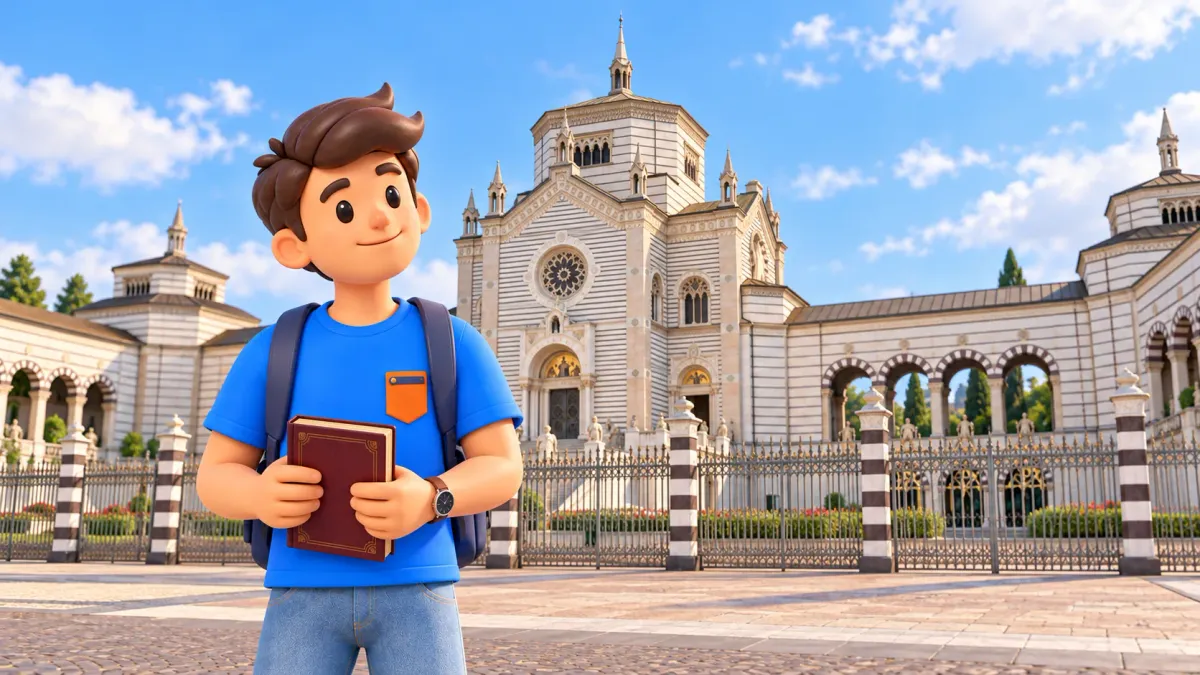
Milan’s Monumental Cemetery is worth a focused visit for sculpture, architecture and the city’s memory. Allow about two hours for a first outing: begin at the main entrance on Piazzale Cimitero Monumentale, spend time with the Famedio, follow the western side towards the Campari monument and return through the entrance area. Admission for individual visitors is free, without a reservation. This is still a working cemetery, so the route follows visitor paths and gives those mourning priority over sightseeing.
Choose a short visit with one sculptural focus
The cemetery is large enough that a list of famous names can quickly become a search exercise. This plan gives the visit a manageable structure: 30 minutes for the Famedio and entrance architecture, 20 for the Campari monument, 35 for walking and orientation, 20 for selected gallery views and 15 as a margin. The total is two hours. Expect roughly 0.8–1.2 kilometres depending on the public paths you use, an editorial estimate rather than a measured route.
To make visits like this part of a Milan trip built around your interests, try RoadMe, which prepares a personal day-by-day plan using your dates, interests, pace and budget. It is more convenient to organise art, neighbourhoods and rest together than turn every day into a long list of names and addresses.
Choose a normal morning, for example 09:00–11:00, subject to the calendar and current notices. Add your journey to and from the main entrance separately. M5 Monumentale is the relevant metro stop, but the route begins at the cemetery entrance rather than at a platform. Take a little time to orient yourself there. The aim is to see a few things attentively, not claim that two hours reveal the whole site.
If music and more intimate sculpture appeal more than the Campari group, choose the Toscanini monument as an alternative focus. It lies in a different section, so ask for directions and adjust the walking allowance. Do not automatically add the eastern and western branches to the same short loop. A visit can be coherent with one main sculpture. Extra names are an option for more time, not a requirement for doing the place properly.
Begin with Maciachini’s architecture and the Famedio
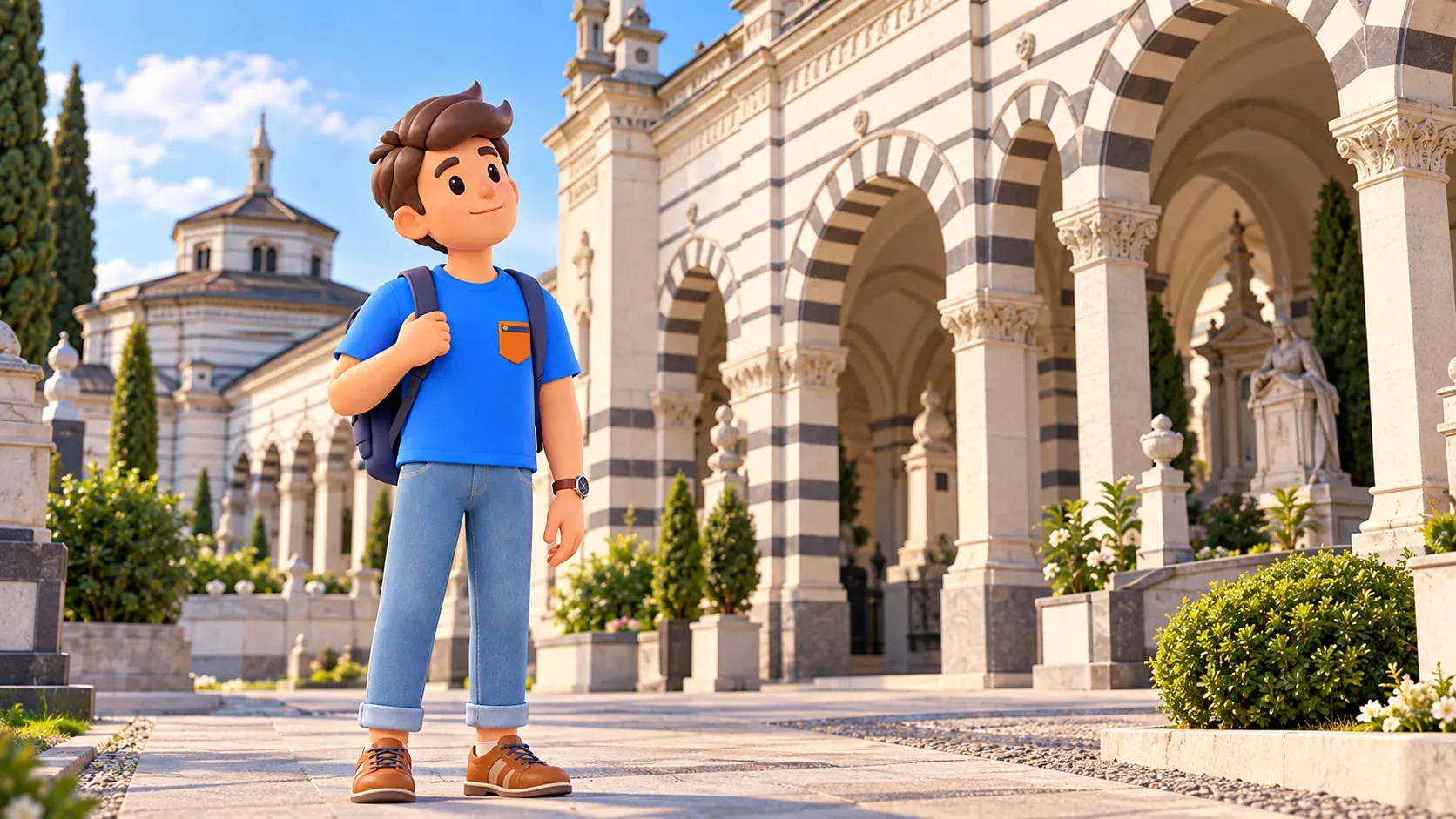
Carlo Maciachini designed the cemetery’s major nineteenth-century architectural setting. Before going inside, look at the alternating light and dark materials, rose window and arcaded wings of the entrance composition. They establish a ceremonial scale that differs from an ordinary park gate. You do not need to settle every stylistic reference to recognise the deliberate combination of forms. It prepares the visitor for a place where architecture and remembrance are closely linked.
The Famedio is a civic place of honour as well as a setting for burials. Alessandro Manzoni’s tomb occupies a central position. His presence gives a clear introduction to the relationship between the cemetery and Milan’s literary history. Look at the overall arrangement before narrowing your attention to the monument. If an area is unavailable or a ceremony is taking place, follow staff directions and keep the exterior architecture as the beginning of your visit.
A name commemorated in the Famedio does not automatically mean that person is buried in that room. The cemetery’s own account makes this distinction, citing people honoured there whose graves stand elsewhere. Remember it when comparing inscriptions with a map. It prevents the entrance from becoming a misleading checklist and helps explain how a city can honour a person through several different forms of memory, rather than through the location of a grave alone.
Orient yourself with the cemetery’s sections
Maps are available at the porter’s office on the left of the main entrance, according to the visitor information. Use the current map and staff directions for the exact paths. Section names matter more here than a vague instruction to walk towards an impressive sculpture. For the Campari monument, retain the official location: Rialzato AB di Ponente, spazio M. Its position is on the western side. The official description places it at the end of the avenue separating the raised A and B areas.
Keep the return to the main entrance in mind before setting out. A cemetery path is not permission to cross a grave plot to shorten the distance. Follow the designated passages and respect any temporary restriction. Walking time includes reading the map and allowing people to pass comfortably. The route does not depend on a private chapel being open, nor does an unlocked door automatically make an interior part of the visitor circuit.
Choose one modest comparison on the way: a sculpted figure against an architectural façade, or a shallow relief against a freestanding group. You can notice differences of scale and technique without identifying every work. Avoid attaching a confident story to an unfamiliar symbol. The subject may require the monument’s own account. Looking first and checking the explanation afterwards makes a better encounter than treating every angel, vessel or hand gesture as a code with one universal meaning.
The Campari monument: the Last Supper in bronze
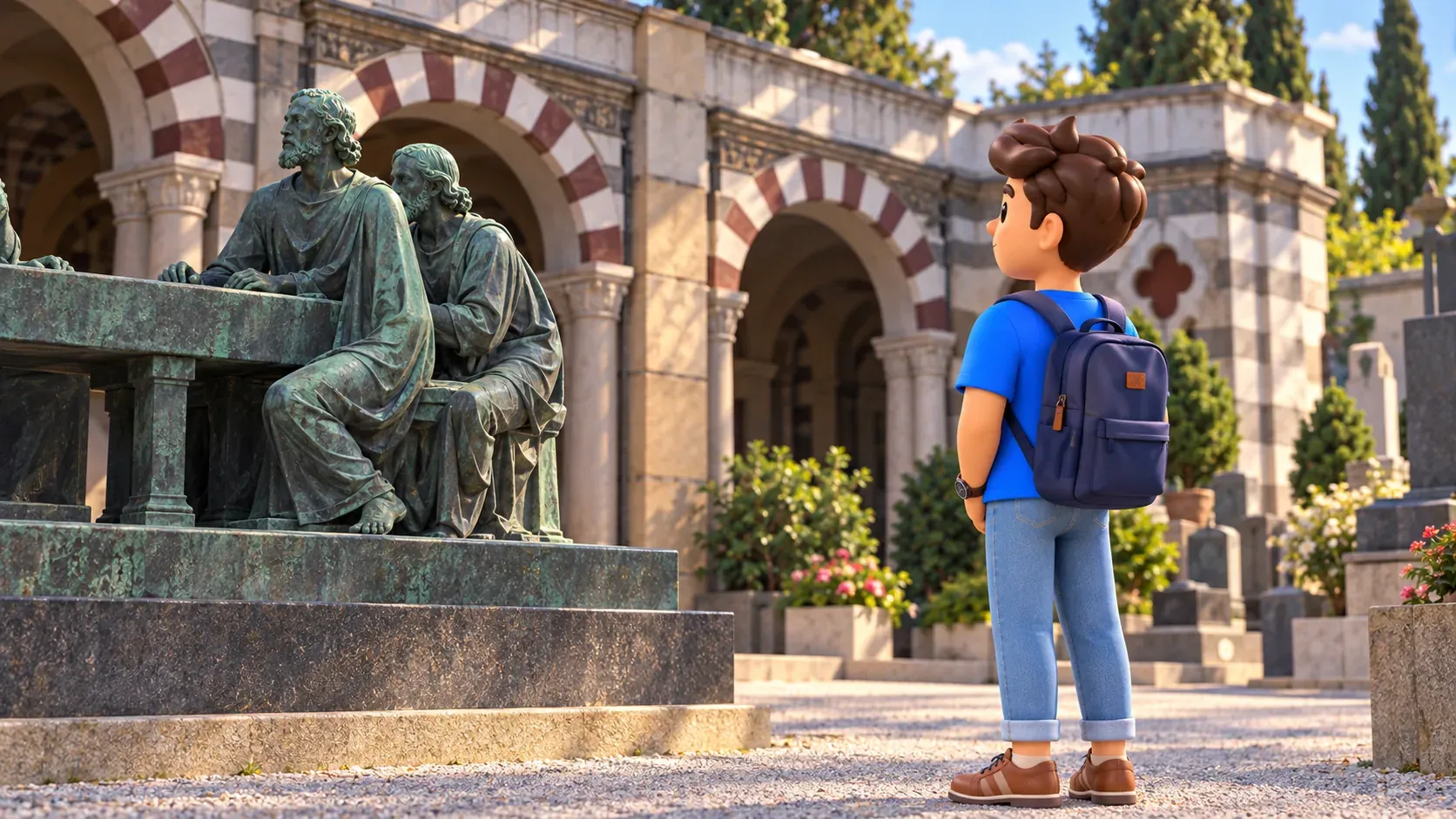
The Campari family monument, by Giannino Castiglioni, presents the Last Supper as a bronze sculptural group. The cemetery dates its execution to 1936–1939. It was commissioned in connection with Davide Campari, whose name belongs to Milan’s business history as well as to this burial place. That is enough context for the visit: a familiar commercial name leads to a work of funerary art, not to a tasting stop or a brand attraction.
From the public approach, look first at the long table and the arrangement of figures. Then choose a smaller detail visible without moving onto the burial area: a turn of a body, the drapery or the relationship between hands and the table. Bronze creates a different encounter from a painted scene, because the forms occupy real space and catch changing light. Your position can alter which figures overlap. Stay on the paths and let that limited change of viewpoint be enough.
This is a different work from Leonardo’s Last Supper at Santa Maria delle Grazie. Seeing it does not replace that museum visit or its reservation requirements. The connection is a shared subject treated in another medium, period and setting. You may enjoy comparing those choices without trying to reproduce the famous painting in your mind at every moment. The sculpture deserves to be considered as a memorial made for this place and this family.
A music-related alternative: the Toscanini monument
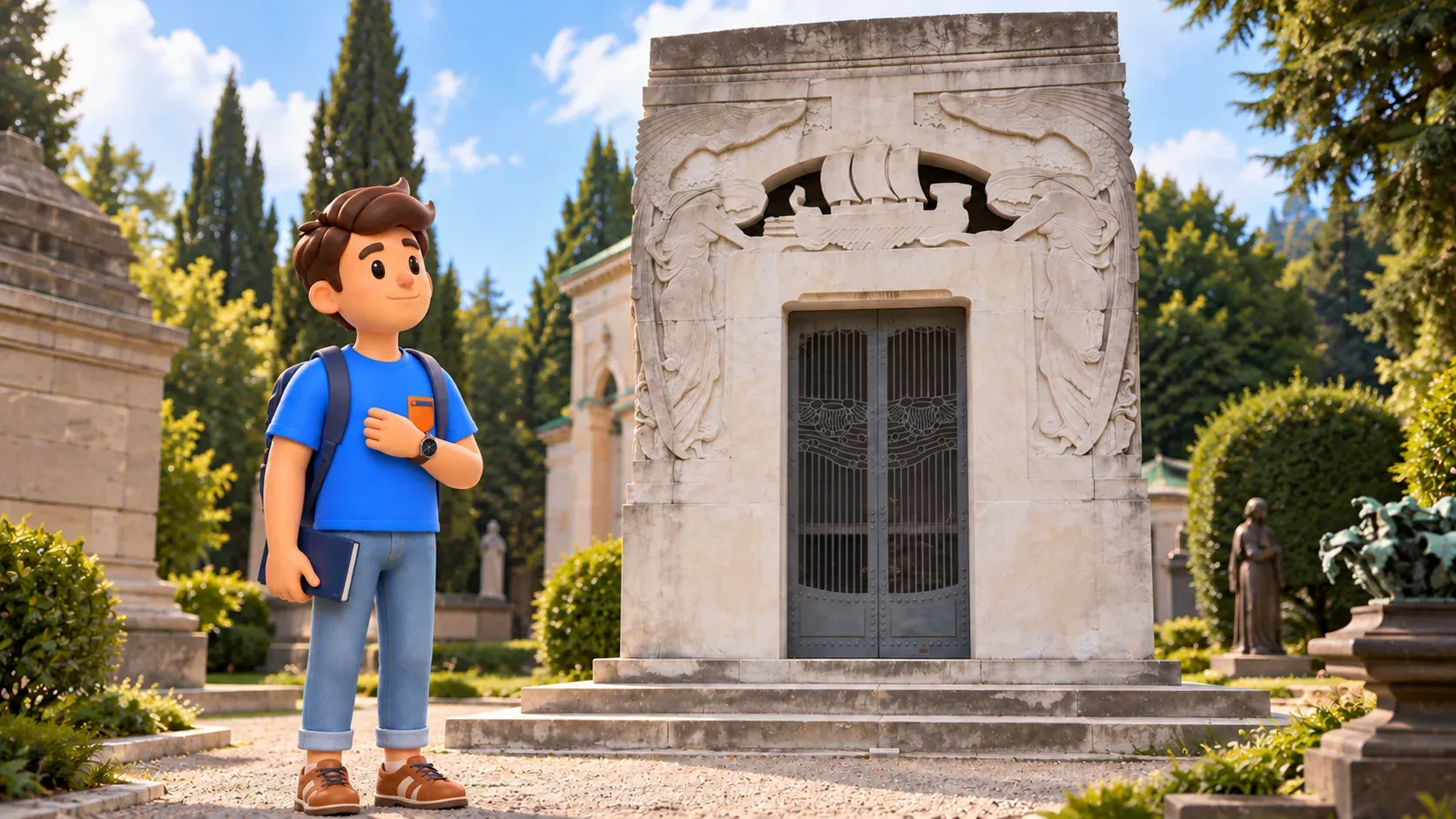
If you select the alternative branch, ask for Edicola Toscanini, Riparto VII, spazio 184, in the eastern section. Leonardo Bistolfi created the monument in the early twentieth century. Arturo Toscanini commissioned it after the death of his young son Giorgio. That origin matters: the family name may first suggest the famous conductor, but the sculpture’s language also concerns childhood, loss and the memory of a child. Treat it as a separate focus with its own emotional scale.
The pale marble structure uses relief rather than the long bronze group of the Campari work. On its front, the theme of a journey gives you a way into the image. The official account interprets other sides through birth, childhood and grief. You need not inspect every face to understand that the different scenes belong together. Look only from suitable public positions, without approaching mourners, touching the relief or entering a family space to obtain another angle.
This alternative is useful for a visitor who prefers one quieter story to a large survey. It should not become an extra mandatory detour simply because another celebrated surname is nearby on a list. Use your time for the selected monument and return comfortably. If you decide to visit both branches, extend the outing and ask for a sensible connection on the current map. The two-hour version does not promise both for everyone.
If sculpture, music or the people behind Milan’s history become the theme you enjoy most, use RoadMe to prepare the remaining days around those interests and your preferred pace. A personal trip plan makes substantial cultural visits easier to combine, while leaving room to absorb what you have seen.
Let the galleries be part of the return
Return towards the entrance rather than chasing the farthest point of the cemetery. Use the selected gallery time to compare the overall architectural rhythm with the individual monuments encountered along it. The place holds works from different periods, commissioned by different families. That diversity helps explain its reputation as an open-air museum, but it remains a cemetery. Art and remembrance coexist here; one does not cancel the other or turn all the spaces into scenery.
Notice how a monument relates to its surroundings: whether it stands apart, occupies an architectural opening or is read against neighbouring forms. This gives the return its own purpose instead of making it dead time between highlights. Keep the final margin for orientation, a pause or a restricted path. Finishing with fewer works than expected is perfectly reasonable when the selected ones have already made a strong impression. There is no requirement to collect every famous family.
Practical conditions before you go
Individual self-guided entry is free and does not require a reservation. Ordinary visiting days are Tuesday to Sunday; non-holiday Mondays are closed. Check the current cemetery notice for your date, especially around holidays and commemorations. Some public holidays have reduced morning opening, ending at 12:30. Do not rely on a round-the-clock listing or arrive near closing for a two-hour visit. The proposed morning arrangement avoids making the route depend on a late admission.
Organised guided visits follow separate arrangements. The municipality offers free tours subject to its booking process; a request is not confirmed until a written reply arrives. Pre-formed groups also have their own registration procedure. None of that changes the normal individual walk into a reserved tour. If you want a guide, choose a real available session and make that the visit rather than assuming somebody will provide a full explanation on arrival.
Keep to the paths, do not sit on graves and give ceremonies and families space. Before photographing, check the rules with staff: funeral activity and images showing deceased people’s names are specifically restricted, while organised filming has separate authorisation requirements. The visit works well without a camera. For another day’s outdoor architecture, our Porta Nuova walk offers a different Milanese setting. Allow the connection separately; this cemetery outing already has its own complete focus.


