
Michelangelo’s Rome: Moses to the Capitoline Walk
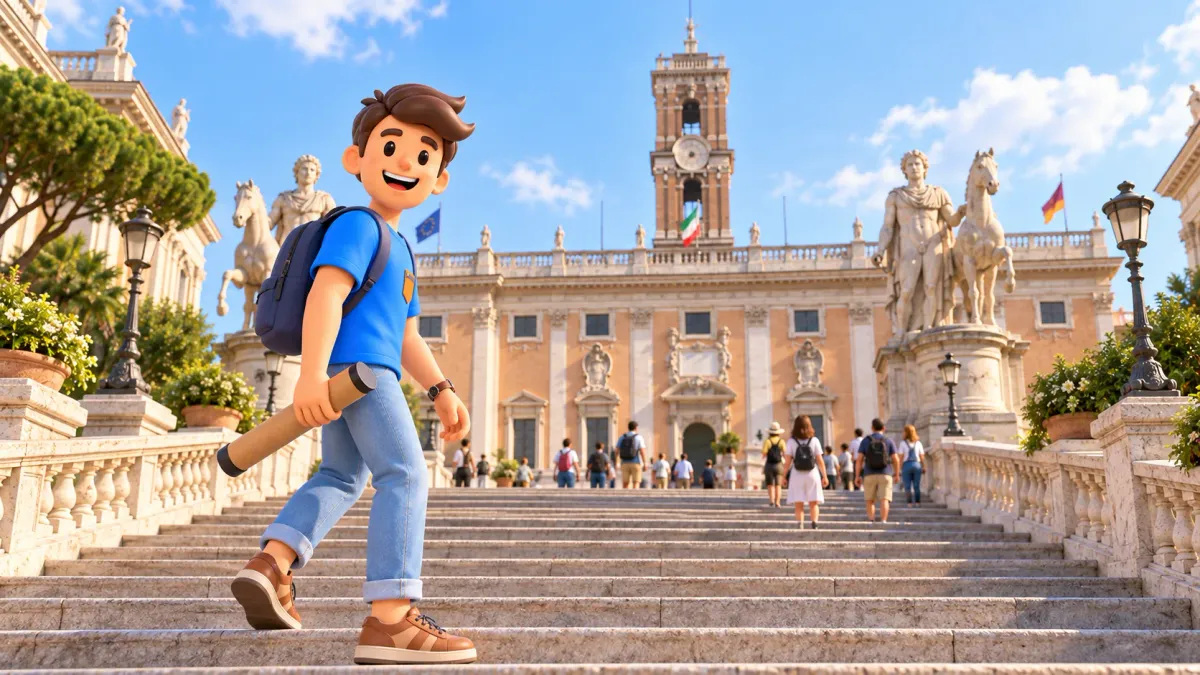
Michelangelo’s Rome can be approached at very different scales. First come the turned head, tense arm and marble drapery of Moses. Then comes the ascent of the Cordonata into a square where movement, façades and paving combine to form an entire urban scene.
This walk connects San Pietro in Vincoli with the Capitoline in about two and a half hours. It includes one church interior and one outdoor architectural ensemble, with a walking connection and a break. Rather than explain every work by the artist, compare how a human figure and the space around people direct your attention.
Begin with sculpture and finish with space
Choose this route for a morning with a clear artistic theme, without committing to a full museum day. The church comes first because sightseeing depends on visiting hours and worship. The Capitoline portion stays outside, allowing a finish that does not depend on entry to palace rooms or museum galleries.
To combine an interest in art comfortably with the rest of your trip, try RoadMe: the app creates a personal plan around your dates, interests, pace and budget. It makes distributing themed walks, museums and rest across different days much more convenient, with a considered programme to use while travelling.
For the example, choose an ordinary weekday morning after checking the basilica’s calendar. Starting at 9:30 aims for a finish on the Capitoline around noon. This is a walking plan rather than a promise of unrestricted viewing every day. When access changes, the programme changes too.
Moses stands inside San Pietro in Vincoli, so statue and basilica are one visit. The Cordonata leads directly into Piazza del Campidoglio, making those connected parts of one ensemble. Four names therefore do not mean four independent sightseeing visits, each requiring another journey or admission process.
A two-and-a-half-hour outline
| Minutes from the start | Included programme |
|---|---|
| 0–45 | San Pietro in Vincoli: entry, Moses and an overview of Julius II’s monument |
| 45–65 | Twenty minutes of rest outside |
| 65–105 | Public-street connection to the bottom of the Cordonata |
| 105–120 | Cordonata ascent and the approaching architectural ensemble |
| 120–150 | Piazza del Campidoglio: façades, paving pattern and equestrian statue |
That totals one hundred and fifty minutes. A 9:30 start allows the church until roughly 10:15, rest until 10:35 and the connection until 11:15. Arriving above around 11:30 leaves thirty minutes for the square. Times are estimates; a slower pace or entrance delay lengthens the outing.
Begin at Piazza di San Pietro in Vincoli, 4, and finish at Piazza del Campidoglio. Reaching the start, returning afterwards, lunch and the Capitoline Museums are additional. Ordinary basilica admission is free. The selected Capitoline programme concerns the exterior, without a museum ticket or access to administrative interiors.
San Pietro in Vincoli: find the monument, then the figure
Inside, follow available circulation towards Julius II’s monument in the right transept. Moses occupies its lower level. Begin with the ensemble so the sculpture does not appear to be a standalone statue placed accidentally against a wall. Its architectural setting contributes to how the figure is perceived.
The commission began in 1505, when the pope asked Michelangelo to create his funerary monument. The proposal changed repeatedly. The final complex appeared here in 1545, considerably reduced from the original ambition. Those forty years concern the history of the commission, not uninterrupted carving of a single statue.
Julius II himself is buried in Saint Peter’s Basilica in the Vatican. Do not describe the monument at San Pietro in Vincoli as the location of his body. That distinction is enough for this outing: a monument with a complicated design history, rather than a reason to seek the pope’s remains here.
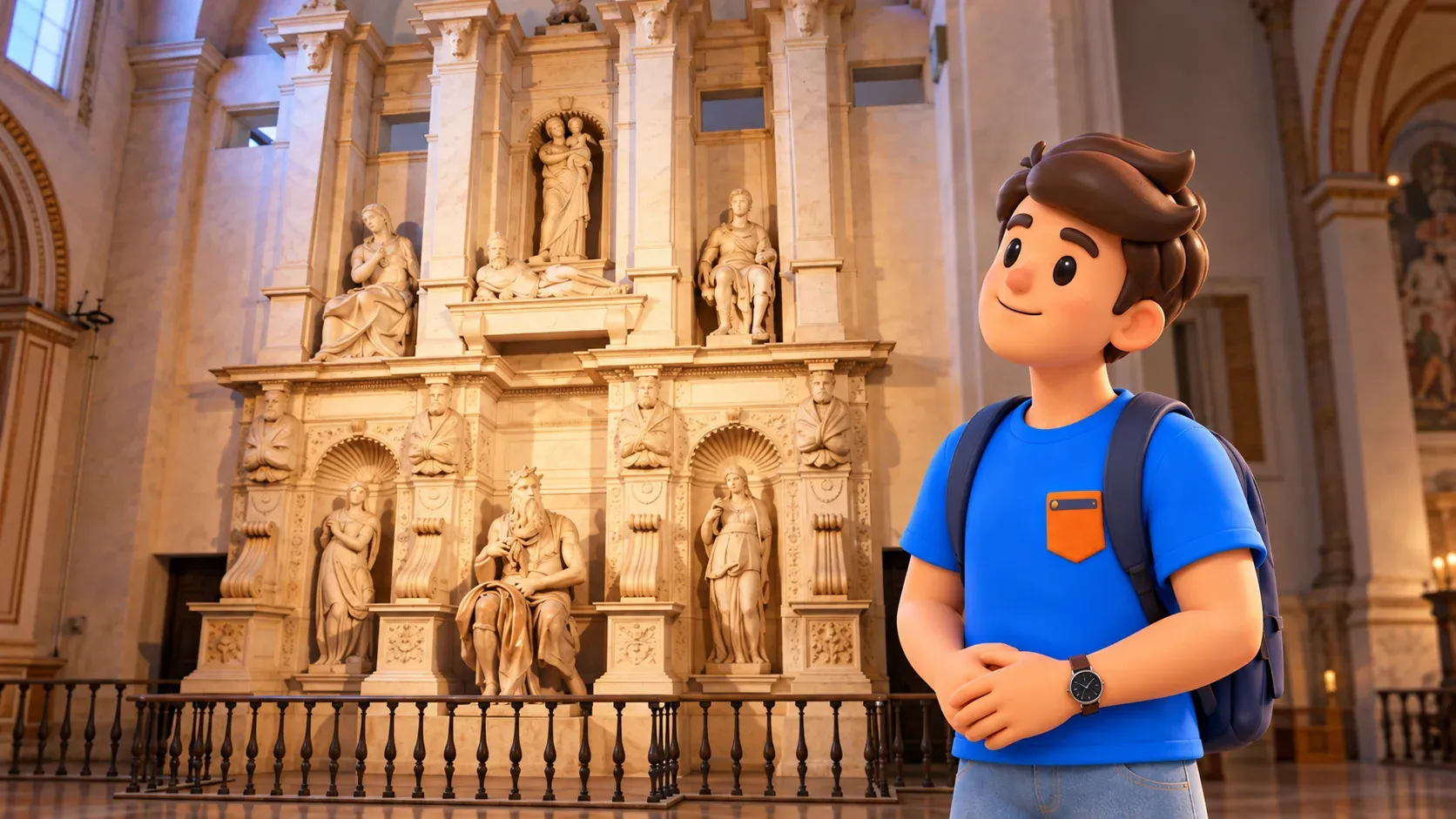
Now look at the seated figure. The head turns, arms and legs create different directions, and the long beard connects details. Tension becomes perceptible even in motionless marble. You do not need to decide immediately which exact second of the biblical narrative is represented. First experience the arrangement of forms.
Choose one detail—a hand, drapery or the position of a foot—then return your attention to the whole. Alternating between the two reveals how particulars sustain the overall pose. One carefully observed detail is more useful than trying to add every relic, tomb and chapel within the same forty-five minutes.
Observe from an allowed position behind the barrier, keeping circulation clear. Close access to the original is not necessary for a meaningful experience. When others are gathered nearby, look at the whole monument first and use an available viewpoint afterwards. Avoid promising companions a particular queue length or guaranteed close photograph.
Use the basilica’s current visiting information
Checked in October 2026, the community’s current page lists Monday–Saturday opening of 7:00–12:20 and 15:00–18:50, with the afternoon closing at 17:50 during standard time. On Sundays and holy days, morning opening is 9:00–12:00. This differs from familiar timetables still repeated in visitor directories.
Weekday Mass is listed at 7:25 and holy-day Mass at 11:00. Our ordinary weekday example places the visit after the morning service and before the break, but individual events still need checking. This remains a working church, and sightseeing follows the arrangements in operation on the day.
The programme needs no separate cloister, excavation or adjoining-room visit. Access to those spaces cannot be inferred from the basilica’s open door. Likewise, there is no need to add a paid guided service merely to enter when an ordinary independent visit is what you want.
If you have particular access or sensory requirements, discuss the relevant arrangements beforehand. A dedicated visual-and-tactile interpretation project exists for the monument, but that does not authorise touching the original Moses. Check its conditions separately rather than assuming every facility is available through an unplanned visit.
A break and a walk: descend before the next hill
Keep twenty minutes of rest outside after seeing the sculpture. Choose an available place or a simple café order; a particular table is not guaranteed. Food stays outside the church. If you prefer a substantial breakfast, extend the programme instead of rushing afterwards to catch up at the steps.
The general connection follows Via Eudossiana towards Via Cavour, descends to Largo Corrado Ricci and continues along Via dei Fori Imperiali towards Piazza Venezia. Head from there towards Via del Teatro di Marcello and the bottom of the Cordonata. Forty minutes allow for orientation and crossings along this public-street corridor.
Follow the public passages and signs currently in use, particularly around Piazza Venezia where circulation arrangements can change. A shortcut through the Forum’s archaeological area is not included. The Colosseum and imperial monuments may enter the city backdrop, but visiting them is not part of this programme.
Both principal places occupy raised ground. The connection includes a descent, followed by another ascent at the end. It is therefore not a level stroll between neighbouring doors. If your legs need more rest, allow it before climbing. The artistic theme loses nothing by taking longer.
The Cordonata: an approach becomes architecture
At the bottom, distinguish two neighbouring stairways. We want the broad Cordonata with low steps, leading to Piazza del Campidoglio. The steeper stairway to Santa Maria in Aracoeli is a different ascent. A roughly similar direction does not make the two interchangeable for this route.
The Cordonata belongs to Michelangelo’s conception of reorienting the ensemble towards the modern city. Ascend gently and look ahead a few times. Façade and upper statues change their relationships as you approach. You are no longer simply walking towards an artwork: arrival itself becomes part of the spatial experience.
Low steps remain steps. Do not describe the Cordonata as a step-free ramp or a universal wheelchair solution. Plan a different access in advance if necessary; museum access arrangements and our pedestrian approach may differ. The fifteen-minute allowance is not an instruction to climb at a fixed speed.
The Capitoline: find the centre and compare the edges
On the square, begin with the buildings’ arrangement. The ensemble has a slightly trapezoidal shape: the side palaces create related frames, while Palazzo Senatorio defines the opposite side. Unlike a single marble figure, this experience emerges through distances and directions between several architectural parts.
Michelangelo developed the conception for Paul III, but construction continued after his death under other architects. Not every visible detail should be credited to his own hand. The process helps explain the square as an evolving ensemble rather than a design completed instantaneously exactly as first imagined.
Look at the star pattern within the paving’s oval. It relates to the artist’s idea, but its present execution dates only to 1940, with changes from the original design. The pattern is therefore interesting as the continuation of a project over time, not wholly preserved sixteenth-century paving.
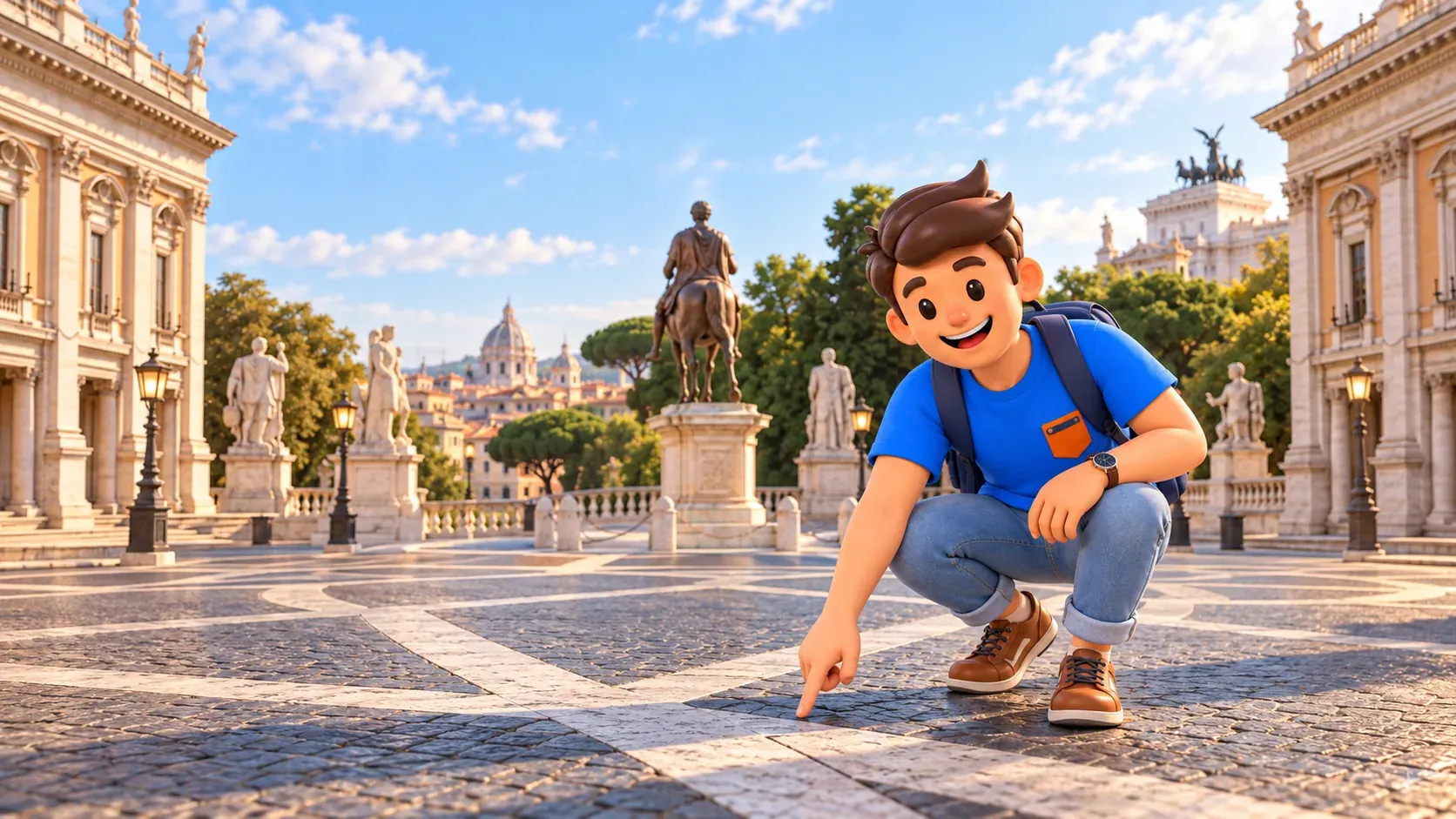
At the centre stands a copy of the ancient equestrian statue of Marcus Aurelius; the original is inside the Capitoline Museums. Michelangelo worked with its placement and pedestal, rather than carving or casting the Roman emperor himself. Distinguishing artwork, copy and architectural arrangement is particularly helpful here.
Move a few steps within the available square and compare the entrance view with a position to one side. Where does the statue become the main reference, and where does a façade’s rhythm dominate? No perfect geometrical point or restricted area is necessary. Thirty minutes offer a first encounter with this spatial language.
Finish without turning the square into a rushed museum visit
The Capitoline Museums deserve separate time. Their galleries, original Marcus Aurelius and connecting spaces do not fit automatically into our thirty-minute exterior block. If a museum visit is already planned for today, count it as a longer programme and check the ticket and entry arrangements separately.
If the basilica is inaccessible, ten minutes outside instead of forty-five inside reduce the outing to roughly one hour fifty-five. You will not see Moses; choose another time for the complete theme. Keeping the original duration should not require an imaginary view through a closed door.
Develop your personal trip more conveniently in RoadMe, distributing sculpture, architecture and other interests across suitable days. The app helps you use an overall plan while travelling; check the current opening notices and conditions before each chosen visit.
For comparison with another artist, save our Borromini architecture walk for another day. Today, remember the change between two scales: tension within an unmoving body, and the movement of people inside a carefully conceived city square.


