Marseille’s fish market and Capucins market: an easy morning walk

Choose a Monday-to-Saturday morning for a compact Marseille walk with two different markets. Begin at the fish stalls on Quai de la Fraternité, look up beneath the nearby Ombrière and continue towards Noailles for the Marché des Capucins. The first market keeps you close to the working harbour; the second brings you into the shopping rhythm of a neighbourhood.
Allow about two to two and a half hours with a proper coffee pause, more if you want to shop slowly or eat afterwards. These are editorial allowances, not a measured guided route. The walk links nearby places without completing a circuit of the port or climbing to Cours Julien. Actual market activity, weather and pedestrian access determine what is possible on your date.
Choose the morning that fits both markets
The fish market is normally listed every day from around 08:00 to 13:00, but its actual activity depends on the fishing, season and conditions. Capucins normally operates Monday to Saturday from 08:00 to 19:00 and is closed on Sunday; check public holidays and exceptional arrangements. The shared window is therefore an ordinary Monday-to-Saturday morning. An editorial start around 09:00 or 09:30 gives the fish market priority without making the morning feel like a timed race.
Do not leave the fish market until after a long lunch simply because Capucins stays open later. The two places have different rhythms, and the harbour market is the reason to begin early. Confirm actual operation before going if that experience is essential. If the stalls are absent or sparse, enjoy a short harbour look and decide whether to continue to the confirmed neighbourhood market rather than waiting for an imagined reopening.
Check the approach as well. At the dated review, RTM announces suspension across its Marseille network from 05:00 on 24 October 2026 to 05:00 on 25 October. Normal transport connections apply only when actually operating; confirm resumption rather than assuming a departure at the advertised end. This notice does not establish the markets’ own opening. Choose a genuinely feasible day and a suitable way back. If you already stay nearby, the compact walking combination can be useful, subject to actual conditions and local access.
Let RoadMe work out a complete personal Marseille itinerary around your interests, days and pace. The app makes it much more convenient and effective to fit a market morning alongside the visits, walks and rest you want across the whole trip.
At the fish market, look at the harbour at work
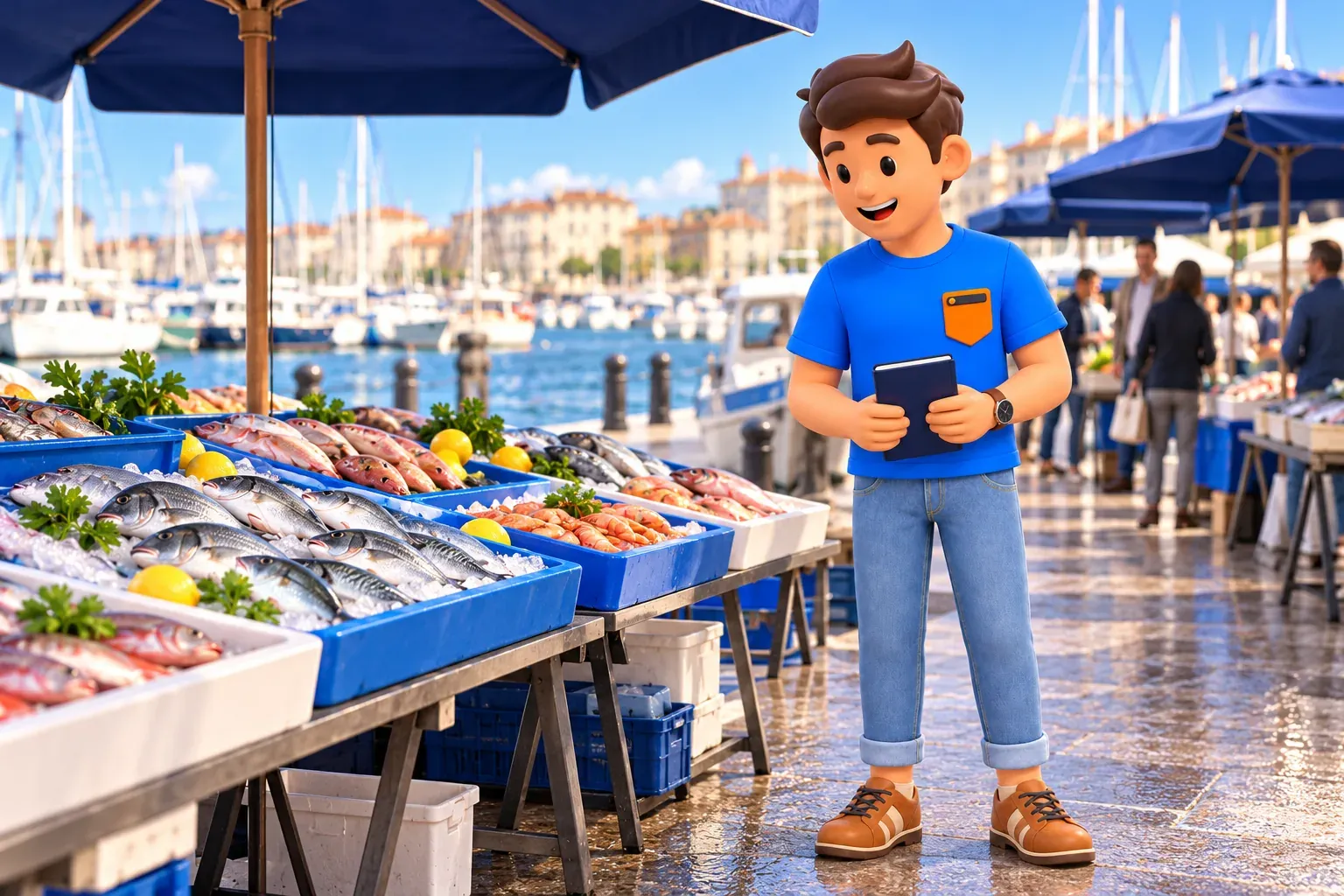
The fish market occupies Quai de la Fraternité at the inland end of the Old Port. It is a small working market, not a vast covered hall. The interest lies in the direct relationship between fishing, selling and the boats around the harbour. Watch from a position that leaves customers and sellers room, and spend time looking at differences in size, colour and arrangement rather than trying to identify every species.
An editorial twenty to thirty minutes can be enough for a short look, with longer needed if you are genuinely buying. Products vary; a list of fish associated with Marseille is not a guarantee of what will be offered that morning. You do not need to buy raw fish to make the visit worthwhile, especially when the rest of the day is sightseeing. If you do want to shop, think through what you can actually use after returning to accommodation.
Ask before making a close photograph of a person or their stall and keep the camera out of the transaction. Notice the water, boats and quay alongside the trade; they explain why the stop belongs here. When you have seen what interests you, move on. This morning works through contrast, so a modest fish-market visit can remain memorable without being stretched into an hour of repeated photographs or turned into an assumed seafood meal on the spot.
Pause beneath the Ombrière without extending the port loop
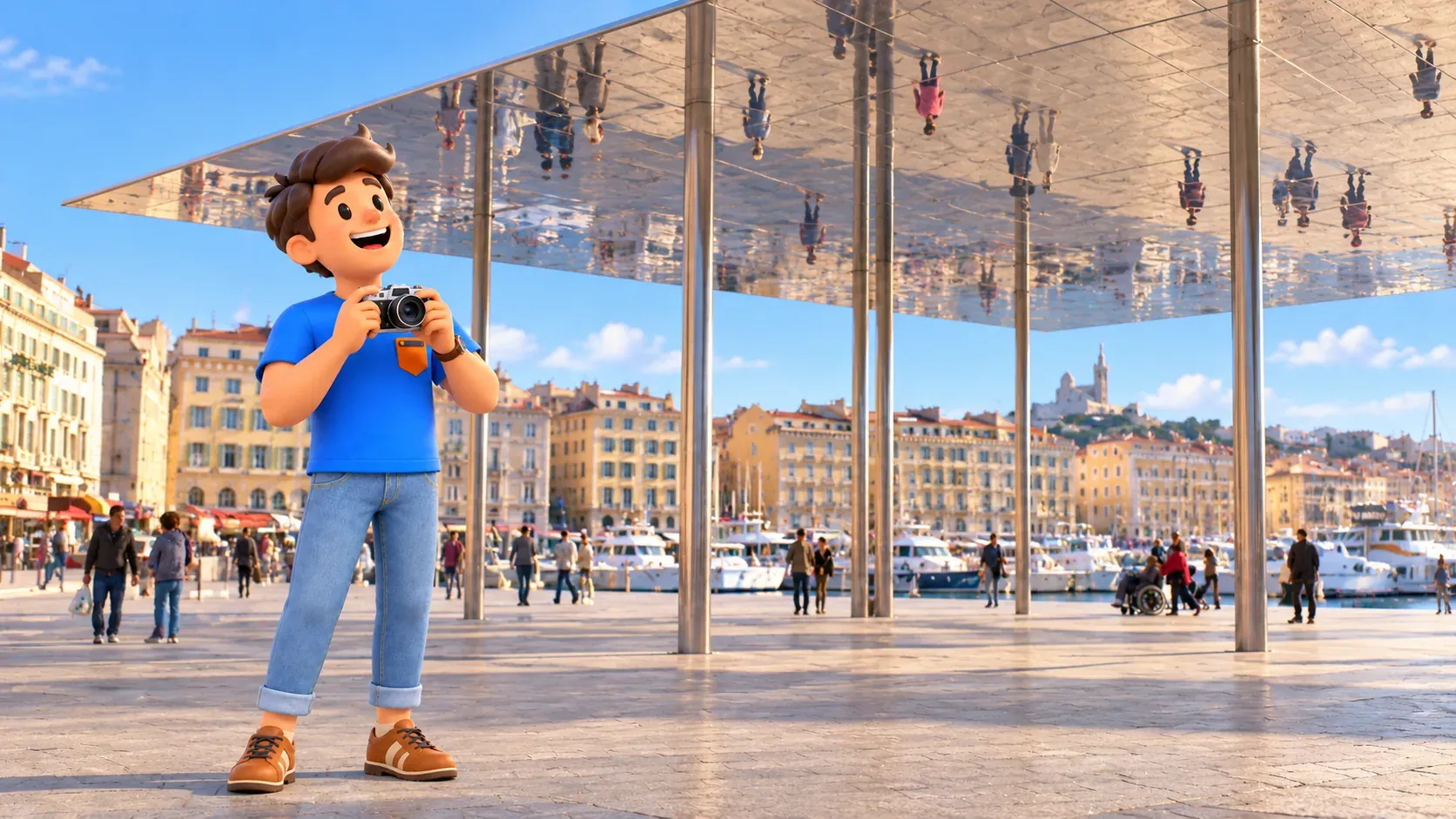
The Ombrière stands close to this part of the quay, so it makes a natural architectural pause rather than another journey. Its thin reflective canopy, carried on slender columns, changes how the public space appears. Look up to see ordinary movement and paving returned in the mirrored underside, then look back across the harbour. A familiar scene becomes briefly strange through a simple change of direction.
The canopy belongs to the Old Port regeneration completed in 2013 by Foster + Partners, with landscape work by Michel Desvigne. Keep the historical detail light and look at what the design does: a roof-like plane provides a meeting point while leaving the sides open. It is not an enclosed indoor attraction. Wind and rain still matter, and a reflective surface is not a promise of a protected route to Noailles. Ten to fifteen editorial minutes allow a look and a photograph if the space and conditions suit.
Our two-hour Old Port walk explores a broader quay loop if the waterfront itself is your main interest. For this market morning, keep the pause compact and continue towards the city. There is no need to walk along both sides of the harbour before changing districts. Before moving on, take a moment to orient yourself towards La Canebière and put the camera away if you need your attention for crossings and the next stretch of pavement.
Follow La Canebière towards the shopping streets of Noailles
Move inland from the head of the port along La Canebière towards Noailles, then make the short local approach to the Capucins market. The connection is part of the outing rather than a transport problem to solve between every stop. Allow an editorial fifteen to twenty minutes for the connecting walk, with more for crossings, browsing or your own pace. This is not a measured navigation time. Use the actual available pedestrian route and a suitable crossing; a compact central itinerary still includes ordinary city movement.
Notice how the scale changes. At the port, the eye moves across water and a broad public space. Around Noailles, the interest comes closer: shopfronts, produce, people making purchases and streets whose uses overlap. You do not need a catalogue of architectural names along the connection. Keep the route directed towards the market rather than turning every side street into an obligation.
If walking is demanding for someone in the group, check the exact approach, surfaces and space before committing. An outdoor market can be busy even when the overall route is short. Take a pause before entering the tighter shopping area if needed, and avoid arriving with more purchases than you want to carry. Our Marseille without a car guide explains how to keep nearby discoveries in one block. Here the benefit is simple: enjoy the centre at walking scale while giving a longer cross-city journey its own separate place in the trip.
At Capucins, join the rhythm of everyday shopping
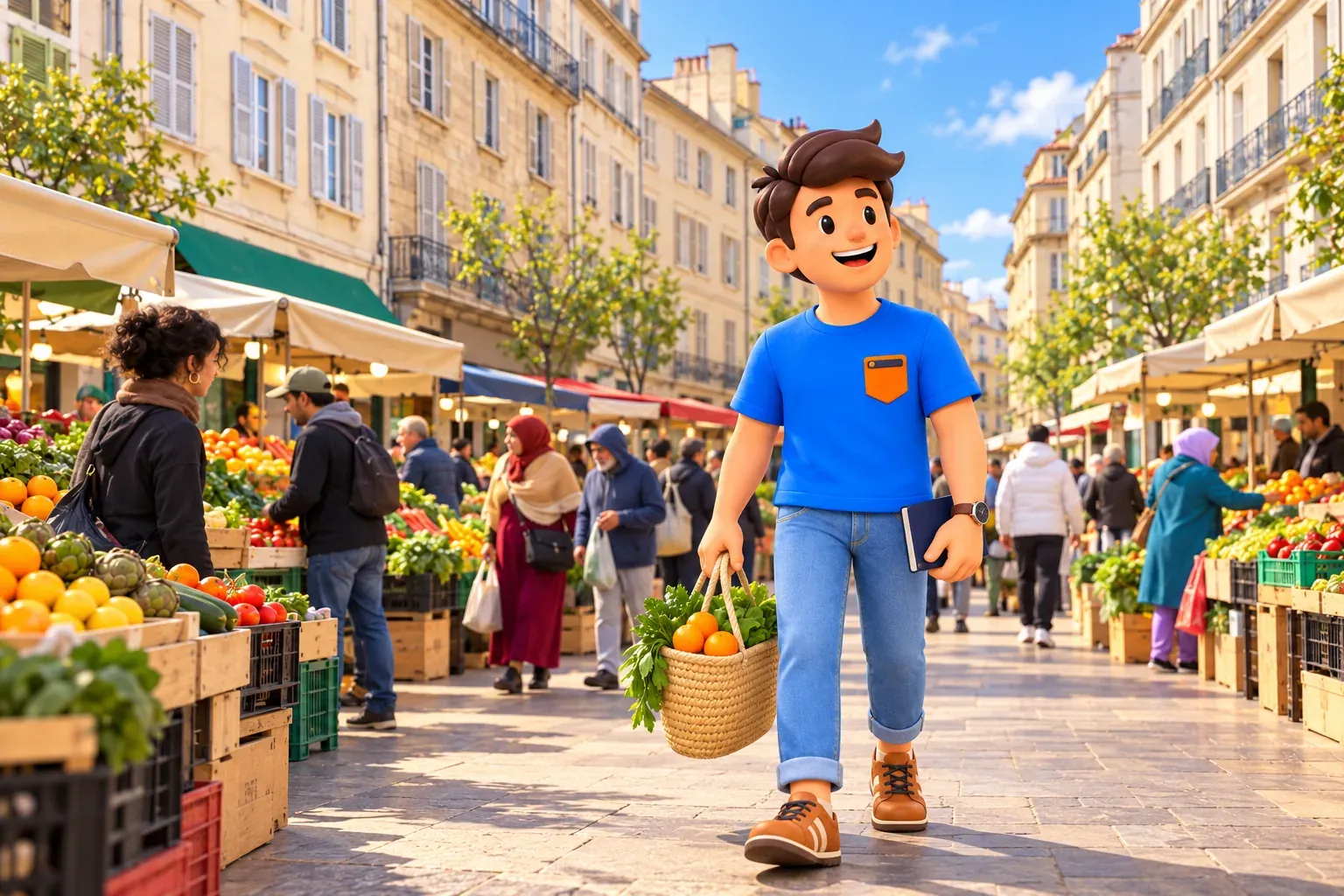
The Marché des Capucins is an outdoor food market in Noailles. Fruit, vegetables and herbs are part of its appeal, with other food businesses in the surrounding streets. The setting matters as much as an individual purchase: stalls sit within a lived-in neighbourhood rather than a purpose-built attraction isolated from the city. Look at what people are actually choosing and how shopping moves between market and street. Avoid treating the district as a show arranged for visitors. You are spending a little time in a place that serves an everyday purpose.
Allow about thirty to forty-five editorial minutes for selected browsing or small purchases. The stated market hours do not mean every stall and nearby shop keeps an identical schedule or stocks the same things. Choose what genuinely interests you instead of seeking a predetermined souvenir list. Prices, quantities and payment arrangements should be checked at the actual stall. A useful question is what you will enjoy using during the stay.
Keep the route inside Noailles small enough to finish comfortably. Our Noailles, Cours Julien and La Plaine half-day develops a longer neighbourhood outing with a different scope and an uphill section. It can be another choice, not an automatic extension after two markets. For this morning, the Capucins stop completes the contrast you came for: water and fishing first, then the close daily commerce of the streets.
Shop considerately and give food its own pause
Let the practical exchanges stay straightforward. Say hello, ask the price and unit if they are unclear, and check how to pay before choosing more than you need. A displayed amount may refer to weight or a particular quantity; do not compare unlike portions as though they were the same purchase. Ask before handling goods or making a close photograph. Keep bags and the group out of the flow of shoppers. A market is easier to enjoy when your visit fits the work taking place, rather than interrupting it for every picture.
Treat Capucins as a place for shopping, not as a covered food hall with assumed tasting rounds. Plan coffee or a meal at a venue that actually serves customers, with its own opening and seating conditions. Do not build the route around eating or sampling at the market stalls. This makes the pause more comfortable and gives the walk a clear rhythm: observe, browse, then sit somewhere suitable. Choose the meal according to appetite and time, rather than promising a particular dish merely because fish appeared in the first part of the morning.
Looking costs no admission, but food, purchases and transport still belong in the day’s budget. Keep those choices proportionate to the trip instead of turning the market walk into a search for a universal cheapest address. An unhurried drink can be enough if lunch is planned elsewhere. With companions, agree whether you are browsing or shopping before entering the busiest part. That small decision makes it easier to stop together, spend the amount you intended and leave without one person waiting indefinitely while another begins a much larger shopping expedition.
RoadMe creates a personal plan for the whole journey, bringing your preferred discoveries and comfortable pauses into suitable days. Use the app to organise the trip around what interests you, while checking current market and transport conditions separately.
Finish the morning with a clear next step
A simple version is fish market first, a short Ombrière pause, the walk towards Noailles, selected browsing at Capucins and a nearby coffee. Around two to two and a half hours is an editorial framework with ordinary pauses, not a fixed appointment or a guarantee that every element will take its maximum allowance. Add a longer meal or serious shopping separately. Starting around nine can leave the later part of the day open. It also lets the morning have a distinct identity rather than becoming an endless approach to the next attraction.
If one market is unavailable, decide whether the remaining one still matches your interest. On Sunday, do not promise the complete two-market route: Capucins has its normal closure. In poor weather, shorten exposed parts or choose another actually available outing. If the group is tired after Noailles, finish there and use a confirmed suitable return. You do not need a distant museum, an island departure or a hilltop viewpoint afterwards to validate the morning. Let later plans follow actual energy and conditions rather than the number of free hours on paper.