
Why Madrid’s squares feel different: Mayor, Sol and Oriente
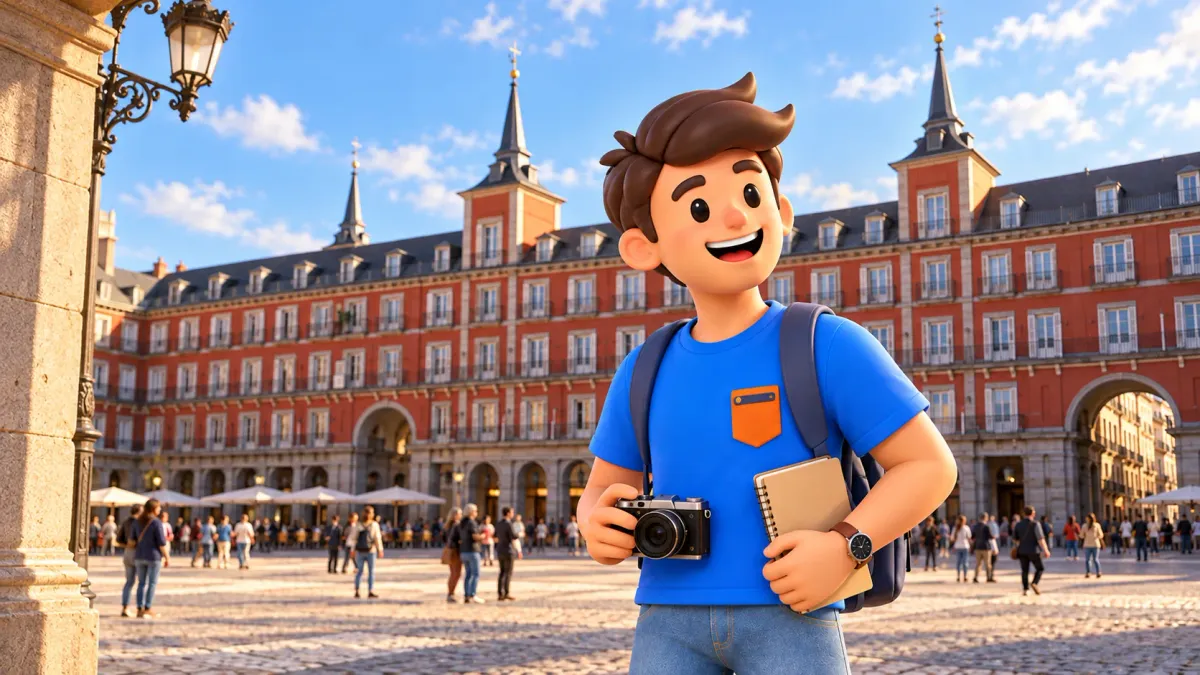
Plaza Mayor, Puerta del Sol and Plaza de Oriente feel different because they developed for different purposes and through different periods. Mayor resembles an outdoor civic room, Sol a junction of streets, and Oriente a formal garden composition between palace and theatre. You can recognise those differences on one connected walk: start at Sol, continue to Mayor and finish at Oriente. Allow around three and a half hours for observation, connections and a meal break. Look beyond individual monuments to the edges, directions and opportunities for stopping that shape each place.
Read the space without an architecture textbook
This outing works for a first introduction or a return to familiar places. Its subject is how squares work, rather than every attraction nearby. At each stop ask where the boundary lies, where the exits lead and what occupies the middle. Then watch how people use the space: crossing it, gathering before one façade or dispersing along garden paths. Those observations connect design with daily life. You do not need to recognise every style or measure the buildings. A clear comparison can begin with what your own movement reveals.
Building walks like this into a trip is more convenient in RoadMe, which develops a personal itinerary around your interests, dates, pace and budget. Try planning the whole journey there so that city discoveries, substantial visits and rest fit naturally across your days.
Begin when you are already at Puerta del Sol and finish around Oriente. Travel from accommodation and your onward journey are extra. The main version stays outdoors, without palace rooms or a theatre tour. Three and a half hours is an editorial estimate, not a timed field walk. Give major interiors their own allowance if you want them. Otherwise a relaxed comparison becomes a different day involving admissions and queues. The intention here is to understand three public spaces, leaving enough time to notice their character.
Sol: a square that continues into the city
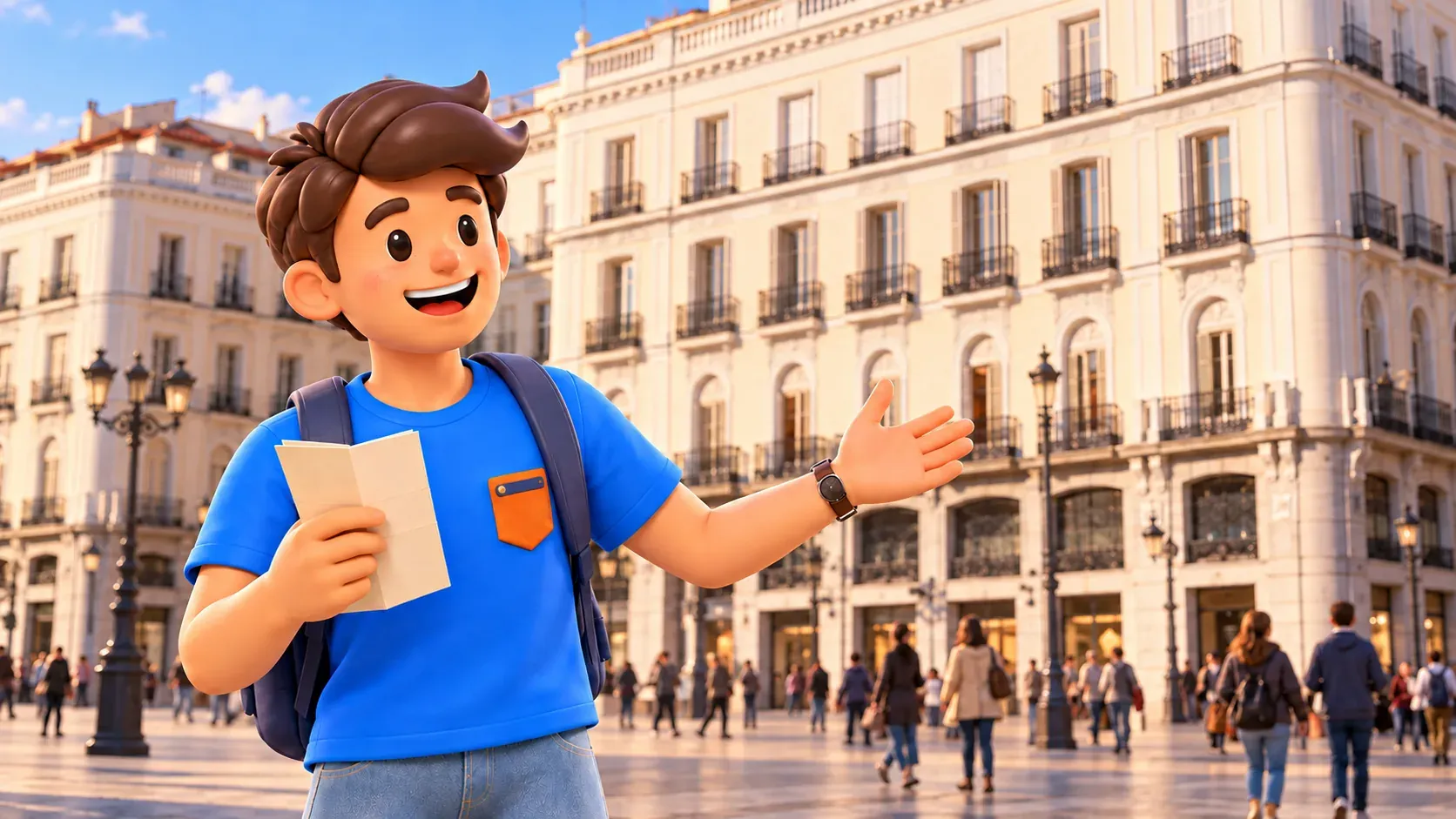
At Sol, first notice the streets leading away. Mayor, Arenal, Alcalá and other directions explain the feeling of somewhere people continually pass through. Even beside a monument, movement remains visible around you. The space developed where urban routes met. Its recognisable semicircular edge owes much to nineteenth-century rebuilding: a competition took place in 1857, with the project associated with Lucio del Valle, Juan Rivera and José Morer. The existing line of the post office was retained, while the opposite side was shaped into a more coordinated architectural frontage.
Sol is therefore not a perfectly symmetrical square constructed entirely at one moment. Compare the straighter frontage of the Real Casa de Correos with the curved line opposite. Between them lies a broad field for movement and meetings. Find an edge where you can stand comfortably and follow the different directions people take. The square extends streets rather than concentrating attention at a single point. Even the famous clock and Kilometre Zero belong within that network. Our separate walk through Sol’s symbols explores those objects; here the whole space is the subject.
Its pedestrian life has a recent history too. Sol became fully pedestrian in August 2020, followed by remodelling that changed paving and the position of elements. Older photographs with cars, previous fountains or a differently placed statue do not show today’s arrangement. Historic places continue changing. Pedestrian does not mean empty: crowds and events can affect where stopping is comfortable. If a central position is busy, move towards the edge. Understanding the outward routes does not require occupying a mathematically chosen centre or obstructing someone’s passage to get a particular photograph.
On the way to Mayor: notice the threshold
Follow Calle Mayor and turn into Calle de la Sal towards Plaza Mayor. Allow around fifteen minutes, including comfortable orientation. The interesting moment is the entrance itself: an ordinary street brings you into a space with suddenly clearer boundaries. Do not rush straight to the horseman. Pause somewhere unobstructive, look ahead, then turn your attention back towards the opening you used. At Sol, streets opened the square outwards; here the entrance feels more like a threshold. That change explains more than deciding which square is prettier or comparing only façade colours.
Mayor: market and public stage
Plaza Mayor developed from Plaza del Arrabal, associated with trade outside the medieval town. In 1617 Juan Gómez de Mora was commissioned to give the surrounding buildings a more uniform character. The broad rectangle, repeated windows and balconies create a coordinated setting. It served as a market and a place for public events. Balconies could become viewing positions, with the square below acting as a stage. Its historical ceremonies included both celebrations and darker episodes, so not every use should be imagined as cheerful entertainment. The spatial point is that many people could watch one shared field.
The enclosure visible today was not unchanged from the beginning. Fires repeatedly affected the square, especially the fire of 1790. Reconstruction following Juan de Villanueva’s design closed corners and gave street connections monumental arches. The rebuilding did not finish instantly in the year of the fire. The effect resembles a large room with openings: buildings make a continuous edge, while the surrounding city remains available through passages. Look along a façade, then through an arch. Repetition unites the setting; an exit restores awareness of the streets beyond its apparently complete architectural frame.
The arcades add a smaller scale. In the open centre you see the overall composition; beneath the arches you enter a closer space along the buildings. Those areas have different uses. A public passage and a café table do not offer identical conditions: using a business’s seating involves its service and a purchase. You need not eat here to appreciate the square. Walk an available route and notice changes in light and scale. Arcades provide a sheltered section in rain, but do not turn the entire subsequent walk into a covered route.
The central horseman is Philip III; later, at Oriente, you will meet Philip IV. Similar clothing and a horse do not make them the same story. Another useful detail is the painted Casa de la Panadería. Its present murals are by Carlos Franco, so they should not automatically be read as surviving seventeenth-century painting. A unified square need not give every detail the same date. You can appreciate the coherence while recognising layers of construction, repair and later decoration. The familiar image is an accumulation of decisions rather than one original drawing preserved without alteration.
Towards Oriente: from enclosure to perspective
Leave through Ciudad Rodrigo to Mayor, continue west, then turn north along Bailén towards Oriente. Allow twenty-five minutes for this connection. It does not require the steps at Arco de Cuchilleros, whose dramatic descent leads in a different direction. Use normal pavements and permitted crossings; pedestrian squares do not make every neighbouring street vehicle-free. Approaching the royal quarter changes the scale gradually. Instead of a close, continuous wall of façades, longer views, separate large buildings and garden areas become prominent. Read those spaces as part of the composition, not simply gaps between attractions.
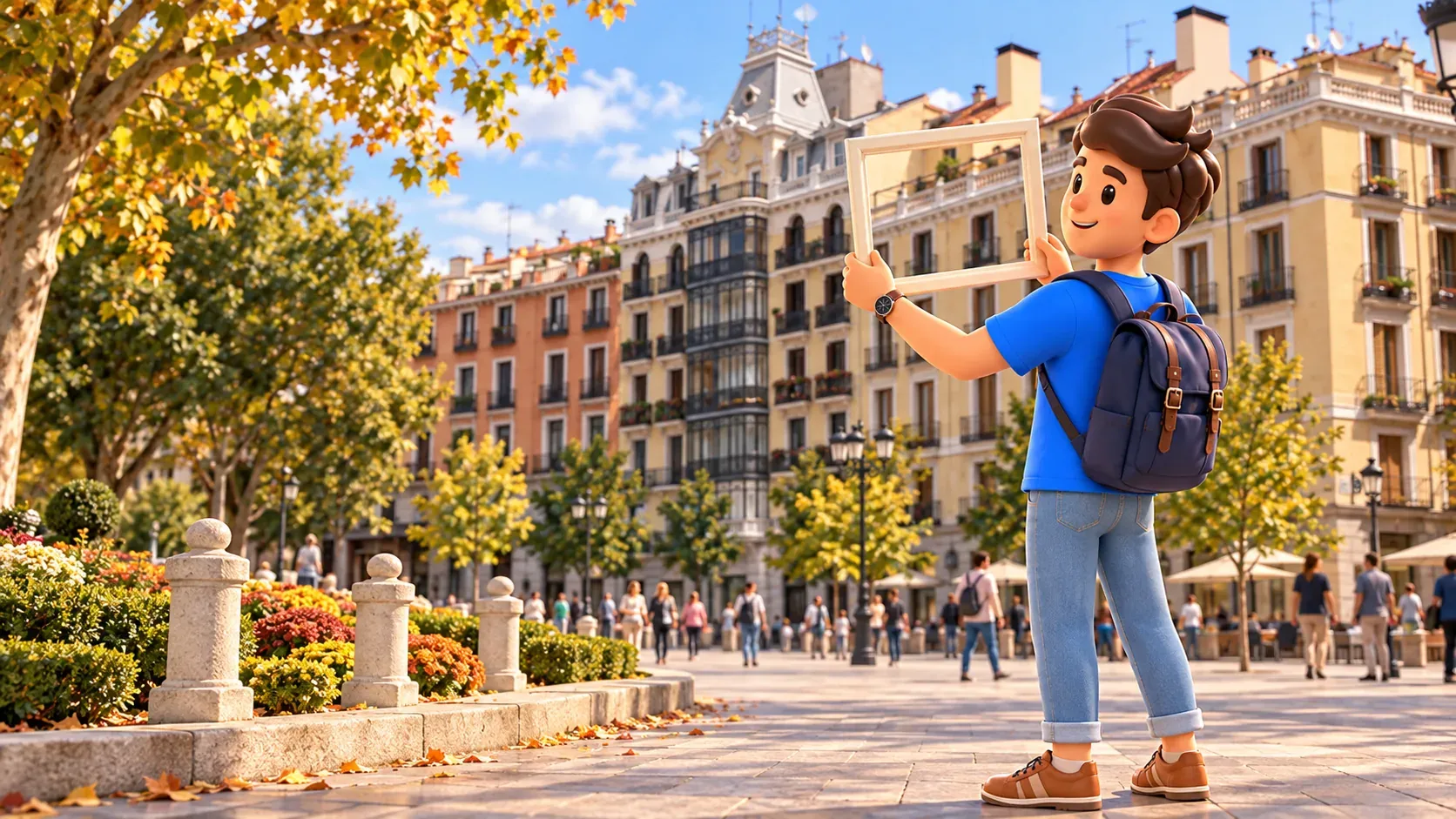
Plaza de Oriente lies east of the Royal Palace, although this is the western side of the historic centre. That distinction helps explain the name. Palace and Teatro Real define opposite sides of an ensemble connected by garden forms. The central parterre differs from the flanking Lepanto and Cabo Noval gardens. You need not inspect every corner. Choose a permitted path, recognise the direction between the main buildings, then look across it. Geometric planting gives a sense of order, while trees change how open individual views feel as you move.
Oriente: a formal garden that kept changing
A key design for the square belongs to Narciso Pascual y Colomer in 1844. That does not date all the present garden details. The municipal history separately identifies the parterre arrangement of 1941 and subsequent remodelling. This is another place shaped through successive decisions. Older pictures can differ without making today’s visit less meaningful. Its history includes both a major design and later adjustments to urban life. Try identifying which elements direct your gaze and which offer the possibility of staying for a while beside a monumental architectural setting.
Philip IV’s equestrian statue, cast by Pietro Tacca in 1640, is older than the nineteenth-century square design. Sculpture and surroundings therefore have different chronologies. The horse raises its front legs; its stability involves the tail as well as the rear legs. You need not turn the stop into an engineering lesson. Comparing it with the horseman at Mayor already shows different roles for royal imagery: one stands within an enclosed civic room, the other centres a garden perspective. Position and surrounding lines alter the way a familiar type of monument is perceived.
Explore an available section of paths and compare the two principal directions, towards palace and theatre. One offers a long ceremonial façade, the other a different architectural scale and ending. The garden is doing more than filling empty ground between them. It creates intervals and helps buildings be seen at a distance. Stay on paths rather than using planted beds as photographic platforms. Do not promise yourself complete quiet or an empty bench: this remains a popular city location. A comfortable pause depends on choosing an available spot rather than insisting on one previously imagined view.
Three and a half hours with a proper break
The example begins around 10am at Sol and ends near Oriente around 1:30pm. Connections have their own blocks; journeys before and after the walk are extra. Outdoor viewing of the three squares is free, while food and purchases remain expenses. Neither palace admission nor a theatre visit is included. Weather, temporary barriers or events may make a shorter version preferable. You do not need an ideal photograph at every stop. Comparing form and movement remains possible during ordinary city life, even when a completely clear panorama is unavailable.
- 30 minutes: Sol, its curved edge and streets leading away.
- 15 minutes: Mayor and Calle de la Sal to the entrance.
- 40 minutes: Plaza Mayor, its boundaries, arcades and selected details.
- 25 minutes: Ciudad Rodrigo, Mayor and Bailén to Oriente.
- 45 minutes: garden paths, statue and views towards palace and theatre.
- 40 minutes: lunch or a substantial break nearby.
- 15 minutes: reserve and an unhurried finish.
For an easier way to connect walks with the rest of your days, try personal trip planning in RoadMe. The app builds your journey around your interests and pace, helping architecture, museums and rest fit together without an overloaded itinerary.
For another day focused on the royal surroundings, use our walk through squares and gardens around the Royal Palace, with its separate timing framework. This outing leaves a different lesson: Sol sends your gaze along streets, Mayor holds it within a common edge, and Oriente creates perspective between buildings. Three neighbouring places tell different stories through their space.


