
From industry to art: Madrid’s reused industrial buildings
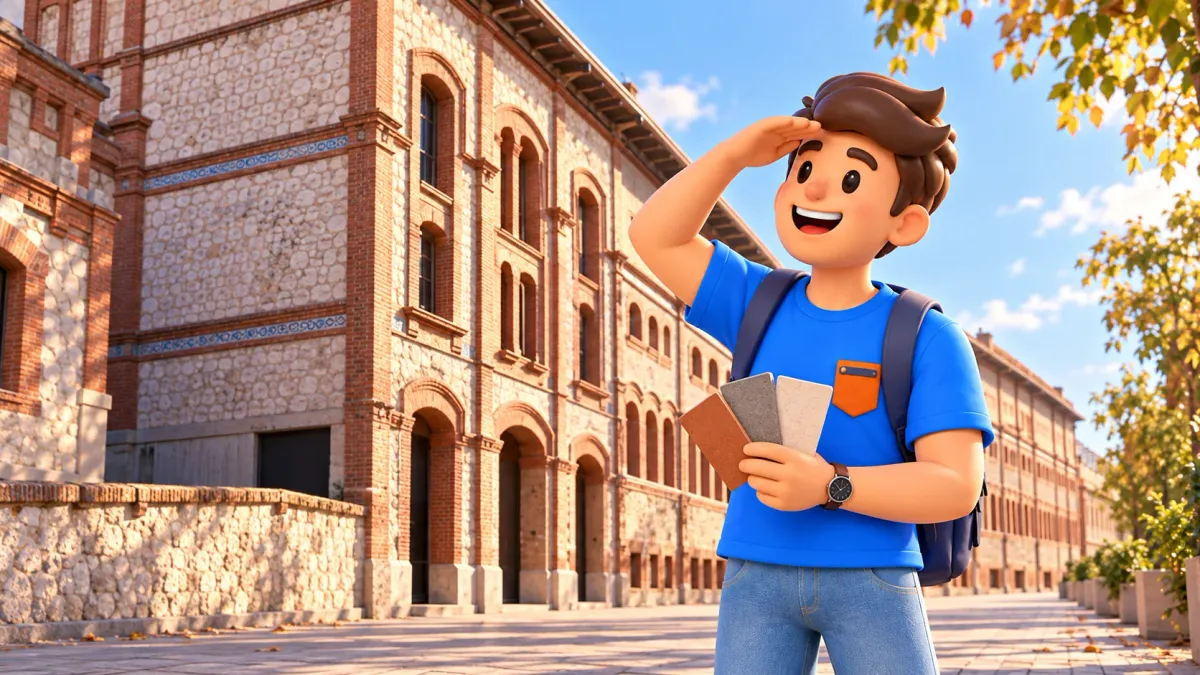
Madrid has a cultural landscape beyond its grand museums: a former power station becomes an exhibition centre, while municipal slaughterhouse pavilions become places for art, cinema and creative work. Explore two approaches to that transformation on one connected outing. Start outside CaixaForum on Paseo del Prado, walk through Delicias to Matadero and choose one exhibition there. Allow around four and a half hours for architecture, the connection and a meal break. The daytime version works on Friday, Saturday or Sunday. Its subject is not simply a new use, but the traces of earlier work that remain visible.
Reading a building with two lives
Three questions make industrial heritage approachable. What did the place originally produce or provide? Which part of its fabric survives? What new activity is possible now? You do not need architectural vocabulary to make those observations. They distinguish a change of sign from a substantial transformation. At CaixaForum, look at the relationship between building, ground and street. At Matadero, notice how a group of production pavilions becomes a cultural setting. A substantial urban connection separates them, so this is a walk with a clear theme rather than a promise to cover every Madrid arts centre.
Turning an interest in architecture into a personal trip is much more convenient in RoadMe, which develops an itinerary around your interests, dates, pace and budget. Try planning the whole journey there so unusual spaces, museums, walking and proper rest fit naturally across your days.
Begin when you are already outside CaixaForum; travel from accommodation and the journey after Matadero are extra. CaixaForum’s indoor exhibitions are not included. That leaves time for its architecture, the walk south and one substantial interior visit rather than two admissions in succession. All timings are editorial estimates, not a measured field walk. If a long connection does not suit you, choose one centre for a separate day. Replacing the walk with transport changes the calculation and needs a check for your date, rather than being treated as an automatic shortcut.
Much of the outing is outdoors. The sheltered space beneath CaixaForum does not protect the subsequent route from rain or heat. With reduced mobility, check the chosen exhibition’s access and assess the street distance beforehand. A shared cultural identity does not guarantee identical conditions in every pavilion. Keeping the number of stops small gives you time to observe; it does not remove the physical effort of walking between them.
CaixaForum: a power station changes the street
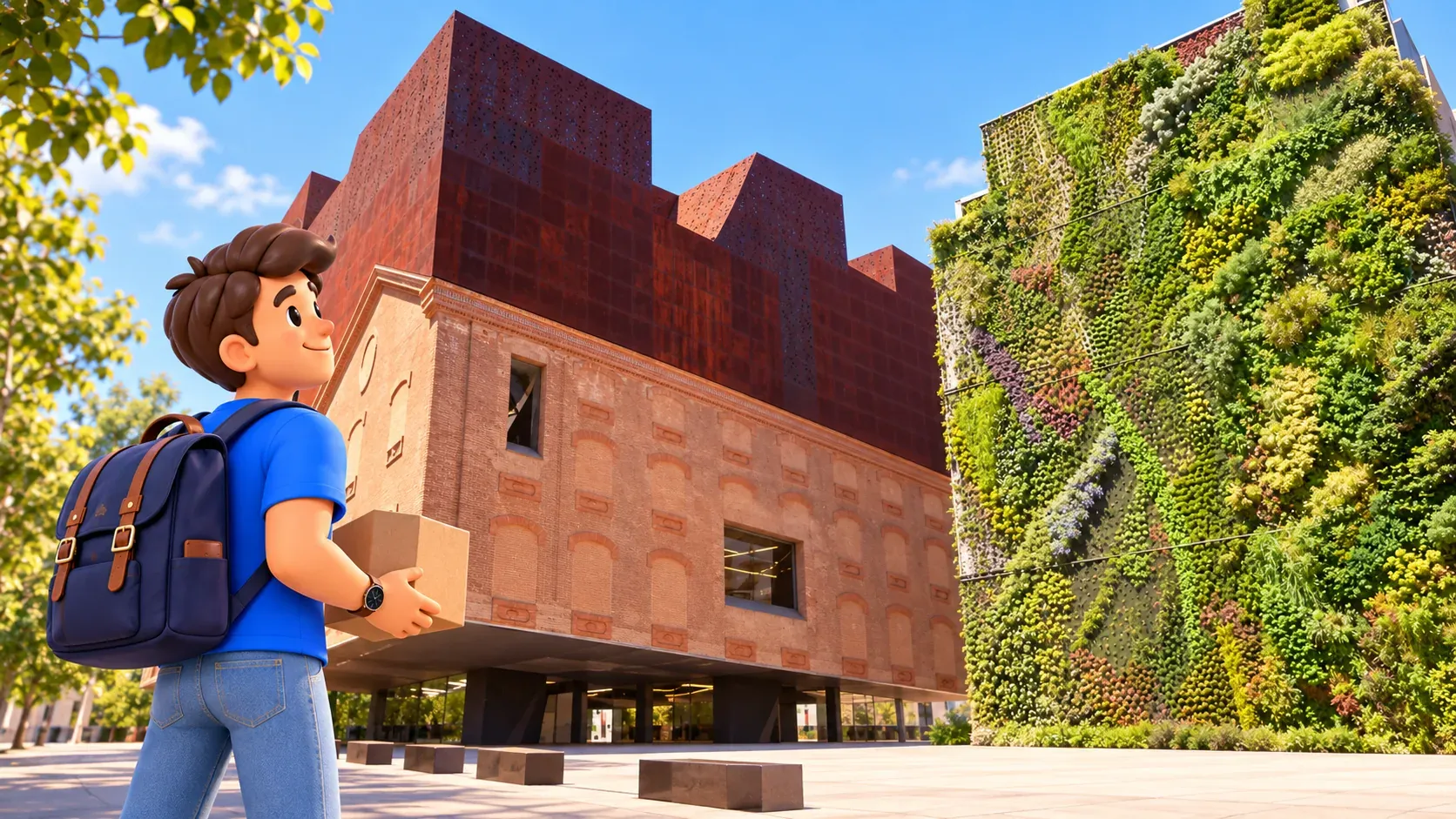
CaixaForum occupies the site of the former Mediodía power station, an industrial building from the early twentieth century. The cultural centre opened in 2008 following transformation by Herzog & de Meuron. A retained brick shell does not mean that an intact generating plant with its working machinery survives inside. The architects substantially changed the structure, incorporating the historic walls into a new composition. Read the façade through that meeting of old material and new volume. It is a contemporary architectural response drawing on industrial memory, rather than simply art displayed within an untouched factory room.
Look towards the lower edge of the brick body. Removing the former base made the building appear lifted, opening a sheltered space beneath it. This changes both the impression of weight and the relationship with nearby streets. A seemingly closed volume now offers an approach and meeting place. Compare the heavy wall with the open gap below. You need not reconstruct the structural engineering to appreciate the contrast. Notice how the design invites people closer and changes the boundary between a building and the public space surrounding it.
The metal upper section introduces another layer and alters the silhouette. Not every part belongs to the same industrial period. The vertical garden associated with Patrick Blanc occupies an adjoining wall; it is not a green roof on the former station. Compare brick, metal and planting. Their juxtaposition shows that conservation can involve an unmistakably contemporary contrast. The pleasant outdoor setting does not make indoor exhibitions automatically free or turn every level into a freely accessible viewpoint. Our main stop stays outside, looking at the building and its relationship with the street.
Through Delicias: leaving the formal boulevard
From CaixaForum, join Paseo del Prado southwards towards Plaza del Emperador Carlos V, then continue along Paseo de las Delicias towards Legazpi. Allow around forty-five minutes, with an additional margin in the overall schedule. This is ordinary urban walking with junctions, not a continuous park path. Use pavements and permitted crossings. Notice the change of scale: a cultural landmark beside the celebrated museum boulevard gives way to more everyday streets. Matadero then appears as part of a working city’s history, rather than an isolated attraction unrelated to the neighbourhood around it.
Do not add a station visit, the Railway Museum or another exhibition centre within this connection. Each requires its own access time. Our separate Atocha to Delicias walk develops the railway theme. Here the purpose is linking two different industrial settings. Pausing at a crossing or checking the direction is perfectly reasonable: the margin exists for real movement, not another compulsory attraction. If your pace is slower, reduce Matadero’s outdoor circuit beforehand while preserving the meal and chosen exhibition. A useful plan should accommodate attention and comfort rather than turn the connection into a race.
Matadero: culture within a pavilion system
Construction of the municipal slaughterhouse and livestock market began in 1911 under architect Luis Bellido; it opened in 1924. Production required separate spaces and circulation between them. Read Matadero as an ensemble of pavilions, rather than one enormous exhibition hall. Today the links between buildings support movement between different cultural activities. Compare the principle with CaixaForum: one transformed volume makes a strong statement there, while a sequence of buildings and spaces matters here. Industrial memory survives in the organisation of the whole, as well as in the colour and texture of the walls.
Approaching from Legazpi, use the entrance at Plaza de Legazpi, 8. Explore available sections of the internal streets and square, observing repeated openings, brick surrounds and stone surfaces. You do not need to enter every door. Some rooms serve work, rehearsals or programme preparation rather than permanent public display. The buildings do not form a single museum with one universal ticket. For a first visit, understand how common spaces connect separate functions, then choose one available exhibition that actually suits your interests and the calendar. The surroundings offer a useful introduction before any indoor activity.
The transformation developed gradually. Slaughterhouse operations ended in 1996, and the first spaces of the new Matadero opened in 2007. Conservation here involves new activity as well as architecture. An empty restored shell differs from somewhere work is made, shown and discussed. Remember that when a square between buildings seems quiet: an open space does not establish that the whole complex has no programme. Some activity happens indoors to specific hours, while other cultural work concerns connections between institutions and participants. You are seeing a changing setting rather than a permanently fixed exhibition of former industrial life.

One exhibition in conversation with its room
For autumn 2026, a relevant example is Carlos Aires’s Bailad, bailad, malditos in Nave 0, scheduled from 11 September 2026 to 24 January 2027. Its starting point is the former cold-storage room and traces of a past fire. Props, screens and sound become part of an installation in which the room affects the experience. This is not a dance lesson or a promise of uncomplicated entertainment: tension and unease are part of the subject. If darkness and a strong soundscape do not appeal, select another available exhibition or keep your visit outdoors.
Inside, distinguish two layers: what belongs to the building and what the artist has introduced for this work. Structural props in an installation do not mean visitors have been admitted into an uncontrolled dangerous ruin. Follow the intended circulation and staff instructions. A less formal atmosphere than a traditional museum does not make the elements touchable. The hour in our plan is an allowance for admission and the selected show, not an official duration for the artwork. You may finish earlier and take a quiet outdoor pause; there is no obligation to remain merely to fulfil a timetable.
This exhibition has free admission until capacity is reached. It opens Tuesday to Thursday 5–9pm, and Friday, Saturday, Sunday and public holidays noon–9pm; Monday is closed. That is why the daytime outline uses Friday, Saturday or Sunday. Matadero’s general outdoor opening of 9am–10pm does not apply to every exhibition room. Cinema, performance, immersive projects and special events may have their own tickets. Check the specific programme before travelling, particularly once the exhibition season changes. Treat the named show as a dated example, not a permanent collection guaranteed on every future visit.
Four and a half hours without collecting pavilions
The example starts outside CaixaForum around 11:15am and finishes near Matadero around 3:45pm. You reach Nave 0 after its daytime opening on the chosen days. It does not include a paid CaixaForum exhibition, performance or immersive session. Food and transport remain expenses; free outdoor viewing does not make the entire trip cost nothing. Choose a nearby meal according to actual availability rather than expecting one particular table. If the selected room is temporarily closed, extend the outdoor section or finish earlier instead of automatically replacing it with an unplanned paid attraction.
- 30 minutes: CaixaForum outside, the brick shell, space below and adjoining vertical garden.
- 45 minutes: the connection through Atocha and along Paseo de las Delicias towards Legazpi.
- 45 minutes: Matadero’s available outdoor spaces and pavilion architecture.
- 60 minutes: admission and one selected free exhibition.
- 45 minutes: a meal or substantial rest nearby.
- 30 minutes: a margin for crossings, waiting and a gentler pace.
- 15 minutes: leaving and finishing near Legazpi.
Personal planning in RoadMe makes it more convenient and efficient to connect this outing with the rest of your stay. The app builds the journey around your interests and pace, giving art, city architecture and rest a sensible place across the days.

Why old lists of cultural centres need checking
Not every historic arts venue was a factory. A palace, barracks, bank and power station have different histories even if all now host exhibitions. Nor is every familiar reuse project currently open. Serrería Belga, the former timber-industry space on Alameda, is closed for adaptation to house the future Pérez Simón collection. Tabacalera is undergoing rehabilitation. An announced centre or active artistic programme is not proof that visitors can freely enter its building today. These places matter to the subject, but neither is an indoor stop on the proposed outing.
For a separate day by the water, use our Madrid Río walk with its own timing. For now, keep the main observation: cultural reuse can treat an old building in different ways. A shell can join a thoroughly new volume, while elsewhere the arrangement of several pavilions remains important. Finish by naming one visible trace of the previous function and one new activity at each place. That offers a clear personal result without turning a walk into an architecture examination or an endless directory of institutions.


