
Juliet’s balcony: how a literary story acquired an address in Verona
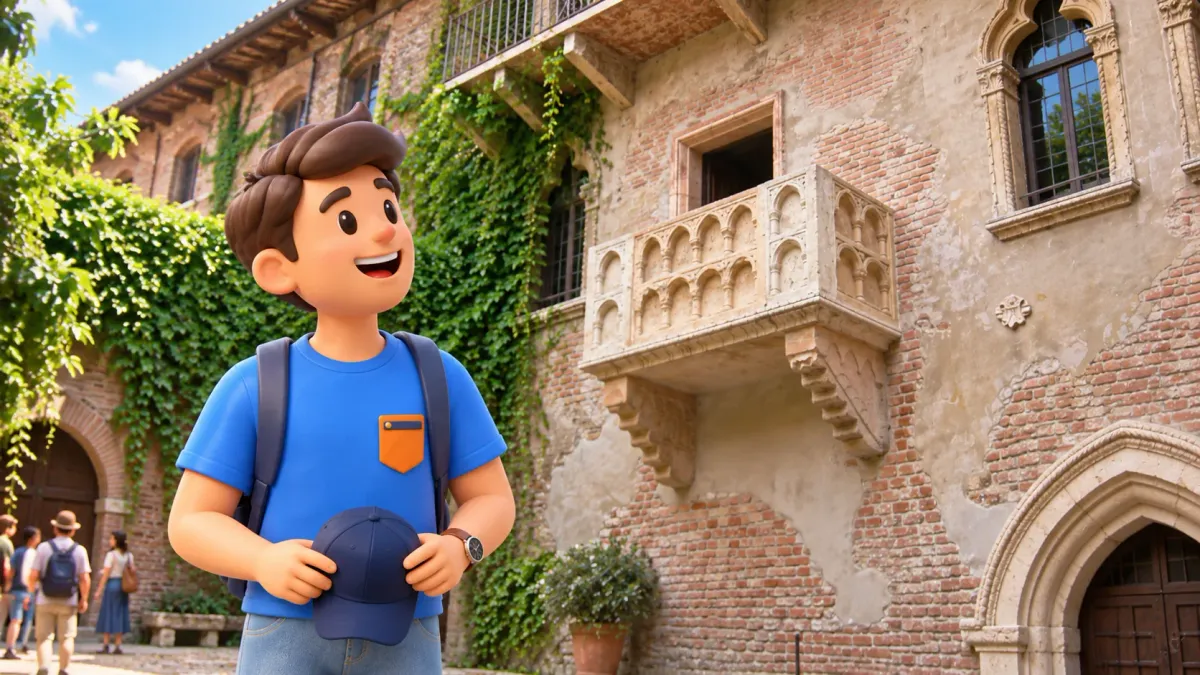
You may recognise Juliet’s balcony before arriving in Verona. A small stone projection, a brick wall and an upward glance already summon a scene from Romeo and Juliet. Yet that recognition has a history of its own. The building is old, its literary association developed later, and the famous balcony appeared during a twentieth-century transformation.
Knowing this before your visit makes a difference. You need not choose between accepting every legend literally and feeling disappointed by a later addition. There is another interesting story here: how readers, travellers and museum decisions helped a fictional narrative acquire a place in a real city. That story deserves some of your attention.
What to expect from Juliet’s House
If you hope to see the documented residence of the heroine, adjust that expectation beforehand. The house’s connection to Juliet is literary. This is a real city building associated with an invented character, rather than an address that archives have established for a person from Shakespeare’s tragedy.
RoadMe makes it much easier to create a personal whole-trip plan around your interests, whether literature, architecture, art or unhurried walks. Try the app to give famous places suitable time while connecting them with the Verona that interests you.
Enjoying the visit does not require pretending you have found the proven location of a lovers’ meeting. You can come for a recognisable image, the history of urban imagination or an architectural detail. Any of those interests is enough. What helps is understanding the question you want this stop to answer.
This also makes the choice easier with companions. One person wants a photograph, another a few minutes with the stonework, another a connection to the story. Those wishes need not turn into an argument about whether the place is real. Agree instead on how much time you want to give it and what comes afterwards.
The story came before the visitor address
The lovers’ narrative existed in Italian literature before Shakespeare. An important name in its Veronese development is Luigi da Porto, a sixteenth-century author. Other retellings followed, while Shakespeare’s play gave the story worldwide fame. This was a narrative changing as it passed between writers, languages and performances.
For a city visit, that matters more than memorising the entire literary family tree. A work of fiction can give a city a powerful identity without functioning as a property record. Readers encounter Verona through love, family conflict and the space separating the characters. That does not identify a particular modern street door or balcony.
You can see the distinction without a complicated literary analysis. Remember what you imagined before travelling: probably a scene and an atmosphere, rather than a building plan. The journey brings that inner image into contact with streets, materials and actual space. It adds an experience instead of having to confirm every detail imagined beforehand.
Theatre helps explain this flexibility too. The same exchange can be staged with different heights, distances, lighting and scenery. A familiar balcony image should therefore not be treated as an architectural drawing left by a playwright for future visitors. The city setting and its later presentation belong to another part of the story.

A medieval building had its own life
The site has a genuinely old building and a history extending beyond the play. Its owners included Verona’s Cappello family, and the complex served as an inn. A carved hat on an arch became one of the visible signs around which the later literary identification developed.
This is a useful example of how recognition works in a city. A detail gains extra meaning because a viewer already knows a narrative and seeks something to anchor it. A similar name, an emblem and old walls can support imagination without automatically proving a heroine’s biography. Historical material and its later interpretation remain different things.
By the late eighteenth and early nineteenth centuries, the house was becoming increasingly associated with Juliet. In 1905, the municipality acquired part of the complex at auction. These stages show that the site’s fame did not begin with a single gesture when the balcony was installed. Interest developed first, followed by decisions about the building’s future.
Try separating those periods mentally during a visit. There is the building’s life before literary fame, the search for a place by readers and travellers, and the later museum presentation. You need not guess the age of every brick. It is enough to recognise that one courtyard can hold several different histories.
Knowledge of later changes can therefore add interest. You are looking at what survived, but also at choices made by people who wanted to present the past intelligibly to their contemporaries. That is part of urban culture too, especially where visitors’ expectations are so closely linked to an image from art.
Antonio Avena and a visible medieval world
The courtyard facade’s present appearance is associated with major work in 1939–1940 under Antonio Avena, director of the civic museums. The intervention created an expressive medieval setting suited to the literary image. The famous balcony formed part of that decision, rather than waiting there unchanged for centuries.
Look at the facade as a carefully organised scene. The projection marks a place for a figure, the wall provides a background and the viewer’s position in the courtyard encourages an upward glance. That does not mean the entire house was newly built or all old material disappeared. An existing building was given a new, legible image.
A useful visitor question follows: what exactly makes the view recognisable? Sometimes one modest detail gives a whole facade its character. Recall the photographs by which you identified the place before travelling, then compare them with the relationship between balcony, wall and the space in front.
You need not judge the restoration decision immediately. First look at its result, then consider its period and purpose. That order lets you form an impression instead of replacing the visit with a ready-made argument about the correct way to represent the past. Curiosity is sufficient; you do not have to reach a verdict.
The stone’s age and the balcony’s age differ
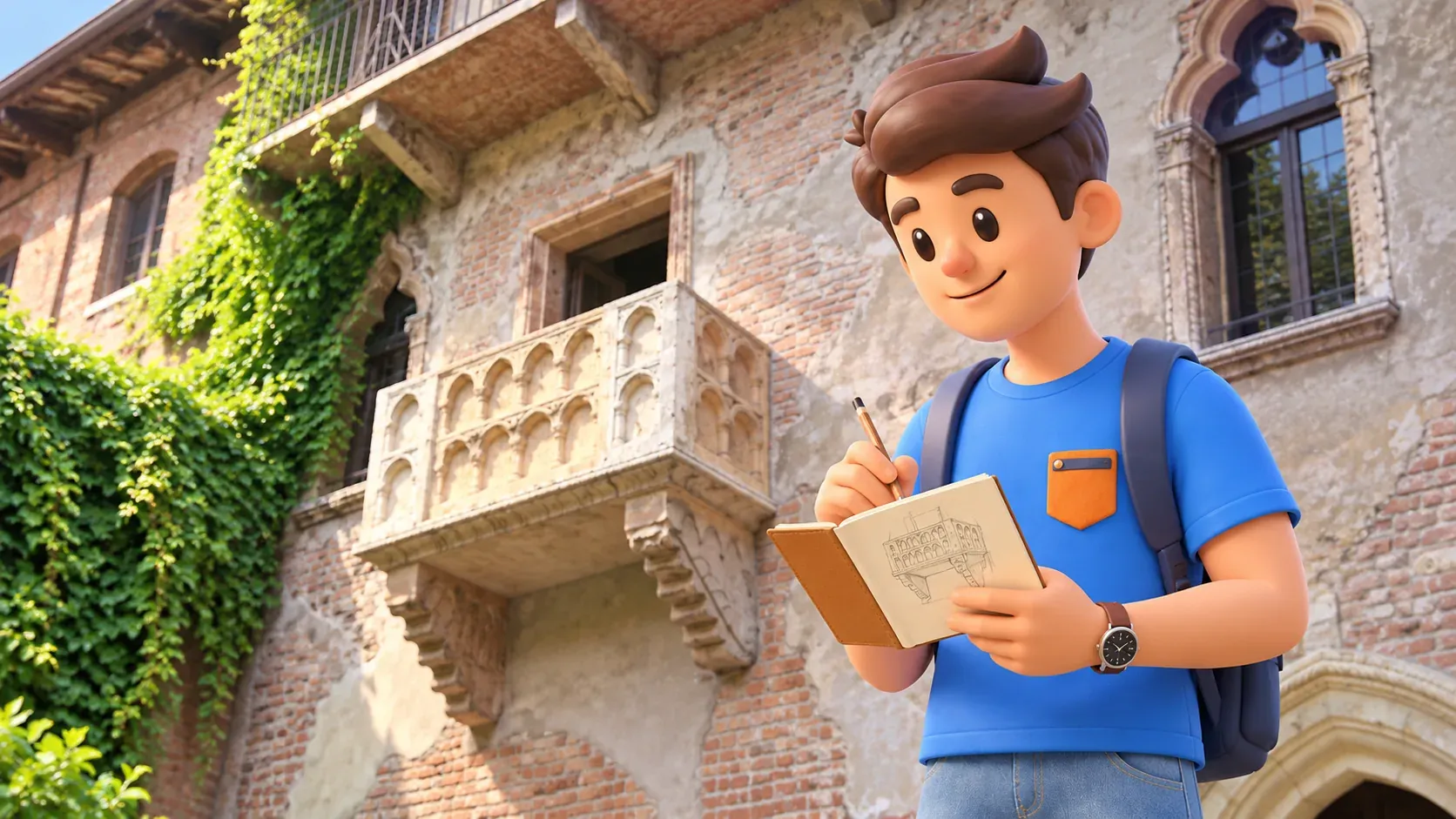
The balcony brings together older and later components. The museum’s account identifies a fourteenth-century central slab of soft Avesa stone from the Scaliger palaces, alongside elements made in a historicising style. Calling the whole thing an ancient balcony leaves out an important part of how it was assembled.
Notice the pale parapet with shallow arched reliefs and the supports below the projection. The interesting point is the way materials of different origins create one convincing image. There is no need to date every surface from a photograph or verify the stone by touch. An attentive look and an understanding of the general principle are enough.
This detail gives even a short encounter more substance. Instead of asking only where to reproduce the famous photograph, you can also ask how the familiar view was created. The photograph may still be part of the visit, but it no longer has to be its only result.
Do not transfer this account automatically to other balconies in Verona. Every building has its own changes and documentation. What matters here is a particular example: old stone can gain a new role and become a sign recognised far beyond its city. One observation of that kind is already a worthwhile addition to a walk.
Look without rushing or obligatory rituals
Give yourself one small task for the visit. Start with the whole balcony, then observe how it projects from the wall, and only afterwards take your own photograph if the visiting arrangements allow it. Your attention moves from overall image to detail instead of going immediately towards somebody else’s familiar pose.
Decide beforehand whether you want the house interior. Current arrangements distinguish options for the theatre and courtyard from a programme including the house. The courtyard should not be planned as a free walk-through. Online reservation is required even with an eligible concession or city card; choose the current option that matches your interest.
Allow for the present movement arrangement too: entry is through Teatro Nuovo from Piazzetta Navona, while exit is onto Via Cappello. An address in an old photograph does not replace the instructions for your booking. Check access to specific rooms and any need for a step-free path separately; information about the courtyard does not describe the whole house.
You do not need to leave a mark on a wall or touch a sculpture for promised luck. Reading, looking and talking to a companion already give the place meaning. Respect for the building and other visitors allows a memorable encounter without making a surface or passage part of a personal ritual.
A small literary encounter within a bigger day
The Juliet theme need not occupy a whole day of compulsory addresses. As an illustrative budget, allow 60–90 minutes for your selected house visit, 20–30 for a separate outdoor stroll around Erbe, 30–45 for a pause and 20–30 as a buffer. That totals approximately 130–195 minutes, excluding extra queues and travel from or back to your accommodation.
This is an editorial time allowance, not a ticket duration or a measured route. If only the courtyard appeals, select the suitable visiting option; if the rooms hold your attention, reduce the next activity. Juliet’s traditional tomb and the fresco museum are elsewhere and should not quietly become an assumed continuation of the same short stop.
Our comparison of Juliet’s House and the fresco museum by her traditional tomb helps with that choice. Decide whether today calls for a literary symbol or a longer encounter with paintings. You do not need both simply to complete a list.
With RoadMe, a single interest in Juliet can become part of a thoughtfully personalised whole-trip plan. The app distributes favourite themes and rest across your days, helping a literary stop fit comfortably within the rest of Verona.
The main thing to take from the balcony is an understanding of how a fictional image enters a city’s life. Old walls, later presentation and a reader’s expectation meet in one place. Knowing this gives you more reasons to look, and a familiar photograph becomes the beginning of a story you can now read for yourself.


