
The Almost Invisible Hippodrome: Reading Sultanahmet Square

At Sultanahmet Square, it is easy to notice an obelisk and barely see the Hippodrome. There is no completely surviving arena with spectator stands to explain its own shape. Yet the elongated space and several monuments let you read the place more closely. Begin with a question rather than a list: how does today’s square relate to Constantinople’s former centre of competition and public life? The walk becomes a small discovery. You need not identify every missing stone or imagine that the present square is an exact copy of an ancient stadium.
Initially allow about forty-five to seventy-five minutes for a selected exterior look with stops. This is an editorial estimate, not a measured route; rest and travel from other districts are extra. Nearby mosque and museum visits are not automatically included. Here the subject is the space itself: distinguish a monolithic obelisk from a masonry one, notice the bronze column and recognise a fountain from another period. Four short observations are more helpful than trying to recount all Byzantine and Ottoman history in an hour. Give each object a question you can actually explore while standing there.
First look between the monuments
The Hippodrome hosted chariot racing and events that gathered the city. Today, understand it through the square’s length and surviving objects rather than imaginary stands still surrounding you. Step back from a close photograph and look along the space. The monuments read as a sequence. Their positions help suggest the old arena’s long direction, although a modern path is not an exact line of the ancient racecourse. Historical reading begins with relationships between things, rather than only identifying each item separately. Space can explain something that no isolated photograph of a column reveals.
RoadMe makes it much easier to develop a personal plan for your whole trip around your interests, available days and preferred pace. Let the app connect discoveries like these, suitable walks and rest in a coherent itinerary, making your Istanbul more interesting to you.
Accounts often use spina for the central dividing part of an arena. For a walk, the monuments’ longitudinal alignment is a useful idea, but do not draw a fully surviving continuous wall across today’s paving. Archaeological research and interpretations of its construction are more complicated than one simple picture. A reconstruction helps ask questions; it does not replace the surviving site. There is no need to locate an authoritative marker for every ancient feature where none is present. Separate what you actually see from the mental explanation of a much larger structure that has largely disappeared.
The Egyptian obelisk: one stone, several histories
The Egyptian obelisk, also called the Obelisk of Theodosius, is recognisable by its single stone shaft and ancient signs. It existed before becoming part of Constantinople. That changes a familiar sightseeing assumption: an object need not have been made for the place where you now encounter it. Movement and a new setting added another story to an earlier one. You do not need to decipher every line of hieroglyphs first. Distinguish material, slender shape and base, then ask how an older object acquired new meaning in another capital before a different urban public.
Look at the obelisk and its marble pedestal separately. Ancient signs appear on the stone; relief figures on the base offer another kind of narrative. They are not a single decorative surface created simultaneously. Notice how the relief organises representation: central figures, surrounding people, order and frontal presentation. You need not identify everyone to recognise a language of authority and public display. See how the composition gathers attention, then look up again. In a brief stop, you discover not only height, but different periods combined within one familiar outline of the square.
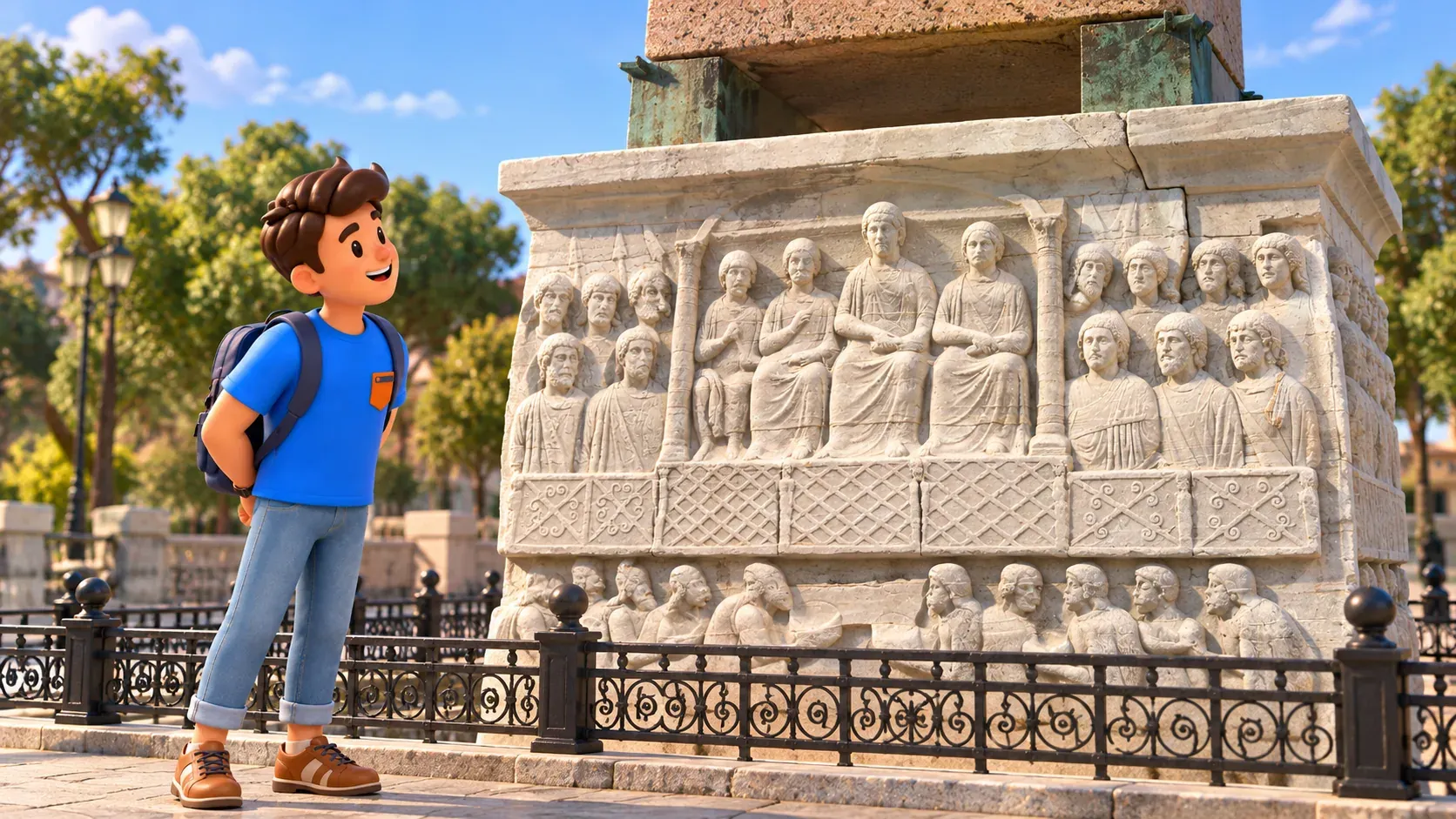
Compare the scale of a relief figure with the entire obelisk. From a distance, the base looks like a small support; close observation reveals its own story. However, a closer look does not require passing the barrier or touching the surface. Choose an angle from the public square without obstructing others. A photograph can preserve a detail for later viewing where current conditions permit photography. An artistic illustration is not a documentary inscription record: do not read its marks as a translation or an exact reproduction of the real stone. Look to the actual object for that encounter.
The second obelisk is not a copy
Further along stands a masonry obelisk, commonly called the Walled Obelisk or Obelisk of Constantine. Its blocks and rougher surface immediately differ from the Egyptian monolith. Calling both simply those columns loses the most accessible comparison. Different construction methods produce different silhouettes and impressions. The shared setting does not make them a pair of identical origin. Here a familiar shape conceals a different material history. A brief pause is enough to recognise the contrast without memorising every later episode or trying to supply a complete biography of both monuments in the same breath.
The association with Constantine should not confuse it with the porphyry column at Çemberlitaş. That is another monument elsewhere. In this reading of the square, distinguishing the two obelisks through material and construction is enough. Do not add a distant object merely because its name is similar. Nor should every monument receive the same imagined date, purpose and biography. The Hippodrome and later urban life provide a shared context. Their differences matter equally: those turn a claim to have seen a column into an attentive encounter with several individual objects occupying related space.
The Serpent Column: modest height, substantial history
After tall obelisks, the Serpent Column can seem modest. Its twisted bronze shaft introduces another story, linked to the ancient Greek monument at Delphi commemorating victory at Plataea in 479 BCE. What stands here is a surviving fragment, not the complete original composition. Do not expect picturesque serpent heads as a compulsory feature of its present top. Loss explains the difference between familiar name and visible outline. This is part of the interest: recognising a long, complicated life behind a smaller remainder. Size within the square is not a scale of historical value.
Notice the material’s difference from both obelisks. Dark patina and the coiled form call for another scale of observation than a long straight stone. The shaft stands below today’s square level, inside a sunken protected space. Observe from the permitted surface outside the railing; the hollow does not invite descent to the base. The level difference suggests that today’s square does not retain every ancient ground height. Yet one photograph should not become a measurement of all historic layers. A visible change in level cannot explain the entire archaeology of the district.
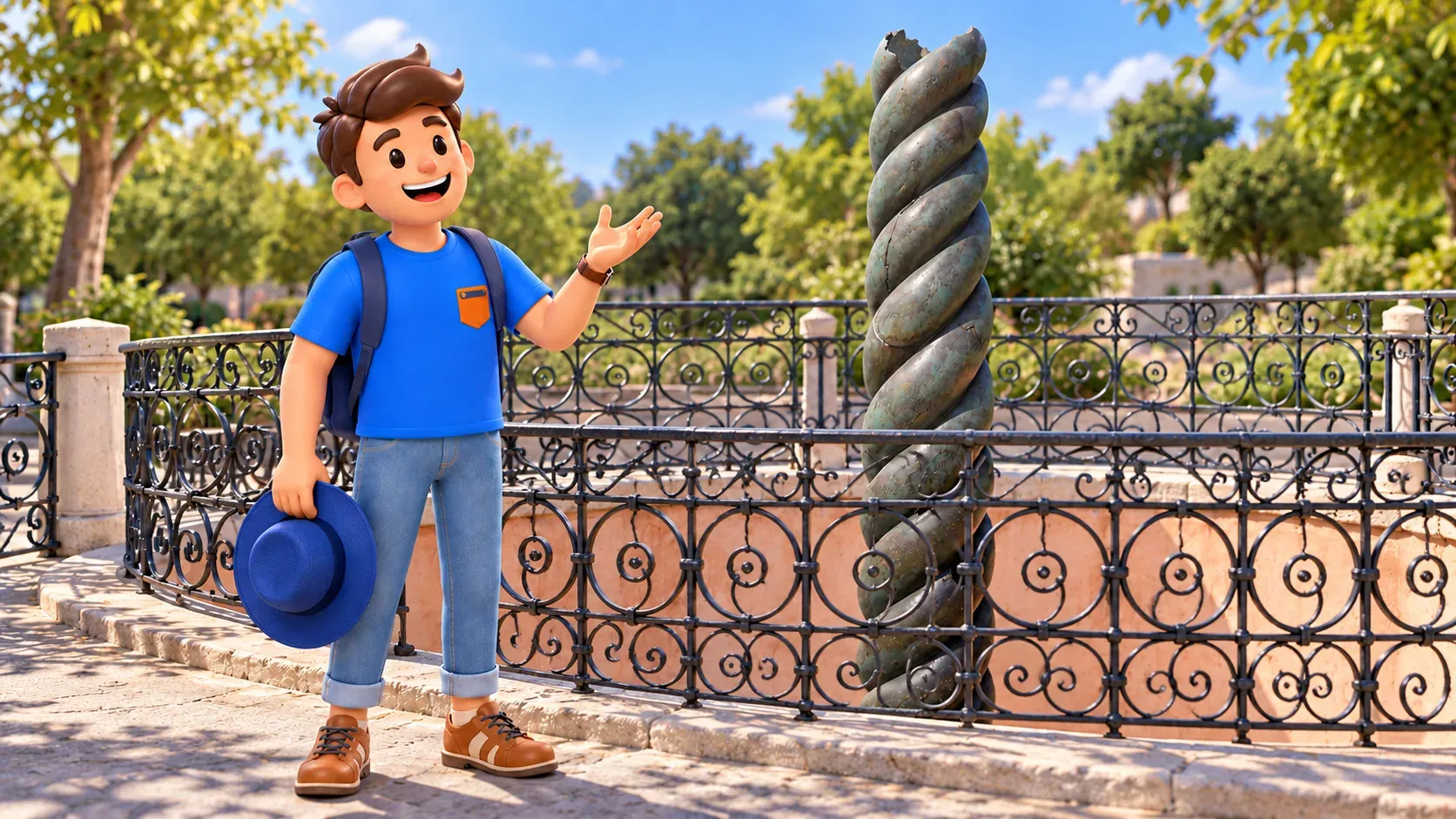
Separate established origin, subsequent losses and dramatic explanations of exactly how those losses occurred. A vivid version does not become fact merely through repetition. For a first encounter, understand an ancient bronze monument transferred here and incompletely preserved. If you want to continue in a museum, check the relevant collection’s current accessibility. Mentioning a museum fragment does not guarantee it is displayed on your date. A good city story can suggest a continuation without promising that every door will open. Curiosity does not require a definite answer to every damage visible on the shaft.
The German Fountain: much later than it looks
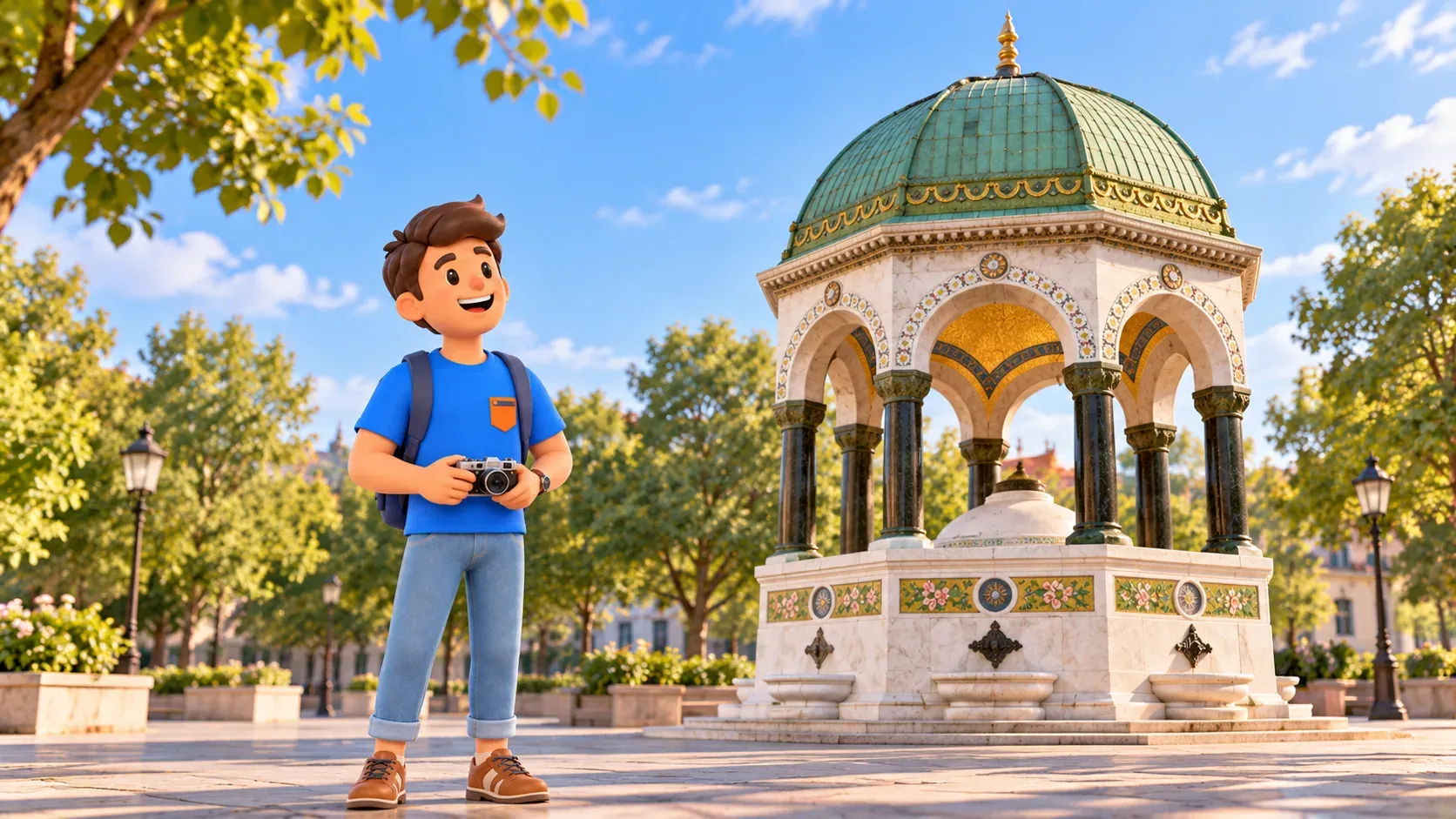
The German Fountain introduces a different layer. Opened in 1901, it commemorates Wilhelm II’s visit to Abdülhamid II in 1898. Dome, arches and mosaic decoration may seem a continuation of the square’s ancient history, yet this is much later architecture referring back to older forms. Style does not automatically establish age. A building can look towards the past while remaining a monument of its own period. Beside ancient objects, the fountain represents another kind of public presentation: a commemorative gift occupying an important urban space. Its presence extends the story rather than illustrating the racecourse’s original equipment.
Look at the octagonal arrangement, dark green columns, rounded arches and golden mosaic beneath the dome. Compare the solid lower volume with the lighter upper structure. You need not interpret every symbol to understand how different this building type is from the obelisks. The fountain was not an ancient racing fixture. Nor should you plan guaranteed drinking from it: historical purpose and current conditions of water use differ. Architectural observation from public space is enough, without a promise of going inside, occupying the steps or obtaining access to every small feature. Notice the whole before collecting details.
Turn the observations into a calm walk
Give each object a question: what was moved, how do materials differ, what is lost, and which period does the style recall? This small set works better than a long lecture while walking. In company, exchange one noticed difference before continuing. You do not need every side of every base. Retain the wider picture: look along the square again and remember that the objects survived different changes in setting. History works here through comparison. You can notice more without increasing distance or adding five compulsory interiors to a short stop.
For an introduction to the district, use the separate two-hour Sultanahmet route. For continuing through public spaces, consider the day model without expensive tickets. These represent different scales and need not be added in full. The square remains a living place, with groups, events and temporary restrictions. Do not promise an empty space or a particular camera position. In strong heat, rain or fatigue, shorten the stops while retaining the principal question. Completing every planned detail at any cost is not necessary to have understood the place.
Connecting this historical episode with the rest of your trip is easier and more effective in RoadMe, which develops a personal itinerary around your interests, time and comfortable pace. Download Istanbul while online beforehand to use maps and navigation offline afterwards.
Attentive looking does not restore the whole Hippodrome, but it stops being invisible. You can sense it in the space’s length and monument alignment, while later objects explain the continuation of city life. Egyptian monolith, masonry obelisk, coiled bronze fragment and domed fountain no longer merge into interchangeable old attractions. Each retains its own question and period. That is a useful outcome from a short walk: reading the square even when the vast structure that once defined its purpose is barely visible in today’s landscape. The missing building still gives the place a meaningful frame.


