
Jonction and Bois de la Bâtie: Geneva’s rivers and woodland walk
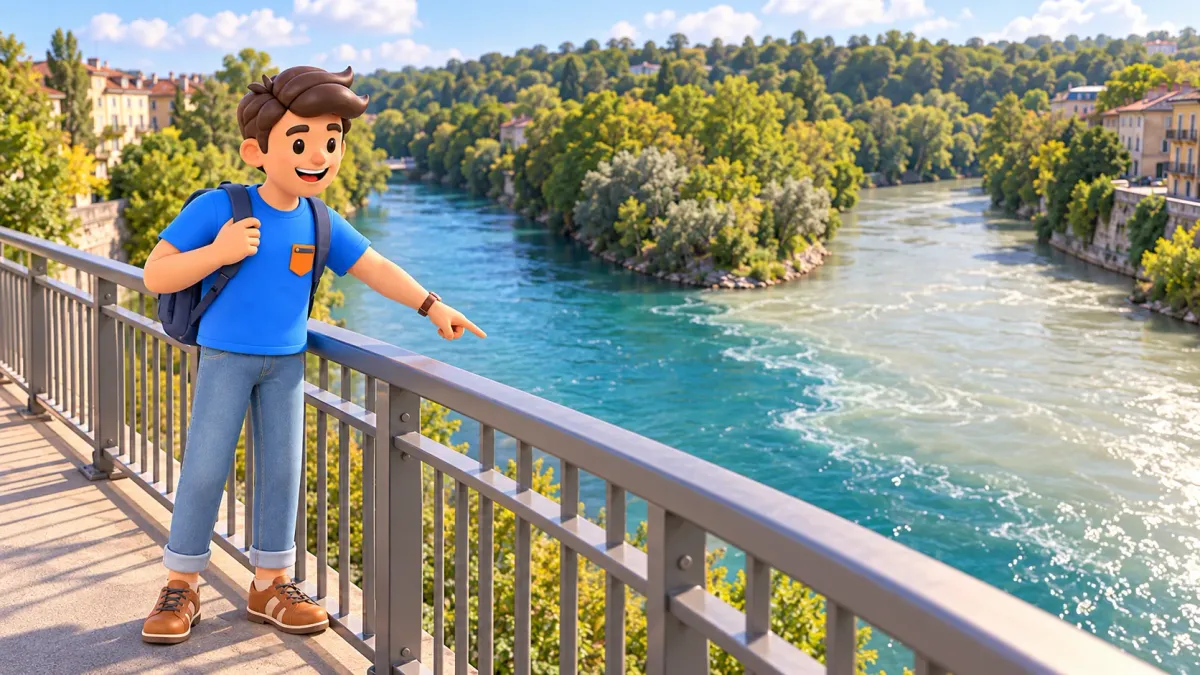
At Jonction, the Rhône and Arve meet below an urban landscape of bridges, slopes and woodland. A rewarding walk combines the view from the pedestrian part of Pont de la Jonction with time in Bois de la Bâtie on the hill. The contrast gives the outing its shape: open water and working railway infrastructure first, then trees, changing levels and a quieter pace.
Choose the approach carefully. Pont de la Jonction is not the low Pointe de la Jonction beside the water. Going to the point first does not establish a direct climb to the bridge. This route starts with the designated pedestrian access to the bridge and continues on permitted paths towards the woods. Treat it as a daylight outing with gradients, rather than assuming a flat circuit or an operating public lift.
Match the bridge approach with a practical woodland finish
For a start from the Saint-Jean side, identify the public approach towards Sentier du Promeneur-Solitaire and Pont de la Jonction. Check that your destination is the bridge itself rather than the similarly named waterside point. Use the pedestrian connection, then continue towards the Bâtie hill. Decide beforehand whether you will finish on the park side or return along a familiar, suitable public route.
Try RoadMe to develop a complete personal trip plan around your interests and preferred pace. It makes it more convenient and efficient to coordinate the river viewpoint, a woodland break and the rest of your Geneva day.
Two close map pins do not establish an easy level connection. The bridge and woods have different approaches and levels. Follow available pedestrian routes and local signs instead of extending a navigation line across a closed slope. If keeping exertion low is the priority, choose one stop and assess its approach separately rather than promising yourself a complete circuit from a general view of the area.
A descent to the confluence at water level is not part of the essential plan. The low Pointe is a separate destination offering another perspective. Here, the bridge provides a way to understand the meeting of the rivers before spending time in the woods. The number of riverbank levels you reach does not determine the quality of the visit. A clear finish helps retain energy for the rest of the trip.
Use Pont de la Jonction to understand the two rivers
The bridge crosses the Rhône downstream of the Arve’s arrival. From the pedestrian side, look at the arrangement of the water: the two approaching directions, the banks and the combined flow beyond the meeting. Trace those lines with your eyes before searching for a photograph. Even a subtle difference in colour then remains a recognisable geographical event rather than evidence that you arrived on the wrong day.
The visual contrast depends on conditions. Light, weather and suspended material can make the difference stronger or weaker, so fixed colours and a perfectly sharp boundary should not be expected. Photographs often select a particularly striking moment that need not repeat during your visit. Look at the actual current and banks. The confluence remains interesting regardless of how dramatically a camera records it.
Choose a position within the designated pedestrian area and leave room for other users. The bridge continues to serve transport; it is not an empty viewing platform built exclusively for sightseeing. Stay away from railway areas and keep belongings out of the passage. A comfortable brief stop is more useful than trying to occupy an ideal angle at any cost.
Look along one incoming flow, then the other, and finally the shared direction downstream. Repeat that sequence without taking a picture. It helps separate the shape of the place from reflections on the water. When visiting together, discuss which bank or line makes the perspective easiest to understand. This is a useful observation exercise without specialist knowledge or measurements.
The bridge was built in the 1940s for the railway connection with Geneva’s industrial and freight areas. That background explains its practical character. The structure’s position also happens to make it useful for seeing the landscape. Its interest comes from working infrastructure meeting natural geography, with a very different atmosphere from central Geneva’s familiar lake panorama.
Continue towards the Bâtie hill through the wooded approach
After the view, follow available signed public paths towards Bois de la Bâtie. The woodland occupies elevated ground, so a climb belongs to the plan rather than appearing as a surprise at the end. Set a pace that leaves room to look around and pause. Allow flexibility for this stage rather than treating it like a level transfer between two city squares.
Notice how the experience changes as trees become more prominent. On the bridge, your gaze follows open water; among the trees, trunks, paths and relief begin to direct it. That does not promise the disappearance of every city sound. Woodland near an urban centre can still change the scale of attention: the surface underfoot, light between branches and nearby trees take over from the distant river perspective.
Use the permitted approach rather than the most direct-looking track on a slope. After rain, wet leaves and surfaces can make progress less comfortable. If a chosen section does not suit you, return to a suitable junction or finish a shorter version on a part you already know. A visible available route is a better basis than assuming a convenient stairway, lift or exit must exist beyond the trees.
With children, make the transition a small activity of its own: notice when the water view gives way to woodland. There is no need to keep promising another attraction to justify the climb. The change in landscape and pace already provides content. If someone needs a break on the approach, use a suitable permitted place rather than waiting for an imagined principal corner of the park.
Choose a few woodland paths and a genuine pause
Bois de la Bâtie is a substantial wooded landscape on a hill, rather than a small square to hurry through. A comfortable selection of paths and an actual rest are enough for a first visit. Look at how the slope directs movement and how trees divide the space. Continuous river views are not the purpose here: the woodland becomes the main experience even when vegetation conceals the water.
Different ways of spending the time can coexist. One person may want a slightly longer walk, another a seat and a look at nearby trunks. These wishes are easier to accommodate when every section has not been given an identical allowance. If an appropriate bench is available, pause there. Rest becomes more valuable when it really happens rather than remaining a line in a busy itinerary.
The green hill has its own history of public recreation, but a full account of every former use is unnecessary for this route. The important thing is that the underlying landscape did not disappear as Geneva grew. It still shapes the climb, path directions and relationship between the city and valley. In this way, the woods complement the railway bridge, showing the same urban setting through its terrain.
For a simple activity, compare two parts of the path. Where is space more open, and where do the trees feel denser? How does light change, and how far can you see? You do not need to identify every species or search for something rare. Everyday differences help adults and children look more carefully while remaining on normal paths. A small question is enough to give the pause its own purpose.
Keep animal enclosures and play areas optional
The woods have additional recreation facilities, including an animal park and children’s play areas. They can be a separate family choice when open and suitable for the day. Avoid making the whole outing depend on seeing one particular animal or entering a specific area. The woodland walk is complete without them, and access to individual facilities needs checking separately from the general outdoor route.
The animal park should not be presented as a petting zoo. Observe from permitted areas without feeding animals or trying to attract them for a photograph. A closed enclosure area or an animal out of sight is an ordinary limit to this kind of visit. Return to walking and resting rather than spending the outing waiting for a guaranteed spectacle.
For a family, make the decision after the woodland pause, when energy and interest are clearer. The climb and change of setting have already provided impressions. Free time does not automatically need another organised stop. Sometimes a child wants a rest, conversation or play in a suitable place rather than one more attraction. Leaving that possibility open helps keep the outing enjoyable for the whole group.
Choose the ending before tiredness decides for you
You can finish on the woodland side and take an appropriate public exit towards the city. Alternatively, return along a familiar open approach if it suits you and you want another look from the bridge’s pedestrian side. That is an optional return, rather than an obligatory loop with a new descent. The finish should not depend on discovering an unfamiliar passage along the water.
With RoadMe, it is more convenient and efficient to work out a complete personal plan for the whole trip around your interests and pace. You can balance nature walks, city visits and proper rest, giving this outing a clear beginning and finish.
For another quiet theme in the neighbouring right-bank landscape, consider the Saint-Jean walk to the priory ruins. It has its own street connections and access limits. Think of it as a way to distribute experiences across the journey, rather than a promise of one continuous open trail linking every nearby place. Separate days may suit a relaxed pace better than two complete walks together.
Practical choices for a daylight outing
Check the weather, the pedestrian bridge approach and your exit from the woods. Wear shoes suited to urban and woodland surfaces. If mobility requirements matter, examine the specific route: nearby locations do not establish level ground, no steps or an operating lift. Keep daylight available for the wooded sections. Bridge access, paths, animal park and other facilities should not be assigned one assumed universal schedule.
A shorter version can focus on a suitable bridge approach and the confluence view, or on a separate woodland break. The fuller outing combines them through a real pedestrian connection and climb. Its value lies in the changing perspective: first the meeting of two rivers, then the hill and trees shaping the surrounding city. Neither a perfect coloured water boundary nor reaching the low Pointe is required for a worthwhile visit.


